Your tax returns are likely the single biggest obstacle standing between you and your next five investment properties. While traditional banks obsess over your personal salary and debt-to-income ratios, savvy investors have moved on to a more efficient model. It’s time to stop letting a “low” on-paper income stall your growth. We know how frustrating it is to be a high-performing investor trapped by rigid, outdated underwriting that ignores your property’s actual potential.
You deserve a financing partner that values your strategy over your tax filings. This guide will show you how to master the specific 2026 dscr loan requirements so you can secure funding based on property cash flow alone. We’ll break down the exact credit score floors, the 20% to 25% down payment standards, and the reserve rules you need to bypass personal income verification. By the end of this article, you will have a clear roadmap to qualify for financing and scale your portfolio at a pace that big banks simply can’t match.
Key Takeaways
- Learn why DSCR loans prioritize property income over personal tax returns to help you scale without debt-to-income limits.
- Understand the core dscr loan requirements for 2026, including the 1.0x to 1.25x ratio benchmarks and credit score floors.
- Master the PITIA calculation lenders use to evaluate your property’s cash flow and determine loan eligibility.
- Prepare for success by organizing your liquid reserves and rental history to meet the standard six-month cushion requirement.
- Discover how to bypass traditional banking red tape by focusing on property-level financials for single-family and multi-family investments.
What is a DSCR Loan and Why Does it Bypass Tax Returns?
Traditional banks want to know your personal life story. They dig through your W2s, calculate your personal debt, and scrutinize every dollar you spend. A DSCR loan flips that script. It focuses entirely on the property’s ability to generate enough cash to pay for itself. This is why the Debt Service Coverage Ratio (DSCR) has become the gold standard for modern real estate scaling.
The fundamental shift here is moving from personal underwriting to asset-based underwriting. Lenders aren’t asking if your personal salary can cover the mortgage. They are asking if the property’s rental income can. This “no doc” approach means your personal tax returns are effectively irrelevant to the approval process. If the rental income covers the debt, you have cleared the biggest hurdle. Understanding dscr loan requirements starts with realizing that you are no longer the focus; the property is. Investors who want to go deeper on how asset-based underwriting works across different property types will find that exploring no doc commercial loans and the myths surrounding them provides critical context for scaling beyond single-family assets.
The Core Philosophy of Cash Flow Lending
Lenders prioritize rent because it’s a more stable indicator of investment success than your personal salary. This philosophy empowers self-employed investors who use legal deductions to lower their taxable income. Traditional banks see a low net income on your 1040 and reject your application. We see a high-performing rental property and see a winning investment. In this model, the property acts as the primary collateral. This makes your personal debt-to-income (DTI) ratio a non-issue, giving you the freedom to expand without hitting a wall built by your own tax strategy. Meeting dscr loan requirements is about the asset’s performance, not your W2 history.
DSCR vs. Conventional Loans: A Quick Comparison
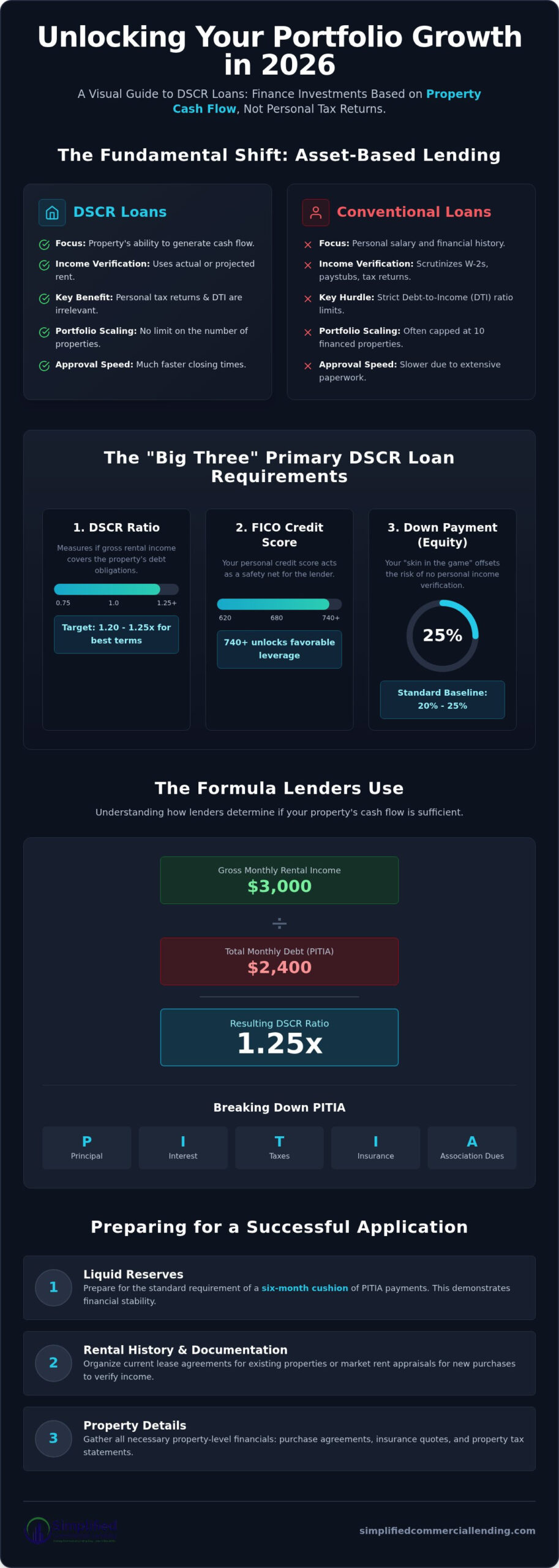
Conventional loans are notoriously slow. They require mountains of paperwork and a deep dive into your personal financial history. DSCR loans move with the speed of the market because the underwriting is streamlined and logical. Here is how they stack up:
- Income Verification: Conventional loans require paystubs and W2s. DSCR uses the property’s actual or projected rent.
- Approval Speed: DSCR skips the bureaucratic deep dive into your personal life, often leading to much faster closing times.
- Portfolio Scaling: Most conventional programs cap you at 10 properties. DSCR has no such limit. You can scale as large as your cash flow allows.
By focusing on the asset, you bypass the red tape that keeps most investors stuck in the single digits. This approach values your expertise as an investor rather than your status as a salaried employee.
The Big Three: Primary DSCR Loan Requirements
Scaling your portfolio requires moving past the “if” and focusing on the “how.” To get approved, you need to align your property’s performance with three specific financial benchmarks. These dscr loan requirements act as the guardrails for asset-based lending, ensuring that both you and the lender are protected from negative cash flow scenarios. By hitting these targets, you demonstrate that the asset is a viable business on its own merits.
Decoding the DSCR Ratio Thresholds
The ratio is the pulse of your deal. It measures whether the gross rental income can cover the monthly debt obligations. Most lenders set the bar at 1.20 or 1.25 for the best terms. This provides a safety margin for maintenance and vacancies. If your ratio drops to 1.0, you are essentially breaking even. While some programs allow for ratios as low as 0.75, these typically come with higher interest rates. It is helpful to research how lenders view DSCR across different asset classes. Short-term rentals (STRs) are often analyzed based on historical data or projections, while multi-family properties might require a more conservative 1.25 ratio to account for higher operating expenses.
Credit and Equity: The Safety Net
Your personal credit score still matters, even without income verification. In the 2026 lending environment, a FICO score of 620 to 640 is the standard entry point. However, if your score is above 740, you’ll find much more favorable leverage options. Equity is your greatest lever here. A 20% to 25% down payment is the baseline for most single-family and multi-family deals. This skin in the game offsets the risk of not checking your personal W2s. If you are a first-time investor, lenders might lean more heavily on your credit score and liquid reserves. If you are an experienced pro, you can often use your track record to negotiate more flexible terms. If you are ready to expand, checking your eligibility for single family residential investment loans is a great first step toward building a high-yield portfolio. This balance of credit and cash-in-deal creates the security lenders need to bypass your personal tax returns.
Calculating Your Ratio: The Formula Lenders Use
Math shouldn’t be a barrier to your growth. The calculation for a Debt Service Coverage Ratio (DSCR) is straightforward: take your gross monthly rental income and divide it by your monthly PITIA. This simple fraction determines if you meet the core dscr loan requirements for a specific property. If the result is 1.25, it means your property generates 25% more income than it costs to maintain the debt. This margin provides the safety net lenders look for when they aren’t checking your personal income.
While residential-style DSCR loans focus on PITIA, commercial-grade assets often use Net Operating Income (NOI). NOI subtracts all operating expenses, including management fees and repairs, from the total income. However, for most single-family and multi-family residential investors, the PITIA-based formula is the standard. Lenders will also apply a vacancy factor, typically 5% to 10%, to ensure the deal still works even if the property isn’t occupied every single day of the year. This ensures the dscr loan requirements reflect real-world market conditions.
PITIA: The Full Cost of Debt
You cannot ignore the “hidden” costs of ownership. PITIA stands for Principal, Interest, Taxes, Insurance, and Association dues. Lenders require you to account for property taxes and insurance premiums because these are non-negotiable obligations that impact your ability to pay the loan. If you are investing in a condo or a Planned Unit Development (PUD), those monthly HOA fees must be included in your math. PITIA represents the total monthly housing expense including principal, interest, taxes, insurance, and any applicable association fees.
Rental Income Verification
Lenders don’t just take your word for what a property will earn. They use a 1007 Rent Schedule, which is a specific part of the appraisal process where a professional compares your property to similar rentals in the area. If you already have a signed lease, the lender will usually use the lower of the actual lease amount or the appraiser’s market rent estimate. This conservative approach ensures the property can sustain itself even if a tenant leaves. For those looking at short term rental financing, lenders often look at historical VRBO statements or specialized market reports to verify income. This specialized underwriting allows you to leverage the high-yield potential of vacation rentals while still meeting strict safety standards.
Step-by-Step: Preparing Your DSCR Loan Application
Speed is the primary advantage of asset-based lending, but that speed depends entirely on your preparation. While you don’t need to dig up years of tax returns, you do need to prove that the property and your liquidity meet current dscr loan requirements. Taking these five steps before you submit an application ensures you don’t hit avoidable bottlenecks during the underwriting process. A clean file is a fast file.
- Step 1: Organize Property Financials. Gather existing leases or a two-year history for short-term rentals. If it is a new purchase, have the market rent estimates ready for the appraiser.
- Step 2: Verify Liquid Reserves. Most lenders require a “6-month rule.” This means you need six months of PITIA payments sitting in a liquid account to prove you can handle vacancies.
- Step 3: Check Your Credit. Ensure your FICO is at least 620 to 640. Higher scores will unlock better interest rates and higher loan-to-value (LTV) limits.
- Step 4: Order the Appraisal. This must include a 1007 rent schedule. This document is the formal verification of the property’s income potential that the lender will rely on.
- Step 5: Capital Matching. Partner with a navigator who can shop your deal across multiple capital sources to find the best leverage for your specific asset.
The Streamlined Document Checklist
Your application package should be tight and professional. Focus on the entity and the asset rather than your personal history. You will need your property insurance declarations, the most recent tax bills, and the purchase contract or current mortgage statement. Because these loans are typically made to business entities, have your LLC Operating Agreements or Articles of Incorporation ready. This allows the lender to verify who has the authority to sign for the loan without needing to see your personal W2s. Seasoned investors expanding into commercial property types should also review how no doc commercial loans work in the 2026 lending landscape to understand which myths could be slowing down their next acquisition.
Liquidity and Reserves
Lenders use reserves as a safety net. They want to know that if the property sits vacant for a few months, you can still cover the debt. Acceptable sources include cash, 401k accounts, and brokerage accounts. Typically, lenders look for 3 to 6 months of PITIA, but this requirement can scale up for larger deals. For example, multi-family residential investment loans often require deeper reserves depending on the unit count and the overall loan amount. Having this capital documented early proves you are a low-risk borrower who can handle the realities of property management. Investors who already hold multiple properties may also benefit from exploring a portfolio line of credit for rentals to unlock the equity sitting across their existing holdings without triggering personal income verification.
Don’t let a single missing document stall your portfolio growth. If you are ready to see how your property stacks up against current dscr loan requirements, contact our team today to start your streamlined application.
Bypass the Red Tape with Simplified Commercial Lending
Traditional banks are built for the average consumer, not the ambitious investor. They see your complex tax returns and high deductions as a risk. We see them as a sign of a savvy business owner. At Simplified Commercial Lending, we’ve stripped away the bureaucratic layers that slow down your growth. By focusing on the asset’s cash flow rather than your personal W2, we help you meet dscr loan requirements without the typical headaches.
Our specialized approach to single family residential investment loans is designed for speed. We understand that in a competitive market, waiting 60 days for a big bank to analyze your personal debt-to-income ratio isn’t an option. You need a partner who can close in weeks, not months. We act as your navigator through the capital markets, matching your specific property with the most aggressive funding sources available.
Why Investors Choose Our ‘No Doc’ Process
Busy entrepreneurs don’t have time to chase down 1099s for a mortgage officer who doesn’t understand rental real estate. Our process is built on efficiency. We skip the personal income verification because your success is already proven by the property’s performance. This flexibility extends beyond standard homes. Whether you are looking at retail spaces, warehouses, or multi-family complexes, we apply the same logic. If the property pays for itself, we want to fund it. This approach is a game-changer for self-employed investors who need to maintain liquidity while expanding their footprint and meeting dscr loan requirements.
Ready to Scale Your Portfolio?
Scaling isn’t just about buying one house; it’s about building a sustainable machine. We help you bridge the gap between your current holdings and your next acquisition. Our team provides transparent communication from the first call to the final signature. You won’t be left wondering where your file stands in an opaque underwriting queue. We provide a clear path to qualify based on your property’s cash flow, helping you stay ahead of the curve as you build your legacy. If you’re tired of the red tape, it’s time to work with a partner who values your results over your paperwork. Get Started with Simplified Commercial Lending today and see how easy it is to secure your next deal when the property does the talking.
Take Control of Your Investment Future
You’ve seen how the right financing strategy can transform your growth from a slow crawl to a rapid scale. By shifting the focus from your personal tax returns to the property’s performance, you remove the biggest bottleneck in real estate investing. Mastering the dscr loan requirements is about more than just checking boxes; it is about reclaiming your time and bypassing the rigid walls of traditional banking. You’ve done the hard work of finding the right asset. Don’t let outdated underwriting standards stall your momentum.
We specialize in helping investors navigate these criteria with speed and transparency. Our team offers national coverage for all investment property types and provides expert underwriting for the unique cash flow of short-term rentals. There is no personal income verification required, meaning your success is judged by your results, not your W2. You deserve a partner who understands the hustle of the independent entrepreneur and values pragmatism over protocol.
Scale your rental portfolio without tax returns; Get a DSCR quote today. Your next acquisition is waiting, and we are ready to help you secure it with ease. Let’s build your legacy together.
Frequently Asked Questions
Can I get a DSCR loan with a 620 credit score?
Yes, you can qualify for a loan with a 620 credit score. While 620 is the current market floor, aiming for a 720 or higher will secure the most favorable interest rates. If your score is on the lower end, expect to provide a larger down payment to satisfy the lender’s risk requirements. This flexibility allows you to keep moving even if your personal credit isn’t perfect.
Do DSCR loans require a down payment?
Yes, a down payment is mandatory for these loans. The standard requirement is 20% to 25% of the property’s value. Because we don’t look at your personal debt-to-income ratio, this equity serves as the primary security for the lender. High-equity deals often move through the approval process much faster than those with minimum skin in the game. It’s a straightforward trade-off for bypassing personal income audits.
What is a good DSCR ratio for a rental property?
A ratio of 1.25 is the ideal “sweet spot” for most investors. This figure indicates the property generates 25% more income than the total debt obligation. While some aggressive programs accept a 1.0 or even a 0.75 ratio, those deals usually come with higher costs. Maintaining a 1.25 ratio ensures you have a healthy cushion for maintenance and vacancies while securing the best possible terms.
Can I use a DSCR loan for an Airbnb or short-term rental?
Yes, you can absolutely use these loans for Airbnb or other short term rental properties. Our underwriting process specifically accounts for the unique cash flow patterns of vacation rentals. We use historical data or market projections to verify the property’s income potential. This specialized approach helps you scale your STR portfolio without the restrictions and red tape of a conventional mortgage.
Do I need to provide tax returns for a DSCR loan?
No, you never have to provide tax returns or W2s for this type of financing. We focus entirely on the asset’s ability to pay for itself. This “no-doc” approach is a core part of the dscr loan requirements and is perfect for self-employed investors with high deductions. Your personal income doesn’t dictate your ability to grow your real estate business or scale your portfolio.
What happens if the property is vacant at the time of the loan?
Yes, you can secure financing for a property that is currently vacant. Lenders will rely on a professional appraisal and a 1007 rent schedule to determine the market rent for the area. This allows you to close on a new acquisition or a recently renovated unit before a tenant is officially in place. Your loan is based on the property’s future earning potential rather than its current status.
Are DSCR loan interest rates higher than conventional rates?
Yes, interest rates are generally 0.5% to 1.5% higher than conventional 30-year fixed mortgages. In August 2026, rates typically fall between 6.12% and 8.0% depending on your credit and leverage. This slight premium is a strategic trade-off for the ability to scale quickly without personal income verification or strict portfolio caps. Most investors find the speed and flexibility worth the marginal rate difference. To understand exactly how to optimize your pricing strategy, reviewing DSCR loan rates today and the levers that move them can help you secure the most competitive terms for your next deal.
Can I close a DSCR loan in an LLC name?
Yes, you can and should close your loan in the name of an LLC. Most lenders prefer business entity borrowers because these are commercial-purpose loans. Closing in an LLC provides an extra layer of liability protection for your personal assets. It also makes it easier to manage your portfolio as a professional business rather than a personal hobby, which is essential for long-term scaling.