What if your tax returns are the single biggest obstacle standing between you and your next multi-family acquisition? It’s a common frustration for seasoned investors. You have the capital and the experience, yet traditional banks continue to stall your growth with mountain-high piles of paperwork. If you’re tired of “no” because your taxable income doesn’t match your real-world success, it’s time to look at no doc commercial loans. These aren’t risky shortcuts for the unprepared. They’re strategic tools for savvy entrepreneurs who value speed and asset performance over bureaucratic red tape.
You probably agree that the standard mortgage process feels outdated and unnecessarily slow in today’s competitive market. We’re here to change that narrative. You’ll learn exactly how to leverage property cash flow to unlock equity and scale your portfolio without ever digging through old tax filings. We’ll break down the 2026 lending landscape, debunk the most common myths about asset-based financing, and show you how to close deals based on what truly matters: the property’s ability to generate revenue.
Key Takeaways
- Learn how no doc commercial loans bypass the “DTI wall” by focusing on property cash flow rather than your personal tax returns.
- Discover why the Debt Service Coverage Ratio (DSCR) is the primary metric lenders use to ensure a property can pay for itself.
- Debunk the myth that asset-based financing is predatory by understanding how slightly higher rates buy you unmatched speed and flexibility.
- Identify the specific credit and liquidity benchmarks, like the 660 score floor, needed to secure competitive terms in 2026.
- Scale your portfolio from one property to ten by leveraging cash-out refinances to fund new acquisitions without personal income friction.
What Are No Doc Commercial Loans? (The “Ghost Loan” Myth)
Don’t let the name mislead you. A common myth suggests that “no doc” means “no proof,” as if lenders are handing out capital to anyone with a pulse. In reality, no doc commercial loans are highly structured financial products designed for a specific purpose. They prioritize the asset’s ability to generate revenue over the borrower’s personal tax history. To get a clear picture of What Are No Doc Commercial Loans?, you must understand that the “no” refers specifically to personal income documentation, not a lack of underwriting altogether. You’re trading a mountain of personal paperwork for a laser focus on property performance.
By 2026, the gap between traditional bank requirements and the needs of independent investors has widened. Banks still demand years of tax returns that often don’t reflect your actual liquidity due to smart write-offs. This friction kills deals in competitive markets. Modern investors are moving toward asset-based lending because it values property performance. It’s about pragmatism over protocol. Lenders still verify your credit and your cash reserves; however, they stop digging into your personal life once the property’s Debt Service Coverage Ratio (DSCR) proves the deal is solid.
The Evolution of Stated Income to Modern No-Doc
The 2008 financial crisis killed the old “liar loans” that gave this industry a bad name. What rose from the ashes is a much more sophisticated version of stated income lending. Non-bank lenders stepped in to fill the void left by rigid institutions, creating a space for high-quality, asset-backed financing. Today, choosing this path isn’t a sign of weakness. It’s a badge of efficiency. It shows you’ve outgrown the slow, bureaucratic systems of the past and prefer a partner who understands the speed of modern real estate. You aren’t cutting corners; you’re just using a sharper tool.
Eligible Property Types for No-Doc Financing
Flexibility is the core of this lending model. You aren’t limited to just one asset class. You can apply this streamlined process to various investments. Common eligible properties include:
- Single-family rentals (SFR) and short-term rentals (STR).
- Multi-family apartments and mixed-use buildings.
- Commercial assets like warehouses, retail centers, and office spaces.
Whether you’re looking to scale a portfolio of vacation homes or acquire a light industrial facility, these loans adapt to the property’s unique cash flow profile. The process remains the same regardless of the roof type. If the numbers work, the deal works.
The Underwriting Shift: Why Cash Flow Trumps Tax Returns
Traditional banks treat you like a consumer. They want to see your W-2s, your tax returns, and your personal debt-to-income ratio. But you aren’t buying a primary residence. You’re building a business. In the world of no doc commercial loans, the property is the star of the show. Lenders focus on whether the asset can stand on its own two feet. This is a fundamental part of The Underwriting Shift that differentiates commercial investment from residential consumer protection rules. If the property generates enough revenue to cover the mortgage and expenses, the deal makes sense. It’s a logical, results-driven approach that ignores the fluff of your personal tax filings and focuses on the reality of the asset’s performance.
Decoding DSCR: The Number That Replaces Your W-2
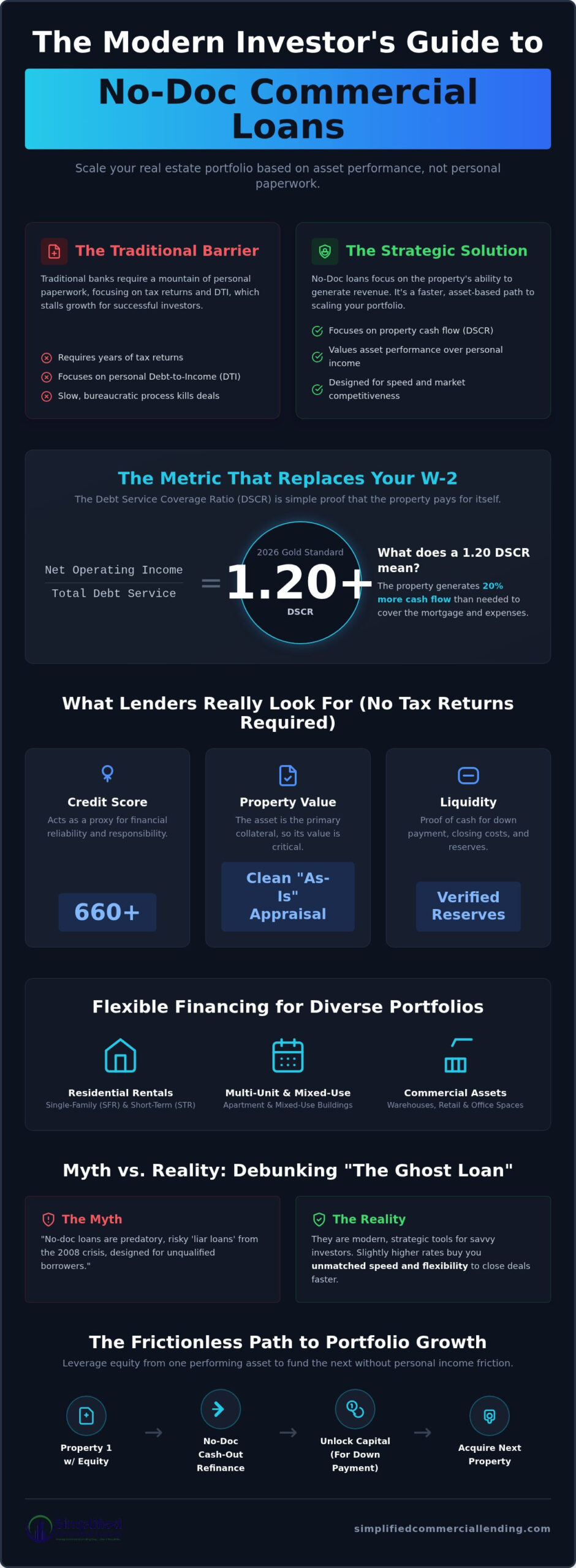
The Debt Service Coverage Ratio (DSCR) is the primary metric that replaces personal tax returns. It’s a simple calculation: Net Operating Income divided by total Debt Service. For 2026, a ratio of 1.20 or higher is the gold standard. This means the property earns 20% more than the mortgage costs. For deeper criteria, see our guide on dscr loan requirements. Savvy lenders also analyze market rent versus actual rent to ensure you qualify based on the property’s true potential. If your current tenants are paying below-market rates, we can often look at the potential upside to get the deal done.
Asset Value vs. Personal Liability
Because the property acts as the primary security, the appraisal is the most critical part of the process. Lenders need a clean, “as-is” value to justify the loan. However, “no doc” does not mean “no credit check.” Your FICO score still matters as a proxy for financial reliability. Most competitive programs require a floor of 660 to 700. This balance of asset performance and personal credit allows for faster closings and less friction. It’s about minimizing the personal liability while maximizing the property’s potential. If you’re ready to move past bank bureaucracy, you can start scaling with Simplified Commercial Lending to see what your portfolio can really do.
Myth vs. Reality: Are No Doc Loans Predatory or Risky?
Some critics label no doc commercial loans as risky or predatory. This is a fundamental misunderstanding of how professional asset-based finance works. Unlike consumer payday loans, these are professional business-to-business agreements. Lenders aren’t looking to seize your assets; they want to fund successful projects that pay them back. Yes, interest rates are often slightly higher than a 60-day traditional bank process. However, this premium reflects the flexibility and speed you receive. If a loan allows you to secure a property that generates significant monthly cash flow within three weeks, it isn’t predatory. It’s an essential tool for those who value time as much as capital.
The Opportunity Cost of Waiting for a Bank
In the 2026 market, speed is your greatest leverage. Waiting 90 days for a traditional bank to scrutinize every line of your tax return often results in a lost deal. Consider the math. Is a 1% higher interest rate really a deal killer if it lets you acquire an undervalued asset before a competitor does? For current market pricing and context, check dscr loan rates today. You’ll see that the spread between bank rates and no-doc rates is often negligible compared to the revenue lost by sitting on the sidelines. Execution wins deals; hesitation loses them.
Risk Mitigation Through Lower LTV
Lenders manage their risk through Loan-to-Value (LTV) limits rather than personal income verification. By requiring a 20% to 30% down payment, they ensure you have significant skin in the game. This protects both parties. If the market shifts, that equity cushion prevents the property from going underwater. When you are Qualifying Without Tax Returns, you are participating in a modern Non-QM market that is far more regulated and stable than the pre-2008 era. Many of these programs also offer non-recourse options. This means your personal assets outside the property are protected if things go south. It’s a calculated, professional way to manage risk while maintaining the momentum needed to grow your portfolio.
Ultimately, the risk isn’t in the loan itself. The risk lies in the property’s performance. As long as you perform your due diligence and the numbers work, these loans provide a streamlined path to success that traditional banks simply cannot match. You’re trading paperwork for performance, and in a fast-moving market, that’s usually a winning trade.
Qualifying Without Tax Returns: What Lenders Really Look For
Just because you aren’t showing tax returns doesn’t mean the lender is flying blind. They’ve simply shifted their gaze. When applying for no doc commercial loans, your FICO score and your liquidity are the new benchmarks. Most competitive programs in 2026 look for a credit score between 660 and 700. This proves you manage your obligations well, even if your tax filings are complex. You’ll also need to show liquidity. Typically, lenders want to see 6 to 12 months of mortgage payments held in reserve. This safety net ensures you can handle temporary vacancies without breaking a sweat.
Experience also plays a massive role in your final rate. If you’ve been a landlord for at least two years, you’re seen as a lower risk. Brand-new investors can still get funded; however, seasoned pros often unlock higher LTVs and better terms. The property type matters too. Single-family rentals and multi-family units are the bread and butter of this space. Warehouses and retail centers are also viable for no-doc financing as long as the tenant profile and lease terms are strong. You’re trading personal history for property potential. To see how this plays out in practice, explore our dscr loan for rental property case study showing how investors scaled their portfolios in 2026 without a single tax return.
Preparing Your “No Doc” Application Package
Your application package should be lean and focused. Forget the 100-page tax transcripts. Instead, prioritize your Rent Rolls and your Schedule of Real Estate Owned (SREO). These documents tell the lender exactly how your current portfolio performs and how much income the target property generates. Accuracy here is non-negotiable. If your SREO is detailed and professional, it builds immediate trust. It shows you’re a sophisticated operator who knows their numbers inside and out. Keep your 1003 loan application direct and honest to avoid unnecessary delays.
The Role of the Appraisal and Environmental Reports
Since the asset is the primary security, the appraisal is the ultimate “make or break” moment. In the 2026 market, valuation gaps can happen. If the appraisal comes in low, you might need to bring more cash to the table or renegotiate the purchase price. For larger commercial assets, expect a Phase I environmental report. This ensures the land is clean and free of liability. It’s a standard step that protects your investment as much as the lender’s capital. Handling these requirements proactively keeps your closing on track and your momentum high.
If you have the reserves and a solid property in mind, you’re already halfway to a closed deal. Apply for your no-doc commercial loan today and skip the bank’s waiting room.
Scaling Your Portfolio with Simplified No Doc Solutions
Scaling a real estate portfolio is a game of numbers, but not the numbers traditional banks usually care about. Most investors hit a ceiling after their third or fourth acquisition because they hit the “DTI wall.” This happens when a bank decides your personal income can’t support any more debt, regardless of how much profit your properties generate. No doc commercial loans remove this ceiling entirely. By focusing on individual property performance, you can keep acquiring assets as long as the deals are profitable. It’s about building a wealth-generating machine where each part pays for itself.
Don’t let your capital sit idle in a stagnant property. Savvy investors use cash-out refinances to pull equity from their performing assets and put it to work immediately. That capital becomes the down payment for your next acquisition, creating a powerful compounding effect. For those with larger holdings, a Portfolio Line of Credit offers even more flexibility. It allows you to move on deals instantly without starting a new application for every single roof. We act as your navigator through this process, helping you bypass the industrial-age bottlenecks that stop other investors in their tracks. By treating each property as its own business unit, you can scale indefinitely.
Breaking the Debt-to-Income (DTI) Barrier
Traditional banks tally up your total debt and compare it to your personal W-2 or 1099 income. It’s a restrictive model that doesn’t account for the reality of commercial cash flow. Asset-based lenders ignore your personal DTI and focus on the property’s DSCR instead. This keeps your personal credit capacity open for other business ventures or personal needs. You aren’t limited by what you earn at a day job; you’re limited only by the quality of the deals you find. For a deeper look at specific scaling strategies, read our single family residential investment loans guide.
Banks see your personal income as the only safety net. We see the property’s revenue as the primary security. This shift in perspective is what allows you to scale from one property to ten without ever hitting a bureaucratic roadblock. You’re trading personal history for property potential, and that’s the fastest way to grow in a competitive market.
The Simplified Path to Closing
You don’t have months to wait for a bank’s committee to meet. You need to move fast to beat the competition. Our process is designed for speed and clarity:
- Step 1: Get a quote based on the property’s specific cash flow and market rent.
- Step 2: Submit your rent roll and a recent credit report for a quick review.
- Step 3: Close the deal in a fraction of the time required by a traditional institution.
Execution is the difference between a growing portfolio and a stagnant one. Don’t let paperwork be the reason you miss out on a prime acquisition. Ready to skip the tax returns? Get a No-Doc Quote from Simplified Commercial Lending and start scaling today.
Scale Beyond the Bank’s Limits
The 2026 real estate market doesn’t wait for bank committees or endless tax transcript reviews. You’ve seen how no doc commercial loans shift the focus from your personal income to the property’s actual performance. By prioritizing the Debt Service Coverage Ratio over personal debt-to-income limits, you can finally bypass the “DTI wall” and scale your holdings with confidence. These aren’t just loans; they’re strategic tools for the modern entrepreneur who values speed and results over outdated protocol.
Simplified Commercial Lending provides the national expertise needed to navigate this landscape with ease. We help you close deals in as little as 3 weeks without requiring a single personal tax return. It’s time to stop letting bureaucracy dictate your success and start leveraging the true value of your assets. Empower your investment journey with a No-Doc Commercial Loan and see how fast your portfolio can grow when the red tape is removed. Your next acquisition is closer than you think.
Frequently Asked Questions
Are no doc commercial loans the same as hard money?
No. No doc commercial loans are distinct from hard money. Hard money is a short-term bridge tool, while these loans provide long-term, permanent financing for stabilized properties. You get the benefit of a 30-year term and lower rates than bridge capital. It’s a more sustainable choice for investors who plan to hold their assets rather than flipping them for a quick profit.
What is the minimum credit score for a no doc commercial mortgage in 2026?
A FICO score of 660 is the standard floor for competitive 2026 programs. Some specialized lenders might look at 640, but you’ll get the best rates and higher LTVs with a score of 700 or above. Since you aren’t providing tax returns, your credit score acts as the primary indicator of your financial reliability. Keep your score high to unlock the most flexible terms available.
Can I get a no doc loan for a multi-family apartment building?
Yes, multi-family apartment buildings are ideal for this financing model. Lenders look at the total rent roll and the property’s operating expenses to calculate the DSCR. If the building’s income comfortably covers the new mortgage payment, your personal income doesn’t matter. This allows you to acquire larger assets without the typical bank bureaucracy that often stalls multi-family deals in fast-moving markets.
Do I still need to show bank statements for a no doc loan?
Yes, you generally need to provide two months of bank statements to prove you have adequate reserves. Lenders want to see that you can cover the mortgage for 6 to 12 months if the property becomes vacant. This liquidity verification replaces the need for tax returns. It proves you have the staying power to manage the asset through market fluctuations without personal income friction.
How much higher are interest rates for no documentation loans?
Expect rates for no doc commercial loans to be roughly 1% to 2% higher than traditional full-doc bank products. This premium covers the lender’s risk and the convenience of a streamlined process. Most savvy investors view this as a fair trade for closing a deal in three weeks. When you factor in the opportunity cost of a lost acquisition, the slightly higher rate is a small price for speed.
Can I use a no doc loan for a cash-out refinance?
Absolutely. Using a no-doc loan for a cash-out refinance is a standard strategy for scaling. It allows you to pull equity from a performing property to use as a down payment for your next deal. You can often access up to 75% of your equity without digging through years of personal financial history. It’s the fastest way to keep your capital moving and growing.
Are no doc commercial loans available for first-time investors?
Yes, first-time investors can qualify, though they might see slightly lower LTV limits. Seasoned investors with a two-year track record usually get the most aggressive terms. If you’re new, focus on finding a property with exceptional cash flow and keeping your credit score above 700. This balances out your lack of experience and makes you a much more attractive candidate for asset-based financing.
Is there a limit to how many no doc loans I can have at once?
Generally, no. There is typically no hard limit on the number of properties you can finance. Traditional residential lenders often stop you at ten, but no doc commercial loans treat every property as its own business unit. As long as each asset produces enough income to cover its debt, you can continue to expand. This flexibility is what makes these loans the ultimate tool for unlimited growth.