Why are you still letting a 2024 tax return dictate your 2026 portfolio growth? Traditional banks still treat short term rental financing like a standard mortgage, demanding piles of paperwork and ignoring the actual cash flow your property generates. They see a “risky” asset where you see a high-yield opportunity. It’s frustrating to watch a prime property slip away because a loan officer doesn’t understand the modern experience economy or how to value a top-quartile gross yield.
You shouldn’t have to choose between personal liquidity and property acquisition. We agree that the property’s performance should be your credit, not your W-2. This article promises to reveal the most flexible, no-doc, and cash-flow-based financing solutions available right now. You’ll learn how to bypass personal DTI limits and secure high-leverage funding to scale your portfolio without the usual bureaucratic bottlenecks.
We’re diving into the top loan options for 2026, including DSCR programs that allow you to close in under 30 days. From portfolio lines of credit to specialized STR products, here is your roadmap to faster growth and simplified lending.
Key Takeaways
- Learn why traditional W-2 requirements and income “seasoning” rules are the biggest bottlenecks for STR growth in 2026.
- Discover how to secure short term rental financing based entirely on the property’s projected cash flow rather than your personal debt-to-income ratio.
- Find out how to unlock equity in your existing units using a portfolio line of credit to fund your next down payment quickly.
- Understand the “no-doc” advantage that allows you to scale your business while keeping your taxable income low through depreciation.
- See why a specialized brokerage approach provides the speed and flexibility needed to close on hot properties in under 30 days.
Why Traditional Banks Fail Short Term Rental Entrepreneurs in 2026
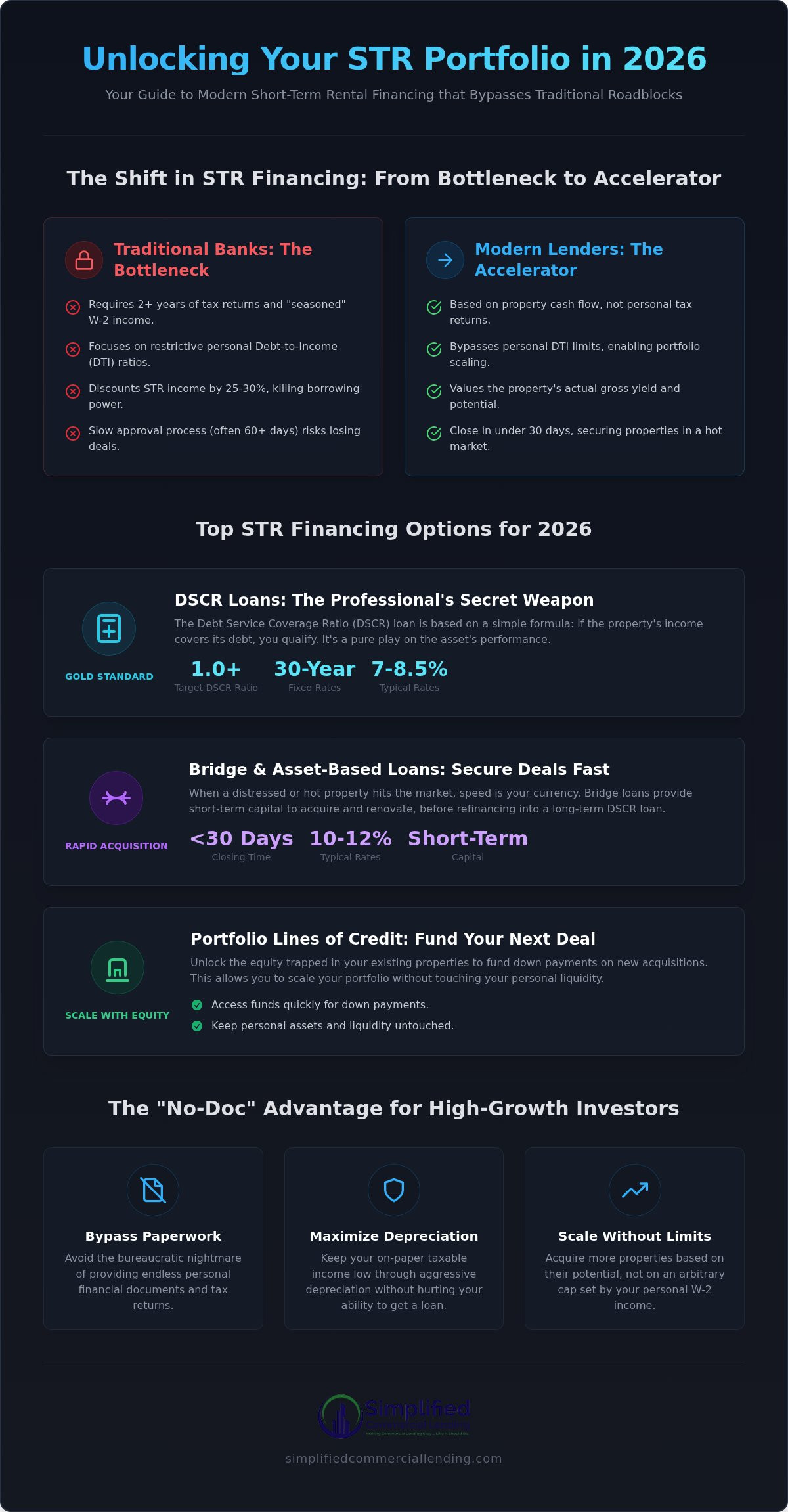
Traditional banks are a brick wall for the modern entrepreneur. They are still operating on a 1990s playbook that prioritizes a steady W-2 paycheck over actual business performance. If you’ve transitioned to full-time investing, most loan officers see you as a risk rather than a success story. This “W-2 trap” makes securing short term rental financing through a local branch almost impossible for the very people driving the market.
The problem is systemic. Banks demand two years of tax returns to prove your income. If you’ve been aggressively using depreciation to lower your tax bill, your “on-paper” income looks tiny. By the time you can show the bank two years of “seasoned” income that meets their rigid standards, the prime property you were eyeing has been sold to an investor who used a more agile lender. They simply don’t understand the high-yield reality of short-term rentals.
Personal Debt-to-Income (DTI) ratios create a hard ceiling for ambitious portfolios. Conventional lenders count your personal debts against you but often refuse to count 100% of your rental income. This math ensures you’ll hit a wall after just a few properties. In 2026, the shift is clear. Serious investors have abandoned the bank lobby for non-bank lenders who prioritize property cash flow over personal tax returns.
The Institutional Bias Against Airbnb Income
Banks are terrified of seasonality. They see a slow January and panic, ignoring the massive peaks of the summer season. Most traditional underwriters discount STR revenue by 25% to 30% compared to a long-term lease. They apply these “haircuts” to your projected income, effectively killing your borrowing power. They want the perceived safety of a 12-month lease, even if that lease pays 50% less than what a well-managed Airbnb generates in the same market.
Speed as a Competitive Advantage
In 2026, the best vacation properties sell in days. A 60-day bank approval process is a death sentence for your deal. You can’t afford to wait on a committee that meets once a week to discuss your “over-documentation.” Asset-based underwriting bypasses this bottleneck by focusing on the property’s potential. When your short term rental financing is based on the asset, you can close in under 30 days and beat out competitors who are still waiting for a bank callback.
Top Short Term Rental Financing Options: A 2026 Roundup
The 2026 market demands more than a one-size-fits-all loan. To scale effectively, you need a toolkit of short term rental financing products designed for different stages of the investment lifecycle. Whether you are eyeing a distressed cabin in the Smokies or a boutique multi-unit property in a coastal hub, the right capital structure determines your ultimate yield. Modern investors are moving away from restrictive personal mortgages and toward specialized rental property financing options that treat their portfolio like the business it actually is.
Asset-based rental loans and no-doc solutions have become the standard for high-net-worth entrepreneurs. These programs prioritize property value and historical or projected cash flow over your personal tax returns. If you are looking to scale into larger assets, commercial mortgages now offer excellent terms for boutique hotel conversions and multi-unit STR complexes. For those who need to move fast on a property that needs a facelift, bridge loans provide the short term capital required to secure the asset before refinancing into a long term hold.
DSCR Loans: The Professional Investor’s Secret Weapon
How do you qualify for a loan without showing a paycheck? You use the Debt Service Coverage Ratio (DSCR). This is the gold standard for short term rental financing in 2026. Lenders calculate the ratio by dividing the property’s monthly rental income by its total debt obligations. A ratio of 1.0 means the property breaks even; anything higher shows a profit. In today’s market, smart lenders use specialized market analytics and local comps to verify income potential, allowing you to secure 30-year fixed rates as low as 7.0% to 8.5% based on the asset’s performance. Before you apply, it’s worth reviewing the exact DSCR loan requirements for 2026 so you know precisely what credit score floors, down payment standards, and reserve rules to expect. For a deeper look at how these programs work specifically for vacation rentals, our complete guide to DSCR loans for Airbnb in 2026 covers the latest rates and qualification strategies. It is a pure play on the property’s ability to pay for itself.
Bridge and Asset-Based Solutions for Rapid Acquisition
Speed is the currency of the 2026 real estate market. When a distressed vacation property hits the market, you don’t have weeks to wait for a traditional appraisal. Bridge loans offer 10% to 12% interest rates for quick acquisitions, giving you the breathing room to renovate and stabilize the asset. Once the property is guest-ready, you can transition into permanent single family residential investment loans with LTV limits typically ranging from 75% to 80%. This strategy allows you to buy low, add value, and pull your initial capital back out to fund the next deal. If you want to see how these pieces fit your specific strategy, exploring a simplified brokerage process can help you identify the best leverage for your goals.
Scaling Your Airbnb Portfolio with a Rental Line of Credit
Scaling from one property to ten requires a shift in mindset. You can’t rely on saving up individual down payments forever. A portfolio line of credit is the tool that separates the hobbyist from the professional. Unlike a HELOC, which is tied to your primary residence and often capped by restrictive personal limits, a portfolio line is a business-grade solution. It allows you to tap into the aggregated equity of your entire rental stack to fund new acquisitions on demand. This is the most efficient form of short term rental financing for investors who refuse to let their growth be dictated by their personal savings account.
Traditional secondary markets like Fannie Mae impose a strict 10-loan limit on financed investment properties. Once you hit that wall, conventional banks stop talking to you. Portfolio lines and blanket loans bypass this roadblock entirely. A blanket loan consolidates multiple properties under a single debt structure, treating your portfolio as one cohesive business asset. It gives you the power to cross-collateralize your holdings, making it easier to secure higher leverage and better terms than you’d get with five separate, disconnected mortgages.
Leveraging Existing Equity for New Acquisitions
Think of the equity in your current rentals as “dry powder” waiting to be deployed. Instead of selling an asset to buy another, you use a portfolio line of credit for rentals to pull out cash while keeping the original property. Many of these programs offer interest-only periods. This is a game-changer for short term rentals because it keeps your monthly overhead low and your cash flow high during the acquisition phase. When a hot deal hits the market in a competitive 2026 landscape, having a ready-to-go fund ensures you’re the first to the closing table.
Consolidating and Streamlining Your Debt
Managing five different lenders and five different due dates is an administrative nightmare. Consolidating your debt into a single short term rental financing structure reduces overhead and simplifies your life. It also improves your overall commercial property loan profile. Lenders see a consolidated portfolio as a stabilized, professional operation rather than a collection of speculative bets. You gain the flexibility to add new properties to the structure or remove them as you sell, giving you total control over your capital stack without the constant need for full re-underwriting.
The ‘No-Doc’ Advantage for High-Growth STR Investors
In the world of short term rental financing, the term “no-doc” is often misunderstood. It doesn’t mean you don’t need to qualify. It means the lender stops treating your personal tax returns as the ultimate source of truth. For a high-growth investor, your 1040s are usually the worst way to measure your financial health. Traditional banks see a “loss” on your tax return and deny the loan. We see a savvy entrepreneur using the legal tax code to build wealth. By removing the need for personal income verification, no-doc loans allow you to scale based on the property’s merits rather than your paper income.
Lenders in 2026 prioritize property performance and your credit history over your debt-to-income ratio. While a solid credit score, typically 620 to 640 minimum, proves you are a responsible borrower, the property’s cash flow is what actually secures the deal. This shift in focus is what enables investors to move from two units to twenty without hitting a personal income ceiling. If the property can pay for itself and then some, why should your W-2 matter? Investors who want a comprehensive breakdown of how these structures apply specifically to vacation properties can explore the full details in our 2026 guide to loans for vacation rental properties.
Why Tax Returns are a Poor Measure of Investment Success
Successful STR investors are masters of cost segregation and accelerated depreciation. These strategies are designed to front-load expenses and lower taxable income, which is brilliant for your bank account but lethal for a traditional mortgage application. A “loss” on paper is often a sign of a high-performing portfolio, not a failing business. Modern underwriting focuses on Net Operating Income (NOI) as the true metric of health. It looks at the actual dollars coming in and going out of the property, ignoring the non-cash “paper losses” that confuse traditional bank underwriters.
Underwriting Based on Property Potential
How do lenders verify income without your tax returns? They lean on sophisticated AI and real-time data platforms to predict revenue with incredible accuracy. These tools analyze occupancy trends, average daily rates, and local demand drivers to project exactly what a property will earn. Professional management also plays a massive role; having a proven operator can often secure you more favorable loan terms. DSCR loans for Airbnb properties provide the ultimate no-doc approval by ensuring the property’s gross income is at least 1.2 times the total debt obligation. If you are ready to stop letting your tax returns hold you back, you can apply for a no-doc rental loan today and keep your momentum moving forward.
Simplified Commercial Lending: Your Partner for STR Growth
Going direct to a single bank is like shopping for a car at a dealership that only sells one model. If you don’t fit their specific box, you’re out of luck. Simplified Commercial Lending acts as your navigator through the complex world of short term rental financing. We don’t just offer one loan; we provide access to a massive national network of private equity and non-bank debt providers. This means we find the program that fits your portfolio, not the other way around. We act as your advocate, ensuring you never miss out on a prime property because of a rigid institutional rule.
Our “Simplified” approach removes the friction from the borrowing process. We’ve eliminated the unnecessary red tape of traditional institutions to help you close your next deal in as little as 30 days. By focusing on property cash flow and asset value, we bypass the personal income hurdles that stop most investors in their tracks. You get the capital you need without the headache of endless documentation or onerous tax return requirements. We believe your success should be measured by your results, not by how well you fit into a bank’s outdated spreadsheet.
Our National Reach and Specialized Expertise
We serve investors in all 50 states with consistent, reliable capital. Whether you are looking at a single unit or complex multi family residential investment loans for apartment-to-STR conversions, our team has the specialized expertise to structure the deal. We don’t just look at the closing date; we look at your exit. We tailor every loan structure to match your specific 5-year or 10-year strategy. This ensures your debt remains an asset that supports your long-term wealth goals rather than a liability that restricts your next move.
Take the Next Step Toward Your 2026 Portfolio Goals
Success in the 2026 market requires preparation and speed. To get started, gather your property data—including current or projected income, expenses, and occupancy rates. This information allows us to provide an accurate, high-leverage quote with minimal friction. An initial consultation is the best way to map out your scaling strategy and identify which short term rental financing products will serve you best as you grow. Don’t let traditional banking limits cap your ambitions. Ready to scale? Get a quote for your short term rental financing today.
Take Control of Your STR Portfolio Growth in 2026
The property investment landscape has shifted permanently. You don’t need to be tethered to the rigid requirements of traditional banks or capped by your personal debt-to-income ratio. By pivoting toward asset-based solutions like DSCR and portfolio lines, you unlock the ability to scale your business based on property performance rather than your 1040s. This modern approach to short term rental financing ensures you can move faster, secure higher leverage, and build a resilient portfolio that thrives in the 2026 experience economy.
Simplified Commercial Lending acts as your savvy navigator in this new era of finance. We provide the national expertise required to navigate complex DSCR and portfolio structures with ease. You can close on your next deal in as little as 30 days. No tax returns or W-2s are required. Scale your Airbnb portfolio with Simplified Commercial Lending. Get Started Now. Your vision for a high-performing portfolio is attainable. Take the leap and secure the flexible capital your business deserves.
Frequently Asked Questions
What is the minimum DSCR required for a short term rental loan?
Most lenders look for a minimum Debt Service Coverage Ratio (DSCR) of 1.2x to ensure the property comfortably covers its debt obligations. However, some flexible programs in 2026 allow for a 1.0x ratio or even lower if the property is located in a high-growth market or if you have significant cash reserves. The goal is to prove the asset can sustain itself without relying on your personal paycheck.
Can I get Airbnb financing without showing my personal tax returns?
You can absolutely secure short term rental financing without showing a single tax return or W-2. No-doc and DSCR loans are designed specifically for this purpose. Underwriters focus on the property’s projected rental income and your credit score rather than your taxable income, which is often lowered by depreciation and other write-offs.
How does a portfolio line of credit differ from a traditional mortgage?
A portfolio line of credit for rentals is a flexible, revolving credit facility secured by your entire collection of properties. A traditional mortgage is a static loan tied to a single house with a fixed repayment schedule. The portfolio line allows you to pull equity from multiple units simultaneously to fund new acquisitions quickly, whereas a mortgage requires a full refinance for every cash-out event.
Do I need a professional property manager to qualify for STR financing?
You don’t always need a professional property manager to qualify, but it can certainly help. Some lenders offer better rates or higher leverage if you use a verified management company with a proven track record. If you plan to self-manage, be prepared to show your own history of successful short term rental operations to satisfy underwriting requirements.
What is the typical down payment required for a non-bank STR loan?
A 20% to 25% down payment is the standard requirement for most non-bank STR loans. While this is higher than a primary residence mortgage, it reflects the investment nature of the asset and the increased risk associated with rental income. Some specialized programs may allow for a 15% down payment if the property shows exceptional cash flow potential and you have a high credit score. To understand exactly how these thresholds are applied alongside credit score floors and reserve rules, reviewing the full DSCR loan requirements for portfolio scaling in 2026 will give you a precise picture of what to prepare.
Can I use a DSCR loan for a multi-family property I plan to use as an Airbnb?
You can definitely use a DSCR loan for a multi-family property intended for Airbnb use. This is a popular strategy for apartment-to-STR conversions where you finance the entire building based on its projected short-term revenue. It’s an efficient way to scale your unit count under one debt structure while benefiting from the higher yields of the vacation rental market.
How long does the approval process take for no-doc rental financing?
The approval process for no-doc short term rental financing typically takes under 30 days. Because these loans don’t require the exhaustive verification of personal tax returns or employment history, the underwriting is significantly faster than traditional bank loans. This speed gives you a major advantage when bidding on hot properties in competitive vacation markets.
Are interest rates higher for short term rental loans compared to residential mortgages?
Interest rates for STR loans are generally 1% to 2% higher than traditional residential mortgages. In 2026, you can expect DSCR rates to range between 7.0% and 8.5% depending on your credit score and the property’s location. This premium is the trade-off for the flexibility, speed, and lack of personal income verification that traditional banks simply can’t match.