Stop letting your tax returns dictate your net worth. If you’re waiting for a traditional bank to approve your personal income, you’re missing out on the fastest wealth building tool in real estate. Many investors are surprised to find that dscr loan rates today sit around 6.12% for domestic portfolios, but the real value isn’t just the number. It’s the speed and the ability to scale without a W2. You’ve likely felt the frustration of a rigid bank rejection because of your business write-offs. It’s confusing to see rates slightly higher than a primary residence when the property itself is a cash-generating machine.
We understand that you’re a business owner, not just a borrower. This guide will show you how to secure the best benchmarks and pull specific levers to optimize your pricing for 2026. You’ll learn exactly how to balance leverage, points, and rates to keep your portfolio growing. We’re going to break down current market benchmarks, explain why a 1.25 ratio is your golden ticket, and show you how to close fast enough to beat the competition to every deal.
Key Takeaways
- Stop relying on personal debt-to-income ratios and learn how property cash flow determines your eligibility for rapid scaling.
- Discover current benchmarks for dscr loan rates today and why 2026 economic shifts have stabilized pricing for savvy investors.
- Master the three core levers, LTV, credit score, and DSCR ratio, that dictate your final interest rate and monthly cash flow.
- Compare 30-year fixed options against hybrid ARMs to find the right balance between long-term security and short-term entry costs.
- Identify how to bypass traditional banking bottlenecks by using a broker-led process that requires no tax returns or personal income verification.
Understanding DSCR Loan Rates Today: The 2026 Landscape
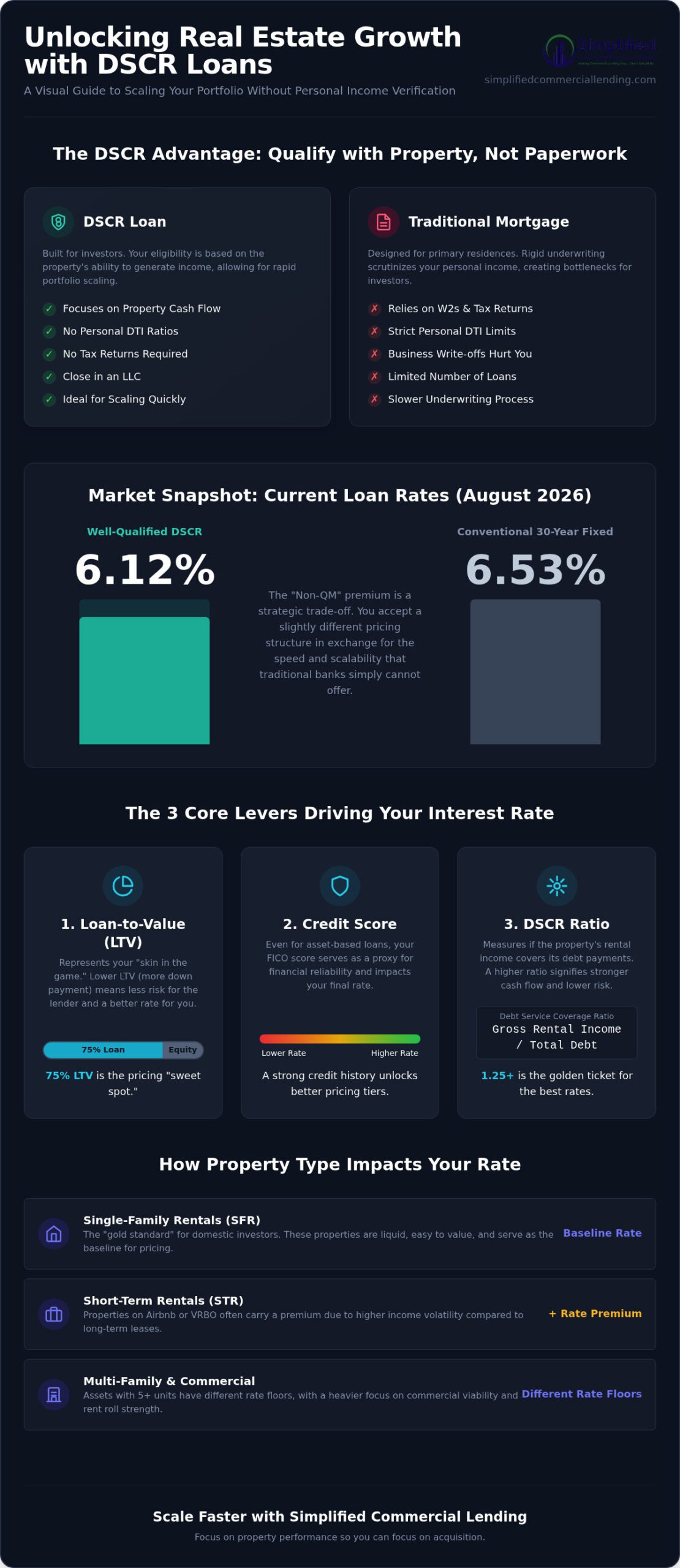
DSCR loans are built for the entrepreneur, not the employee. Unlike traditional mortgages that scrutinize your personal tax returns and W2s, these loans qualify you based on the property’s ability to generate cash flow. The Debt Service Coverage Ratio (DSCR) is the engine under the hood. It measures whether the rental income covers the monthly debt. As of August 2026, the market has stabilized after several years of volatility. Tracking dscr loan rates today is about more than just finding the lowest number; it’s about identifying the right leverage to scale your portfolio without personal income bottlenecks.
You’ll notice that DSCR pricing is “de-coupled” from the rates you see for primary residences. While a 30-year fixed conventional mortgage might sit near 6.53%, DSCR benchmarks for domestic investors currently hover around 6.12% for well-qualified borrowers. This spread exists because these are commercial-grade products. You’re paying for the freedom to bypass debt-to-income (DTI) checks and the ability to close in the name of an LLC. It is a strategic trade-off. You accept a slightly different pricing structure in exchange for the speed and scalability that traditional banks simply cannot offer.
DSCR vs. Conventional Mortgage Rates
The “Non-QM” premium is the price of flexibility. Conventional lenders use rigid DTI limits that often kill an investor’s ability to grow after their third or fourth property. Once your personal debt reaches a certain threshold, the bank stops lending, regardless of how much your rentals earn. DSCR loans remove this ceiling. The true cost of waiting for a traditional bank isn’t just the interest rate; it’s the opportunity cost of the deals you lose while waiting weeks for a manual underwriter to comb through your tax write-offs. We focus on property performance so you can focus on acquisition.
Why Rates Differ Across Property Types
Not every asset class is priced the same. Lenders view risk through the lens of income stability, which creates nuances in your quote. Here is how property types typically impact your rate:
- Single-Family Rentals (SFR): These often serve as the baseline for pricing. They are liquid and easy to value, making them the “gold standard” for domestic investors.
- Short-Term Rentals (STR): Properties listed on Airbnb or VRBO often carry a pricing premium. Lenders account for the higher volatility of seasonal income compared to a long-term lease.
- Multi-Family and Commercial: Assets with 5+ units or retail centers have different rate floors. These are underwritten with a heavier focus on the commercial viability of the location and the strength of the rent roll.
By understanding these distinctions, you can better position your portfolio to capture the most aggressive pricing available in the current market.
The Three Core Levers Driving Your DSCR Interest Rate
Pricing isn’t a mystery. It’s a transparent calculation based on risk. When you check dscr loan rates today, you aren’t just looking at a static market figure. You’re looking at a starting point that shifts based on your specific deal structure. Lenders use three primary dials to determine your final quote. Understanding how to turn these dials allows you to engineer a loan that fits your cash flow goals perfectly. It also helps you move faster than the competition when a deal is on the line.
The first lever is your Loan-to-Value (LTV) ratio. This represents your “skin in the game.” The second lever is your credit score. Even in the world of asset-based lending, your FICO score serves as a proxy for financial reliability. The third lever is the Debt Service Coverage Ratio itself. A property that generates a 1.25x ratio will always secure better pricing than one sitting at 1.0x. For investors in high-growth, low-yield markets, “no-ratio” exceptions exist, though they come with a pricing premium to account for the tighter margins. Lenders also look at your track record. Experienced investors with a history of successful long-term holds often access lower rate floors that beginners can’t reach.
Maximum Leverage vs. Minimum Rate
There is a distinct pricing “sweet spot” in the market at 75% LTV. At this level, you’ve provided enough equity to satisfy most risk models while keeping enough capital to fund your next acquisition. If you choose to push for 80% LTV, be prepared for your monthly cash flow to shrink. High-leverage borrowers pay a leverage tax in the form of a higher interest rate to compensate the lender for the increased risk of a smaller equity cushion. You must decide if the extra 5% in leverage is worth the long-term cost of a higher rate.
The Role of Credit in Asset-Based Lending
Don’t mistake “no-doc” for “no-credit.” While we don’t care about your tax returns, your FICO score remains a critical pricing factor. The most significant rate drops typically occur at the 680, 720, and 740 tiers. A borrower with a 740 score might see a rate nearly 0.5% lower than someone with a 660 score. Keeping your credit clean is the easiest way to lower your cost of capital without increasing your down payment. For a deeper dive into what lenders look for, check out our DSCR Loan Requirements: 2026 Portfolio Scaling Guide. If you’re ready to see how your score impacts your numbers, explore our portfolio financing options today and start scaling your business with confidence.
Fixed vs. ARM vs. Interest-Only: Choosing the Right Structure
Choosing the right architecture for your financing is just as critical as the property’s location. While dscr loan rates today are influenced by the broader bond market, the structure you select determines your actual monthly margin. You aren’t just buying a loan; you’re buying a financial tool. Many investors ask why these rates carry a spread over Treasury yields. This is the “Investor Premium.” Lenders account for the increased risk of investment properties compared to government bonds. You’re paying for liquidity and the ability to scale without personal income hurdles.
The 30-year fixed rate remains the gold standard for “set it and forget it” investors. It offers total protection against future inflation and rate hikes. If you plan to hold a property for a decade or more, this is your primary defensive play. However, if your exit strategy involves a sale or refinance within 5 to 7 years, a hybrid ARM might be the smarter move. In August 2026, some 1-year ARMs start as low as 5.375%. This offers a significant discount over fixed-rate products for those with shorter hold periods.
When to Choose an Interest-Only DSCR Loan
Interest-only (IO) options are the ultimate lever for maximizing cash-on-cash returns. By deferring principal paydown, you keep more cash in your pocket every month. This is ideal for high-growth markets where appreciation is the primary wealth driver. It’s also a savvy move for short-term holds where you plan to add value and refinance quickly. Keep in mind that IO payments significantly improve your DSCR calculation during underwriting. Since the qualifying payment is lower, your ratio looks stronger. This can often help you secure financing on a property that might not qualify under a full principal and interest payment.
The Prepayment Penalty (PPP) Trade-off
Lenders value predictability. If you commit to staying in the loan for a set period, they’ll reward you with a lower rate. A standard 3-2-1 structure is common, where the penalty drops each year. If you’re willing to accept a 5-year penalty, you can often shave 0.25% to 0.50% off your interest rate. It’s a calculated trade-off. If your goal is long-term cash flow, take the discount. If you need an early exit strategy, pay the slightly higher rate for a shorter penalty. For more on complex deal structures, read our guide on How to Secure a Commercial Property Loan.
How to Secure the Lowest DSCR Rate for Your Portfolio
Securing the best dscr loan rates today requires more than just a high credit score. It requires a strategy. You have to look at your portfolio as a business. While the market sets the baseline, you control the final quote by adjusting how you present your deals to a lender. We see too many investors accept the first rate they’re offered without pulling the levers available to them. Taking a proactive approach to your loan structure can save you thousands in interest over the life of the loan.
First, look at your LTV. It’s tempting to keep as much cash as possible for the next deal. However, the pricing tiers are sharp. Sometimes putting an extra 5% down can save you a full 1% on your interest rate. That’s a massive return on that incremental capital. Second, lean on your track record. If you have successfully closed 5 or more investment deals, make sure your lender knows. Experience reduces their perceived risk, which often translates directly into a lower rate floor. Third, stop financing properties one by one if you have a growing collection. You can bundle your assets into a portfolio line of credit to tap equity and lower your overall cost of capital. This approach treats your portfolio as a single entity, giving you more weight at the negotiating table.
Calculating the Break-Even on Points
A “point” is an upfront fee equal to 1% of your loan amount paid to lower your par rate. Is it worth it? Use the 3-year rule. If the monthly savings from the lower rate pay back the cost of the points within 36 months, and you plan to hold the property longer, buy the points. This is a common move for long-term rental owners who want to maximize monthly cash flow. For real estate investors, points are generally tax-deductible as a business expense in the year they are paid. To see how these strategies play out in practice, our DSCR loan for rental property 2026 case study walks through a real portfolio scaling scenario from acquisition to cash flow optimization.
The Power of Cross-Collateralization
Cross-collateralization allows you to use multiple properties to secure a single blanket loan. This often results in a lower weighted average interest rate and significantly reduces your closing costs. Instead of five separate appraisals and five separate rate locks, you streamline the process into one. This is particularly effective for those seeking Short Term Rental Financing: Top Loan Options for Investors in 2026, where cash flow is high but management is intensive. Ready to see how much you can save? Contact Simplified Commercial Lending to get a custom quote tailored to your portfolio goals.
Scale Faster with Simplified Commercial Lending
Simplified Commercial Lending isn’t a bank. We’re your advocate in a crowded market. When you search for dscr loan rates today, you shouldn’t be limited to the balance sheet of a single institution. We act as brokers, which means we shop your deal across an elite network of private equity and non-bank institutional capital. This gives you access to the most aggressive pricing and flexible terms available in 2026. We don’t just find a loan; we find the specific program that matches your portfolio’s growth trajectory.
Our process is built for speed. Forget the mountain of paperwork that traditional lenders demand. We’ve eliminated tax returns and 4506-C forms from our requirements. We focus on the asset. Whether you’re financing a single-family rental, a multi-family complex, or specialized assets like Airbnb properties and warehouses, our underwriting centers on property cash flow. If you want to see exactly how this works in a real-world scenario, read our detailed breakdown of using a DSCR loan for rental property to scale a portfolio without tax returns. If you’re still unsure how no doc commercial loans actually work and whether they’re the right fit for your situation, our myth-busting guide breaks down the 2026 lending landscape in plain terms. This streamlined approach removes the headaches and lets you get back to finding your next deal. You need a partner who understands that time is your most valuable currency.
Beyond the Rate: Why Execution Matters
A “cheap” rate is worthless if the loan doesn’t close. The industry is full of lenders who over-promise and under-deliver, leading to a last-minute bait-and-switch that can cost you a property. We prioritize transparency and execution. The real cost of a failed closing is the lost equity and the missed opportunity of the deal itself. We help you build a scalable financing machine. By providing reliable capital, we empower you to act with the confidence of a cash buyer. Our commitment is to get you to the finish line without the typical anxieties of institutional lending.
Ready to Lock Your Rate?
Speed is our competitive advantage. In a market where deals move in hours, you can’t afford to wait weeks for a pre-approval. We provide a custom quote within 24 hours. You don’t need a massive document dump to get started. Just provide the property address and a current rent roll. We’ll handle the heavy lifting, analyzing the income and market data to give you a clear path forward. Stop acting like a W2 employee and start acting like the business owner you are. Get a custom DSCR rate quote today and see how fast your portfolio can grow with dscr loan rates today that actually work for your bottom line.
Take Control of Your Portfolio’s Future
Success in real estate isn’t just about finding the right property. It’s about securing the right capital. You now understand that dscr loan rates today are more than just a number on a spreadsheet; they are a strategic lever for rapid growth. By optimizing your LTV, maintaining your credit score, and choosing a loan structure that matches your exit strategy, you position yourself to outperform traditional investors who are still stuck in the bank’s waiting room. Speed and flexibility are your greatest assets in a competitive market.
Don’t let rigid institutional norms slow you down. We specialize in financing for single-family homes, multi-family units, and short-term rentals without the burden of personal income verification. We move at the speed of the market, often closing deals in as little as 10 days. The status quo of traditional lending is over. It’s time to start acting like the business owner your portfolio deserves. Scale your portfolio today with a custom DSCR rate quote and secure the financing you need to win. Your next deal is waiting. Go take it.
Frequently Asked Questions
What are DSCR loan rates today for 2026?
Baseline par dscr loan rates today are approximately 6.12% for domestic investors as of August 2026. These rates can range up to 6.49% depending on your specific loan-to-value ratio and property type. If you have a credit score above 740 and a DSCR of 1.25 or higher, expect your rate to land between 6.5% and 7% for a 30-year fixed product.
Is a DSCR loan rate higher than a conventional mortgage?
Yes, DSCR rates are usually 0.5% to 1.5% higher than conventional mortgages. You pay this premium to skip the invasive personal income checks and debt-to-income limits of traditional banks. For example, while conventional rates were near 6.53% in June 2026, DSCR loans provide the speed and LLC-title options that conventional products simply can’t match for professional investors.
Can I get a DSCR loan with a 1.0 ratio or lower?
You can certainly qualify with a 1.0 ratio, where rental income matches the debt payment exactly. High-growth markets often see “no-ratio” programs that ignore the ratio entirely to help investors secure properties in low-yield areas. Keep in mind that a ratio of 1.25 or higher is the standard for unlocking the best possible pricing and terms for your portfolio.
How much of a down payment is required for the best DSCR rates?
A down payment of 20% to 25% is typically required to access the best market rates. If your credit score is 740 or higher, some lenders offer options with as little as 15% down. Putting more “skin in the game” reduces the lender’s risk. This is the most direct path to lowering your interest rate and boosting your long-term cash-on-cash return.
Do DSCR loans require tax returns or W2s?
DSCR loans never require tax returns, W2s, or 4506-C forms. We qualify the deal based on the property’s gross rental income rather than your personal earnings. This is a game-changer for self-employed entrepreneurs who use legal tax write-offs. It allows you to continue scaling your real estate business based on the strength of your assets, not your personal tax filings.
Can I use a DSCR loan for an Airbnb or short-term rental?
You can absolutely use DSCR financing for Airbnb and VRBO properties. We look at the short-term rental income potential to qualify the loan rather than relying on a traditional long-term lease. While these loans might carry a slight pricing premium due to the volatility of seasonal income, they are the fastest way to finance high-cash-flow vacation rentals in the 2026 market.
What is the minimum credit score for a DSCR loan in 2026?
The minimum credit score for most DSCR programs in 2026 falls between 620 and 660. While the property’s cash flow is the primary focus, your credit score still influences your interest rate and maximum leverage. Achieving a score of 740 or higher is the threshold for the most aggressive pricing, allowing you to secure significantly lower rates for your investment portfolio.
How does a prepayment penalty affect my interest rate?
A prepayment penalty lowers your interest rate because it provides the lender with guaranteed interest income for a set period. By agreeing to a 3-year or 5-year penalty, you can often shave 0.25% to 0.50% off your par rate. It’s a strategic choice. If you’re a long-term holder, the lower rate saves you more money over time than the penalty would ever cost.