What if the equity in your rental could help fund your next move without selling the property? If you’re asking, “can i get a loan on a rental property i own,” the short answer is yes, depending on your equity, the property’s cash flow, and lender requirements. The right structure depends on how you plan to use the funds and how you want to repay them.
Several options may be available, including a refinance, a property-secured loan or line of credit, and a portfolio line of credit. They work differently, and conventional underwriting may involve personal tax returns. Some programs use different documentation, but requirements depend on the lender and loan.
This guide explains the main ways to access equity or refinance an existing rental, what lenders may assess, and how to prepare before applying. It also explains where portfolio lines of credit may fit, including options that assess property cash flow rather than personal income. Compare the trade-offs before choosing a path.
Key Takeaways
- Whether you can get a loan on a rental property you own depends on more than ownership. Equity, existing liens, rental cash flow, and lender requirements all matter.
- Compare a cash-out refinance with a property-secured credit option to see which structure better fits your funding needs and repayment plans.
- Lenders may assess the property’s value and condition, rental income, debt payments, and your borrower profile.
- Prepare by defining how you’ll use the funds, reviewing existing debt, and organizing property records before comparing offers.
- Check each offer’s collateral, qualifying basis, repayment terms, and permitted uses. Usable equity doesn’t automatically mean you’ll qualify to borrow that amount.
Can I Get a Loan on a Rental Property I Already Own?
Yes, you may be able to borrow against a rental property you own or refinance its existing mortgage if a lender approves the property, available equity, cash flow, and your application. Owning the property doesn’t guarantee approval. Existing liens, property condition, and the selected program’s rules can affect whether financing is available and how much you may borrow.
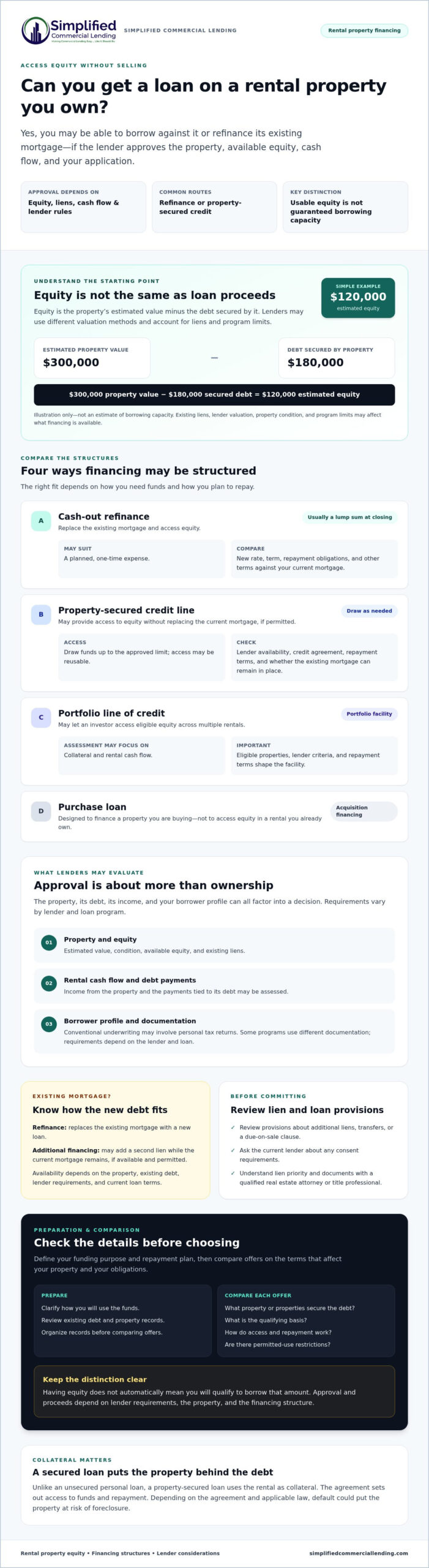
Equity is the property’s estimated value minus the debt secured by it. For example, if a rental is valued at $300,000 and has $180,000 in secured debt, the estimated equity is $120,000. This is a simple illustration, not an estimate of borrowing capacity. Lenders use different valuation methods and may account for other liens and program limits. Usable equity and approved loan proceeds aren’t necessarily the same.
What does it mean to borrow against a rental property?
The property serves as collateral for a new loan or credit facility. That’s different from collecting rent, which is income from tenants, or selling the property, which transfers ownership. A home equity loan is one example of borrowing secured by property equity. A portfolio line of credit may also let an investor access equity across existing rentals, subject to lender and program requirements.
This is different from an unsecured personal loan because the rental property backs the debt. The agreement sets out how you can access funds, how repayment works, and what may happen if you don’t meet your obligations. Depending on the agreement and applicable law, default could put the property at risk of foreclosure.
Can I qualify if the property already has a mortgage?
Possibly. A refinance replaces the existing mortgage with a new loan. Other financing structures may add a second lien while the current mortgage remains in place. Whether either route is available depends on the property, existing debt, lender requirements, and the terms of your current loan.
Before applying, review your loan documents for provisions about additional liens, transfers, or a due-on-sale clause. Don’t assume a new loan is permitted or prohibited based on the clause’s name alone. Ask the current lender about any consent requirements, and consult a qualified real estate attorney or title professional to understand lien priority and the documents involved. Confirm these details before committing, since the new lender’s claim against the property may depend on its lien position.
Which Loan Options Let You Use Equity in a Rental Property?
If you’re asking, “can i get a loan on a rental property i own,” first decide how you want to access the funds. A cash-out refinance may provide a lump sum while replacing existing debt. A property-secured credit line may allow staged draws, subject to lender availability and approval. Investors with multiple rentals may also consider a portfolio line of credit. These differ from a purchase loan, which finances the acquisition of a property rather than accessing equity in one you already own.
| Option | Purpose | How funds are accessed | Repayment structure and trade-offs |
|---|---|---|---|
| Cash-out refinance | Replace existing mortgage debt and access equity | Typically as a lump sum at closing | Repay the new loan under its terms. The rate, term, and other conditions may differ from your current mortgage. |
| Property-secured credit line | Access equity without replacing the existing mortgage, if the lender permits | Draw funds as needed, up to the approved limit | Repay according to the credit agreement. Access may be reusable, but terms and availability vary by lender. |
| Portfolio line of credit | Access eligible equity across multiple rentals | Draw funds under an approved portfolio facility | Collateral, rental cash flow, and lender criteria shape approval and repayment terms. |
| Purchase loan | Finance a property you’re buying | Funds support the acquisition | Designed for a purchase, not for accessing equity in a rental you already own. |
Cash-out refinance versus a property-secured credit line
A refinance replaces the existing mortgage with a new loan. A credit line may let you draw funds in stages without replacing that mortgage. A refinance may suit a planned, one-time expense; a line may offer flexibility if you expect to need funds over time. Not every lender offers both structures. Compare the new terms with your current loan, including repayment obligations and how each option affects the property securing the debt. The Consumer Financial Protection Bureau offers general housing and mortgage information that may help you prepare questions for lenders.
When can a portfolio line of credit make sense?
A portfolio line may be worth exploring if you own multiple rentals and want to access eligible equity across them rather than assess only one property. Lenders determine availability based on the collateral, cash flow, property mix, and program criteria. Some portfolio-line underwriting focuses on property cash flow rather than personal income, but documentation and eligibility depend on the lender and program. For more context, see the guide “Portfolio Line of Credit: Scale Rentals Without Tax Returns.”
For property-focused options, review the portfolio line of credit options available through Simplified Commercial Lending. Confirm property eligibility, permitted uses, and terms with the lender before deciding.
How Do Lenders Evaluate a Loan on a Rental Property You Own?
Lender approval depends on the complete loan file, not equity alone. Whether you can get a loan on a rental property you own depends on how the lender evaluates the property, its income, existing debt, and your borrower profile under the specific loan program.
Lenders may assess several parts of the application:
- Property value: The lender may use an appraisal or another valuation method to assess the collateral.
- Existing liens: Current mortgage balances and other claims against the property can affect available financing and lien position.
- Rental cash flow: The lender may compare income available for debt service with the property’s required debt payments.
- Property condition: Repairs, deferred maintenance, or other condition concerns may affect the lender’s view of the collateral.
- Borrower profile: Depending on the program, the lender may review credit, assets, experience, income, or other financial details.
How property cash flow and DSCR may affect approval
The debt service coverage ratio, or DSCR, compares a property’s income available for debt service with its required debt payments. A lender may review rent, operating expenses, vacancy assumptions, and proposed payments to calculate it. Methods and qualifying thresholds vary by lender, loan structure, and property type, so don’t treat one DSCR figure as a universal approval rule.
Actual leases and operating records can help show how a rental performs. Projected rent or seasonal income may be assessed differently, depending on the program. Gather leases, rent records, and expense documents, and ask how the lender will treat income that hasn’t been consistently received. For more detail, consult the “DSCR Loan Requirements: 2026 Portfolio Scaling Guide.”
Do lenders require tax returns for a rental-property loan?
There isn’t one documentation rule for every rental-property loan. Requirements depend on the lender, loan program, borrower, and property. Some property-focused programs may place more weight on rental cash flow and may not require personal tax returns. That doesn’t mean approval is automatic or that lenders won’t verify income, assets, or property records in another way.
Before applying, ask for the program’s document checklist. It may include current leases, operating statements, mortgage information, bank records, or borrower financial documents. Confirm which items apply to your situation and how the lender will assess cash flow. This helps you prepare the right file without assuming a particular loan structure will waive standard verification.
What Should You Check Before Borrowing Against Your Rental?
Before applying, turn “can i get a loan on a rental property i own” into a practical decision: what will the funds do, and can the property support repayment if income changes? Equity is only one part of the picture. A lender may approve less than you expect, or decline an application, based on its valuation, existing debt, property cash flow, and program rules.
Use this order to prepare:
- Define the use of funds. Be specific. Repairs, another acquisition, and liquidity across a rental portfolio may call for different financing structures.
- Review existing debt. Check mortgage balances, payment obligations, lien information, and loan terms that could affect additional financing.
- Organize property records. Gather leases, rent and expense records, property details, and ownership documents before approaching lenders.
- Compare written offers. Look beyond the amount available. Review total obligations, repayment flexibility, draw rules, and fees in the lender’s written disclosures.
Ask how payments could change if the terms are variable, where applicable, and what happens if you can’t repay. Because the property is collateral, default may lead to enforcement against it, subject to the agreement and applicable law. Approval and timing vary by lender, program, and property, so don’t rely on a universal timeline or assumed borrowing limit.
Which records should I gather before applying?
Start with current mortgage statements, copies of leases, rent records, expense history, and basic property details. If an entity owns the rental, gather relevant entity ownership and title information as well. A lender may also request financial records, insurance details, or documentation about property condition. Requirements differ, so ask for the specific checklist rather than assuming one set of records will fit every application.
How can I decide whether borrowing is worth the risk?
Match the loan structure to the purpose, then test whether repayment remains manageable under less favorable conditions. For example, if you plan to use funds for repairs, consider how payments would fit if the work takes longer or the unit sits vacant. Use conservative assumptions for vacancy, expenses, and rental income. If the plan only works with full occupancy and uninterrupted rent, reassess before pledging the property.
Borrowing creates obligations even if the investment doesn’t perform as expected. Review the final terms carefully and seek independent legal, tax, or financial advice about consequences specific to your situation. Information about rental property loan options can help you compare financing structures and lender requirements.
How to Compare Rental-Property Loan Offers and Take the Next Step
Once you’ve clarified what you need the funds for, compare each offer on the same terms. The best fit depends on how many properties you own, available equity, rental cash flow, and whether you need a lump sum or flexible access to funds. “Can i get a loan on a rental property i own” is only the starting point. Next, consider whether the structure and obligations suit your investment plan.
- Collateral: Which property or properties secure the financing, and what lien position will the lender hold?
- Loan structure: Does the option replace existing debt or provide access to funds through a credit facility?
- Qualifying basis: How does the lender assess property value, rental income, cash flow, and borrower information?
- Repayment terms: What payments are required, can terms change, and what flexibility is available?
- Permitted uses: Are there restrictions on how you can use the proceeds?
Questions to ask before choosing a lender or loan structure
Ask how the lender will value the property and calculate qualifying rental income. Confirm the lien position, how and when you can access funds, repayment requirements, and any limits on fund use. Request a written outline of fees, conditions, required documentation, and closing requirements. Then compare offers side by side, including what happens if rental income falls or your plans change. Don’t rely on a verbal summary when written terms are available.
How Simplified Commercial Lending can help explore options
A broker can help you explore lender options and compare property-focused financing structures. This may be useful if conventional underwriting doesn’t fit your situation or you want to understand how a lender may evaluate rental cash flow. A broker can’t guarantee approval or preferred terms, and eligibility, documentation, and availability depend on the lender and program.
Simplified Commercial Lending is a nationwide commercial mortgage broker for investment-property financing. Its options include single-family investment property loans, multifamily residential investment loans, commercial property loans, and portfolio lines of credit. A portfolio line may let eligible investors access equity across existing rentals, with underwriting based on property cash flow rather than personal income. Requirements vary, so confirm the details for your properties and intended use.
Review financing options for a rental property you own and ask what lender-specific documentation may apply.
Choose a Financing Path That Fits Your Rental Strategy
So, can i get a loan on a rental property i own? You may be able to refinance or borrow against its equity, but the right fit depends on your property, cash flow, financing purpose, and lender requirements. A cash-out refinance and a property-secured credit option work differently, so compare how you’ll access and repay funds before choosing.
Start by defining your funding goal, organizing property and debt records, and reviewing written terms. Ask how the lender evaluates rental income, what documentation it requires, and what obligations come with the loan. Usable equity can help frame the conversation, but it doesn’t guarantee approval or a particular borrowing amount.
Simplified Commercial Lending is a nationwide commercial mortgage broker serving investment-property borrowers. Its portfolio lines of credit may provide access to equity across eligible rentals, subject to lender and program requirements. With clear goals and careful comparisons, you can take your next step with greater confidence.
Frequently Asked Questions
Can I get a loan on a rental property I own outright?
Yes, you may be able to borrow against a rental you own free and clear, subject to lender approval. With no existing mortgage, there may be no mortgage balance to pay off, but that doesn’t guarantee approval or access to the property’s full value. A lender may assess the property, rental cash flow, your borrower profile, and program requirements. Those factors help determine your options.
Can I borrow against a rental property that still has a mortgage?
Yes, some financing options may be available even if the property has an existing mortgage. A refinance may replace that debt, while another structure could add a lien if the lender and existing loan terms allow it. Review your mortgage documents for provisions related to additional liens or transfers. Ask the lender about consent and lien priority, and confirm how the proposed financing interacts with your current loan before proceeding.
What types of loans can I use to access rental-property equity?
Options may include a cash-out refinance, a property-secured loan or credit line, and, for eligible investors with multiple rentals, a portfolio line of credit. A refinance replaces existing debt and may provide funds as a lump sum. A credit line may allow staged draws under its terms. Availability varies by lender, property type, and intended use. Compare how funds are accessed, how repayment works, and which properties secure the debt.
Do I need tax returns to get a loan on a rental property?
Not always, but documentation depends on the lender, program, borrower, and property. Some property-focused programs may assess rental cash flow without relying on personal tax returns. That doesn’t mean no verification is required: a lender may ask for leases, rent records, financial statements, asset information, or other documents. Ask for the program-specific checklist early so you know how income and repayment capacity will be reviewed.
How much can I borrow against a rental property I own?
There’s no single amount that applies to every rental. A lender may consider its property valuation, existing mortgage balances and liens, cash flow, borrower details, and the limits of the loan program. The property’s estimated equity is not the same as approved borrowing capacity. Ask how the lender calculates available funds and whether its estimate accounts for existing debt, required payments, and any restrictions on the property or loan.
Can I use a rental-property loan to buy another investment property?
Possibly, if the loan program permits that use and the lender approves the transaction. Some investors seek funds from existing rental equity to support another acquisition, while a purchase loan is structured to finance the property being bought. Check the proposed loan’s permitted uses, repayment terms, and collateral requirements before relying on proceeds for a purchase. Lender criteria and availability may differ based on the properties and financing structure involved.
What happens if I cannot repay a loan secured by my rental property?
If you don’t meet the repayment obligations, the lender may have remedies under the loan agreement and applicable law. Since the rental property secures the debt, default could ultimately put it at risk of foreclosure. Read the agreement for payment terms, default provisions, and any options for addressing financial difficulty. If repayment becomes a concern, contact the lender promptly and seek qualified legal or financial advice about your circumstances.