Why are you still letting a stack of tax returns dictate how fast your real estate empire can grow? If you’re like most ambitious investors in 2026, you’ve likely hit the “bank wall” where debt-to-income limits and endless documentation requests bring your momentum to a screeching halt. It’s a common frustration. You have the equity and the experience, but traditional lenders are often too slow and rigid to keep up with the pace of the modern market.
We believe your success should be measured by your results, not your paperwork. In this article, you’ll learn how to unlock the hidden value in your existing properties using a portfolio line of credit for rentals. This flexible, no-doc financing tool allows you to bypass personal income checks and focus on what actually matters: property cash flow. It’s time to stop acting like a borrower and start acting like a CEO.
We’re going to show you how to consolidate multiple properties into a single, powerful loan vehicle that provides immediate access to acquisition capital. You’ll discover the streamlined underwriting process that prioritizes Debt Service Coverage Ratio (DSCR) over your personal 1040s, giving you the speed and leverage needed to scale your portfolio without the typical institutional friction.
Key Takeaways
- Discover how a portfolio line of credit for rentals turns your existing equity into a revolving fund for immediate acquisitions.
- Learn how to qualify using the Debt Service Coverage Ratio (DSCR) of your properties instead of your personal tax returns.
- Understand why a flexible, repeatable line of credit is a superior scaling tool compared to traditional “one and done” cash-out refinances.
- Identify the key differences between rigid institutional banks and agile non-bank lenders who specialize in asset-based financing.
- Find out how to consolidate multiple properties into a single loan vehicle to slash closing costs and eliminate administrative friction.
What is a Portfolio Line of Credit for Rentals?
Imagine having a financial tool that grows alongside your rental empire. A portfolio line of credit for rentals isn’t your standard mortgage. It’s a revolving credit facility secured by a pool of two or more residential rental properties. If you’ve ever wondered What is a Line of Credit? in a commercial context, think of it as a flexible reservoir of capital. You draw funds to buy a new property, repay the balance after a refinance or sale, and then redraw those funds whenever the next deal appears.
The credit limit isn’t pulled out of thin air. It’s determined by the combined equity and cash flow of your entire portfolio. This setup provides the “dry powder” you need to move fast. In the competitive 2026 market, waiting weeks for a traditional loan often means losing out on distressed or off-market gems. This line of credit ensures you’re always ready to strike when an opportunity hits your desk.
How it Differs from Traditional Bank Financing
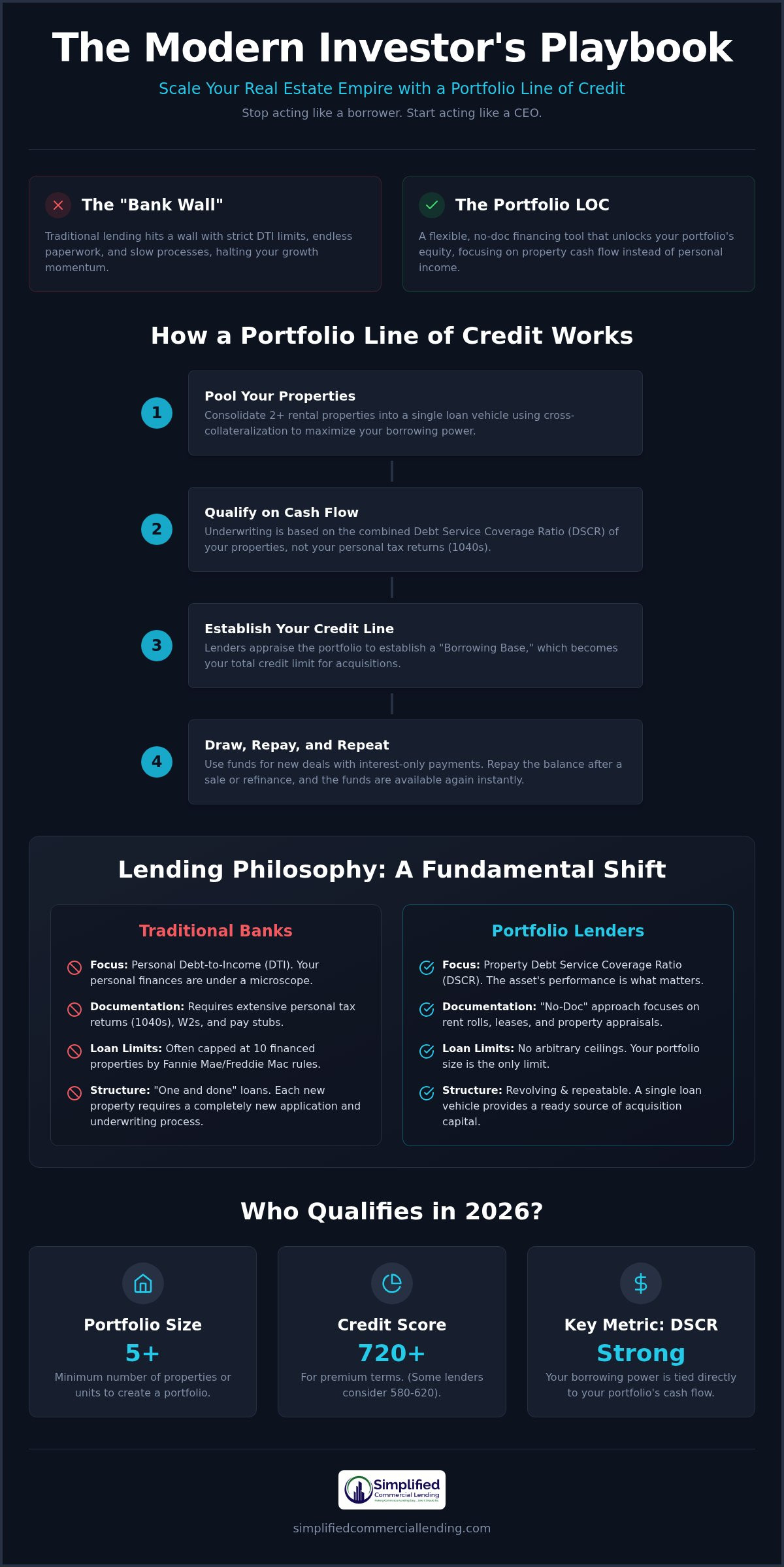
Traditional banks are obsessed with your Debt-to-Income (DTI) ratio. They want to know every detail of your personal life. Portfolio lenders work differently. We focus on how your properties perform. While Fannie Mae and Freddie Mac often cap you at 10 loans, a portfolio line removes those arbitrary ceilings. The “No-Doc” advantage is simple: documentation focuses on property leases and appraisals rather than personal 1040s. You’re judged on your business savvy, not just your tax returns.
Who Qualifies for a Portfolio LOC in 2026?
Who can actually get one of these in 2026? Most lenders look for a minimum property count, typically starting at five units or properties. You’ll also need a solid credit score to unlock the best non-bank rates. While some specialized lenders consider scores as low as 580 to 620 with a larger down payment, a score of 720 or higher is usually the ticket to premium terms.
Your borrowing power rests heavily on DSCR loan requirements. This ratio compares your property’s gross income to its debt obligations. If your rentals cash flow well, your credit line will reflect that strength. It’s a partnership where your assets do the heavy lifting for your future growth. You aren’t just a number on a spreadsheet; you’re an investor with a track record that deserves better than basic banking norms.
The Mechanics: How No-Doc Portfolio Lines of Credit Work
Understanding the inner workings of a portfolio line of credit for rentals is the first step toward masterfully leveraging your assets. Unlike a traditional mortgage that looks at one property in a vacuum, this vehicle uses cross-collateralization. This means every property in your pool acts as security for the entire line. By grouping your rentals, you create a powerhouse of equity that allows for a higher maximum Loan-to-Value (LTV) across the board. It’s a strategic move that turns a collection of individual houses into a unified financial engine.
During the draw period, most investors opt for interest-only payment structures. This is a deliberate choice to maximize monthly cash flow, keeping your capital liquid for the next down payment or renovation project. To set this up, a lender establishes a baseline “Borrowing Base” by conducting appraisals for the entire portfolio. This baseline serves as your credit limit, giving you a clear picture of exactly how much capital you can deploy at a moment’s notice.
Underwriting Without Tax Returns
Traditional banks demand tax returns because they’re stuck in a legacy mindset. They want to see your personal income, your grocery bills, and your debt-to-income ratio. We believe that’s irrelevant. If your properties generate sufficient net operating income, they should stand on their own. In 2026, modern underwriting centers on the Debt Service Coverage Ratio (DSCR) of the combined properties.
To move fast, you need to keep your records tight. A clean rent roll and professional property management reports are your best friends here. When you swap tax returns for asset performance data, the speed-to-close accelerates. You can often cut weeks off the traditional bank cycle, allowing you to close deals while your competitors are still waiting for a loan officer to call them back. If you want to see how your current portfolio stacks up, you can connect with our team for a quick review.
Understanding the Borrowing Base
Your borrowing base is the lifeblood of your scaling strategy. Lenders typically calculate your maximum draw as a percentage of the total portfolio value, often ranging between 70% and 75% in current market conditions. The mix of your properties matters. A portfolio heavy on single-family homes might have different leverage points than one focused on larger units.
Strategically integrating multi family residential investment loans into your broader portfolio can significantly boost your borrowing base. Multi-family assets often provide the stable, high-volume cash flow that lenders love to see when expanding a portfolio line of credit for rentals. By treating your real estate holdings as a single business entity, you gain the flexibility to draw funds, acquire new assets, and repeat the process indefinitely.
Portfolio LOC vs. Cash-Out Refinance: Which is Better for Scaling?
Choosing between a cash-out refinance and a portfolio line of credit for rentals is a decision that defines your growth trajectory. Most investors start with the traditional cash-out refinance. It is a “one and done” event. You pull out a lump sum of equity, pay your closing costs, and the transaction is over. If a new deal appears six months later, you’re forced to start from scratch. A portfolio line of credit works differently. It functions as a repeatable tool for growth that stays open, allowing you to cycle capital through multiple acquisitions without the constant friction of new loan applications.
Consider the math behind your closing costs. Refinancing ten individual properties means paying ten separate sets of origination fees, appraisal costs, and title charges. This administrative weight can kill your margins. With a portfolio line, you pay a one-time fee to establish a facility for the entire pool. It’s a massive reduction in overhead. You also gain unmatched flexibility; you only pay interest on the funds you actually draw. If you have a $1 million line but only use $200,000 for a renovation, you aren’t charged for the remaining $800,000. This eliminates the “unused cash” problem where investors pay interest on money sitting idle in a bank account.
Speed of execution is the final differentiator. In a market where the best deals disappear in hours, having immediate access to capital is a superpower. Sellers prioritize buyers who can show proof of liquid funds. An active credit line proves you are ready to close immediately, giving you a significant edge over competitors who are still waiting on a bank’s slow approval process. For a deeper look at the exact strategies involved, our step-by-step guide on how to tap equity from rental portfolio assets walks you through unlocking $100k or more in capital without the bureaucratic nightmare.
When to Choose a Cash-Out Refi
There are specific scenarios where a traditional refinance is the right move. If you have a single, high-value asset and desire long-term, fixed-rate stability, a refinance offers peace of mind. It’s the ideal choice for investors who don’t plan on buying more properties soon and want to lock in a rate for 30 years. For those focused on individual property strategies, our guide on single family residential investment loans provides a deep dive into these individual refi tactics.
When the Portfolio Line of Credit Wins
For the “BRRRR” investor, this is the ultimate secret weapon. It allows you to fund renovations, pull your equity back out, and immediately redeploy it into your next deal. It’s also the perfect vehicle for consolidating several smaller, high-interest loans into one streamlined facility. This simplifies your monthly bookkeeping and keeps your focus on finding new opportunities rather than managing a dozen different lenders. You’re building a system, not just a collection of houses. This approach turns your portfolio line of credit for rentals into a single, liquid business entity ready for rapid expansion. If you’re comparing your options, our rental property equity line of credit comparison guide breaks down the key differences between products available in the 2026 market so you can choose the right structure for your goals.
Selection Criteria: Choosing the Right Portfolio Lender
Finding the right portfolio line of credit for rentals requires looking past the glossy marketing. You need a partner that understands the velocity of real estate investment. Start by prioritizing “Non-Bank” lenders. Unlike traditional banks that rely on retail deposits and rigid federal regulations, non-bank lenders specialize in asset-based lending. They’re more interested in the cash flow of your properties than the balance of your personal savings account. This fundamental difference in perspective is what allows for the flexibility you need to scale.
Be skeptical of “No-Doc” claims until you verify them. Some lenders use this as a buzzword but still quietly ask for two years of 1040s halfway through the process. A true no-doc lender focuses exclusively on property-level data. You should also look for “Release Clauses” in your contract. These clauses are vital because they allow you to sell a single property from the pool without the lender calling the entire line of credit due. Without this, your portfolio is essentially locked, which defeats the purpose of having a flexible growth tool.
Structure matters just as much as the rate. Evaluate the draw period against the repayment period. A common setup in 2026 involves a 5-year draw period followed by a 20-year term. This gives you five years to use the credit like an ATM for new acquisitions before the loan transitions into a predictable amortizing phase. If you’re ready to see how a professional team handles these complex structures, you can apply for a portfolio line today to get started.
Key Terms to Negotiate
Don’t just accept the first term sheet you receive. Focus your negotiation on these three areas:
- Unused line fees: Some lenders charge a small percentage on the portion of the credit limit you aren’t using. Ensure this fee is minimal so you aren’t penalized for having “dry powder” ready.
- LTV (Loan-to-Value) caps: Aim for lenders offering 70% to 75% of the portfolio value. While some might push for 80%, 75% is the current 2026 industry standard for maintaining a healthy safety margin.
- Prepayment penalties: You want the ability to pay down the line whenever you have excess cash without being hit by fees.
The Application Checklist
Since these are commercial products, the documentation is different than a personal mortgage. Most portfolio lines require you to hold the properties in an entity, such as an LLC or Corporation. To keep the process moving fast, have these items ready:
- Current rent rolls for every property you intend to include in the pool.
- Full entity documents, including your Operating Agreement and EIN.
- Insurance declaration sheets and recent property tax records to verify carrying costs.
By focusing on these criteria, you ensure that your lender is an ally in your expansion rather than a bottleneck in your business plan.
Scaling Your Real Estate Empire with Simplified Commercial Lending
Scaling a portfolio requires more than just ambition. It requires a lender that doesn’t flinch when you present a complex, multi-property strategy. At Simplified Commercial Lending, we’ve built our reputation by cutting through the bureaucratic red tape that stops most investors in their tracks. We don’t see your portfolio as a liability; we see it as a powerful engine for growth. Our process is designed for speed and transparency, ensuring you have the capital you need exactly when you need it.
We provide national service coverage across the United States. Whether you’re acquiring single-family rentals or multi-family units anywhere in the nation, we have the reach to support your expansion. We don’t just find you a loan. We act as your expert guide to structure a portfolio line of credit for rentals that fits your specific long-term goals. We value pragmatism over protocol, focusing on your success as an independent entrepreneur rather than checking boxes for a traditional bank committee.
The Simplified Advantage
Traditional brokers often struggle to look beyond the local bank down the street. We provide direct access to non-bank capital sources that understand the nuances of the 2026 market. Our deep expertise in the commercial property loan market allows us to offer solutions that traditional institutions simply can’t match. You won’t deal with personal DTI headaches or arbitrary loan caps that penalize you for being successful. We prioritize property performance, meaning no tax returns are required to prove your worth.
Ready to Unlock Your Equity?
Your journey to a more liquid portfolio starts with a simple conversation. We believe in providing value before asking for a commitment. You can receive a preliminary quote for your portfolio line of credit for rentals without a hard credit pull, protecting your score while you explore your options. Once we establish your borrowing base, our streamlined workflow moves you from application to your first draw with incredible efficiency. We know that in real estate, time isn’t just money; it’s opportunity.
Don’t let rigid banking norms hold your empire back. It’s time to leverage your assets and move with the confidence of a cash buyer. Get a custom quote for your portfolio today and see how easy scaling can be when you have the right ally in your corner.
Take Control of Your Growth Strategy
Scaling your rental empire shouldn’t feel like a battle against your own bank. You’ve seen how a portfolio line of credit for rentals transforms dormant equity into a repeatable, high-speed acquisition tool. By shifting the focus from your personal tax returns to the cash flow of your assets, you eliminate the friction that stalls most investors. You aren’t just getting a loan; you’re building a liquid foundation for your business.
Simplified Commercial Lending is here to help you bypass the status quo. Our process requires no tax returns and delivers closing times 3x faster than traditional banks. With national service coverage, we provide the expert guidance needed to structure a strategy that actually works for your goals. Stop waiting for a loan officer to understand your vision and start moving with the speed of a cash buyer.
Ready to see what your equity can do? Scale your portfolio faster with a No-Doc Line of Credit from Simplified Commercial Lending. Your next acquisition is waiting, and we’re ready to help you fund it.
Frequently Asked Questions
Can I get a portfolio line of credit on just two properties?
Most lenders require a minimum of five properties or units to establish a portfolio line of credit for rentals. While some boutique firms might review a pool of three high-value assets, the industry standard focuses on larger pools to ensure a stable income stream. Reaching the five-property threshold typically unlocks more competitive terms and higher credit limits. This diversification protects both the lender and your capital access from single-unit vacancies.
Do I need to provide tax returns for a portfolio line of credit?
No, you don’t need to provide personal tax returns for a true no-doc portfolio line. The underwriting process focuses entirely on the performance of the properties and their ability to generate net operating income. This allows self-employed investors or those with complex tax situations to qualify based on their business results rather than their personal 1040s. It is a pragmatic approach built for the modern entrepreneur.
What is the typical interest rate for a rental portfolio LOC in 2026?
In the August 2026 market, interest rates for portfolio lines typically range between 6.5% and 9%. Investment-specific lines often sit at 7.5% or higher depending on your credit score and the combined leverage of your properties. These rates reflect the flexibility and speed of the product. They’re slightly higher than conventional mortgages but offer far more utility for active scaling and immediate capital deployment.
Can I use a portfolio line of credit for short-term rentals or Airbnbs?
Yes, you can absolutely include short-term rentals and Airbnbs in your credit facility. Lenders use specialized market data and revenue projection tools to establish cash flow viability. They often apply a “haircut” of 75% to 80% to these projections to account for seasonal fluctuations and higher management costs. This makes it a perfect tool for investors who specialize in the hospitality niche and need quick capital for new acquisitions.
What is a ‘release clause’ in a portfolio loan?
A release clause is a critical contractual feature that allows you to remove or sell a single property from the pool without paying off the entire line. Without this clause, your entire portfolio is stuck together until the loan is fully settled. It provides the essential flexibility needed to prune your portfolio or trade up into larger assets without disrupting your main source of acquisition capital or trigger a full refinance.
How does the lender calculate the DSCR for an entire portfolio?
Lenders calculate the Debt Service Coverage Ratio (DSCR) by dividing the combined gross monthly rent of all properties in the pool by the total monthly debt obligations. This includes principal, interest, taxes, insurance, and association fees. Most lenders look for a ratio of 1.20 or higher. This ensures the portfolio line of credit for rentals is supported by assets that pay for themselves and generate surplus cash flow.
Is a portfolio line of credit better than a blanket loan?
A portfolio line of credit is generally better for growth because it is revolving. A blanket loan is often a fixed-term mortgage that covers multiple properties in a single transaction. While both consolidate debt, the line of credit allows you to draw, repay, and redraw funds as needed. It provides a permanent source of liquid capital for new deals that a standard, “closed-end” blanket loan cannot match. For a side-by-side breakdown of how these products compare, our rental property equity line of credit investor comparison guide offers a detailed analysis of each option available in today’s market.
Do I have to hold the properties in an LLC to qualify?
Yes, holding your properties in an LLC or Corporation is a standard requirement for these commercial products. Since these lines are designed for business use rather than personal housing, lenders require a professional entity structure. This also provides an added layer of liability protection for your investment activities. If your properties are currently in your personal name, you’ll likely need to transfer them before the loan closes.