Your personal tax returns shouldn’t be the ceiling for your real estate empire. Most independent investors hit a wall when traditional banks start obsessing over debt-to-income ratios instead of the actual profit potential of an apartment building. It’s frustrating to lose a deal in a competitive market because a loan officer can’t interpret a complex tax return. This is why more savvy investors are turning to multi family residential investment loans that prioritize the asset over the individual.
We agree that the old way of lending is broken for anyone trying to build real wealth. This guide shows you how to bypass those hurdles and scale your portfolio using asset-based loans that don’t require personal tax returns. You’ll learn how to secure high-leverage financing by focusing on property cash flow rather than your personal income history. We’re breaking down the shift toward DSCR-based underwriting and showing you how a streamlined, digital-first approach gets you to the closing table before your competitors even get a callback.
Key Takeaways
- Learn how to bypass traditional bank denials by shifting to asset-based underwriting that focuses on property cash flow.
- Understand the critical differences in multi family residential investment loans when crossing the five-unit threshold into commercial territory.
- Master the Debt Service Coverage Ratio (DSCR) to prove your property’s income can support its own debt.
- Discover how to use portfolio lines of credit to unlock equity across multiple properties without selling assets.
- Follow a streamlined, no-doc qualification process that uses pro-forma rental income to get you to the closing table faster.
The Bureaucratic Bottleneck: Why Traditional Multifamily Lending Fails Investors
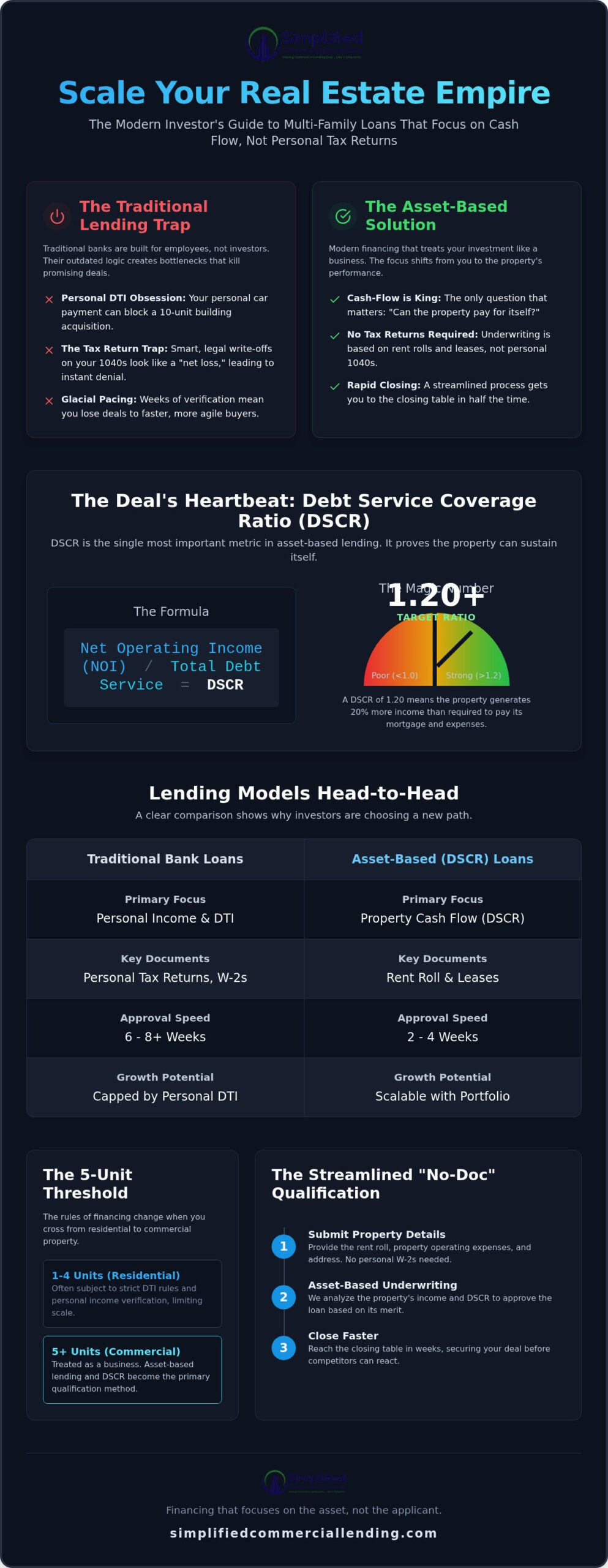
Traditional banks are built on a foundation of outdated logic. They want to see a stable W-2 and a predictable paycheck. But you’re an investor, not an employee. When you apply for multi family residential investment loans at a big-box bank, they treat you like a risk instead of a partner. They focus on your personal debt instead of the potential equity and cash flow sitting right in front of them. It’s a system designed for homeowners, not wealth builders.
The 2026 market doesn’t wait for a committee to meet next Tuesday. Volatility is high, and the best deals are gone in days. If your lender takes six weeks to verify your 2023 tax filings, you’ve already lost the property to a more agile buyer. You need a financing partner that moves at the speed of your business, not at the pace of a local branch manager’s lunch break.
Many new investors get caught in the house hacking trap. They think an FHA loan is the ultimate shortcut to a portfolio. While government-backed loans are fine for your very first duplex, they aren’t built for serious scaling. They come with residency requirements and strict unit limits that cap your growth. If you want to own fifty units, you can’t rely on products designed for people who only want to own one.
The Problem with Personal DTI in Multifamily Deals
Debt-to-Income (DTI) ratios are a relic of consumer lending. Why should your personal car payment or a student loan prevent you from acquiring a 10-unit building? In the world of multi family residential investment loans, the asset should stand on its own merit. Modern investors are shifting toward asset-based lending because it decouples personal lifestyle choices from business expansion. It’s about the property’s performance, not your personal balance sheet. If the building pays for itself and then some, your personal DTI should be irrelevant.
The Tax Return Trap for Entrepreneurs
Smart entrepreneurs use every legal tax write-off available. It’s good business. However, it’s a total loan killer at a traditional bank. When your tax returns show a net loss due to depreciation and expenses, a bank sees an unqualified borrower. They don’t understand that “paper losses” don’t equal a lack of cash. Asset-based lending uses logic instead of rigid boxes. Simplified Commercial Lending bypasses tax return requirements by focusing exclusively on the property’s Debt Service Coverage Ratio (DSCR) and overall cash flow.
Understanding Asset-Based Multifamily Loans: Cash Flow Over Credit
Asset-based lending flips the script on traditional financing. Instead of dissecting your personal paycheck, lenders look at one thing: can the property pay for itself? An asset-based loan is a financing structure where the property’s rental income is the primary source for covering the mortgage, taxes, insurance, and association fees. It treats your real estate as a self-sustaining business entity. This approach is the cornerstone of multi family residential investment loans in 2026, allowing you to bypass the invasive scrutiny of your personal life.
The speed advantage here is massive. By removing the need for personal income verification and years of tax transcripts, the underwriting process moves at a sprint. You can often close in half the time it takes a traditional bank to even issue a pre-approval. These loans also frequently offer “non-recourse” or “limited-recourse” structures. This means that if the deal goes south, the lender’s primary recovery is the property itself, not your personal home or your children’s college fund. It’s a cleaner, safer way to grow.
How DSCR is Calculated for Apartment Buildings
The Debt Service Coverage Ratio (DSCR) is the pulse of your deal. To find it, take your Net Operating Income (NOI) and divide it by your Total Debt Service (your annual principal and interest payments). In the current market, a 1.20 DSCR is often the magic number. This means the property generates 20% more income than is required to pay the mortgage. If your ratio is tight, you can improve it before applying by increasing rents to market rates, reducing utility waste, or appealing property tax assessments to boost your NOI.
Asset-Based vs. Traditional Mortgages
The documentation gap between these two worlds is night and day. A traditional lender demands 1040s, W-2s, and exhaustive profit and loss statements for every business you own. Asset-based underwriting focuses on lease agreements, rent rolls, and the property’s historical performance. It’s a shift from “Who are you?” to “What is this property worth?” This logic applies whether you are looking at large buildings or smaller units. If you are just starting with smaller properties, you might want to review our guide on Single Family Residential Investment Loans: The 2026 Investor Guide to Scaling to see how these principles apply across different asset classes.
Ready to see how your property stacks up? You can explore our streamlined funding options to get a clear picture of your borrowing power without the tax return headache.
The 5-Unit Threshold: Residential vs. Commercial Multifamily Loans
The fifth unit changes everything. In the eyes of a traditional lender, a four-unit property is just a large house. Once you hit five units, you’ve officially entered the world of commercial real estate. This distinction is the most important pivot point in your career as an investor. Why? Because the rules for multi family residential investment loans shift from personal comparisons to business performance. You’re no longer just buying a building; you’re acquiring an income stream.
The appraisal process highlights this divide perfectly. Residential appraisals (1-4 units) rely almost entirely on “comparable sales.” The value of your duplex depends on what the duplex down the street sold for last month. Commercial appraisals (5+ units) are driven by the income approach. If you increase the Net Operating Income (NOI) through better management or higher rents, you increase the property value immediately. You don’t have to wait for the neighbors to sell. This gives you direct control over your equity growth.
Larger buildings also offer a built-in safety net against vacancy risks. If you lose one tenant in a duplex, you’ve lost 50% of your income. That’s a crisis. If you lose one tenant in a ten-unit building, you’re still 90% occupied. This stability is exactly why non-bank lenders are often more comfortable with larger assets. They see the diversified income as a lower risk, which can lead to more favorable terms for seasoned investors. For a comprehensive overview of how non-bank financing works across asset types, our commercial property loan guide to financing your investment in 2026 covers the full landscape of flexible lending options available to today’s investors.
Financing 5+ Unit Apartment Buildings
When you step into the 5+ unit arena, the paperwork changes from personal to professional. Lenders will ask for a Trailing 12-month (T-12) profit and loss statement and a current rent roll. They want to see how the machine has been running under the current owner. Having a professional property management plan is often a requirement here, but it’s also a major benefit. Many commercial products offer flexible interest-only periods. These allow you to maximize your monthly cash flow during the early years of ownership while you implement your value-add strategy. For a deeper breakdown of how these programs work, our 2026 investor guide to financing for 5+ unit apartment buildings walks through every step of the commercial underwriting process.
The Strategic Advantage of Commercial Multifamily
Stop thinking about your properties as isolated silos. Commercial financing allows you to look at your growth holistically. You can use Blanket Loans to wrap multiple buildings into a single financing structure, simplifying your life and potentially lowering your overall costs. Transitioning from single-family rentals to multi family residential investment loans for larger buildings is how you stop “buying a job” and start building a scalable business. It’s the ultimate move for investors who are tired of the 1-4 unit grind and want to see real momentum in their portfolio.
How to Qualify for a No-Doc Multifamily Loan in 2026
Qualification in the non-bank world is a breath of fresh air. It’s about the health of the asset and your track record as an investor, not the size of your last paycheck. If you’ve been denied by a bank because your tax returns show too much depreciation, you’re looking in the wrong place for multi family residential investment loans. Underwriting in this space is designed to empower the entrepreneur, not the bureaucrat. Here is how you actually qualify in 2026.
First, you must verify the property’s current and pro-forma rental income. Lenders want to see what the building earns now and what it could earn with better management. Second, keep your credit score competitive. While you don’t need a perfect 800, a score of 660 or higher usually unlocks the best rates. Third, prepare a clean rent roll and a T-12 expense statement. This “Trailing 12” shows exactly how much it costs to keep the lights on and the units filled. Finally, partner with a broker who understands the non-bank landscape. They know which lenders value cash flow when underwriting multi family residential investment loans over personal tax transcripts.
The “No-Doc” Documentation Checklist
Don’t let the term “no-doc” fool you. It doesn’t mean no paperwork. It means no personal income paperwork. You’ll still need to provide your LLC formation documents, a signed purchase contract, and high-quality property photos. Lenders will also require a professional appraisal and an environmental report to protect their investment. Simplified Commercial Lending streamlines this process by focusing only on the documents that actually matter for the deal. You can get started with a multifamily loan quote today to see our simplified checklist in action.
Managing Down Payments and Liquidity
In 2026, expect LTV (Loan-to-Value) ratios to range between 70% and 80% for most multifamily deals. Lenders aren’t looking at your monthly salary to cover the gap. They are looking at your “reserves.” This is the cash or liquid assets you have on hand to handle unexpected repairs or temporary vacancies. If you’re short on cash but high on equity, you can leverage equity from other properties in your portfolio to cover your down payment. It’s about using your existing success to fuel your next acquisition. One of the most effective strategies for accessing that trapped equity is executing a multi family cash out refinance, which allows you to pull capital from your existing buildings without selling them.
Strategic Scaling: Using Portfolio Lines of Credit for Multifamily Growth
Stop treating every building like a separate silo. If you want to scale, you must look at your entire portfolio as a single, powerful engine. Most investors get stuck because they finance each acquisition individually. This creates a management nightmare and leaves valuable equity trapped in separate buckets. By shifting to a portfolio view, you leverage the collective strength of your assets to fuel rapid growth. This is where multi family residential investment loans transition from simple purchase tools into a comprehensive wealth strategy.
A portfolio line of credit is your most effective tool for tapping equity without selling assets. Why sell a cash-flowing building and pay capital gains taxes just to get a down payment for the next one? Instead, use a revolving line of credit secured by your existing buildings. It gives you immediate access to capital whenever a new deal hits the market. This flexibility is critical for the BRRRR (Buy, Renovate, Rent, Refinance, Repeat) method at scale. You buy a value-add multifamily building, improve the units, increase the NOI, and then refinance the debt to pull your initial capital back out. It’s a cycle of growth that doesn’t require constant infusions of your own cash.
Unlocking Equity Without Tax Returns
How do you jump from 10 units to 100? You stop letting tax returns dictate your liquidity. A portfolio line of credit focuses on the aggregate performance of your properties rather than your personal income history. This strategy often results in a single, streamlined monthly payment for multiple buildings, which slashes your administrative overhead significantly. This is the secret weapon for investors who need to move fast. You can use the equity in your current multi family residential investment loans to fund your next acquisition’s down payment instantly, or deploy a multi family cash out refinance to unlock that equity without personal income verification. It’s about keeping your momentum alive without the friction of traditional bank reappraisals for every minor move you make.
Your Next Move in Multifamily Investing
The 2026 market rewards the decisive. Don’t let a bank’s “no” or their obsession with your personal debt-to-income ratio stop your progress. Certainty of execution is the most valuable currency you have when negotiating with sellers in a tight market. When you have a financing partner that understands asset-based reality, you make offers with total confidence. Simplified Commercial Lending acts as your navigator through the bottlenecks of traditional finance, providing the speed and flexibility you need to dominate your local market. See how our no-doc multifamily loans can fund your next deal.
Take Command of Your Multifamily Growth
The days of begging traditional banks for approval are over. You’ve seen how asset-based lending shifts the focus from your personal tax returns to the actual cash flow of the property. By mastering the 5-unit threshold and utilizing DSCR-based underwriting, you can bypass the bureaucratic delays that kill deals. Securing multi family residential investment loans shouldn’t feel like an interrogation; it should feel like a strategic partnership.
Remember that your next move depends on certainty of execution. Focus on property performance, scale beyond unit limits, and use portfolio lines of credit to keep your equity liquid. As national lending experts for 5+ unit buildings, we help you unlock the value you’ve already built. Don’t let rigid institutional norms cap your potential. Scale your portfolio today with Simplified Commercial Lending and experience a faster, smarter way to fund your real estate empire. Your 100-unit goal is closer than you think.
Frequently Asked Questions
What is the minimum unit count for a commercial multifamily loan?
The industry standard for commercial multifamily financing starts at 5 units. Properties with 1 to 4 units are classified as residential and follow different underwriting rules. Once you reach that fifth unit, lenders switch to an income-based valuation model. This shift allows you to qualify based on the building’s profit potential rather than just comparable neighborhood sales.
Can I get a multifamily investment loan without showing my personal tax returns?
Yes, you can secure multi family residential investment loans without providing personal tax returns by choosing an asset-based lender. These programs focus on the property’s Debt Service Coverage Ratio (DSCR) instead of your personal W-2 income. This approach is ideal for entrepreneurs who use legal tax deductions that might make their personal income appear lower than it actually is.
What is a good DSCR ratio for a multifamily property in 2026?
A DSCR of 1.20 or higher is generally considered the benchmark for a healthy multifamily deal in the current market. This means the property’s net operating income is 20% higher than its annual mortgage payments. Some specialized lenders may consider ratios as low as 1.10 or 1.15 if the property is in a high-demand area or has significant upside potential.
How much down payment is required for a 5+ unit apartment building?
Most non-bank lenders require a down payment between 20% and 30% for properties with 5 or more units. This corresponds to a Loan-to-Value (LTV) ratio of 70% to 80%. While some government programs offer lower down payments, they often come with invasive documentation and residency requirements that asset-based loans successfully avoid.
Do multi-family residential investment loans cover renovations?
Many asset-based lending structures allow you to include renovation costs or provide a bridge to a long-term exit. These multi family residential investment loans are designed for value-add investors who plan to upgrade units and increase the property’s Net Operating Income. It’s a powerful way to execute the BRRRR method on a larger scale without waiting for a traditional bank’s slow approval process.
What is the difference between an FHA multifamily loan and an asset-based loan?
FHA loans are government-backed products that require you to live in one of the units and provide extensive personal financial history. Asset-based loans are built specifically for pure investors and don’t require owner-occupancy. They prioritize the property’s cash flow over your personal debt-to-income ratio, making them the superior choice for scaling a professional portfolio.
How long does it take to close a no-doc commercial multifamily loan?
You can typically expect to close an asset-based multifamily loan in 30 to 45 days. Because these programs skip the exhaustive review of your personal tax transcripts, the underwriting process is significantly faster than at a traditional bank. This speed gives you a competitive edge when you need to provide a certain closing date to a motivated seller.
Are these loans available for short-term rentals or Airbnbs with 5+ units?
Yes, short term rental financing is available for larger multifamily properties being used as Airbnbs or vacation rentals. Lenders will evaluate the property based on its historical or projected short-term rental income rather than traditional long-term leases. It’s an excellent way to fund high-yield hospitality projects while using the same streamlined, no-doc underwriting process.