Why should a profitable street-level retail space with upstairs apartments get rejected just because a conventional loan committee cannot figure out which box it fits into? If you’ve tried securing mixed use property loans through traditional institutions, you already know the frustration. Bank underwriters demand mountains of multi-year tax returns, calculate rigid personal debt-to-income ratios, and drag timelines out for months while prime investment deals slip away.
You shouldn’t have to jump through bureaucratic hoops when an asset generates strong, verifiable revenue. Smart capital doesn’t focus on your personal tax filings; it evaluates property cash flow and debt service coverage. In this guide, you’ll discover how to finance hybrid commercial and residential properties using modern, cash-flow-driven underwriting that bypasses conventional banking friction. We’ll break down the exact qualification criteria you need to know, explore flexible non-bank financing solutions, and show you how to secure capital nationwide to close your next purchase or cash-out refinance with speed.
Key Takeaways
- Learn how mixed use property loans evaluate combined residential and commercial spaces, letting in-place property cash flow carry the loan approval.
- Master the 51 percent square footage threshold that determines whether your hybrid building follows commercial or residential underwriting rules.
- Discover how debt service coverage ratios and non-bank capital replace cumbersome multi-year personal tax returns.
- Follow a clear qualification process to audit rent rolls, calculate net operating income, and present your asset effectively.
- Leverage nationwide non-bank financing networks to close acquisitions and cash-out refinances without institutional delays.
What Are Mixed Use Property Loans and How Do They Work?
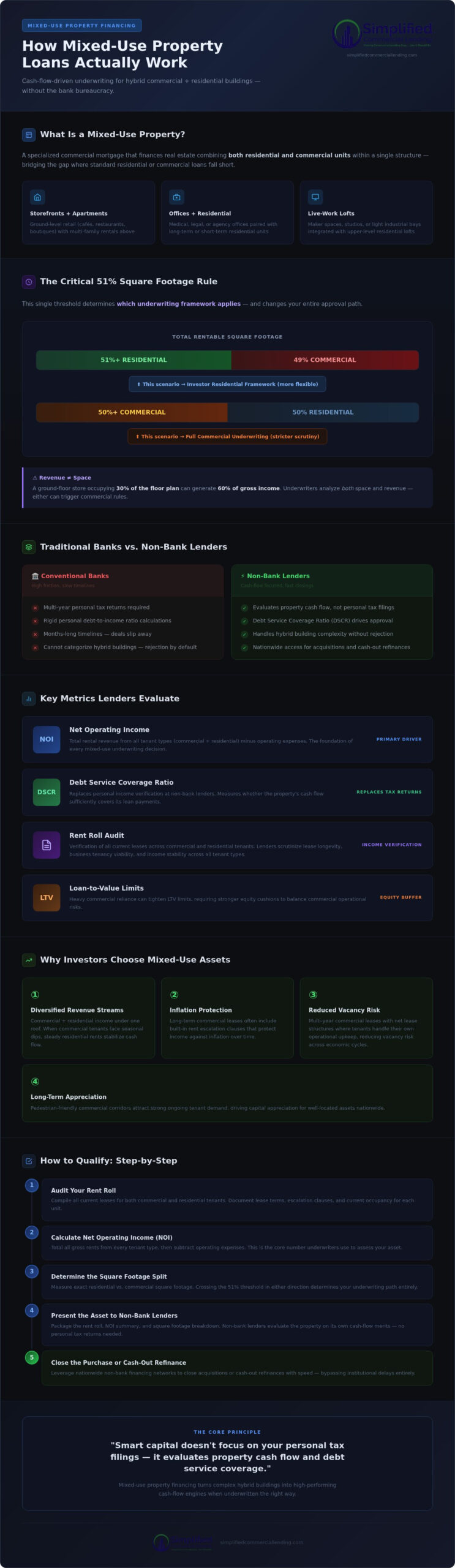
A mixed-use property loan is a specialized commercial mortgage designed to finance real estate that combines both residential and commercial units within a single physical structure. While pure residential mortgages back single-family rentals or small multifamily buildings, and standalone commercial real estate debt covers retail plazas or warehouses, mixed-use financing bridges the gap. These hybrid buildings blend tenant types under one roof, creating an asset profile that standard residential underwriters cannot process.
The concept of mixed-use development centers on maximizing urban utility. Investors favor these properties because blending commercial leases with residential apartments diversifies overall revenue. If a commercial retail tenant faces seasonal dips, steady residential rents keep cash flow stable. Conversely, long-term commercial leases often feature built-in rent escalations that protect against inflation, effectively reducing overall vacancy risk across changing economic cycles.
Common Mixed-Use Property Configurations
Mixed-use assets take several distinct physical forms across urban and suburban markets:
- Storefronts with Upper-Floor Apartments: Ground-level retail, such as coffee shops, restaurants, or boutiques, supporting multi-family rental units on the floors above.
- Professional Offices with Residential Units: First-floor spaces housing medical practices, legal firms, or creative agencies, paired with long-term or short-term residential rentals on secondary levels.
- Live-Work and Light Industrial Lofts: Ground-floor maker spaces, studio workshops, or light flex industrial bays integrated directly with upper-level residential lofts.
Key Advantages of Mixed-Use Real Estate Investments
Why do active investors seek out these hybrid assets? The core benefit lies in multi-layered income stability.
Commercial tenants typically sign multi-year leases, handling their own operational upkeep under net lease structures. Meanwhile, residential tenants provide consistent, monthly demand that adjusts quickly to market rent increases. This balance mitigates downside risk during market shifts. Additionally, pedestrian-friendly commercial corridors continue to attract strong tenant demand, driving long-term capital appreciation for well-located assets nationwide. Securing modern mixed use property loans allows investors to leverage these combined revenue streams efficiently, turning complex physical layouts into high-performing cash-flow engines.
How Lenders Underwrite Mixed Use Properties: Commercial vs. Residential Rules
Underwriting a hybrid building is far more technical than reviewing a standard rental duplex or an office warehouse. Lenders can’t look at one single asset class, so they dissect the property by its operational footprint and income streams. When applying for mixed use property loans, the very first metric underwriters assess is physical square footage.
The dividing line sits at the 51 percent rule. If at least 51 percent of the total rentable area serves residential use, some non-bank lenders evaluate the deal under investor residential frameworks. The moment commercial usage reaches 50 percent or higher, the entire deal shifts under strict commercial underwriting. To explore full guidelines on commercial classifications, check out our Commercial Property Loan Guide: How to Finance Your Investment in 2026.
Square Footage and Revenue Allocation Benchmarks
Physical space and incoming revenue don’t always match. A ground-floor convenience store might take up 30 percent of the building’s floor plan but generate 60 percent of the gross income. Underwriters review both metrics closely:
- Predominantly Residential (51%+ Square Footage): Lenders often offer more flexible leverage allowances and streamlined review structures when apartments dominate the asset.
- Commercial Dominant (50%+ Commercial Area or Revenue): The asset triggers full commercial scrutiny, shifting focus to business tenancy viability, lease longevity, and broader debt-yield metrics.
- Leverage Impact: Heavy commercial reliance can tighten loan-to-value limits, requiring stronger equity cushions to balance commercial operational risks.
Evaluating the Rent Roll Across Diverse Tenants
Next comes the calculation of Net Operating Income (NOI) and the Debt Service Coverage Ratio (DSCR). Underwriters look at the blend of leases making up the rent roll. Residential units typically feature one-year leases with standard tenant turnover, while commercial units feature multi-year leases, often structured as triple-net agreements where tenants pay taxes, insurance, and maintenance directly.
Lenders scrutinize the financial health of commercial tenants, reviewing business longevity and payment history. They also apply distinct vacancy factors to each side of the building, often assigning an automatic 5 to 10 percent vacancy rate to residential spaces while underwriting commercial vacancy based on submarket retail or office data.
Once expenses and vacancy deductions are applied, the remaining NOI must cover the proposed debt service, typically requiring a DSCR of 1.20 or higher. If you want to see how your property’s net income stacks up against modern financing standards, the team at Simplified Commercial Lending can help you evaluate your numbers without institutional friction.
Financing Options for Mixed Use Buildings: Comparing Capital Sources
Different capital sources evaluate hybrid buildings through completely different lenses. Choosing the right partner determines whether you close in weeks or stay trapped in underwriting limbo for months. While government programs like SBA loans assist business owners occupying their commercial units, real estate investors rely on distinct private and non-bank capital channels to secure mixed use property loans.
Traditional Banks vs. Non-Bank Commercial Lenders
Conventional banks prioritize full-documentation depository relationships. They scrutinize multi-year personal tax returns, global cash flows, and personal debt-to-income ratios. If you run a tax-efficient business with heavy paper write-offs, traditional banks will likely decline your file.
Non-bank alternative lenders take a practical approach. They bypass tax-return roadblocks, moving fast so you don’t lose time-sensitive acquisitions. Because these lenders accommodate complex LLCs and holding companies, they provide clear paths forward where bureaucratic institutions see dead ends.
DSCR and Asset-Based Mixed Use Mortgages
Asset-based Debt Service Coverage Ratio financing represents the modern standard for stabilized hybrid properties. Underwriters focus on the property’s gross rental income versus its principal, interest, taxes, and insurance. They don’t dig into personal tax transcripts or W-2 forms.
This structure protects your personal financial privacy and eliminates friction during closing. Read our detailed breakdown of DSCR Loan Requirements: 2026 Portfolio Scaling Guide to see how cash-flow-driven underwriting accelerates portfolio growth.
Portfolio Lines of Credit for Multi-Property Investors
Scaling beyond your first few properties requires liquidity. Portfolio Lines of Credit allow investors to leverage equity across multiple residential or commercial properties into a single, flexible credit facility.
Instead of completing a separate underwriting process for each transaction, a cross-collateralized credit line gives you ready-to-deploy capital. You can draw funds to purchase new mixed-use assets, handle value-add tenant renovations, or act decisively when discounted properties hit the market nationwide.
Step-by-Step Guide: How to Qualify for a Mixed Use Loan
Qualifying for mixed use property loans doesn’t require jumping through standard bank hurdles if you follow a practical roadmap. When you focus on asset fundamentals rather than personal tax filings, the approval process becomes straightforward.
Here is how experienced investors move from property evaluation to closing:
- Step 1: Document Property Financials: Gather current rent rolls, lease agreements, and trailing twelve-month operating statements.
- Step 2: Calculate Debt Service Coverage: Verify that net operating income comfortably satisfies target debt service ratios.
- Step 3: Partner with a Commercial Mortgage Broker: Work with an agile financing broker to match your property with non-bank debt solutions tailored to hybrid buildings.
- Step 4: Complete Valuation Due Diligence: Navigate hybrid commercial appraisals and environmental screenings smoothly.
If your property tilts heavily toward residential units, compare this roadmap with our guide to Multi-Family Residential Investment Loans: The 2026 Guide to Non-Bank Financing.
Preparing the Property Documentation Package
Start by organizing all signed agreements. Commercial leases need to detail base rent, renewal schedules, and expense allocations, while residential agreements confirm security deposits and monthly terms.
Next, assemble trailing twelve-month profit-and-loss records, local property tax assessments, and utility histories. Underwriters will also verify certificates of occupancy and municipal zoning compliance for each space. Including capital expenditure records shows that major mechanical systems, roofs, and parking facilities are properly maintained, speeding up underwriter approval.
Navigating Specialized Commercial Appraisals
Valuing a mixed building requires a certified general commercial appraiser. These professionals use a blended appraisal technique, combining the sales comparison approach for residential spaces with the income capitalization approach for retail or office suites.
You also need to prepare for environmental due diligence. If the commercial ground floor houses dry cleaners, auto service bays, or printing facilities, lenders generally commission a Phase I Environmental Site Assessment (ESA) to ensure no hazardous materials threaten the property’s value. Addressing physical records early prevents closing delays.
Ready to structure your next acquisition or refinance? Connect with Simplified Commercial Lending today to secure nationwide debt options designed around property performance.
Scaling Your Mixed Use Portfolio with Simplified Commercial Lending
Expanding your commercial footprint shouldn’t grind to a halt because a local bank balks at a blended rent roll. Simplified Commercial Lending operates as your dedicated nationwide commercial mortgage brokerage partner. We eliminate institutional roadblocks by focusing on property cash flow rather than personal tax returns. When building a portfolio of hybrid assets, you need an agile financing ally that understands how to maximize leverage across both commercial retail spaces and residential units.
Why Investors Choose Non-Bank Mortgage Brokerage
Why choose a specialized mortgage broker over a conventional bank branch? The answer comes down to capital options, speed, and underwriting flexibility.
- Access to Diverse Capital Channels: We connect borrowers directly to established debt funds, institutional non-bank programs, and flexible private lenders.
- Streamlined Deal Packaging: Experienced commercial debt specialists package your rent rolls and operating figures to highlight property strengths from day one.
- Tax-Efficient Underwriting: Our lenders evaluate property-level net operating income, allowing self-employed investors and business entities to secure mixed use property loans without disclosing personal tax returns.
Seamless Deal Structuring and Execution Nationwide
Real estate growth shouldn’t stop at state borders. Whether you’re acquiring a storefront with upper-floor lofts or refinancing an office building with residential suites, our national lending footprint covers your investments across all major domestic commercial markets.
We tailor Commercial Property Loans and flexible Portfolio Lines of Credit to match your business plan. Whether executing tenant improvements to boost commercial rents or stabilizing long-term residential leases, your capital structure should support your strategy rather than box you into rigid bank covenants. Our team moves quickly, eliminating bureaucratic delays so you never miss an acquisition window.
Stop letting depository banks dictate your portfolio’s growth rate. Partner with specialists who understand asset-based debt and close transactions with certainty. Submit your scenario to Simplified Commercial Lending today, and discover how fast mixed-use financing moves when cash flow takes center stage.
Take Control of Your Mixed-Use Debt Strategy
Financing a property that blends residential spaces with commercial utility shouldn’t feel like a compromise. You don’t have to settle for rigid institutional mandates, invasive personal tax reviews, or months of underwriting friction. By focusing on property-level performance and in-place debt service coverage, you can unlock capital that matches the true commercial value of your real estate.
Whether you’re acquiring storefront apartments or refinancing urban live-work spaces, securing modern mixed use property loans gives you the agility to expand on your terms. Simplified Commercial Lending provides a nationwide commercial lending platform designed specifically for active real estate investors. With expansive brokerage access to private capital, debt funds, and asset-based programs that close without requiring personal tax returns, we help you execute your acquisition or refinance without bureaucratic hurdles.
Your next investment opportunity is waiting. Connect with Simplified Commercial Lending to structure your mixed use loan today, and build your commercial footprint with confidence.
Frequently Asked Questions
What is considered a mixed use property for commercial financing?
A mixed-use property is a single building or parcel that combines commercial spaces, such as retail storefronts or professional offices, with residential dwelling units. In commercial financing, lenders evaluate the property as a unified asset, underwriting income streams from both commercial leases and residential tenants. The allocation of usable square footage determines whether the loan follows commercial or investor-residential underwriting guidelines.
Can I get a mixed use property loan without showing personal tax returns?
Yes, you can secure mixed use property loans through non-bank debt solutions and asset-based programs without showing personal tax returns. These programs evaluate the property’s gross rental cash flow against its mortgage debt, taxes, and insurance rather than your personal W-2 income or personal debt-to-income limits. This approach allows self-employed investors and holding entities to qualify based entirely on asset performance.
What debt service coverage ratio is typically required for mixed use buildings?
Most commercial lenders look for a Debt Service Coverage Ratio (DSCR) between 1.20 and 1.25 for mixed-use properties. This ratio ensures that the building’s net operating income exceeds annual loan payments by 20 to 25 percent, providing an adequate buffer against commercial tenant turnover and residential vacancies. Properties with established leases and strong occupancy easily meet these targets.
How does the residential-to-commercial ratio affect loan terms?
The physical square footage and revenue split dictate loan guidelines. When residential space makes up 51 percent or more of the property, lenders often provide higher leverage and more streamlined underwriting. If commercial space reaches 50 percent or higher, the asset triggers strict commercial underwriting rules, which focus heavily on commercial tenant creditworthiness, lease durations, and submarket retail trends.
What is the difference between bank and non-bank mixed use property loans?
Conventional banks require extensive multi-year personal tax returns, corporate financials, and strict global debt service calculations, often resulting in prolonged underwriting timelines. Non-bank lenders focus primarily on asset cash flow and debt service coverage. This structural difference allows non-bank providers to approve mixed use property loans faster, eliminate personal tax verification, and offer flexible terms tailored to independent real estate investors.
Are Phase I environmental assessments required for mixed use financing?
Phase I Environmental Site Assessments depend entirely on the operational history and nature of the commercial space. While residential spaces do not trigger them, lenders usually order an assessment if the ground-floor space contains or previously housed higher-risk commercial businesses like dry cleaners or auto repair shops. Standard retail boutiques, creative studios, and professional offices often qualify for lighter environmental questionnaires.
Can I use a portfolio line of credit to purchase mixed use properties?
Yes, investors frequently use a Portfolio Line of Credit to acquire or renovate mixed-use assets. By cross-collateralizing equity across multiple existing residential or commercial properties into a single facility, you gain immediate access to capital. This structure lets you move swiftly on new opportunities without undergoing a lengthy, standalone loan approval process for every single acquisition nationwide.