What if the biggest barrier to your real estate ambitions isn’t your bank balance, but the outdated playbook of traditional lenders? Most new investors assume that to build a rental portfolio from scratch, they must rely on massive personal savings and immaculate debt-to-income ratios. That single misconception stops promising portfolios dead in their tracks before door number two.
You’ve likely felt that exact frustration. Conventional underwriters comb through your personal tax returns, enforce rigid DTI caps, and freeze your progress after a single purchase. It leaves you wondering how to fund subsequent deals without exhausting your personal reserves or overpaying in competitive markets.
Here’s the reality: portfolio velocity depends on property cash-flow financing, not personal income limits. In this guide, you’ll discover how to acquire, finance, and scale your real estate investments from zero to a high-performing, cash-flowing rental portfolio. We map out the repeatable acquisition roadmap to evaluate profitable assets, secure debt based on property performance, and build long-term equity with confidence.
Key Takeaways
- Master the commercial framework required to build a rental portfolio from scratch by setting strict cash-on-cash and cash-flow underwriting targets before buying door number one.
- Uncover hidden inventory through multi-channel sourcing, avoiding bidding wars on retail listings and acquiring assets with built-in equity.
- Break past traditional banking bottlenecks by using cash-flow-driven financing that qualifies deals based on asset performance rather than personal W-2 income and tax returns.
- Execute a repeatable capital-recycling blueprint to force appreciation and roll initial funds continuously into your next acquisitions.
- Scale past ten units efficiently by consolidating standalone assets into portfolio credit facilities and blanket debt structures.
Laying the Groundwork to Build a Rental Portfolio from Scratch
Most novice investors buy a rental property the same way they purchase a primary home. They browse consumer listing sites, calculate a down payment from personal savings, and hope appreciation does the heavy lifting. That approach stalls quickly. To build a rental portfolio from scratch, you have to treat your acquisitions as an interconnected commercial enterprise from day one. Scale requires operational systems, defined financial metrics, and a corporate framework designed to attract institutional debt.
Defining Your Rental Investment Strategy and Target Metrics
Profitable portfolios run on math, not emotion. Master the core real estate investing fundamentals to filter out marginal deals before spending capital on inspections or appraisals. You need clear performance benchmarks for every target asset:
- Cash-on-Cash Return: Divide annual pre-tax cash flow by total invested cash. Aim for double-digit baseline returns to ensure your capital works efficiently.
- Net Operating Income (NOI) and Cap Rates: Measure gross income against operating expenses before debt service. This benchmarks the pure asset yield against other market opportunities.
- Monthly Net Cash Flow: Establish a firm minimum threshold per door after accounting for principal, interest, taxes, insurance, property management, vacancy, and capital expenditure reserves.
- Asset Strategy: Decide whether your balance sheet favors the consistent tenant stability of long-term single-family rentals or the active yield optimization of short-term rentals.
Establishing Your Real Estate Business Infrastructure
Do you want your personal assets exposed every time a tenant slips on a sidewalk? Of course not. Setting up proper infrastructure protects your wealth and positions your enterprise for seamless capital access.
Form a limited liability company (LLC) for your acquisitions. Holding title inside an entity ring-fences liabilities, keeping them isolated from your personal balance sheet. Dedicated entities also pave the way for non-bank commercial financing, as commercial lenders prefer lending to business entities rather than individuals.
Next, open dedicated commercial bank accounts. Co-mingling funds destroys corporate liability protection and complicates your accounting. Run all rental income, operational expenses, security deposits, and maintenance reserves through business accounts. Finally, assemble your core advisory bench: a real estate-focused CPA and an attorney who understand commercial asset protection. When you build a rental portfolio from scratch with institutional-grade habits, scaling from door one to door ten becomes a repeatable execution rather than a financial scramble.
How to Purchase Your First Rental Property: The Step-by-Step Blueprint
Buying deal number one sets the trajectory for everything that follows. Make an error here, and you burn capital that could have funded future acquisitions. To build a rental portfolio from scratch, you cannot rely on retail consumer tactics or compete in emotional bidding wars on public portals. Successful investors source off-market leads through wholesaler networks, direct outreach, and investor-savvy real estate agents who understand cap rates and rent-to-price ratios.
Analyzing Rental Deals with Conservative Underwriting
Deals look fantastic on paper when you omit necessary line items. Protect your downside by stress-testing every variable against real market conditions:
- Underwrite Property Management: Always budget 8% to 10% of gross rents for management fees. Even if you self-manage initially, omitting this cost gives you a false cash-flow signal and limits your ability to step away later.
- Separate CapEx from Maintenance: Routine repairs, like fixing a disposal, are standard operating expenses. Structural replacements, such as HVAC units and roof updates, require dedicated capital expenditure reserves. Review the IRS Publication 527 guidance on rental properties to understand how operating deductions and depreciation treatment impact your annual bottom line.
- Verify Market Rents: Never trust seller pro formas. Pull actual closed lease comps from local property management databases to confirm your revenue assumptions before submitting an offer.
Executing the Acquisition and Managing Onboarding
Once you locate an asset with strong projected numbers, structure your purchase contract with a rigorous inspection contingency. Uncovering hidden foundation defects, aging plumbing stacks, or deteriorating electrical panels gives you the leverage to renegotiate the purchase price or walk away with your earnest money intact.
After closing, focus immediately on tenant placement and risk mitigation. Screen prospective tenants systematically against objective standards for credit history, verified gross income, and clean background checks. A single bad placement can drain months of operating revenue through legal eviction fees and vacancy loss. Pair strict tenant vetting with specialized landlord insurance designed specifically for non-owner-occupied investment properties.
Securing the right leverage upfront simplifies this execution. While mainstream retail banks force you through personal financial interrogations, exploring dedicated single family residential investment loans lets you qualify based on the property’s projected rental yield. When you want to streamline your acquisition timeline, partnering with specialists at simplifiedcommerciallending.com keeps your capital moving without the traditional underwriting friction.
The Financing Dilemma: Traditional Bank Mortgages vs. Cash-Flow-Based Lending
You purchase your first two doors, utilize legitimate tax deductions, and suddenly your bank denies your next loan application. Why? Traditional underwriting is engineered for salaried homeowners, not growing real estate enterprises. If you want to build a rental portfolio from scratch, relying strictly on consumer retail banks guarantees an early dead end.
Why Traditional Bank Financing Stalls Growing Portfolios
Retail banks view real estate through personal debt-to-income (DTI) calculations. When your CPA maximizes depreciation, property write-offs, and operating expenses, your taxable income drops. That tax efficiency lowers your tax bill, but it makes you look undercapitalized to a conventional mortgage underwriter.
Institutional red tape creates another barrier. Under strict agency rules, the Fannie Mae guidelines for multiple financed properties cap borrowers at 10 financed residential properties while mandating steep liquidity reserves as your door count grows. Many retail lenders implement even tighter internal overlays, slamming the brakes after three or four properties. Add in 45-day underwriting cycles, and you will repeatedly lose profitable off-market acquisitions to faster buyers.
Unlocking Scale Through Asset-Based DSCR Financing
Asset-based debt changes the playing field entirely. Instead of interrogating your personal financial life, Debt Service Coverage Ratio (DSCR) financing focuses squarely on the asset’s financial performance. Does the gross monthly rent sufficiently cover the property’s principal, interest, taxes, and insurance (PITIA)? If it does, the deal qualifies.
This structure eliminates the paperwork bottlenecks that derail conventional applications:
- No Personal Income Scrutiny: You qualify without submitting personal tax returns, W-2s, or employment verifications.
- Entity-Friendly Closing: Loans close directly in the name of your LLC, maintaining clear corporate separation.
- Uncapped Scalability: Qualifying on asset performance allows you to acquire single-family and multi-family properties across nationwide rental markets without hitting arbitrary caps on the number of mortgaged properties.
Take time to review verified dscr loan requirements early in your investing journey. When you align your capital structure with property performance, you can build a rental portfolio from scratch based on true commercial logic rather than personal income limitations.
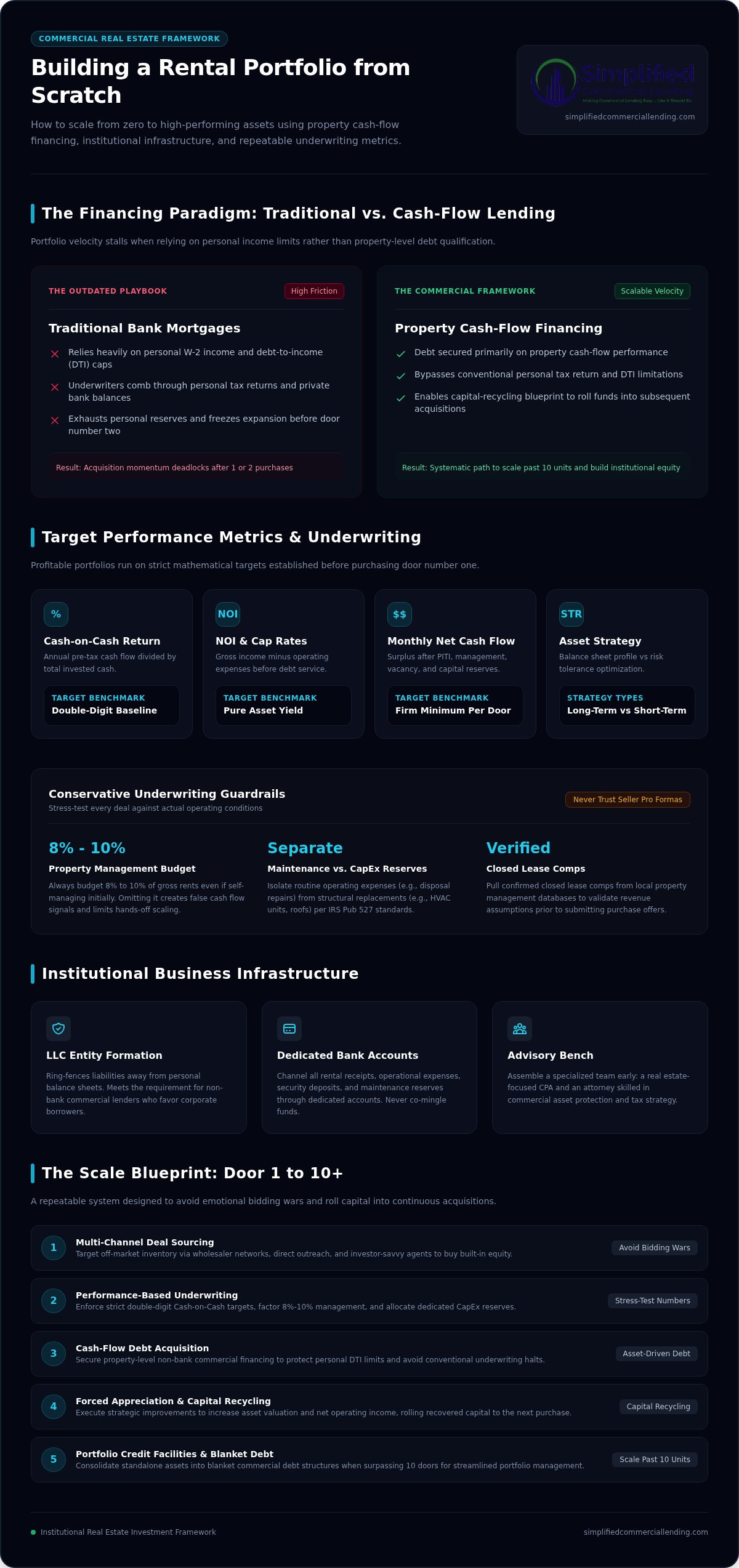
The 5-Step System to Scale from One Property to Ten
Saving a fresh down payment from your day job for every single purchase takes decades. If you want to build a rental portfolio from scratch at pace, you have to treat your capital as a renewable resource. The real momentum begins when you stop saving for deals manually and start recycling your acquisition funds through forced equity and deliberate portfolio compounding.
Recycling Down Payments with Systematic Forced Equity
Waiting on passive market appreciation is a spectator sport. Proactive investors force equity by targeting distressed, outdated, or mismanaged properties priced below market value.
Execute strategic, high-ROI updates that maximize rents and minimize maintenance: install durable quartz countertops, luxury vinyl plank flooring, and modern fixtures. Once the property is stabilized with a qualified tenant, complete a cash-out refinance based on its higher appraised value. By pulling your initial acquisition and rehab capital back out of the property, you replenish your cash reserves. You can then deploy those exact same dollars into your next deal without waiting years to save again.
Expanding Beyond Single-Family into Multi-Family Properties
When you build a rental portfolio from scratch, transitioning from single-family homes into multi-family properties transforms your scaling math. Multi-unit assets give you immediate operational leverage. You manage one roof, one insurance policy, and one foundation while collecting rent from multiple doors.
Vacancy risk drops immediately. A single-family rental goes completely vacant the moment a tenant departs. In contrast, a fourplex with one turn still generates 75% of its rental income, easily protecting your operating reserves and debt service.
You can finance these acquisitions using specialized multi family residential investment loans that assess debt coverage and asset revenue rather than personal DTI caps. Ready to scale beyond single-family doors and recycle your equity into higher-yielding assets? Connect with our team and access commercial investment financing tailored to your portfolio goals.
Accelerating Long-Term Portfolio Growth with Strategic Commercial Debt
Managing ten individual loans across ten different properties creates administrative drag that drains your momentum. As your door count expands, juggling staggered renewal dates, disparate lenders, and varying escrows becomes a liability. Moving beyond initial acquisitions to build a rental portfolio from scratch requires modern commercial credit structures that treat your aggregate holdings as a singular, institutional balance sheet.
Leveraging Portfolio Lines of Credit for Instant Liquidity
Why lock your capital into isolated properties when your overall portfolio holds substantial trapped equity? A portfolio line of credit bundles your performing rentals under a single, unified debt facility. Instead of applying for individual mortgages deal by deal, you establish an overarching credit line secured by the equity across your multi-property asset base.
This approach gives you a distinct edge in competitive acquisitions:
- On-Demand Cash Reserves: Draw liquidity instantly to submit non-contingent, cash offers when high-yielding off-market inventory hits the table.
- Retain Cash-Flowing Assets: Access fresh capital for down payments or property renovations without triggering capital gains taxes or selling off prime rentals.
- Reduced Transaction Friction: Consolidate closing costs, legal fees, and title work under one credit structure rather than paying duplicate origination fees across multiple single-asset loans.
Discover how securing a portfolio line of credit for rentals allows you to tap trapped equity cleanly, bypassing the friction of repeated personal income documentation.
Professionalizing Your Growing Real Estate Enterprise
Scaling past ten doors forces an operational pivot. You can no longer act as the maintenance coordinator, bookkeeper, and acquisition manager simultaneously. Professional real estate operators step out of the daily tasks and focus entirely on high-level capital allocation.
Hand over daily maintenance coordination and tenant interactions to third-party property management companies. Establish firm Key Performance Indicators (KPIs) to monitor each manager, focusing on turn times, lease renewal percentages, and operating expense ratios. Keep your focus on overarching debt service coverage ratios and liquid reserves to keep your enterprise insulated against market fluctuations.
When you align disciplined operations with scalable commercial credit, your portfolio transitions from an exhausting side hustle into a self-sustaining investment vehicle. If you are ready to streamline multiple properties under institutional debt, examine your options with Simplified Commercial Lending to finance your long-term growth across nationwide rental markets.
Scale Your Real Estate Enterprise with Confidence
Stepping away from the traditional banking playbook changes everything. When you build a rental portfolio from scratch, your long-term growth isn’t dictated by your personal paycheck or restrictive debt caps. Real portfolio velocity comes from treating your assets like an interconnected business: acquiring cash-flowing properties, recycling equity through value-add improvements, and utilizing commercial debt that fuels continuous expansion.
You don’t have to let institutional red tape stall your acquisition pipeline. Partner with lenders who prioritize your deal’s merits. With underwriting decisions focused on property cash flow rather than personal tax returns, you can secure capital without personal income friction. Take advantage of national financing scope for single-family, multi-family, and portfolio credit facilities to expand your footprint across nationwide rental markets. Ready to turn your strategy into scalable wealth? Take action now and explore streamlined investment financing at Simplified Commercial Lending.
Frequently Asked Questions
How much money do I need to start building a rental portfolio from scratch?
You typically need enough capital to cover a 15% to 25% down payment, standard closing costs, and three to six months of operating reserves. On an entry-level investment property, this often totals $30,000 to $60,000. However, investors can reduce out-of-pocket costs by partnering with equity partners or targeting distressed properties where strategic value-add renovations create immediate equity.
Can I build a rental portfolio without showing personal tax returns or W-2 income?
Yes, you can build a rental portfolio from scratch without submitting personal tax returns or employment verification by using asset-based debt. Independent commercial lenders offer loan programs that qualify buyers based solely on the property’s rental revenue rather than your personal debt-to-income ratio. This setup keeps tax deductions from shrinking your borrowing capacity.
What is a Debt Service Coverage Ratio (DSCR) loan and how does it help investors scale?
A DSCR loan is an asset-based mortgage where approval depends on whether a property’s gross rental income covers its monthly debt obligations. Lenders divide monthly rental income by principal, interest, taxes, insurance, and association dues. Because these programs evaluate the asset instead of personal employment history, investors can finance properties across nationwide rental markets without personal DTI caps.
How many rental properties can I buy before traditional banks stop lending to me?
Fannie Mae and Freddie Mac guidelines officially cap borrowers at ten financed residential properties. In practice, many retail banks set internal limits at three to five mortgages. Once you hit those institutional caps or your debt-to-income ratio maxes out, you must transition to non-bank commercial financing and asset-based loans to keep purchasing additional doors.
Is it better to start investing with single-family rentals or multi-family properties?
Single-family rentals offer simpler entry hurdles, accessible purchase prices, and broader tenant demand, making them ideal for learning core operations. Small multi-family properties, such as duplexes or fourplexes, carry higher initial purchase prices but offer built-in vacancy protection and consolidated maintenance under one roof. Your choice depends on your starting capital and local market inventory.
How does the cash-out refinance strategy allow investors to repeat the buying process?
A cash-out refinance lets you extract forced equity from a stabilized property to fund your next acquisition. After purchasing an underpriced asset, completing strategic renovations, and placing a paying tenant, you refinance into a new long-term loan based on the higher appraised value. This returns your original capital so you can deploy it directly into your next investment.
What is a portfolio line of credit and when should a real estate investor use one?
A portfolio line of credit is a commercial financing facility that bundles multiple performing rental properties into a single revolving credit line. Investors should use one after accumulating equity across multiple properties. It lets you tap trapped liquidity on demand, giving you ready cash to fund renovations or make rapid, non-contingent offers on new assets.