Your personal tax returns shouldn’t be the bottleneck that stops you from scaling into large scale multifamily real estate. Most investors hit a wall at the five unit mark because they expect the same rigid debt to income requirements they faced in the residential world. You’ve likely felt the frustration of traditional banks demanding endless paperwork while your deal sits in limbo. Securing financing for 5+ unit apartment buildings doesn’t have to feel like an interrogation of your personal finances. It’s time to stop letting institutional red tape dictate your portfolio’s growth.
This guide shows you how to master the transition to commercial multifamily financing by focusing on what actually matters: the property’s performance. We’ll show you how to bypass institutional red tape and secure high leverage loans based on property cash flow rather than your personal salary. You will learn the exact steps to close deals faster in 2026, leverage DSCR options that require no tax returns, and finally break free from the slow underwriting cycles of traditional banking. We are diving into the streamlined world of commercial underwriting where property income is king and your personal debt to income ratio is irrelevant.
Key Takeaways
- Understand why the fifth unit marks the transition from residential to commercial lending and how this shift unlocks more flexible capital.
- Learn how to secure financing for 5+ unit apartment buildings by focusing on property cash flow instead of your personal debt to income ratio.
- Discover the “no doc” advantage for 2026 that allows independent entrepreneurs to qualify for high leverage loans without providing personal tax returns.
- Compare the latest Agency and portfolio loan options to determine which commercial product matches your long term hold or bridge strategy.
- Master a streamlined roadmap for organizing property data to bypass bank red tape and accelerate your closing timeline.
The 5-Unit Threshold: Why Apartment Financing Changes at Five Units
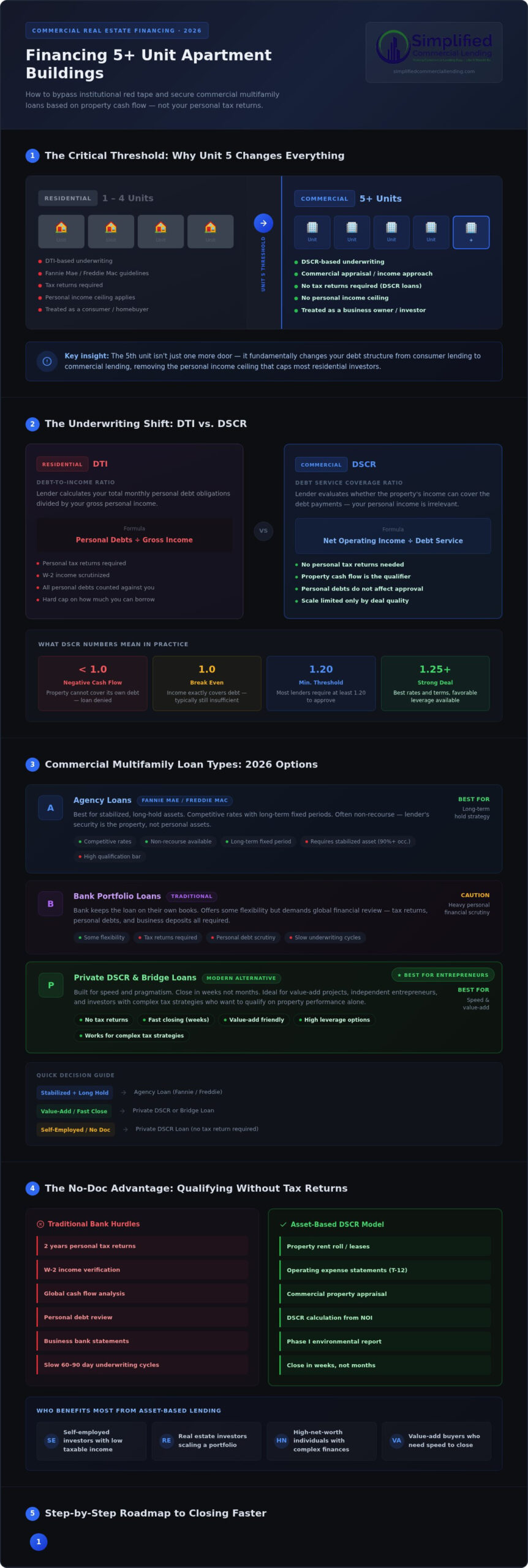
Crossing the line from a fourplex to a five unit building isn’t just a minor upgrade. It is a fundamental shift in how the financial world views your investment. For properties with one to four units, you are usually playing in the residential sandbox. Once you add that fifth unit, you enter the commercial arena. This transition is where many investors get stuck, but it’s actually the moment your growth can become exponential. It isn’t just about adding more doors. It’s about changing the very foundation of your debt structure.
Financing for 5+ unit apartment buildings operates under a completely different set of rules. You are no longer treated as a consumer buying a house; you are treated as a business owner acquiring an asset. This means the rigid debt to income (DTI) requirements that limit residential buyers simply don’t apply here. Instead, lenders look at the Debt Service Coverage Ratio (DSCR). They care about whether the property can pay for itself and generate a profit. This shift removes the artificial ceiling on your personal income and lets the deal speak for itself.
Residential vs. Commercial Multifamily: A New Set of Rules
Residential mortgages are built for the masses. They rely on standardized Fannie Mae and Freddie Mac guidelines. These rules are designed for stability, not for the complex needs of a scaling investor. When you move to 5+ units, the property undergoes a commercial appraisal. This appraisal focuses heavily on the income approach, calculating value based on the net operating income the building produces. You should also expect a Phase I environmental report. This is a standard commercial requirement to ensure the property doesn’t have underlying liabilities like soil contamination. It is a business purpose loan through and through.
Why Banks Say ‘No’ and Why You Should Care
Traditional banks are often the biggest obstacle for independent entrepreneurs. They are addicted to tax returns and W-2 income. If you are a savvy investor who uses legal tax strategies to reduce your taxable income, a traditional bank might see you as a risk despite your high net worth. They use a global cash flow analysis that drags your personal finances into the deal. This creates a massive bottleneck for anyone who doesn’t fit a standard corporate mold.
Fortunately, the commercial market has evolved. By moving away from bank level red tape, you can secure financing for 5+ unit apartment buildings by focusing on the asset’s performance. This shift allows you to scale without the artificial ceiling of personal income limits. You become a resourceful navigator, bypassing the bottlenecks that stop everyone else. This is the entrepreneurial advantage: scaling your portfolio based on property potential, not your personal tax bracket.
Commercial Multifamily Loan Types: Comparing Your 2026 Options
Picking the right debt is just as important as picking the right property. In 2026, the landscape for financing for 5+ unit apartment buildings is split between institutional stability and private market speed. Which one should you choose? It depends on your timeline, your tax strategy, and the current condition of the asset. Not every deal belongs in a traditional bank vault. Some require the agility of a private lender to cross the finish line.
Agency loans from Fannie Mae or Freddie Mac are often the first choice for stabilized assets. They offer competitive rates and long term fixed periods. However, they come with high bars for entry. You need a stabilized property and a clean financial history. If your building is currently 90% occupied and you have no interest in selling for ten years, this is your path. These loans are often non-recourse, meaning the lender’s primary security is the property itself, not your personal assets.
Bank portfolio loans are the traditional route. These lenders keep the loan on their own books rather than selling it to the secondary market. While they offer some flexibility, they usually demand a global look at your finances. They want to see your tax returns, your personal debts, and often your business deposits. This is the institutional red tape that slows down most independent investors and limits their ability to move quickly on new opportunities.
Private DSCR loans and bridge options represent the modern alternative. These are built for speed and pragmatism. If you are eyeing a value add project or need to close in weeks rather than months, these are the tools you need. Bridge loans provide the capital to renovate and stabilize a building before you flip it into long term debt. They focus on the future potential of the building, not just its current state. Once your asset is stabilized, you can also unlock the equity you’ve built through a multi family cash out refinance to fund your next acquisition without selling the property.
Agency vs. Non-Bank: Stability vs. Speed
Agency loans win on interest rates. Private non-bank loans win on execution. If you want to scale your portfolio without tax returns, the non-bank route is the clear winner. You trade a slightly higher rate for the ability to close without an interrogation of your personal income. It is about opportunity cost. Can you afford to wait ninety days for a bank to say maybe? Most savvy investors choose the path of least resistance to keep their momentum.
Portfolio Lines of Credit for Multi-Family Assets
Why manage five separate loans when you can have one? A portfolio line of credit allows you to leverage the equity across several 5+ unit buildings. It provides a single, streamlined facility for future acquisitions. This is how the heavy hitters move so quickly. They aren’t applying for new loans every time; they are drawing from their existing line. If you’re looking for a more efficient way to manage your debt, check out our Multi-Family Residential Investment Loans to see how a streamlined approach can work for you.
Qualifying Without Tax Returns: The Asset-Based Lending Model
Traditional banking forces you to prove your personal worth through a mountain of paperwork. It doesn’t matter if you have significant cash reserves; if your tax returns show heavy depreciation or high business expenses, a traditional bank sees a loss. Asset-based lending flips this script. In the world of 2026 commercial finance, No Doc means we stop looking at your personal 1040s and start looking at the property profit and loss statement. This is the most efficient way to secure financing for 5+ unit apartment buildings because it aligns the loan with the asset’s actual performance, not your personal tax strategy.
Lenders replace personal income verification with a deep dive into the building’s ability to generate cash. They want to see that the property can comfortably cover its own debt while leaving room for a profit margin. This approach empowers independent entrepreneurs who may have complex financial structures that traditional underwriters simply don’t understand. By removing the focus from your personal salary, you unlock the ability to scale your portfolio as fast as you can find profitable deals. When you’ve built sufficient equity in your holdings, a multi family cash out refinance using the same asset-based underwriting model can free up capital for your next move without requiring personal income documentation.
The DSCR Formula for Apartment Buildings
Lenders use the Debt Service Coverage Ratio (DSCR) to measure risk. The math is straightforward: take your Net Operating Income (NOI) and divide it by your annual debt service. If a lender requires a 1.20x DSCR, they want to see the property generating 20% more income than the mortgage payment requires. You can improve this ratio by cutting unnecessary operating expenses or by implementing modest rent increases. A strong DSCR is your primary tool for securing better rates and higher leverage without ever opening a personal tax file. If your units are operating as short-term rentals, review our 5-8 unit DSCR loan checklist for short-term rental investors to understand how Airbnb and vacation rental income is evaluated in this underwriting model.
Asset-Based Underwriting: What Lenders Really Look At
If personal income is off the table, what takes its place? The rent roll is your most critical document. It provides a snapshot of current occupancy, lease terms, and payment history. Lenders also prioritize your Schedule of Real Estate Owned (SREO). This document acts as your professional resume, showing your track record as a resourceful navigator in the multifamily space. While your W-2 doesn’t matter, your credit score and liquidity still do. Lenders want to see that you have the reserves to handle a temporary vacancy or an unexpected repair. This model rewards your actual business success as an investor rather than your ability to fit into a corporate box. It is a pragmatic, results-driven approach that prioritizes the deal over the individual.
How to Secure Financing for 5+ Unit Properties: A Step-by-Step Roadmap
Securing financing for 5+ unit apartment buildings shouldn’t feel like a mystery. It’s a structured process that rewards the prepared investor. While big banks might make you wait weeks for a simple callback, you can take control by following a clear roadmap. It starts with your data and ends with a funded asset. You don’t need to be an institutional giant to navigate this. You just need to be organized and proactive.
The first step is gathering your property financials. Lenders want to see the Trailing 12 (T-12) statement. This shows the actual income and expenses over the last year. Next, you must define your exit strategy. Are you looking for a ten year fixed rate or a short term bridge loan to fund a renovation? Knowing your end goal helps you choose the right lending partner. Skip the local bank queue and look for a broker who specializes in non-bank, asset-based options. Once you have a term sheet, you’ll move into the due diligence phase. This involves a commercial appraisal and a Phase I Environmental report. Finally, you’ll review the loan documents and close the deal.
Preparing Your ‘Deal Package’
A professional presentation speeds up underwriting significantly. If your documents are messy, lenders assume your management is messy too. Your deal package should be a digital folder that includes your current rent roll, a detailed P&L statement, and high quality property photos. Providing this upfront shows you’re a serious player. To see how a streamlined package helps you move faster, explore our guide on Multi-family residential investment loans. A clean package often means a faster “yes” from the underwriter.
The Appraisal and Environmental Hurdle
Commercial appraisals are more complex than residential ones. They focus on income potential rather than just nearby sales. You also have to account for the Phase I Environmental report. This study checks the property’s history to ensure there are no hidden liabilities like old underground storage tanks or chemical leaks. These reports are standard for properties with five or more units. Expect the entire process from application to funding to take between 30 and 45 days. Stay in constant contact with your team to keep the momentum moving toward the closing table.
Ready to bypass the red tape and get your deal funded? Connect with our team to start your 5+ unit loan application today and experience a faster path to closing.
Streamline Your Growth with Simplified Commercial Lending
Traditional banks operate on a model that hasn’t changed in decades. They prioritize rigid protocols over your potential as an investor. If you’ve been slowed down by endless requests for personal tax returns or rigid debt to income ratios, it’s time for a different approach. Simplified Commercial Lending acts as a disruptive alternative to these legacy institutions. We provide the speed and flexibility that independent entrepreneurs need to scale their portfolios in a competitive 2026 market. You shouldn’t have to choose between professional expertise and a streamlined experience.
Our focus is entirely on your success as a business owner. We offer national service for all US-based investment assets, ensuring that you have a consistent partner regardless of where your next deal is located. By prioritizing asset-based underwriting, we move the focus away from your personal salary and onto the property’s performance. This pragmatic method allows us to provide financing for 5+ unit apartment buildings that banks simply can’t match. We understand that your time is your most valuable asset. Our process is designed to protect it.
Why Investors Choose a Resourceful Broker
Working with a resourceful navigator gives you an immediate edge. Instead of being locked into a single bank’s limited appetite, you gain access to a wide range of non-bank lending partners. This variety ensures that we can find a home for complex deals that traditional lenders reject. We provide expert guidance through the commercial bottleneck, helping you avoid the common pitfalls of environmental reports and specialized appraisals. We don’t just look for one-off transactions. We focus on building long term partnerships that help you grow from your first five unit building to a massive multifamily portfolio.
Get Started Today
How much faster could you grow if your lender was an advocate rather than an obstacle? We invite you to reach out for a comprehensive deal review. Our team takes a pragmatic approach to every scenario, providing quick responses and transparent feedback. We don’t hide behind institutional red tape. We provide the tools you need to close quickly and move on to your next acquisition. The market in 2026 waits for no one, and your financing shouldn’t either. Master your transition into the commercial space with a partner who values your ambition.
Are you ready to see what your property’s cash flow can really do for you? Get a quote for your 5+ unit building today and start your 2026 scaling journey with confidence. We are ready to help you bypass the bottlenecks and secure the financing for 5+ unit apartment buildings that your portfolio deserves.
Take Control of Your Multifamily Future
The transition from residential to commercial investing is your opportunity to leave rigid bank requirements behind. You now understand that financing for 5+ unit apartment buildings relies on the property’s performance, not your personal tax returns. By focusing on asset-based underwriting and the DSCR model, you can scale your portfolio without the artificial limits of traditional debt to income ratios. You have the roadmap. You have the strategy. Now, you just need the right partner to execute.
Simplified Commercial Lending provides national US coverage and specialized “no doc” options designed for the modern entrepreneur. We prioritize speed and pragmatism so you can focus on finding your next deal rather than chasing paperwork. Don’t let institutional red tape stall your momentum. It’s time to leverage the cash flow of your assets and build the wealth you deserve.
Scale your portfolio today with a 5+ unit commercial loan and experience a faster, smarter way to grow. Your next major acquisition is waiting. Let’s get it funded.
Frequently Asked Questions
Can I get a loan for a 5-unit building without personal tax returns?
Yes, you can secure financing for 5+ unit apartment buildings through “no doc” or asset-based lending programs. These products focus on the property’s income rather than your personal 1040 filings. It’s a perfect solution for independent entrepreneurs who use legal tax strategies to reduce their taxable income but still have strong property cash flow. Underwriters will prioritize your rent rolls and profit and loss statements over your personal salary history.
What is the minimum down payment for a 5+ unit apartment building?
Expect to provide a down payment of at least 20% to 25% for most commercial multifamily assets. This usually results in a maximum Loan-to-Value (LTV) of 75% to 80%. While some bridge programs might offer higher leverage for value-add projects, a 25% equity stake is the standard benchmark for stabilized properties. Lenders want to see that you have enough “skin in the game” to protect their investment.
How does DSCR work for multifamily properties?
The Debt Service Coverage Ratio (DSCR) measures the building’s ability to pay its own mortgage. You calculate it by taking the Net Operating Income (NOI) and dividing it by the annual debt service. Most lenders look for a ratio of 1.20x or higher. This means the property generates 20% more income than the mortgage payment requires. It’s the primary tool used in financing for 5+ unit apartment buildings to determine risk without looking at personal debt.
Is a 5-unit building considered commercial or residential?
A 5-unit building is strictly classified as a commercial property. While properties with one to four units follow residential mortgage rules, the fifth unit triggers a shift into the commercial arena. This change means you’ll deal with commercial appraisals, different environmental requirements, and business-purpose loan documents. It also removes the rigid debt-to-income limits found in the residential world, allowing for much greater scalability.
What is the typical interest rate for 5+ unit apartment loans in 2026?
Interest rates for 5+ unit buildings generally sit slightly higher than standard 30-year residential mortgages. These rates are influenced by the 10-year Treasury and the specific risk profile of your asset. In 2026, private DSCR and bridge loans often carry a small premium compared to traditional bank loans. You trade a slightly higher rate for significantly faster closing times and the removal of institutional red tape.
Do I need previous property management experience to qualify?
You don’t always need a long track record, but it certainly helps you secure better terms. If you’re a first-time commercial investor, lenders might require you to hire a professional third-party management company. This ensures the asset is managed by experts, which reduces the lender’s risk. As you build your “Schedule of Real Estate Owned,” you’ll find that future financing becomes even easier to secure.
What is a Phase I Environmental report in apartment financing?
A Phase I Environmental report is a standard due diligence study that checks a property for potential contamination. Lenders require this to ensure there are no hidden liabilities like old underground storage tanks or soil pollution from previous owners. It’s a non-invasive search of historical records and a physical site inspection. This report is a mandatory part of the commercial underwriting process for any property with five or more units.
How long does it take to close on a commercial multifamily loan?
Closing typically takes between 30 and 45 days from the time you sign your term sheet. This timeline is longer than residential loans because commercial appraisals and environmental reports take more time to complete. You can speed up the process by having your rent rolls, T-12 statements, and property photos ready for the underwriter on day one. Staying proactive with your lending partner is the best way to hit your closing date. If your property includes short-term rental units, our 5-8 unit DSCR loan checklist for short-term rental investors in 2026 can help you prepare the right documentation to keep your timeline on track.