Why should your personal tax returns dictate the growth of your real estate empire when your buildings are already doing the heavy lifting? You’ve worked hard to build value in your properties, yet traditional banks often treat you like a liability instead of a partner. It’s frustrating to watch a perfect acquisition opportunity slip away because a lender is moving at a snail’s pace while demanding two years of 1040s. Securing a multi family cash out refinance in 2026 doesn’t have to mean drowning in a sea of paperwork or waiting months for a closing date.
You deserve a financing partner that values the performance of your assets as much as you do. We agree that the old institutional norms are a bottleneck to your success. This guide will show you how to unlock equity from your apartment buildings using streamlined financing that bypasses the hurdle of personal tax returns. We’ll explore the latest DSCR requirements, current LTV limits for 2026, and the exact strategy you need to access liquidity and scale your portfolio with total confidence. It’s time to stop asking for permission and start leveraging your success.
Key Takeaways
- Learn how to convert your property’s appreciation into immediate liquidity for new acquisitions or major capital improvements.
- Master the specific steps to execute a multi family cash out refinance by prioritizing your property’s performance over personal income documentation.
- Discover how asset-based lending allows you to bypass the rigid tax return requirements and slow closing times of traditional banks.
- Understand the 2026 benchmarks for DSCR and LTV that lenders use to determine your maximum leverage and loan terms.
- Explore the bridge-to-permanent loan strategy to stabilize distressed assets and successfully transition into long-term debt.
What is a Multi Family Cash Out Refinance and Why Tap Equity Now?
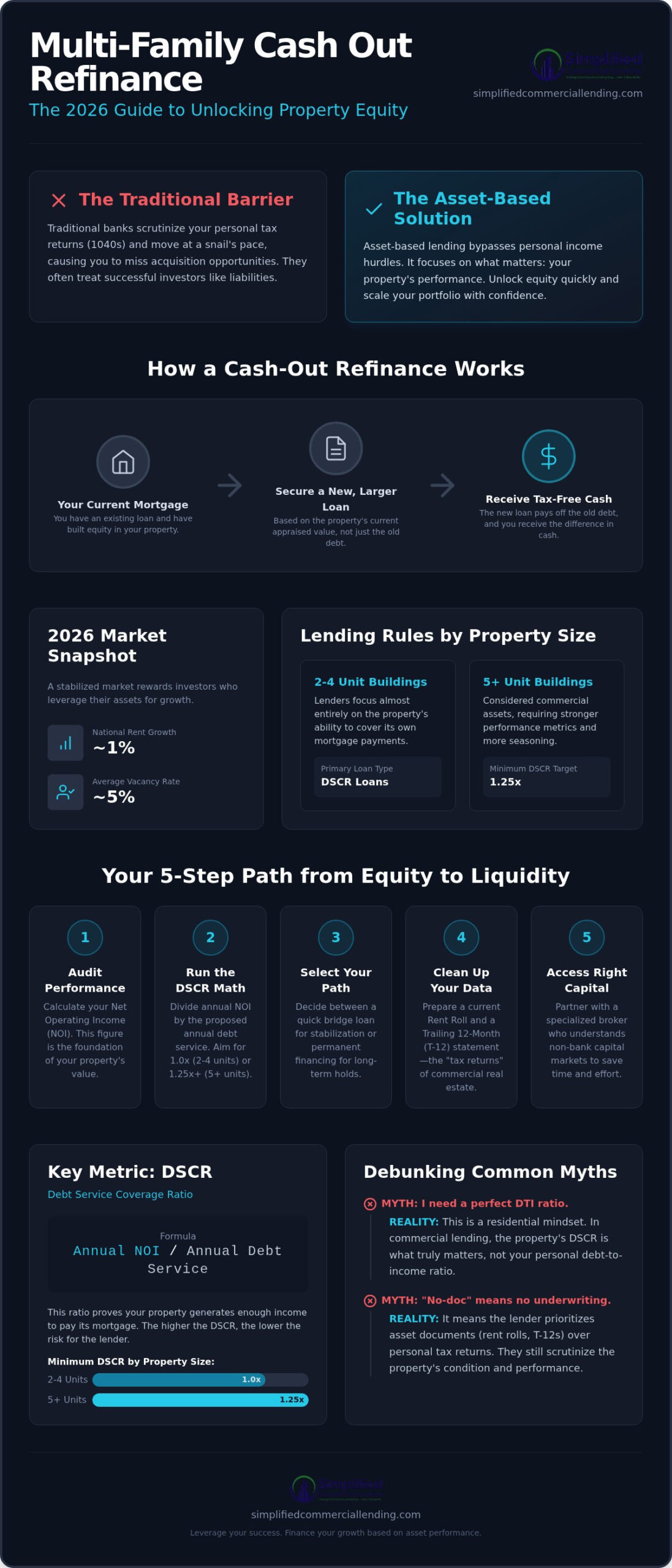
A multi family cash out refinance is a strategic move that replaces your current mortgage with a new, larger commercial loan. You pay off the old debt and receive the remaining balance as a tax-free lump sum. It’s not just a loan; it’s a tool for rapid expansion. Before getting into the weeds of apartment buildings, you should understand the basic principles of What is Refinancing to see how debt restructuring fuels growth. This process allows you to pull your hard-earned equity out of a property without selling the asset.
In 2026, the market has finally stabilized. National rent growth has leveled off at approximately 1% while vacancy rates have returned to a healthy 5% average. This environment rewards investors who stop playing defense. If you own a property with significant equity, sitting on those funds is an expensive opportunity cost. You could be using that capital to acquire more doors while the market is steady.
The rules change depending on your property size. For 2-4 unit buildings, you’ll likely use DSCR loans. Lenders focus almost entirely on the property’s ability to cover the mortgage. For 5+ units, you’re entering the commercial arena. Lenders like Fannie Mae look for a minimum DSCR of 1.25x and often require more seasoning. Knowing which bucket your property falls into is the first step toward a successful close.
The Strategic Advantage of Liquidity
Cash is the lifeblood of a growing portfolio. A multi family cash out refinance provides the capital needed to pounce on new acquisitions without waiting for a property sale. You can also use these funds for value-add renovations. Upgrading units allows you to push rents and increase your Net Operating Income (NOI). This creates a cycle of growth. Many savvy investors also use this liquidity to consolidate high-interest short-term debt into stable, long-term permanent financing. It reduces your monthly burn and protects your cash flow.
Common Misconceptions About Multifamily Refinancing
Many investors mistakenly believe they need a perfect Debt-to-Income (DTI) ratio to qualify. That’s a residential mindset that doesn’t apply here. In the commercial world, we care about the building’s performance. Your personal salary is often secondary to the property’s Debt Service Coverage Ratio. Don’t let a low personal income stop you from leveraging a high-performing asset.
Another myth is that “no-doc” lending means there is no underwriting. That’s false. It simply means the lender prioritizes the asset over your personal tax returns. They will still scrutinize your rent rolls, property condition, and management experience. They want to see a profitable asset. We focus on the cash flow because that’s what actually pays the mortgage. It’s a faster, more logical way to borrow.
How to Execute a Multi Family Cash Out Refinance: A Step-by-Step Guide
Executing a multi family cash out refinance requires a shift in mindset. You aren’t just applying for a loan; you’re presenting a business case. In 2026, speed is your greatest asset. While traditional banks get bogged down in your personal history, asset-based lenders look at the numbers that actually matter. Follow these steps to move from equity to liquidity without the institutional friction.
- Step 1: Audit your performance. Calculate your Net Operating Income (NOI) by subtracting all operating expenses from your total revenue. Your property’s value is directly tied to this figure.
- Step 2: Run the DSCR math. Divide your annual NOI by your proposed annual debt service. For 2-4 unit properties, aim for at least 1.0. For larger 5+ unit buildings, you’ll need a minimum of 1.25.
- Step 3: Select your path. Decide if you need a bridge loan for quick stabilization or permanent financing for long-term security.
- Step 4: Clean up your data. Prepare a current Rent Roll and a Trailing 12-month (T-12) statement. These documents are the “tax returns” of the commercial world.
- Step 5: Access the right capital. Partner with a broker who specializes in non-bank capital markets. Working with an expert who understands multi-family residential investment loans can save you months of wasted effort compared to a local retail bank.
Calculating Your Cash-Out Potential
Your maximum loan amount is determined by the property’s current appraised value and the lender’s Loan-to-Value (LTV) limits. In the current 2026 market, the maximum LTV for a cash-out deal is typically 75%, though some 2-4 unit DSCR programs may stretch to 80% for high-credit borrowers. To find your potential check, multiply your property’s value by 0.75 and subtract your existing mortgage balance. Keep in mind that seasoning requirements apply. For Fannie Mae backed deals, you must be on the title for at least six months, and any existing first mortgage must be at least 12 months old before you can tap into that equity.
Documenting the Deal Without Tax Returns
The “No Doc” advantage is real, but it isn’t a free pass. It means the lender prioritizes property profit over your personal 1040s. Research into financial outcomes for cash-out refinance borrowers shows that those who use equity to consolidate debt or improve assets often see stronger long-term credit profiles. To secure the best terms, your documentation must tell a story of stability. Beyond the T-12 and Rent Roll, provide high-quality property photos and a brief summary of recent capital improvements. This “story” proves to the lender that the asset is well-managed and the income is sustainable, which is the ultimate key to unlocking maximum leverage.
Asset-Based Lending vs. Traditional Banks: Breaking the Documentation Barrier
Banks love boxes. If you’re a savvy entrepreneur with a complex tax return, you don’t fit in them. Traditional lenders look at your personal income and debt-to-income ratio, often ignoring the strength of the asset itself. This creates a massive documentation barrier for investors who use legal tax deductions like depreciation to reduce their taxable income. A multi family cash out refinance through a traditional bank can take 90 days or more, assuming you even get past the initial underwriting hurdles.
Asset-based lending flips this script. Instead of scrutinizing your 1040s, these lenders focus on property cash flow. They look at the building as a self-sustaining business. This shift in priority allows for significantly faster execution. While a big bank is still requesting your 2024 tax transcripts, a non-bank lender can close your deal in as little as 30 days. It’s about efficiency and pragmatism over rigid institutional protocol.
The Reality of ‘No Doc’ Commercial Loans
The term “No Doc” is often misunderstood. It doesn’t mean the lender is flying blind. It means they don’t require personal income verification or tax returns. Using DSCR loans for rental property simplifies the entire approval process. This is a game-changer for investors who show low net income on paper due to high depreciation. You shouldn’t be penalized for being tax-efficient. Asset-based lenders agree and prioritize your property’s profit over your personal salary.
When to Choose a Non-Bank Lender
Sometimes, speed is more valuable than the absolute lowest interest rate. If you have a deadline on a new acquisition, waiting three months for a bank is a non-starter. You need a lender that can move at the speed of business. Non-bank lenders are also more flexible with properties that have “hair,” such as minor deferred maintenance or temporary vacancy issues that would trigger an automatic rejection from a traditional institution.
Scaling is another major factor. Traditional banks often hit a wall once you have 10 financed properties. Non-bank capital markets don’t have these arbitrary limits. Learning how to Use Home Equity To Build Wealth is essential for long-term growth. When you choose a partner that values your property’s performance over your personal salary, you remove the ceiling on your portfolio’s potential. A multi family cash out refinance becomes a repeatable strategy for building an empire rather than a one-time bureaucratic nightmare.
Qualifying for Maximum Leverage: DSCR, LTV, and Property Standards
To secure the best terms for a multi family cash out refinance, you must understand how lenders weigh risk. It isn’t about your personal paycheck. It’s about the math of the asset. Most institutional and non-bank lenders look for a Debt Service Coverage Ratio (DSCR) between 1.20x and 1.25x for larger assets. This benchmark ensures the property generates enough income to cover the mortgage and operating expenses with a comfortable buffer. If your building hits these numbers, you’re in a position of strength.
Property condition also dictates your leverage. A Class A building in a prime metro area will always command better rates than a Class C property in a secondary market. Lenders also look for liquidity. They want to see that you have cash reserves to handle a sudden HVAC failure or a temporary spike in vacancies. Your track record as an investor is your greatest currency here. If you’ve successfully stabilized similar buildings, lenders will trust your projections more than a high W2 salary from an unrelated industry. They are betting on the operator and the asset, not just a credit score.
Optimizing Your DSCR Before You Refinance
Don’t leave money on the table by applying with sloppy books. You can boost your income by implementing a Ratio Utility Billing System (RUBS) to pass utility costs back to tenants. Small additions like laundry fees or reserved parking can also move the needle on your bottom line. On the expense side, shop your insurance policy and review your property management fees for inefficiencies. A simple 0.1 increase in your property’s DSCR can unlock tens of thousands of dollars in additional cash-out proceeds by proving the asset can safely support a larger loan. Every dollar of Net Operating Income you find is magnified when it comes time to refinance.
Property Eligibility and Unit Counts
The financing path changes once you cross the threshold into 5+ unit apartment buildings. Smaller plexes often fall under residential-style DSCR programs, while larger assets move into the commercial capital markets. If your property is mixed-use, be aware that lenders will scrutinize the percentage of retail space. Too much commercial square footage can shift the loan into a different risk category. Lenders also keep a close eye on geographic factors like local market vacancy rates. In 2026, staying near the national average vacancy of 5% is key to maintaining maximum leverage. Investors operating short-term rental units within this size range should also review the 5-8 unit DSCR loan checklist for short-term rental investors to ensure their Airbnb or vacation rental income is properly documented for underwriting. If you’re ready to see what your property can do, it’s time to apply for a multi-family residential investment loan today.
Scaling Your Portfolio: The Multi Family Bridge to Permanent Strategy
Speed is your edge. In a competitive market, the ability to acquire a distressed asset and stabilize it quickly separates the elite investors from the amateurs. The “Bridge to Permanent” strategy is the ultimate accelerant for scaling your empire. You use short-term bridge capital to secure a property that doesn’t yet qualify for long-term debt, fix the operational issues, and then execute a multi family cash out refinance to pull your initial capital back out. This isn’t just a loan; it’s a wealth-recycling machine.
Simplified Commercial Lending streamlines this entire lifecycle. We understand that you can’t afford to wait 90 days for a bank to “maybe” approve your stabilization plan. You need a partner that moves at the speed of your next deal. By focusing on the property’s potential and your track record, we help you bypass the bureaucratic friction that kills momentum. You focus on the value-add; we focus on the capital.
The Bridge to Permanent Multi Family Loans Lifecycle
Successful portfolio growth follows a repeatable pattern. Stop guessing and start executing with this three-step lifecycle:
- Step 1: Acquisition and Renovation. Use short-term bridge capital to buy a property with “hair” on it. These loans close fast, allowing you to beat out competitors who are stuck waiting for traditional bank appraisals.
- Step 2: Stabilization. Execute your business plan. Renovate units, implement a Ratio Utility Billing System (RUBS), and drive occupancy toward the 2026 national average of 95%. As your Net Operating Income (NOI) rises, so does your property’s value.
- Step 3: The Exit. Once the property is stabilized, you transition into a long-term DSCR loan. This multi family cash out refinance pays off the bridge loan and often returns your original down payment. Now, you have your capital back and a cash-flowing asset in your portfolio.
Next Steps: Get Your Cash-Out Quote
Are you waiting for the “perfect” interest rate? That delay is costing you more in lost opportunity than a quarter-point ever will. While you wait on the sidelines, your competitors are using their equity to snap up the best deals in the market. Liquidity is power. Getting a preliminary look at your property’s cash-out potential takes minutes, not weeks. We cut through the noise to show you exactly how much equity you can unlock based on today’s 2026 benchmarks. Stop letting your capital sit idle in your buildings. Ready to scale? Get a customized multifamily loan quote from Simplified Commercial Lending today.
Take Control of Your Growth Strategy
The 2026 market belongs to the proactive investor. You’ve seen how a multi family cash out refinance can transform a stagnant asset into a catalyst for your next acquisition. By shifting the focus from your personal tax returns to your property’s cash flow, you remove the primary bottleneck that holds most entrepreneurs back. Asset-based underwriting isn’t just a trend; it’s the modern standard for those who value speed and efficiency over institutional bureaucracy.
Stop letting your equity sit idle while opportunities pass you by. Whether you’re stabilizing a distressed asset or consolidating debt, the right financing partner makes all the difference. We bring national commercial brokerage expertise to the table, ensuring you get the leverage you deserve without the typical paperwork headache. Our asset-based underwriting focus means we prioritize the numbers that actually matter: your property’s performance. It’s time to leverage your success and move your portfolio forward with confidence.
Scale your portfolio with a No-Doc Multi Family Refinance today. Your growth shouldn’t have to wait on a bank’s schedule. Take the lead and start building your real estate legacy now.
Frequently Asked Questions
How much equity can I cash out of my multifamily property?
You can typically access up to 75% of your property’s appraised value in most commercial scenarios. For smaller 2-4 unit properties, certain DSCR programs allow for a multi family cash out refinance at 80% LTV if your credit score is 740 or higher. This liquidity allows you to pull out your initial investment while retaining ownership of the asset.
Do I need tax returns for a multi family cash out refinance?
You don’t need personal tax returns when you choose an asset-based lender. We prioritize the building’s Net Operating Income and Debt Service Coverage Ratio over your personal 1040s. This “no-doc” approach is designed specifically for entrepreneurs who utilize high depreciation to reduce their taxable income on paper.
What is the minimum credit score for a multifamily refinance?
Most lenders look for a minimum credit score between 660 and 680 to qualify for a multi family cash out refinance. While the property’s cash flow is the primary driver, your credit profile helps determine the final interest rate and maximum leverage. Borrowers with scores above 740 often qualify for the most competitive pricing and the highest LTV limits available in 2026.
How long do I have to own the property before I can do a cash-out refinance?
You generally need to be on the property’s title for at least six months prior to the new loan’s disbursement. If you’re paying off an existing first mortgage, many institutional programs require that loan to be at least 12 months old. Some private capital sources may offer more flexible seasoning requirements for high-performing assets that have seen rapid appreciation.
Can I use cash-out refinance proceeds for anything?
You have total flexibility with your cash-out proceeds. Most investors use the funds as a down payment for their next acquisition or to fund value-add renovations that further increase the property’s NOI. You can also consolidate high-interest debt, pay off partners, or build a capital reserve for future maintenance needs without restriction.
What is the difference between a bridge loan and permanent multifamily financing?
Bridge loans are short-term solutions used to acquire and stabilize distressed properties over one to three years. Permanent financing provides long-term stability with terms ranging from five to thirty years. Many savvy investors use bridge capital to fix a property before executing a refinance into permanent debt once the asset is stabilized.
How does DSCR affect my ability to get a cash-out refinance?
DSCR is the primary qualifier for your loan application. It measures whether your property’s income can comfortably cover the new mortgage payment. For 2-4 unit properties, lenders typically require a 1.0 ratio. Larger 5+ unit buildings usually need a 1.25 ratio to qualify for maximum leverage and the best available terms. If your property includes short-term rental units, understanding how to qualify using 5-8 unit DSCR financing with short-term rental income is essential before you apply.
Are multifamily cash-out refinance rates higher than purchase rates?
Yes, cash-out refinance rates are typically 0.25% to 0.50% higher than standard purchase or rate-and-term refinance rates. Lenders view pulling equity out as a slightly higher risk than a simple acquisition. Even with this premium, the ability to recycle your capital and scale your portfolio often outweighs the marginal increase in interest costs.