Why should your growth stop just because a traditional bank says you’ve reached a ten-loan limit? You’ve worked hard to build a solid foundation, yet you’re hitting a wall where personal income requirements and 60-day approval times kill your momentum. It’s frustrating when your tax returns don’t reflect the actual strength of your rental cash flow. A rental portfolio line of credit texas investors use to bypass these hurdles allows you to act like a cash buyer by leveraging the equity you’ve already built.
We know that in the 2026 market, speed is your greatest asset. This guide will show you how to unlock that trapped equity and scale your portfolio faster using flexible lines of credit that don’t require tax returns. You’ll learn how to navigate the current 20% appraisal cap on non-homestead properties and use property-level DSCR to secure financing. We’ll cover everything from consolidating multiple loans into one manageable line to obtaining rapid approvals based on rental income. It’s time to stop letting rigid institutional norms dictate your success and start using a revolving fund that grows with your ambitions.
Key Takeaways
- Understand how a rental portfolio line of credit texas investors utilize works as a revolving commercial facility to tap into accumulated equity across multiple properties.
- Discover the “no tax return” advantage by qualifying through property cash flow (DSCR) rather than personal debt-to-income ratios.
- Compare the long-term flexibility and cost savings of a single revolving line against the high closing fees of multiple individual cash-out refinances.
- Identify the 2026 qualification benchmarks, including the typical five-property minimum and the credit score thresholds needed for the most competitive rates.
- Learn how to leverage your existing equity to act like a cash buyer, allowing for rapid acquisitions in a fast-moving market.
What is a Rental Portfolio Line of Credit in Texas?
A rental portfolio line of credit texas investors rely on is a high-leverage commercial loan facility secured by a pool of residential or commercial rental properties. It’s essentially a strategic “blanket” financial tool designed for aggressive scaling. Instead of leaving equity locked away in individual houses, this facility allows you to tap into that value to fund your next move. It transforms your portfolio from a collection of static assets into a dynamic source of working capital that you can deploy at a moment’s notice.
This financial instrument functions as a revolving Line of Credit. You draw what you need, pay it back as your properties cash flow or you sell off assets, and then reuse those same funds for future deals. It’s the ultimate tool for the investor who wants to move with the speed and certainty of a cash buyer without tying up all their personal liquidity in a single transaction.
How Portfolio Lines Differ from Standard Mortgages
Standard mortgages are rigid. Each one requires a separate application, a separate appraisal, and a separate closing process. A portfolio line of credit creates a “blanket” effect that simplifies your life. You close once on the line itself. From there, you can access cash without a new application for every property you want to buy. This efficiency is why many pros prefer it; it consolidates multiple individual mortgages into one manageable facility. Additionally, these lines often feature interest-only payment options. This maximizes your monthly cash flow, providing the breathing room you need to renovate a new acquisition or cover unexpected repairs across your holdings.
The Texas Market Context for 2026
In 2026, the Texas market remains a powerhouse for rental demand, but it comes with specific regional hurdles. Property taxes are a primary concern. Since Texas homeowners often pay effective tax rates of 2% to 2.5%, these figures directly impact your Debt Service Coverage Ratio (DSCR) calculations. Lenders generally require a ratio between 1.0 and 1.2, meaning your rental income must comfortably cover these high tax bills alongside the debt. Commercial lending in the Lone Star State is also distinct from consumer lending. It operates under different state regulations, allowing for more aggressive terms and faster execution than a traditional homestead mortgage. With the current 20% appraisal cap on non-homestead properties providing some predictability in tax assessments through late 2026, now is an ideal window to lock in a line based on current valuations.
The ‘No Tax Return’ Advantage: Scaling Without the Paperwork
Traditional banks are obsessed with your past. They want years of tax returns, stacks of W2s, and a deep dive into your personal spending habits. For a high-growth entrepreneur, this is a trap. If you’re looking for a rental portfolio line of credit texas lenders offer, you likely know that heavy tax write-offs for repairs and depreciation are great for your bottom line but terrible for your “bankability” at a local branch. Conventional lenders use Debt-to-Income (DTI) ratios that penalize you for the very expenses that make your business profitable. We flip that script by focusing on the strength of your assets rather than the size of your taxable income.
This “no doc” approach is a game changer for full-time real estate investors. Instead of verifying your personal paycheck, we look at the performance of the properties themselves. Underwriting becomes a streamlined process focused on lease agreements and property appraisals. This shift in perspective allows you to scale your empire based on the quality of your deals, not the limitations of your personal tax filings.
Understanding the DSCR Calculation
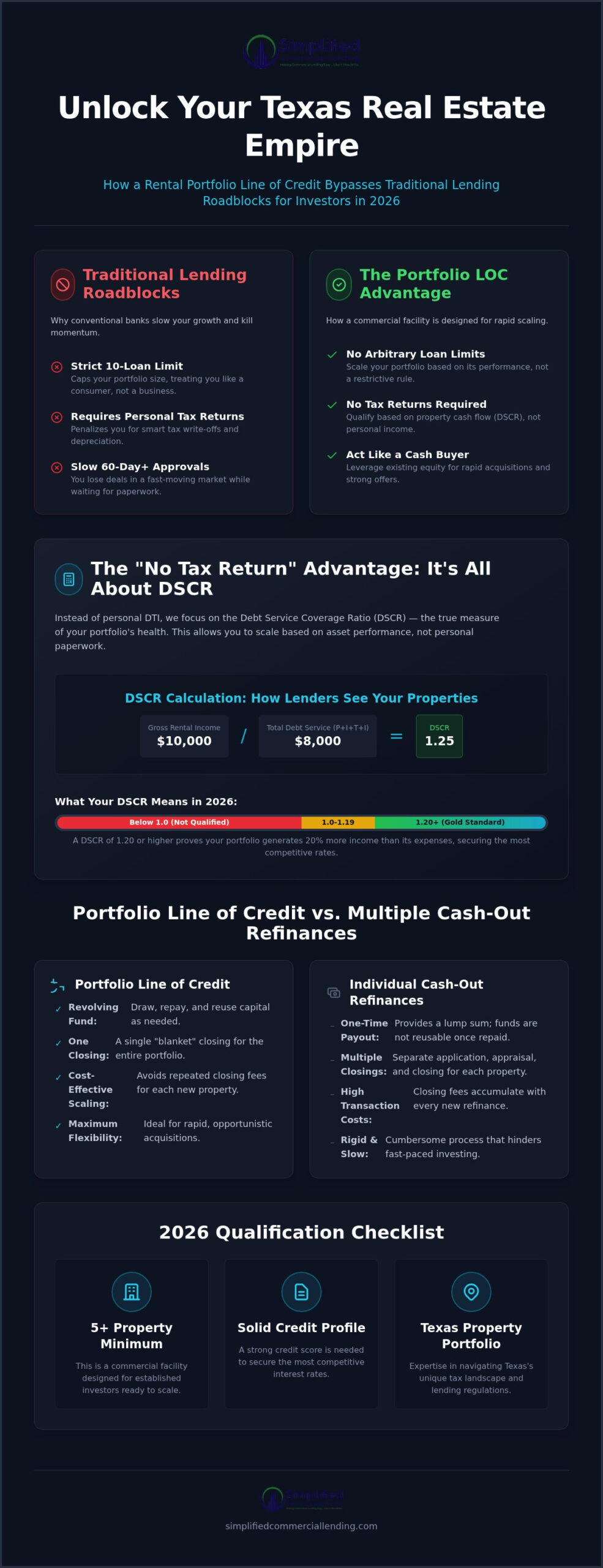
The Debt Service Coverage Ratio (DSCR) is the primary metric used to evaluate your portfolio’s health. Lenders calculate this by taking your Gross Rental Income and dividing it by the Debt Service (the total principal, interest, taxes, and insurance). In the 2026 market, a DSCR of 1.20 or 1.25 is the industry standard for securing the most competitive terms. This number proves the property generates 20% to 25% more income than it costs to maintain. A property paying for itself is more important than your personal income. If your portfolio meets this threshold, you’ve already done the hard part of qualifying.
Why Traditional Banks Say No (And Why We Say Yes)
Conventional mortgage rules often include a “10-property limit.” Once you hit your eleventh acquisition, traditional banks view you as a high-risk consumer rather than a savvy business owner. Commercial portfolio lines bypass this limit entirely because they treat your rentals as a unified business entity. Another bottleneck is speed. Traditional bank approvals can drag on for 60 days or more. By focusing on asset-based lending, we can often close in a fraction of that time. If you’re ready to stop waiting on a loan officer’s permission to grow, you can explore our portfolio options to see how your current equity can fund your next acquisition. We value the future potential of your properties over the paper trail of your past.
Portfolio Line of Credit vs. Cash-Out Refinance
Choosing between a one-time cash-out refinance and a revolving facility depends entirely on your growth strategy. A cash-out refinance provides a lump sum of capital by replacing an existing mortgage with a larger one. It’s a static solution. Once you spend that cash, it’s gone, and you’re locked into a new long-term debt obligation. A rental portfolio line of credit texas investors prefer offers a dynamic alternative. It functions as a revolving fund, meaning you only pay interest on what you use. When you pay it back, the funds become available again immediately. This flexibility is the engine behind rapid scaling.
If your goal is to consolidate debt at a fixed rate for the next 30 years, a refinance might make sense. However, if you’re actively hunting for new deals, the “one and done” nature of a refinance is a bottleneck. A portfolio line allows you to Tap Equity from Rental Portfolio to Reinvest without restarting the loan application process every time you spot an undervalued property.
Cost and Efficiency Analysis
Efficiency starts with your bottom line. Closing costs for five individual refinances can eat your profits alive. You’re looking at five appraisals, five title policies, and five sets of origination fees. With a rental portfolio line of credit texas, you typically face one master closing. This consolidation saves thousands in upfront capital. Speed is the other major factor. A traditional refinance often drags on for 45 to 60 days. In contrast, drawing from an established line of credit is instantaneous. While refinances often offer fixed rates, lines of credit usually feature variable rates. You trade a fixed rate for the ability to access capital in minutes rather than months.
The ‘Cash Buyer’ Strategy
The 2026 Texas market is fast. Sellers value certainty and speed. When you use a portfolio line of credit, you aren’t waiting on a mortgage contingency. You act as a cash buyer. This is a massive advantage during the “Buy” and “Rehab” phases of the BRRRR method. You can negotiate lower purchase prices by offering a 10-day close, something a competitor with a traditional bank loan simply cannot do. Once the property is renovated and rented, you can choose to move that specific asset into long-term financing and “refill” your line of credit. It’s a repeatable cycle that keeps your capital moving and your portfolio growing. Stop letting slow bank processes dictate your acquisition pace.
Requirements and Qualification Steps for 2026
Qualifying for a rental portfolio line of credit texas investors use to scale requires a shift in mindset. You aren’t applying for a personal mortgage; you’re securing a commercial facility. This means lenders look for a proven track record of property management and a portfolio that demonstrates consistent cash flow. For a true commercial line, most lenders expect a minimum portfolio size of five properties. This threshold ensures you have the operational experience to handle a revolving credit facility. While single-family residences (SFR) are the most common assets, these lines often include 2-4 unit properties and even larger multi-family buildings. For a deeper dive into the specifics of property eligibility, check out our DSCR Loan Requirements: 2026 Portfolio Scaling Guide.
Your credit score still matters, even in asset-based lending. While you can find options with scores as low as 620, a 680+ score is typically the threshold for unlocking the most competitive interest rates and higher Loan-to-Value (LTV) ratios. Lenders view a higher score as a sign of financial discipline, which reduces their risk and lowers your cost of capital. In the 2026 market, expect lenders to prioritize borrowers who hold their properties within an LLC or corporate structure, as this provides a layer of professional liability protection standard for commercial financing.
Preparing Your Portfolio Schedule
Organization is the key to a fast approval. You need a comprehensive portfolio schedule that includes updated rent rolls and active lease agreements. Underwriters will audit these documents to verify your gross rental income. You also need to document your property taxes and insurance for every asset in the pool. In Texas, where property tax rates often hover between 2% and 2.5%, having precise figures is essential for an accurate DSCR calculation. If your paperwork is messy, your closing will be slow. Get your digital files in order before you submit your initial request.
The Application Process
The path to closing a “blanket” facility is surprisingly straightforward when you have the right navigator. The process generally follows three main steps:
- Step 1: Soft Quote. We perform an initial review of your portfolio schedule to provide a preliminary term sheet. This gives you a clear idea of your borrowing power without a hard credit pull.
- Step 2: Property Reviews. Once you move forward, the lender initiates property appraisals and “desktop” reviews. These verify the market value and rental potential of your assets.
- Step 3: Underwriting and Closing. The final step involves a formal audit of your LLC documents and title work. Once cleared, you sign the master agreement and gain access to your revolving funds.
Stop letting equity sit idle in your properties while new deals pass you by. If you meet these benchmarks, you can apply for a portfolio line today and start acting like a cash buyer in the Texas market.
Scaling Your Texas Empire with Simplified Commercial Lending
Scaling a real estate business in the Lone Star State requires more than just grit; it requires a sophisticated capital strategy. We act as your navigator through the complex world of non-bank lending, where the focus remains on your success rather than bureaucratic boxes. A rental portfolio line of credit texas investors use to dominate the market provides the liquidity needed to pivot between different asset classes as opportunities arise. Whether you specialize in long-term family rentals or high-turnover short-term rentals (Airbnb), we customize your credit facility to match your specific operational rhythm. You can learn more about these diverse options in our Commercial Property Loan Guide.
Understanding the Texas landscape is our specialty. With the 2026 school-district homestead exemption recently increased to $140,000, the financial gap between homesteads and investment properties has widened. This makes efficient debt management even more vital for your bottom line. We know how to position your portfolio’s DSCR to account for these tax dynamics, ensuring you get the maximum leverage possible. We don’t just provide a loan; we provide a partnership designed to keep your capital moving.
Beyond Residential: Multi-Family and Commercial Assets
Your growth shouldn’t be limited to single-family homes. As you move toward institutional-grade assets, your financing must keep pace. We help you include 5+ unit apartment buildings and other commercial properties within your portfolio line. This “blanket” approach allows you to transition from small residential holdings to larger, more complex investments without the friction of multiple separate lenders. Grouping these assets provides a stronger collateral base and often leads to more favorable terms. If you’re looking to jump into larger buildings, see our guide on Multi-Family Residential Investment Loans.
Your Next Move
Stop waiting for tax season to prove your worth to a traditional bank. Your properties are already performing; they should be providing the capital for your next acquisition right now. We provide quotes based on what your properties actually earn today, bypassing the tax-return bottleneck that stalls so many talented investors. The 2026 market rewards the fast and the prepared. It’s time to unlock the equity you’ve built and turn it into your next deal. Scale your rental portfolio today with a custom line of credit.
Take Command of Your Texas Growth Strategy
You’ve seen how a rental portfolio line of credit texas investors use can dismantle the barriers of traditional banking. By focusing on property cash flow instead of personal income, you bypass the ten-loan limit and the endless paperwork of tax season. This isn’t just about getting a loan; it’s about building a revolving fund that allows you to strike while the iron is hot. You can consolidate multiple properties into one manageable facility and use that equity as a weapon for future acquisitions.
We specialize in the Texas market and understand how to navigate its unique property tax and appraisal landscape. With no tax returns required and the ability to close in as little as 21 days, we provide the expert speed you need to act like a cash buyer. Don’t let your hard-earned equity sit idle while prime deals pass you by. Get Your Custom Portfolio Line of Credit Quote today and start scaling your empire on your own terms. Your next acquisition is waiting; it’s time to go get it.
Frequently Asked Questions
What is the minimum number of properties needed for a portfolio line of credit?
A true commercial line usually requires a minimum of five properties. This ensures your portfolio has enough aggregate equity to justify the master facility. If you have fewer than five, you might look at individual DSCR loans until you hit that threshold. This structure is designed for investors who have moved past the hobbyist stage and are actively scaling their business. It allows for a single closing rather than multiple individual processes.
Can I include short-term rentals like Airbnbs in my Texas portfolio line?
Yes, you can definitely include short-term rentals in your line of credit. We specialize in short-term rental financing, which means we understand how to underwrite based on AirDNA data or actual historical booking revenue. This is a massive advantage in the rental portfolio line of credit texas market, where vacation rentals are a high-growth asset class for savvy investors. We treat these properties as the legitimate businesses they are.
Do I really not need to provide my personal tax returns?
You don’t need to provide personal tax returns for our underwriting process. We focus entirely on the Debt Service Coverage Ratio (DSCR) of the properties in the pool. This means we verify that the rental income covers the debt obligations, taxes, and insurance. It’s the perfect solution for self-employed entrepreneurs whose tax write-offs often make them look less bankable to traditional institutional lenders. We value your properties’ performance over your paperwork.
How much equity do I need in my properties to qualify?
Most lenders require at least 20% to 25% equity in your properties to qualify for a portfolio line. This translates to a maximum Loan-to-Value (LTV) ratio of 75% to 80%. Having this cushion protects both you and the lender against market fluctuations. High-equity portfolios often secure better interest rates because they represent a lower risk profile during the appraisal phase. It ensures your business remains stable even during shifts in the housing market.
Are the interest rates on a line of credit fixed or variable?
Interest rates on a rental portfolio line of credit texas are typically variable. Because these are revolving facilities designed for flexibility, the rates often fluctuate based on a market index. This allows you to pay interest only on the funds you have currently drawn. If you prefer fixed rates, you might consider moving specific assets into a long-term, fixed-rate DSCR loan once your renovations are complete and the property is fully stabilized.
Can I use the line of credit to pay for property renovations?
Yes, you can use your line of credit to fund property renovations and repairs. Since the facility is revolving, it acts as a pool of working capital. You can draw funds to renovate a newly acquired house, increase its value, and then pay the line back once the property is stabilized. This strategy keeps your personal cash free for other investment opportunities. It’s a powerful tool for investors using the BRRRR method.
Does the line of credit show up on my personal credit report?
Commercial lines of credit generally don’t appear on your personal credit report. Because these loans are made to a business entity like an LLC, they are considered commercial debt. While a soft pull or personal guarantee is often required to verify your history, the debt itself doesn’t typically impact your personal debt-to-income ratio. This keeps your personal credit profile clean for other financial needs while allowing your business to carry its own weight.
How long does the approval process take compared to a traditional bank?
Our approval process is significantly faster than a traditional bank. While a standard bank might take 60 days or more to navigate through committees and red tape, we can often close a line in as little as 21 days. This speed is possible because we focus on property cash flow rather than exhaustive personal background checks. It allows you to move at the speed of the market and secure deals before competitors.