In the 2026 Texas market, your property’s cash flow is a more powerful credit reference than your tax returns will ever be. You’ve likely felt the sting of traditional lenders demanding years of personal income proof just to reject a deal because of a paper loss. It’s frustrating to watch a high-performing asset get sidelined by rigid banking protocols and shifting property tax rates that complicate your net income. Using a precise dscr loan calculator texas investors can trust allows you to bypass these hurdles and master the math required to secure financing based purely on your property’s performance. You’ll see exactly how to qualify for higher leverage without ever showing a single pay stub.
This guide breaks down the 2026 requirements for gross versus net rent, helps you navigate the 1.60% statewide effective tax rate, and provides a streamlined path to closing your next deal in weeks rather than months. We’re giving you the clear pass or fail number you need to move forward with confidence. Since Texas has no state income tax, your property’s ability to cover its own debt is the only metric that should matter. It’s time to stop letting paperwork slow down your growth and start using your property’s own income to build your empire.
Key Takeaways
- Understand why Debt Service Coverage Ratio (DSCR) is the primary metric for asset-based lending and how it helps you scale without personal debt-to-income limits.
- Master the core formula by using a dscr loan calculator texas to ensure your property’s gross rent comfortably covers principal, interest, taxes, and insurance.
- Discover the unique calculation methods for Single-Family, Multi-Family, and Short-Term Rentals to maximize your leverage across different asset classes.
- Learn the five essential steps to gather your property data and prepare a high-leverage application that bypasses traditional tax return requirements.
- Find out how a streamlined, cash-flow-focused approach allows you to skip bank bureaucracy and move from application to closing in just a few weeks.
What is a DSCR Loan and Why Use a Calculator for Texas Properties?
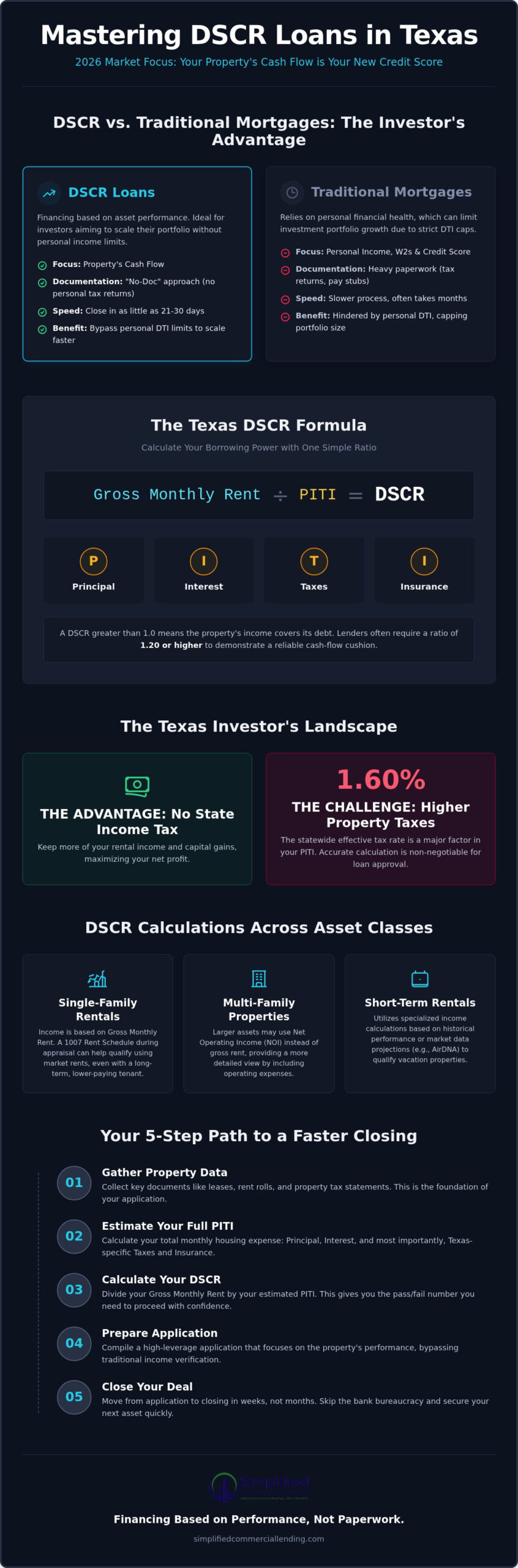
Scaling a rental portfolio in 2026 requires speed and precision. Traditional banks often stall your growth by obsessing over your personal tax returns and W2s. A DSCR loan changes the game by shifting the focus from you to the property itself. At its core, the Debt Service Coverage Ratio (DSCR) is a simple comparison of a property’s monthly rental income against its debt obligations. If the property pays for itself, it qualifies. This “No-Doc” advantage means you can secure financing without the typical mountain of paperwork that slows down traditional mortgages. Using a dscr loan calculator texas investors trust is the first step toward bypassing personal debt-to-income (DTI) limits that often cap how many properties you can own. It’s a tool for the bold innovator who values results over protocol.
DSCR vs. Traditional Mortgages: The Investor’s Advantage
Traditional banks treat you like a liability; we treat your property like an asset. While a standard mortgage lender might spend weeks digging through your personal financial history, DSCR lending focuses on the cash flow of the real estate. This shift in perspective allows for a much faster closing timeline, often ranging from 21 to 30 days. Removing personal income verification eliminates the most common bottlenecks in the lending process. It’s a “Simplified” approach designed for the independent entrepreneur who wants to scale a portfolio without being held back by their personal debt profile. You don’t need to prove your personal income when the property does the talking for you. This allows you to close deals that traditional institutions would simply walk away from.
Why Your Texas Property Tax Bill Changes the Math
Texas offers a unique landscape for investors. You’ll enjoy the lack of a state income tax, but you must account for property taxes that sit well above the national average. With a statewide effective tax rate of approximately 1.60%, your fixed costs are higher than in many other states. These taxes are a critical component of your PITI (Principal, Interest, Taxes, and Insurance) calculation. While we have a national reach, we possess deep expertise in the specific hurdles of the Texas market. If you use a generic tool that doesn’t account for these specific Texas realities, you’ll likely face a loan denial or a last-minute reduction in leverage. A dscr loan calculator texas needs to be precise because a generic calculator that ignores Texas-specific tax burdens will provide a false sense of security and lead to a failed loan application. Managing these property tax shocks is the difference between a successful closing and a wasted appraisal fee.
The Texas DSCR Formula: Calculating Your Borrowing Power
The math behind a successful investment isn’t a mystery. Lenders use a straightforward formula to determine your eligibility: Gross Monthly Rent divided by PITI equals your DSCR. PITI represents the sum of your Principal, Interest, Taxes, and Insurance. This single ratio tells a lender if your property can stand on its own two feet. While larger multi-family assets might use Net Operating Income (NOI) to account for broader operating expenses, residential deals rely on this PITI-based snapshot. It’s a transparent process that values the asset’s performance over your personal financial history.
Don’t assume your current lease is the final word on income. Lenders typically order a 1007 Rent Schedule during the appraisal process. This document provides a professional estimate of current market rents. If your long-term tenant is paying below-market rates, the 1007 can actually boost your ratio and help you qualify for better terms. Using a dscr loan calculator texas allows you to test different rent scenarios to see how market shifts impact your leverage. If you want to see how your specific numbers stack up, you can explore our streamlined lending options to find the right fit for your portfolio.
Factoring in Texas Property Taxes and Insurance
Texas property taxes require a proactive approach. Since the statewide effective tax rate is approximately 1.60%, these costs are often the heaviest lift in your PITI calculation. You can find the most accurate historical data by searching the local appraisal district’s public records. When estimating insurance, ensure you’re quoting a “Landlord Policy” rather than a standard homeowner’s policy. These rates are generally higher but offer the specific protections you need. Savvy investors always add a small cushion to their tax estimates. Property values in Texas can shift rapidly, and a slight buffer ensures your deal stays viable even if the next assessment is higher than expected.
Understanding the 1.20 and 1.25 DSCR Thresholds
Your ratio is more than just a pass or fail grade. A 1.0 ratio means the property breaks even, covering its debt but leaving no room for error. Most lenders in 2026 look for a “sweet spot” of 1.20 or 1.25. Reaching these thresholds often unlocks the highest loan-to-value (LTV) ratios and the most competitive interest rates. If your property falls into the 1.0 to 1.15 range, you can still secure financing, but you might be asked for a larger down payment. Aiming for a 1.25 ratio is the most efficient way to maximize your leverage and keep your capital free for the next acquisition.
Comparing DSCR Loan Requirements for Different Asset Types
Not all investment properties are calculated the same way. While a single-family rental (SFR) uses a straightforward rent-to-debt ratio, multi-family and short-term rentals require a more nuanced approach. For a standard SFR, your dscr loan calculator texas will focus on the 1007 Rent Schedule provided by the appraiser. If you’re stepping up to a 2 to 4 unit property, the appraiser uses a Small Residential Income Property Appraisal Report, known as Form 1025. This accounts for multiple rent streams under one roof. Don’t forget that if you’re looking at a condo or townhome, you must include Homeowners Association (HOA) fees in your debt column. These fees are non-negotiable fixed costs that directly reduce your coverage ratio. To dive deeper into the specifics of qualifying across different asset classes, check out our DSCR Loan Requirements guide.
DSCR Loans for Short-Term Rentals (Airbnb/VRBO)
Vacation rentals are a different beast. Traditional lenders often struggle with the seasonal nature of short-term rental income. We don’t. For these properties, we often use professional hospitality data projections or actual historical revenue reports to determine the property’s earning potential. Lenders look at the “smoothed” monthly average rather than focusing on a single low-occupancy month. This is vital in Texas, where coastal or hill country properties might see huge spikes in summer but slower winters. Keep in mind that professional management fees, which can range from 15% to 30% for STRs, are often factored into the expense side of the equation. Using a dscr loan calculator texas specifically designed for short-term assets ensures you aren’t underestimating the costs of high-turnover hospitality.
Multi-Family and Portfolio Line of Credit Nuances
Scaling your empire means moving beyond individual loans. When you’re managing multiple doors, a portfolio line of credit for rentals offers a more efficient way to leverage your equity. Instead of calculating DSCR for each house individually, a “blanket” calculation can be applied to the entire portfolio’s performance. This allows your high-performing properties to support those with tighter margins, giving you more flexibility. For larger commercial assets, lenders might also look at debt yield. This measures the cash flow return on the loan amount regardless of interest rates or amortization periods. It’s a more conservative check that ensures the deal remains safe for the lender while providing you with the capital needed to keep growing. This proactive approach helps you bypass the rigid bureaucracy of traditional banks.
5 Steps to Use a DSCR Calculator and Prepare Your Application
Success in real estate is about preparation. Before you approach a lender, you need to know your numbers better than they do. Using a dscr loan calculator texas allows you to vet your deal in minutes and identify potential red flags before they cost you an appraisal fee. This proactive approach separates the savvy entrepreneur from the amateur. Follow these five steps to ensure your application is built for a fast approval.
- Step 1: Gather gross monthly rental income. Use your current lease agreement or a professional market estimate from a 1007 Rent Schedule.
- Step 2: Pull your most recent property tax and insurance statements. Don’t guess. Use the 1.60% statewide benchmark if you’re still in the offer phase, but get actual numbers as soon as possible.
- Step 3: Estimate your loan amount. Most investors target a loan-to-value (LTV) of 75% to 80%. This keeps your down payment manageable while maintaining a healthy coverage ratio.
- Step 4: Run the numbers. Input your PITI and rent into the calculator to find your ratio.
- Step 5: Consult with a broker. A professional guide can “stress test” your results against current market shifts and lender-specific requirements.
Once you have your numbers in hand, you can apply for a DSCR loan online to start the streamlined closing process.
What to Do If Your DSCR is Below 1.0
A ratio below 1.0 doesn’t have to be a deal-breaker. If your property is currently under-rented or has high fixed costs, you have options. You can increase your down payment to lower the principal and interest, which naturally boosts the ratio. Alternatively, many investors choose interest-only payment options. By removing the principal from the PITI calculation, you can often turn a “failing” 0.95 ratio into a “passing” 1.15. We also offer “no-ratio” loan programs for properties with high appreciation potential but tight current cash flow. These programs prioritize your credit score and liquidity over the property’s immediate income.
Documentation You’ll Actually Need (Since There Are No Tax Returns)
While we bypass the mountain of paperwork required by traditional banks, we still need a few core items to verify the deal. You don’t need tax returns or W2s, but you will need to provide bank statements showing 3 to 6 months of reserves. This proves you have the liquidity to handle vacancies or repairs. We also require your entity documents, such as an LLC Operating Agreement or Articles of Incorporation. In Texas, holding property in an LLC is the standard for liability protection. Finally, a clean credit report is essential. While we focus on the property, your credit score helps determine the interest rate and LTV thresholds you qualify for.
Why Simplified Commercial Lending is the Disruptive Choice for Texas Investors
Traditional banking systems weren’t built for the modern real estate investor. They rely on outdated protocols that punish entrepreneurs for having “too many” mortgages or complex tax returns. Simplified Commercial Lending acts as a resourceful navigator, bypassing the rigid bureaucracy that stalls your growth. We don’t just offer a service; we act as a knowledgeable ally for those who feel underserved by mainstream institutions. While we operate with a national reach, our deep Texas market expertise ensures we account for every nuance of the local tax code. As a specialized brokerage, we provide a distinct advantage by shopping multiple DSCR programs to find the terms that best fit your specific strategy. Whether you’re financing a single-family rental or a multi-family complex, we prioritize your results over protocol.
Working with a collaborative partner means you get access to flexible solutions that traditional banks simply can’t offer. We understand that independent entrepreneurs need a lender who speaks their language and values pragmatism. By focusing on the property’s cash flow rather than your personal W2s, we remove the most common industry bottlenecks. This allows you to scale your portfolio with confidence, knowing that your borrowing power is limited only by the quality of your assets. It is a slightly rebellious approach to finance that puts the power back in your hands.
Speed to Close: The Competitive Edge in 2026
In the fast-paced 2026 market, a delay of even a few days can cost you a deal. Traditional banks often take 60 to 90 days to close an investment loan because they get bogged down in personal income verification. Our streamlined process removes these bottlenecks by focusing entirely on the property’s performance. By using a dscr loan calculator texas investors can trust, you’ve already done the heavy lifting of vetting your deal. We take that data and move rapidly through underwriting. Our goal is to get you from application to closing in weeks, not months. This speed gives you a massive competitive edge when bidding against other investors who are still waiting for a bank’s loan committee to meet. We are solution-oriented partners who value your time as much as your capital.
Ready to Calculate Your Next Move?
Scaling a rental portfolio shouldn’t feel like an uphill battle against your own tax returns. The math is simple: if your property generates the right cash flow, it deserves the right financing. You now have the tools to master the debt service coverage ratio and navigate the unique fiscal structure of the Texas market. Stop letting traditional lending hurdles hold you back from your next acquisition. Using a dscr loan calculator texas is the first step toward taking control of your financial future. With the right math and a disruptive partner by your side, your growth potential is limitless. Take the first step toward a faster, simpler closing process today. Get a custom DSCR quote from Simplified Commercial Lending today.
Take Control of Your Texas Investment Strategy
Mastering the math behind your portfolio is the ultimate power move for any independent investor. You’ve seen how a precise dscr loan calculator texas can transform a complex property tax landscape into a clear roadmap for growth. By focusing on the asset’s cash flow instead of your personal W2s, you bypass the institutional bottlenecks that slow down your peers. Whether you are scaling single family rentals or expanding into short term vacation stays, the path to closing in weeks is now wide open.
Simplified Commercial Lending provides the specialized no-doc financing you need to move fast. We combine national reach with the localized market savvy required to navigate the unique fiscal structure of the Lone Star State. It’s time to stop letting paperwork dictate your timeline and start letting your properties do the talking. We specialize in SFR, Multi-Family, and STR assets, providing the flexibility you need to build an empire on your terms.
Scale your rental portfolio without tax returns; get started with Simplified Commercial Lending.
Your next deal is waiting. With the right math in hand and a solution-oriented partner by your side, your goals are well within reach. Let’s get to work.
Frequently Asked Questions
What is a good DSCR ratio for a rental property in Texas?
A good DSCR ratio typically starts at 1.20 or 1.25 to unlock the most competitive interest rates and higher loan-to-value options. While some programs allow for a 1.00 ratio, meaning the property breaks even, lenders prefer a cushion to account for maintenance and vacancies. Reaching a 1.25 ratio demonstrates that your property generates 25% more income than its debt obligations, making it a lower risk for financing in the 2026 market.
Can I get a DSCR loan in Texas with no tax returns?
You can secure a DSCR loan without providing any personal tax returns or W2s. These are asset-based loans where the underwriting focuses entirely on the property’s ability to generate cash flow. This “no-doc” approach is ideal for independent entrepreneurs who have complex tax filings or significant paper deductions. Instead of your personal income, lenders verify your liquidity through bank statements to ensure you have adequate cash reserves for the property.
How do high property taxes affect my DSCR loan eligibility?
High property taxes directly impact your eligibility because they are a fixed component of the PITI calculation. Since the debt service coverage ratio is determined by dividing gross rent by the total monthly debt, a higher tax bill increases the denominator and lowers your final ratio. When using a dscr loan calculator texas, it’s vital to use accurate local tax data to ensure your property still meets the 1.20 or 1.25 threshold for approval.
Do DSCR loans require a minimum credit score?
Most DSCR programs require a minimum credit score of 640, though some specialized lenders may accept scores as low as 620 with compensating factors. While the loan is based on property performance, your credit score acts as a secondary layer of risk assessment. It determines your interest rate and required down payment. Investors with scores above 700 generally qualify for the highest leverage and the most favorable terms available from disruptive lenders.
Can I use a DSCR loan for an Airbnb or short-term rental?
You can absolutely use DSCR financing for short-term rentals like Airbnb or VRBO properties. Lenders typically use AirDNA projections or historical stay data to estimate the gross monthly income rather than a traditional long-term lease. This allows you to leverage the higher earning potential of vacation rentals. Because STR income can be seasonal, lenders often look for a “smoothed” monthly average or additional cash reserves to mitigate the risks of fluctuating occupancy.
What is the 1007 Rent Schedule and why does the appraiser need it?
The 1007 Rent Schedule is a supplemental form completed by the appraiser that provides a professional estimate of the property’s fair market rent. Lenders require this document to verify that the income used in your dscr loan calculator texas aligns with current market realities. If your actual lease is lower than the market average, the 1007 can often be used to boost your ratio and help you qualify for a larger loan amount.
Is there a limit to how many DSCR loans I can have?
There is virtually no limit to the number of DSCR loans an investor can hold because these loans don’t rely on your personal debt-to-income ratio. Traditional banks often cap borrowers at ten properties, but asset-based lending allows you to scale indefinitely as long as each property meets the required coverage thresholds. Many successful investors eventually transition their individual loans into a portfolio line of credit to manage multiple assets under a single structure.
How do interest-only payments help my DSCR ratio?
Interest-only payment options help your DSCR ratio by significantly lowering the monthly debt obligation used in the calculation. By removing the principal portion of the payment from the PITI total, the denominator in the formula decreases, which causes the final ratio to rise. This is a strategic move for properties with tight margins. It allows you to meet lender requirements while maximizing your monthly cash flow for other investments or property improvements.