Why should your personal tax returns dictate whether a 20-unit apartment building is a solid investment? If the property generates enough cash to cover the mortgage and then some, that should be the end of the conversation. You’ve likely felt the sting of a traditional bank declining a loan because your personal debt-to-income ratio looks high on paper, even when the deal itself is a goldmine. It’s a frustrating cycle of slow underwriting and endless Fannie Mae red tape that causes savvy investors to lose out on prime real estate.
This guide is your roadmap to a faster, more logical alternative: the multi family dscr loan. We’ll show you how to leverage property cash flow to secure financing without the intrusive scrutiny of your private financial history. You’ll learn how to qualify for these asset-based loans and use them as a repeatable model to scale your portfolio with speed and precision. It is time to stop jumping through hoops and start focusing on the numbers that actually matter.
We are diving deep into the current 2026 market landscape, including specific interest rates and LTV requirements. From understanding minimum debt service coverage ratios to navigating non-recourse options, you’ll gain the clarity needed to stop acting like a typical borrower and start acting like a closer.
Key Takeaways
- Qualify for financing based on a property’s income potential, allowing you to bypass the intrusive scrutiny of personal tax returns and debt-to-income ratios.
- Discover why a multi family dscr loan offers a faster path to closing, often moving from application to funding in a fraction of the time required by traditional banks.
- Identify the specific credit score and debt service coverage ratio (DSCR) thresholds you need to hit to unlock the best possible leverage for your apartment building.
- Learn how to scale your portfolio using repeatable financing models like portfolio lines of credit to consolidate debt and tap into existing equity.
- Maintain your financial privacy and professional autonomy by working with a broker who connects you to a national network of non-bank lenders.
What is a Multi-Family DSCR Loan?
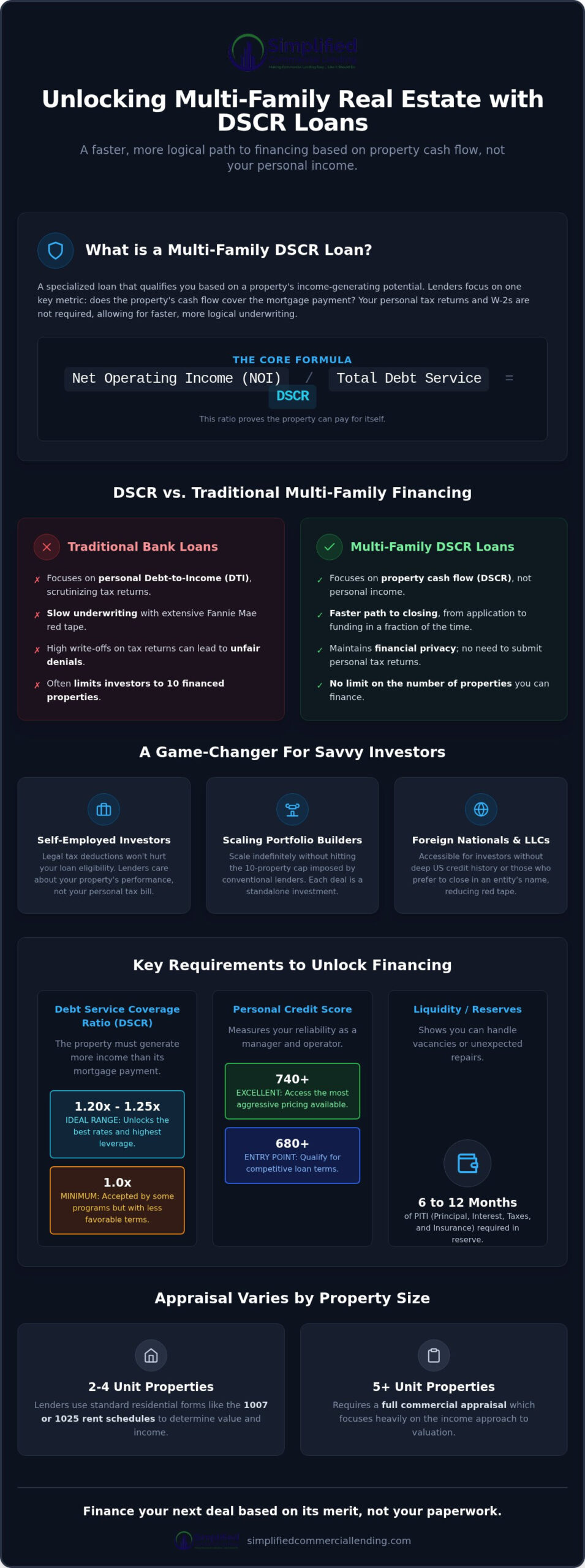
A multi family dscr loan is a specialized financing tool that prioritizes a property’s income over your personal financial history. Unlike traditional mortgages that scrutinize your W-2s or 1040s, this asset-based approach focuses on the Debt Service Coverage Ratio (DSCR). This metric tells the lender one thing: does the property generate enough rent to cover its own debt? If the answer is yes, you are halfway to a closing date.
The “no-doc” advantage is the primary reason investors choose this path. In the world of multi-family real estate, your personal tax returns are often a poor reflection of your investment power. High write-offs might lower your tax bill, but they also inflate your personal debt-to-income (DTI) ratio in the eyes of a rigid bank. A DSCR loan bypasses this hurdle entirely, making your personal income irrelevant to the underwriting process. This flexibility is what allows you to move at the speed of the market rather than the speed of a bank’s bureaucracy.
It’s also important to distinguish between property types. While DSCR loans are available for 2-4 unit residential properties, the underwriting shifts when you move into 5+ unit commercial buildings. For these larger assets, lenders look beyond simple market comps. They analyze the building as a standalone business, where the efficiency of its operations directly dictates your interest rate and loan-to-value (LTV) options.
The Mechanics of Asset-Based Underwriting
Lenders start by evaluating the Gross Potential Rent (GPR), which is the total income a property could generate if every unit were occupied at market rates. From there, they calculate the Net Operating Income (NOI) by subtracting operating expenses like taxes, insurance, and maintenance. DSCR is the mathematical proof of a property’s ability to pay its own debt. By focusing on the property level rather than your personal DTI, lenders can offer more aggressive terms for high-performing assets. This shift in focus is why many investors find they can secure higher leverage on a well-managed apartment complex than they could on their own primary residence.
Who Benefits Most from Multi-Family DSCR?
This financing model is a game-changer for several types of investors:
- Self-Employed Investors: If you use legal deductions to minimize your taxable income, traditional banks will likely decline you. DSCR lenders don’t care about your tax bill; they care about your property’s performance.
- Scaling Portfolio Builders: Conventional lending often caps you at 10 properties. With a multi family dscr loan, you can scale indefinitely because each loan is underwritten as an independent business deal.
- Foreign Nationals and LLCs: Investors who lack a deep US credit history or prefer to close in the name of an entity find DSCR loans much more accessible. They provide a streamlined path to acquiring US-based multi-family assets without the typical red tape.
DSCR Loan Requirements for Multi-Family Properties
Securing a multi family dscr loan isn’t about proving your personal wealth. It’s about proving the property’s efficiency. Lenders primarily look for a Debt Service Coverage Ratio between 1.20x and 1.25x. This means the building generates 20% to 25% more income than the mortgage payment requires. While some specialized programs accept a 1.0x ratio, hitting the higher threshold unlocks significantly better interest rates and higher leverage for your deal.
Your credit score still carries weight in this process. Think of it as a measure of your reliability as a manager. A score of 680 or higher is typically the entry point for competitive terms. If your score is above 740, you’ll see the most aggressive pricing available. Beyond credit, don’t forget about liquidity. Lenders typically require 6 to 12 months of principal, interest, taxes, and insurance (PITI) in reserves. They want to know you can weather a temporary vacancy or an unexpected repair without the investment collapsing.
The appraisal process changes based on your unit count. For 2-4 unit properties, lenders use standard residential forms like the 1007 or 1025 rent schedules. For buildings with 5 or more units, you’ll need a full commercial appraisal. This in-depth report focuses on the income approach to value, which is central to how DSCR loans work for multifamily properties. It ensures the projected rents align with current market realities.
Calculating Your Property’s DSCR Ratio
The math is simple but vital. Divide your Net Operating Income (NOI) by your total annual debt service. Remember that NOI must account for real-world factors like vacancy rates and management fees. If you’re unsure where your current portfolio stands, reviewing detailed DSCR Loan Requirements can help you prepare your documentation before you apply. Accuracy here prevents surprises during the underwriting phase.
Property Condition and Occupancy Standards
Your building must be “rent ready” to qualify for these programs. DSCR lenders generally avoid distressed assets that require major structural overhauls. If you’re looking to refinance, most programs require a minimum occupancy of 90% over the last 90 days. For larger deals, such as a 10-unit building, lenders often look for at least one or two years of prior property management experience. If you’re ready to see which programs fit your specific asset, you can explore customized debt structures that match your long-term goals.
DSCR vs. Traditional Multi-Family Financing
Speed is the ultimate currency in real estate. While a traditional bank might take 90 days or more to move a file through a committee, a multi family dscr loan can often close in as little as 30 days. This 60-day gap is often the difference between winning a bid on a high-yield apartment building and watching a competitor swoop in with a faster offer. Traditional lenders are bogged down by institutional bureaucracy, whereas asset-based lenders focus on the deal’s merit.
Documentation is another major differentiator. Traditional financing requires a mountain of personal paperwork, including years of tax returns and personal financial statements. DSCR lending offers a “Simplified” approach that protects your privacy. This flexibility aligns with the federal definition of multifamily DSCR, which emphasizes the property’s ability to sustain its own debt rather than the borrower’s personal income. Because these loans are underwritten to the asset, there is no technical “cap” on how many properties you can own, unlike the 10-loan limit often imposed by conventional programs.
Liability also shifts in your favor. Many DSCR products offer non-recourse options, meaning your personal assets aren’t on the line if the property underperforms. Traditional bank loans almost always require a personal guarantee, putting your home and personal savings at risk for a commercial venture.
Why Banks Decline Cash-Flowing Deals
Banks often fall into the “Global Cash Flow” trap. They don’t just look at the apartment building you want to buy; they look at every other business and property you own. If one of your other entities shows a paper loss, it can kill your new deal, regardless of how much profit the target property generates. This is why even investors with $1M in personal income still get declined due to rigid DTI limits. Choosing Multi-Family Residential Investment Loans through a non-bank partner allows you to isolate each investment, ensuring one underperforming asset doesn’t freeze your entire growth strategy.
The Cost of Convenience: Rates and Fees
You’ll typically pay a slight premium for this speed and flexibility. Interest rates for DSCR loans are generally 0.5% to 1.5% higher than conventional bank rates. It’s a trade-off: you pay more for capital to avoid the red tape that stops most deals. Prepayment penalties are also standard in this space. A common 5-4-3-2-1 structure, where the penalty decreases by 1% each year, is typical for commercial-sized assets. When you factor in brokerage points and originating fees, it’s vital to calculate your ROI based on the total cost of capital, not just the monthly interest rate.
Strategic Scaling: Using DSCR for 5-20 Unit Portfolios
The 5-20 unit apartment building is the “missing middle” of real estate investing. Most lenders focus on either tiny single-family homes or massive institutional complexes. This leaves a massive opportunity for independent investors using a multi family dscr loan. These assets are large enough to benefit from professional management efficiencies but small enough to bypass the extreme red tape of HUD or Fannie Mae. It is the perfect sweet spot for building a high-yield portfolio with speed. You’ll find less competition from institutional hedge funds in this space, giving you more room to negotiate better purchase prices.
Scaling in this niche often involves the BRRRR method on steroids. You buy a value-add building, improve the Net Operating Income through renovations or better management, and refinance based on the new cash flow. This strategy allows you to pull your initial capital out and move to the next deal immediately. To streamline this growth, many savvy investors use a portfolio line of credit for rentals. This tool lets you consolidate multiple properties into a single, efficient debt structure while tapping into your hard-earned equity. It turns a collection of individual properties into a cohesive, wealth-generating machine.
Tapping Equity to Reinvest
Refinancing seasoned multi-family assets is the fastest way to fund your next acquisition. While purchase transactions often allow for 80% LTV, cash-out refinances typically cap around 75% LTV. This 5% difference is a small price to pay for the liquidity needed to jump on your next building. If you are managing a mix of asset types, check our Commercial Property Loan Guide to see how to balance leverage across your entire portfolio. Using equity from a stabilized 10-unit building to fund the down payment on a 20-unit building is the ultimate scaling hack. It keeps your personal capital on the sidelines while your assets do the heavy lifting.
Multi-Family DSCR for Short-Term Rentals
You aren’t limited to traditional long-term leases. If your multi-unit building is in a high-demand vacation area, you can qualify using verified market rental projections to prove potential income. This is a powerful way to boost your NOI. To handle the seasonal nature of vacation rentals, look for interest-only options. These lower your monthly obligation during slow months and maximize your cash-on-cash return during peak seasons. Transitioning a traditional 8-unit building into a short-term rental powerhouse can double your income and drastically improve your debt coverage ratio. You get the benefits of commercial scale with the high-yield potential of the hospitality market.
Ready to see how much equity you can unlock to fuel your growth? Talk to a specialist today about building a customized debt structure for your portfolio.
Secure Your Multi-Family Future with Simplified Commercial Lending
Simplified Commercial Lending acts as your expert guide in a market that often feels rigged against the independent entrepreneur. Traditional banks have limited “buckets” for investment capital. If you don’t fit their exact mold, they say no. As a national broker, we provide a disruptive alternative. We access a nationwide network of non-bank lenders, each with unique appetites for multi-family assets. This means we don’t just find you a loan; we find the specific multi family dscr loan that fits your 5-year or 10-year exit strategy.
We prioritize transparency and momentum. You shouldn’t have to spend thousands of dollars on a commercial appraisal just to find out if the lender likes the deal. We provide clear, transparent terms upfront. This allows you to move with the confidence of a cash buyer in a competitive market. Whether you are acquiring a new 12-unit building or consolidating a portfolio, our customized debt structures ensure your financing supports your growth rather than stifling it. We know the commercial landscape is complex, so we handle the heavy lifting of lender negotiations for you.
The Simplified Process: From Inquiry to Closing
Our workflow is designed for speed and clarity. It starts with an initial scenario review where we look at the property’s NOI and your basic credit profile. We don’t require a hard credit pull just to give you a quote. Once we establish the deal’s viability, we move into streamlined document collection. We focus on the property’s performance and lease data rather than your personal tax returns. You’ll have dedicated support throughout the process, acting as your ally to navigate every hurdle from the letter of intent to the final wire. We value pragmatism over protocol, ensuring your deal stays on track.
Ready to Scale Your Portfolio?
Stop letting personal tax returns or high DTI ratios hold back your multi-family ambitions. The market waits for no one, and the best deals go to those who can execute quickly. Submit your deal today for a same-day preliminary review and see how a multi family dscr loan can transform your investment strategy. Take the first step toward a more efficient, repeatable financing model that puts you in control. Institutional-grade financing is now accessible to the independent investor.
Take Control of Your Multi-Family Growth
The path to a massive apartment portfolio doesn’t have to be blocked by traditional bank red tape. You now understand that property-level cash flow is the most powerful tool in your financing arsenal. By focusing on the income your building generates rather than your personal tax returns, you can bypass the intrusive scrutiny that stops most investors in their tracks. Whether you’re targeting a 5-unit value-add or a stabilized 20-unit complex, the multi family dscr loan provides the speed and privacy you need to close deals and scale with confidence.
Simplified Commercial Lending is here to help you navigate this transition. We offer national coverage across all 50 states and provide direct access to wholesale non-bank rates that you won’t find at your local branch. Best of all, we never require your personal tax returns to get the deal done. It’s time to stop acting like a typical borrower and start acting like a high-velocity closer.
Get a Custom Multi-Family DSCR Quote Today and see how fast your portfolio can grow when the numbers finally work in your favor. Your next big acquisition is closer than you think.
Frequently Asked Questions
What is the minimum unit count for a multi-family DSCR loan?
Most lenders define multi-family starting at 2 units for residential programs and 5 units for commercial ones. While 2-4 unit properties follow residential guidelines, buildings with 5 or more units are treated as commercial assets. A multi family dscr loan is available across both categories, though underwriting for 5+ units focuses more heavily on the building’s business operations and net operating income than simple market comps for properties.
Do I need tax returns for a multi-family DSCR loan?
You don’t need to provide personal tax returns or W-2s to qualify. This is a no-doc asset-based lending model where the property’s ability to cover its own debt is the primary concern. Lenders focus on the cash flow generated by the multi-family asset rather than your personal income. This allows self-employed investors with high tax write-offs to secure financing that traditional banks would typically decline based on personal debt-to-income ratios.
Can I use a DSCR loan for a 5-unit apartment building?
Yes, 5-unit buildings are a perfect fit for this financing model. At 5 units, a property officially crosses into the commercial category. A multi family dscr loan for a 5-unit building is underwritten based on the building’s Net Operating Income (NOI). Lenders analyze the rent roll and operating expenses to ensure the property can sustain the mortgage. This is often much faster than traditional commercial bank financing which can take months to process.
What is the typical down payment for a multi-family DSCR loan?
Most purchase transactions require a down payment of 20% to 25%, resulting in a 75% to 80% Loan-to-Value (LTV) ratio. While some aggressive programs may allow for a 15% down payment if the property’s cash flow is exceptionally strong, 20% is the industry standard for competitive rates. For cash-out refinances, lenders typically cap the LTV at 70% to 75% to ensure there’s enough equity remaining in the property to weather market fluctuations.
Is a multi-family DSCR loan non-recourse?
Many multi-family DSCR programs offer non-recourse options, especially for larger commercial assets. This means the lender cannot pursue your personal assets like your home or savings if the property defaults. However, some lenders may require a bad boy guarantee to protect against fraud or gross negligence. It’s vital to review the specific loan terms, as smaller residential properties are more likely to require a standard personal guarantee than 5+ unit buildings.
How does a DSCR loan differ from a Fannie Mae multi-family loan?
The primary differences are speed and documentation. Fannie Mae and Freddie Mac programs offer lower interest rates but come with rigid guidelines and a closing process that can take 60 to 90 days. DSCR loans from non-bank lenders can close in as little as 30 days. Additionally, DSCR loans don’t require the exhaustive personal financial disclosure or high liquidity reserves that agency debt demands, making them a more flexible choice for scaling portfolios quickly.
Can I close a multi-family DSCR loan in an LLC?
Closing in the name of an LLC or other business entity is not only allowed but often encouraged. This structure provides an extra layer of liability protection and makes it easier to manage the property as a standalone business. Traditional residential mortgages often force you to close in your personal name, but asset-based lenders recognize that professional investors prefer entity-based ownership. It simplifies the transition of assets and helps maintain your personal financial privacy.
What happens if the property’s DSCR falls below 1.0?
If the DSCR falls below 1.0, it means the property isn’t generating enough income to cover the mortgage payment. While most lenders prefer a ratio of 1.20 or higher, specialized no-ratio programs exist for properties with high growth potential. Expect to see lower leverage and higher interest rates if the ratio is weak. In these cases, you might need to provide a larger down payment to lower the debt service and bring the ratio into a fundable range.