What if you could access the equity in your entire rental portfolio without ever handing over a personal tax return? You’ve likely felt the frustration of missing a prime deal because a traditional bank moved at a snail’s pace or demanded endless piles of personal financial documents. It’s exhausting to watch your equity sit idle while you’re forced into high-interest hard money loans just to keep your momentum. You know your properties are performing, but the bank only cares about your personal income history.
This guide shows you how a commercial real estate line of credit can transform your business into a revolving acquisition engine. You’ll discover how to secure flexible financing based on your property’s cash flow, or DSCR, rather than your personal debt-to-income ratio. We’re breaking down the 2026 strategies for using portfolio-wide equity to bypass bank bureaucracy and move with the speed of an all-cash buyer. It’s time to stop treating your rentals like static liabilities and start using them as a standing pool of liquidity for your next big move.
Key Takeaways
- Learn how a commercial real estate line of credit provides revolving capital so you don’t have to deal with the rigid debt-to-income limits of traditional banks.
- Understand how to consolidate equity from multiple single-family or multi-family properties into a single blanket facility for maximum borrowing power.
- Discover why paying interest only on the funds you actually deploy means it’s more cash-flow friendly than a standard cash-out refinance.
- Master the “No-Doc” underwriting process that prioritizes your property’s cash flow (DSCR) over your personal tax returns and W-2s.
- Explore a streamlined, national lending approach designed to help you move with the speed of an all-cash buyer in competitive markets.
Beyond Traditional Banking: What is a Commercial Real Estate Line of Credit?
A commercial real estate line of credit is a strategic financial tool designed for the modern investor. It functions as a revolving line of credit secured by your investment property. Unlike a term loan that provides a one-time payout, this facility allows you to draw, repay, and redraw funds as needed. It’s the ultimate flexible financing solution for those who want to move fast without the burden of a new loan application for every single acquisition. You gain a permanent capital reserve that grows alongside your portfolio.
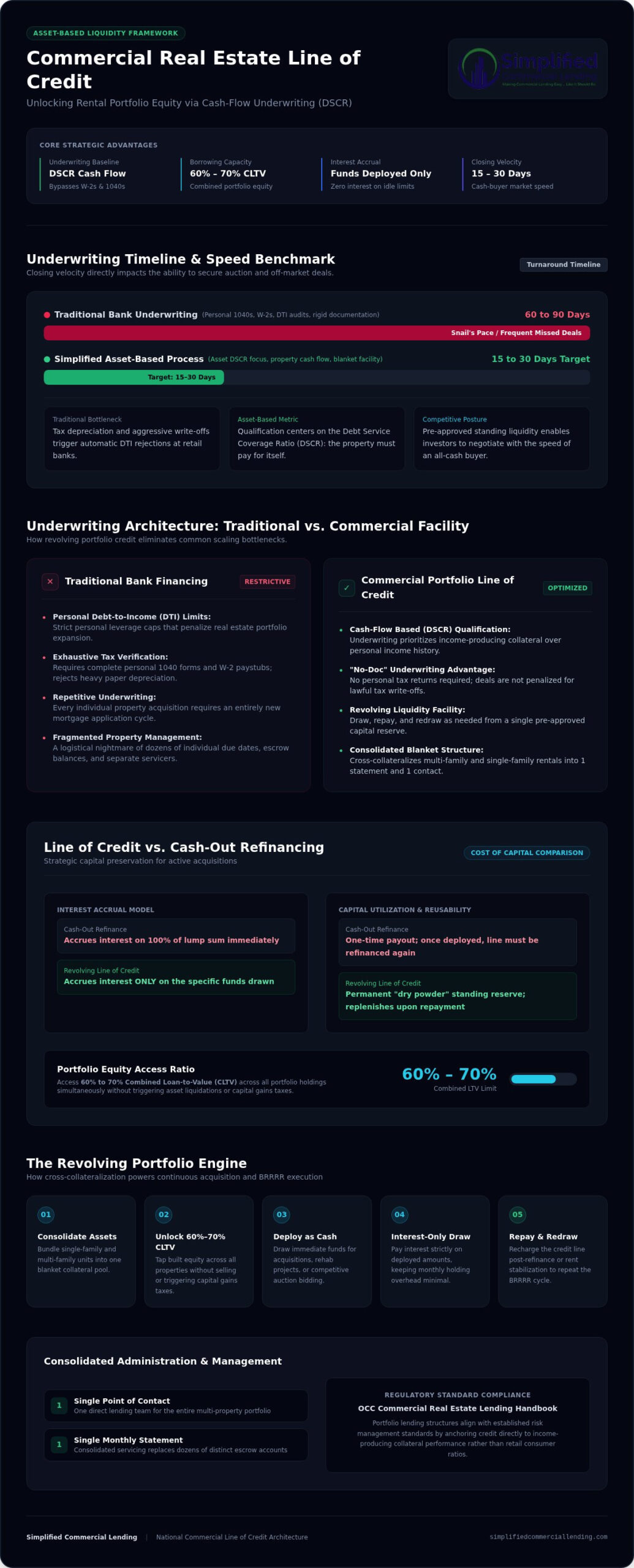
Traditional “business lines” often fail real estate investors. Banks typically rely on rigid Debt-to-Income (DTI) requirements and personal income verification. If your tax returns show heavy depreciation or high write-offs, a traditional bank might reject you. We bypass this bottleneck. While traditional bank underwriting can drag on for 60 to 90 days, our simplified process targets closing in 15 to 30 days. By focusing on asset-based lending, the property’s value and income potential do the heavy lifting. This approach prioritizes the actual performance of your real estate rather than your personal 1040s.
The Gap Between Personal and Commercial Credit Lines
Your personal credit score is just one piece of the puzzle. In the world of commercial lending, traditional institutions often view independent investors as high-risk. They demand piles of paperwork and personal guarantees that can stifle your growth. Our model bridges this gap by shifting the focus to property-level cash flow analysis. We look at the Debt Service Coverage Ratio (DSCR) to ensure the asset pays for itself. This means you can scale your portfolio based on the strength of your deals, not the size of your W-2 paycheck. It’s about empowering the entrepreneur, not the bureaucrat.
Why Investors Choose Lines of Credit Over Lump Sum Loans
Why pay interest on money you aren’t using? With a commercial real estate line of credit, you only accrue interest on the specific amount you draw. This is a game-changer for maintaining cash flow. It provides a “dry powder” fund that makes you as competitive as an all-cash buyer at auctions or during off-market negotiations. You get the liquidity you need for renovations or new acquisitions without the long-term debt burden of a fixed mortgage. You keep your momentum high and your interest costs low. Having capital on standby allows you to deploy funds the moment a high-value opportunity appears. Speed is your greatest advantage.
The Portfolio Line of Credit: Leveraging Your Entire Rental Engine
Managing a dozen individual mortgages is a logistical nightmare. Each property brings its own due date, escrow account, and lender requirements. A portfolio line of credit for rentals simplifies your entire operation by bundling your assets into one powerful financial engine. Whether you own a mix of single-family homes or multi-family units, this blanket facility provides a single monthly statement and one point of contact. You aren’t just saving time; you’re maximizing your borrowing power. By using your entire portfolio as collateral, you can secure a larger commercial real estate line of credit than any single-property loan could offer.
Unlocking Equity Without Selling Your Assets
Selling a high-performing property just to fund your next deal is often a mistake. You lose the asset, the cash flow, and a chunk of your profits to capital gains taxes. A better path is to tap into the equity you’ve already built. Most portfolio facilities allow you to access between 60% and 70% of your combined loan-to-value (CLTV) across your holdings. This provides immediate liquidity while you keep your properties. It’s the perfect fuel for the BRRRR method. You buy, rehab, and rent, then pull that new equity into your revolving line for the next project. A portfolio line of credit turns stagnant equity into active capital for your next acquisition. This approach aligns with the risk management standards found in the OCC Commercial Real Estate Lending Handbook, focusing on the strength of income-producing collateral.
The Blanket Loan Approach to Flexible Financing
Cross-collateralization is what makes this tool so effective for scaling. Your properties work as a team. If one property has lower equity, a high-equity asset in the same pool can balance the scales. This structure is the preferred choice for investors growing toward 20 or more units. You gain the flexibility to add or remove properties from the line as you trade or reposition your portfolio. When you’re ready to sell an individual asset, you simply pay down an allocated portion of the loan to release the lien. It’s a dynamic system that evolves with your business needs. If you want to see how much equity you can unlock, you can check your portfolio’s potential with our team. You get the dry powder you need without the constant headache of new loan applications.
Line of Credit vs. Cash-Out Refinancing: Which Fits Your 2026 Strategy?
Choosing between a cash-out refinance and a commercial real estate line of credit depends on one thing: how fast do you need to move? A refinance drops a lump sum into your lap. You pay interest on every dollar from day one, whether you’ve found a deal or not. A line of credit works like a faucet. You turn it on when you find an opportunity and shut it off when you’re done. In the 2026 market, where the WSJ Prime Rate sits at 6.75%, the cost of carrying “lazy” cash from a refinance can kill your monthly margins.
While a cash-out refinance often comes with a multi-year prepayment penalty, like a 5-4-3-2-1% step-down, a line of credit offers the freedom to pay down and redraw without penalty. This flexibility is vital for managing credit exposures under the Federal Reserve real estate lending guidelines. You get the capital you need without the long-term debt trap. Plus, our simplified lending process targets closing in 15 to 30 days, while traditional bank refinances can drag on for months.
Speed and Flexibility: When the Line of Credit Wins
A line of credit is your secret weapon for auctions and off-market deals. It gives you the psychological edge of “cash-like” bidding power. You aren’t waiting 60 days for a bank to approve a specific property; you already have the funds ready. Once you’ve stabilized a property, you can transition into permanent debt using single family residential investment loans. This “buy-with-credit, refi-to-term” strategy keeps your acquisition engine running hot without tying up your personal credit.
Cost Analysis: Interest on Draw vs. Interest on Total Loan
Imagine you’re looking at $500,000 in capital. If you take a $500,000 cash-out refinance at a fixed rate, you’re paying interest on the full amount immediately. If you choose a $500,000 line of credit but only draw $100,000 for a renovation, you only pay interest on that $100,000. With floating rates for commercial lines in 2026 often ranging between 7.25% and 9.25%, interest cost optimization is your best friend. Be sure to check for “non-use fees” which some lenders charge on undrawn balances. In an environment where the Federal Funds Target Range is 3.50% to 3.75%, managing your interest-on-draw is the smartest way to protect your monthly cash flow.
Qualifying Without Tax Returns: The No-Doc Advantage
Traditional banks often penalize real estate investors for being smart with their taxes. If your 1040s show high depreciation or strategic write-offs, a standard lender might see a “loss” where you see a successful business. Our no-doc approach flips the script. We don’t care about your W-2s or personal debt-to-income ratios. Instead, we focus on the property’s ability to generate cash flow. This shift allows you to secure a commercial real estate line of credit based on the strength of your portfolio, not the complexity of your tax returns.
This asset-based lending model is built for speed and growth. By bypassing the mountain of personal paperwork required by traditional institutions, you can focus on what matters: finding and closing deals. You can review the full technical criteria in our guide to DSCR loan requirements to see how your current holdings stack up. We prioritize the math of the deal over the history of the borrower.
Underwriting Based on Property Cash Flow (DSCR)
We evaluate your portfolio using the Debt Service Coverage Ratio (DSCR). The calculation is straightforward: we divide your gross monthly rental income by the total debt service, including principal, interest, taxes, insurance, and HOA dues (PITIA). In the 2026 market, a ratio of 1.20x to 1.25x is the standard benchmark for most portfolio lenders. If your property generates $1,250 in rent for every $1,000 in debt, it qualifies. For short-term rentals or Airbnb properties, we use specialized data to verify income potential even when traditional lease agreements aren’t in place. This flexibility ensures your unique strategy is recognized and rewarded.
Asset-Based Requirements for 2026 Investors
While we don’t look at tax returns, we still require a clear picture of your assets. You’ll need to provide a professional rent roll and basic P&L statements for the properties in your collateral pool. Credit scores still play a role in determining your rate and leverage. A FICO score between 660 and 700 is typically the floor for simplified commercial lines. Most facilities require a minimum aggregate portfolio value to justify the credit line, often starting around five properties or a specific total valuation. Preparing these documents ahead of time ensures our team can move your application through the system in as little as 15 days. If you’re ready to stop the paperwork chase, apply for your portfolio line today and see how fast your equity can move.
Scaling Your Portfolio with Simplified Commercial Lending
Simplified Commercial Lending is your national partner for aggressive portfolio growth. We don’t just offer loans; we provide a tech-enabled infrastructure that strips away the red tape of traditional banking. Our model is built for the independent entrepreneur who needs to move with precision and speed. Whether you’re managing a cluster of single-family rentals or seeking multi-family residential investment loans, we offer a unified capital solution. Working with a broker who truly understands the no-doc landscape gives you a massive competitive advantage. You can stop worrying about personal tax returns and start focusing on your next acquisition.
A Streamlined Process for National Investors
We serve investors in all 50 states without geographic bias. Our 3-step path moves you from application to “ready to draw” status in as little as 15 to 30 days. First, we perform a high-level review of your portfolio’s cash flow. Second, we verify the asset values through our streamlined appraisal process. Third, we establish your credit limit. It’s a fast-paced briefing, not a slow, methodical lecture. You’ll work with a dedicated loan officer who speaks “investor,” not “banker.” We understand that your time is your most valuable asset. We prioritize pragmatism over protocol to ensure you never miss a deal due to slow funding.
Ready to Draw? Your Next Steps to Funding
Taking the first step toward a commercial real estate line of credit is simpler than you think. You don’t need a mountain of paperwork. You just need a clear view of your current holdings and the desire to grow. Follow this checklist to prepare for your application:
- Property List: Prepare a current rent roll and basic P&L statements for your collateral pool.
- Entity Documents: Have your LLC, LP, or Corporate formation papers ready.
- Preliminary Quote: Request a quote to see exactly how much borrowing power you’ve unlocked.
Don’t let your equity sit idle while prime opportunities pass you by. Use our expertise to navigate the complexities of modern finance and secure the liquidity you deserve. We’re here to act as your resourceful guide in a market that often feels rigged against the independent investor. It’s time to take control of your capital. Apply for your Commercial Real Estate Line of Credit today and start scaling your empire with confidence.
Unlock Your Next Acquisition Engine
Your rental portfolio shouldn’t be a collection of static assets; it should be your greatest source of liquidity. By securing a commercial real estate line of credit, you gain the standing capital needed to move with the speed of an all-cash buyer. You’ve seen how asset-based lending prioritizes property cash flow over your personal tax history. This shift allows you to scale aggressively without the bureaucratic hurdles of traditional banking. Whether you’re managing single-family homes, multi-family units, or commercial properties, the power of a revolving credit facility is undeniable.
Simplified Commercial Lending provides national coverage and expert guidance for investors ready to bypass the status quo. We don’t require personal tax returns for qualified investors; we look at the strength of your deals. It’s time to stop letting your equity sit idle while prime opportunities disappear. Bypass the bank red tape and secure your portfolio line of credit today. Your goals are attainable, and we have the tools to help you reach them. Let’s start building your empire together.
Frequently Asked Questions
How does a commercial real estate line of credit work for investors?
It works as a revolving credit facility secured by your investment properties. You receive a maximum credit limit but only pay interest on the funds you actually deploy. As you pay back the balance, your available credit increases again. This makes it a flexible tool for funding renovations or making quick acquisition offers. It’s designed to provide standing liquidity without the need for a new loan for every deal.
Can I get a commercial line of credit without providing tax returns?
Yes, you can secure a commercial real estate line of credit without providing personal tax returns or W-2s. We specialize in no-doc financing where the underwriting focuses on the property’s cash flow, also known as the Debt Service Coverage Ratio (DSCR). If your rental income covers the debt service and operating expenses, your personal income history becomes a secondary factor. This is ideal for investors with complex tax structures.
What is the minimum credit score required for an asset-based line of credit?
Most lenders require a minimum FICO score between 660 and 700 for a simplified commercial line. While the property’s performance is the primary focus, your credit score helps determine the final interest rate and maximum loan-to-value (LTV) ratio. A higher score typically unlocks more competitive terms. We look at the full picture of your investment experience and portfolio strength alongside your credit history to find the best fit for your goals.
How is a portfolio line of credit different from a traditional business line?
A portfolio line is specifically secured by a pool of real estate assets, whereas traditional business lines are often unsecured or based on general business revenue. Traditional banks apply rigid debt-to-income limits that don’t account for the unique nature of real estate investing. Our portfolio lines prioritize the equity and income of your rental engine. This allows for higher credit limits and terms tailored specifically to the property market.
What types of properties can be included in a commercial line of credit?
You can include a wide range of income-producing properties in your credit facility. This includes single-family rentals, multi-family residential buildings, retail centers, warehouses, and even hotels. The flexibility of our model allows you to tap equity from a diverse mix of assets. As long as the properties are owned by a business entity like an LLC, they can serve as collateral for your revolving capital reserve across the country.
How long does it take to close on a commercial real estate line of credit?
Our streamlined, tech-enabled process targets a closing window of 15 to 30 days. This is significantly faster than traditional commercial banks, which often take 60 to 90 days to process similar applications. We move at the speed of your business by bypassing the standard bank bottlenecks. Having your property list and entity documents ready to go ensures the fastest possible path from your initial application to active funding.
Can I use a line of credit for short-term rentals or Airbnbs?
Absolutely. We offer specialized financing for short-term rentals and Airbnb properties. Underwriting for these assets uses market data and historical performance to verify income potential, even without long-term leases. Short-term rentals are excellent candidates for a credit line because they often generate high cash flow that supports a strong Debt Service Coverage Ratio. This allows you to leverage your vacation rentals to fund further acquisitions or portfolio improvements.
Are the interest rates on a commercial line of credit fixed or variable?
These facilities typically feature floating or variable interest rates tied to a benchmark like the WSJ Prime Rate or SOFR. In the 2026 market, rates often price between Prime plus 0.50% and 2.50%. While rates can fluctuate, you only pay interest on drawn funds. This structure provides a lower carrying cost than a fixed-rate term loan where you’re forced to pay interest on the full lump sum immediately.