Your personal income is often the biggest bottleneck in your real estate growth, but it doesn’t have to be. Traditional banks love to talk about debt-to-income ratios and years of tax returns, but these rigid requirements often penalize the most successful investors. If you’ve ever had a deal stall because a lender couldn’t look past your deductions, you know the frustration of losing momentum. It’s time to stop letting outdated institutional norms dictate the pace of your success.
We believe your ability to scale should depend on the quality of your deals, not the size of your W-2. This guide reveals how to master the DSCR cash out refinance BRRRR strategy to pull your capital out of a project without ever showing a single tax return. You’ll learn how to leverage property cash flow to bypass traditional hurdles and keep your capital moving. We’ll walk you through the 2026 requirements for rapid seasoning, full capital recovery, and the exact steps to transition from a rehab project to long-term financing. Discover how to build a massive rental portfolio using a model that values your results over your paperwork.
Key Takeaways
- Break free from debt-to-income constraints by qualifying for financing based on property cash flow rather than your personal salary.
- Execute the DSCR cash out refinance BRRRR strategy to pull your initial capital out of stabilized deals with zero personal income verification.
- Leverage forced appreciation through strategic rehab to create the equity required for rapid, high-leverage refinancing.
- Accelerate your closing timeline by focusing on property-level documentation like leases and insurance instead of digging through years of tax returns.
- Scale your portfolio faster by using a broker-led approach that provides access to specialized lending programs designed for independent investors.
Mastering the BRRRR Method with DSCR Financing
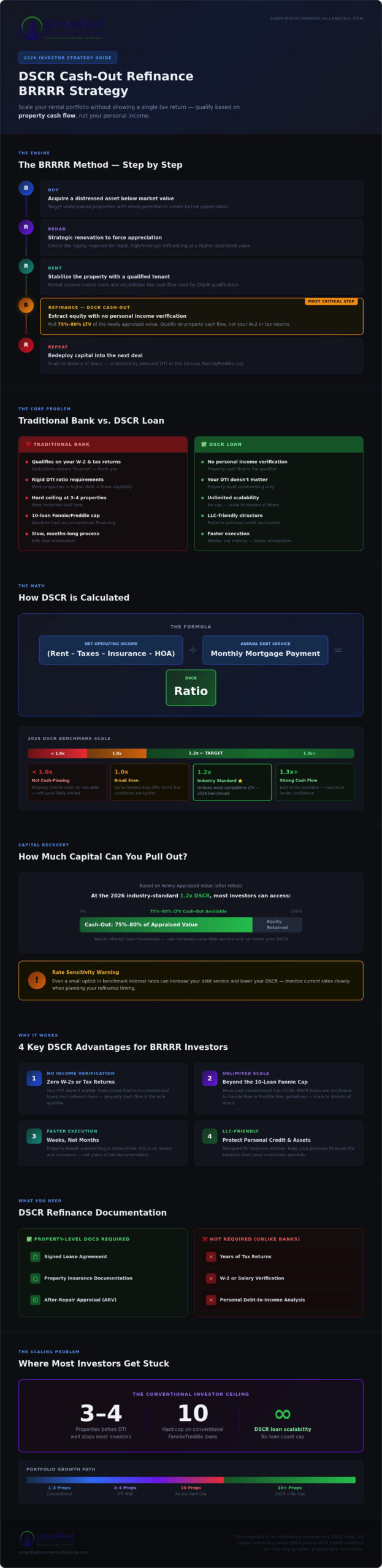
The BRRRR method is the ultimate engine for wealth creation. You buy a distressed asset, rehab it to add value, rent it to cover costs, and refinance to pull your capital back out. The goal is to repeat the process indefinitely. However, many investors find that the cycle breaks at the refinance step. This is the most common failure point in the entire lifecycle. You’ve done the hard work of finding the deal and managing the rehab, only to have a traditional bank reject your application because of your personal income profile.
The Debt-to-Income Wall: Why Banks Say No
Conventional lenders use debt-to-income (DTI) ratios to measure your borrowing power. This works for a primary residence, but it’s a trap for growing investors. As you acquire more properties, your total debt increases. Even if your rentals are highly profitable, banks often see this debt as a liability that limits your capacity for more loans. Most investors hit a hard ceiling after three or four properties because they can’t satisfy rigid DTI requirements.
The problem is compounded by how you report income. Savvy investors use legal deductions to reduce their tax burden. While this is great for your bank account, it’s terrible for traditional loan underwriting. A bank looks at your bottom line on a tax return and sees “low income,” completely ignoring the actual cash flow your portfolio generates. This disconnect stops your momentum and kills your ability to scale.
DSCR: The Investor’s Secret Weapon
A debt service coverage ratio loan changes the rules of the game. Instead of obsessing over your paycheck or your tax returns, lenders look at the property’s ability to pay for itself. This is the core of a successful DSCR cash out refinance BRRRR strategy. It allows you to bypass the personal income hurdles that stop most people in their tracks. By focusing on property-level underwriting, you gain several advantages:
- No Personal Income Verification: Your DTI doesn’t matter because the property’s cash flow is the primary qualifier.
- Unlimited Scalability: You can move past the 10-loan limit of Fannie Mae or Freddie Mac.
- Faster Execution: Property-based underwriting is streamlined, helping you move from rehab to long-term financing in weeks, not months.
- Business-Friendly: These loans are designed for LLCs, protecting your personal credit and assets.
Using these specialized single family residential investment loans means you aren’t limited by your salary. You can scale to dozens of doors without needing a bigger paycheck. A DSCR cash out refinance BRRRR strategy decouples your borrowing power from your personal life. It transforms the “Repeat” step of BRRRR from a hope into a predictable, repeatable system for growth.
The Mechanics of a DSCR Cash-Out Refinance
Executing a successful DSCR cash out refinance BRRRR strategy requires a shift in how you view equity. A DSCR cash-out refinance allows you to extract the value you’ve created during the rehab phase based on the property’s stabilized rental income. Unlike traditional loans that focus on your personal financial history, this method prioritizes the property’s ability to pay for itself. DSCR is defined as the ratio of Net Operating Income to annual debt service. This single number determines your borrowing power and the amount of capital you can pull back into your pocket for the next deal.
In 2026, the industry standard for a healthy “cash-flowing” property remains the 1.2x benchmark. This means your property generates 20% more income than the cost of the mortgage payment. While some lenders may offer terms for ratios as low as 1.0x, hitting the 1.2x mark usually unlocks the most competitive LTV (Loan-to-Value) limits. Most investors can expect to pull out 75% to 80% of the property’s newly appraised value, providing the liquid capital needed to repeat the BRRRR cycle.
Calculating Your Ratio: The Math Behind the Money
The math is straightforward but unforgiving. To find your ratio, start with your gross monthly rent and subtract essential expenses like taxes, insurance, and HOA fees to find your Net Operating Income (NOI). This figure is then divided by your proposed monthly mortgage payment. It is vital to monitor current benchmark interest rates, as even a small uptick in rates can increase your debt service and lower your DSCR.
What happens if your property falls below a 1.0 ratio? In these cases, the asset is technically “unprofitable” in the eyes of a lender. You may still secure financing, but you’ll likely face lower LTVs and higher interest rates. Maximizing your rent and keeping operating costs lean during the “Rent” phase of BRRRR is the best way to ensure your ratio supports a full capital recovery.
No-Doc vs. Traditional Refinancing
The primary advantage here is the removal of the “paperwork mountain.” You won’t spend weeks digging up W-2s, 1099s, or years of personal tax returns. Because the underwriting is asset-based, the speed to close is significantly faster. A traditional bank might take 60 to 90 days to process a cash-out refinance; a specialized DSCR lender can often close the deal in three to four weeks.
There is a trade-off to consider. DSCR rates are typically slightly higher than prime conventional mortgages. However, for the serious investor, this rate spread is a small price to pay for the ability to scale without limits. If you’re ready to stop waiting on bank approvals and start moving at the speed of the market, you can explore customized financing options that prioritize your property’s performance over your personal income. This efficiency is what makes the BRRRR method truly infinite.
Achieving ‘No Money Down’ BRRRR via DSCR Leverage
The “perfect” BRRRR is the holy grail of real estate investing. It happens when you pull 100% of your initial capital back out of a deal, leaving you with a cash-flowing asset and zero dollars of your own money left in the property. This isn’t magic. It’s a calculated result of forced appreciation. By executing a DSCR cash out refinance BRRRR strategy, you leverage the value you’ve created during the rehab phase rather than just the price you paid at closing.
The math makes the difference. Traditional lenders often base their loan amounts on the purchase price or the total cost basis. In contrast, DSCR lenders focus on the After Repair Value (ARV). If you buy a property for $150,000 and spend $50,000 on renovations, your total “buy-in” is $200,000. If your rehab pushes the market value to $270,000, a 75% LTV refinance yields $202,500. You’ve recovered your full investment. You now have a stabilized rental and your original $200,000 is ready to down-pay your next property.
The ARV Advantage
Your appraisal is the most critical document in the BRRRR real estate investment method. To maximize your cash-out potential, you must treat the appraisal like a job interview for your property. Provide the appraiser with a detailed “rehab book” that lists every upgrade, from new HVAC systems to cosmetic finishes. This documentation justifies the jump in value from the purchase price to the ARV. When you bridge that gap effectively, you unlock the maximum amount of capital possible, ensuring your next deal is funded by the equity of the last one.
DSCR vs. Traditional Cash-Out: A Head-to-Head
Speed is the primary reason investors choose DSCR over conventional banking. Traditional lenders typically require 12 months of “seasoning” before they allow a cash-out refinance based on the new appraised value. DSCR programs are far more flexible, often allowing you to refinance in as little as 0 to 6 months if you can document the improvements made. This allows you to cycle your capital twice as fast.
There are also fewer restrictions on how you hold the asset. Traditional banks prefer lending to individuals, which can create personal liability. DSCR lenders actively encourage entity vesting. You can close your refinance in the name of an LLC, protecting your personal credit and allowing for a much higher portfolio concentration. You aren’t limited by the “10-loan cap” that stops traditional borrowers. This flexibility is what turns a small side-hustle into a scalable commercial enterprise.
How to Execute the Perfect BRRRR Refinance Step-by-Step
Executing a DSCR cash out refinance BRRRR strategy requires precise timing and a focus on property performance. You’ve already done the heavy lifting by purchasing and rehabbing the asset. Now, you need to navigate the transition from a short-term project to a long-term, cash-flowing investment. This five-step process ensures you don’t leave capital on the table.
- Step 1: Complete rehab and secure a long-term tenant. A signed lease is the primary evidence of your property’s income potential.
- Step 2: Gather property-level documentation. Forget tax returns; focus on the lease agreement, homeowners insurance (HOI), and clear title work.
- Step 3: Partner with a specialized DSCR broker. A broker can shop market-clearing rates across multiple lenders, ensuring you get the best leverage for your specific asset.
- Step 4: Execute the appraisal and lock your term sheet. This is the moment of truth where your After Repair Value (ARV) is finalized.
- Step 5: Close and deploy capital into your next ‘Buy’ phase. Use your recovered investment to start the cycle again immediately.
Stabilizing the Asset: Renting for Maximum DSCR
Lenders look at more than just your signed lease. They also review the appraiser’s Section 1007 report, which estimates market rents for the area. If your actual lease is significantly higher than market averages, the lender might use the lower figure for underwriting. This is why choosing the right neighborhood is vital. If you are pursuing a short-term rental (STR) model, ensure your lender accepts specialized market analytics or historical occupancy reports to calculate the ratio. Managing your vacancy and expense factors early ensures your final ratio supports the maximum cash-out amount.
Navigating Seasoning and Prepayment Penalties
Seasoning is the length of time you’ve owned the property. Traditional banks usually demand 12 months before they’ll refinance based on a new appraisal, which can kill your momentum. Many specialized DSCR products offer 90-day seasoning. This allows you to recycle your capital four times faster than a conventional borrower.
You must also consider prepayment penalties. While these are common in commercial lending, they can be structured to fit your goals. If you plan to hold the asset for decades, a longer penalty period often secures a lower interest rate. If you want more flexibility, you can opt for a shorter “step-down” penalty. If you’re ready to bypass the 12-month wait, you can apply for a DSCR loan today to lock in your next refinance and keep your portfolio growing.
Scaling Your Rental Portfolio with Simplified Commercial Lending
Traditional banks are rigid. They operate with a single set of rules and a limited appetite for risk. If your profile doesn’t fit their specific box, your growth stops. A broker-led approach is the disruptive alternative you need to master the DSCR cash out refinance BRRRR strategy. We act as your navigator, bypassing the institutional bottlenecks that kill momentum. Instead of being limited by one bank’s internal policy, you gain access to a nationwide network of capital partners designed for the independent entrepreneur.
You need speed and flexibility to stay competitive. Accessing single family residential investment loans shouldn’t feel like a second job. Our no-doc commercial loans focus on the asset’s performance rather than your personal paycheck. We don’t ask for years of tax returns or W-2s. We look at the property’s ability to generate revenue, allowing you to close deals while your competitors are still digging through filing cabinets.
Once you’ve stabilized several properties, managing individual refinances can become a hurdle. This is where a portfolio line of credit for rentals becomes your most powerful tool for infinite scaling. It allows you to tap into the combined equity of your entire portfolio at once. This model provides the liquid capital you need to strike the moment a new distressed property hits the market. It transforms your equity from a static number on a spreadsheet into a proactive engine for acquisition.
Beyond Single Family: Multi-Family and Commercial BRRRR
The BRRRR method isn’t limited to small houses. You can scale into larger assets by leveraging multi family residential investment loans using the same core principles. DSCR logic applies to 5+ unit properties and commercial assets with equal efficiency. As you transition to larger buildings, the underwriting remains focused on the Net Operating Income. This shift allows you to move from owning individual doors to managing a significant commercial portfolio without ever hitting a debt-to-income ceiling.
Your Partner in Infinite Scaling
Stop letting tax returns dictate the pace of your success. You are a bold innovator, and you deserve a financing partner that values pragmatism over protocol. We understand the frustrations of the self-employed investor because we built our systems to solve them. Whether you are working on your second property or your fiftieth, we provide the expert guidance needed to bypass industry bottlenecks. It is time to embrace a financing model that works as hard as you do. Get your custom DSCR loan quote today and take the next step toward a truly scalable rental empire.
Unlock Infinite Scaling for Your Portfolio
Building a massive rental empire shouldn’t depend on how well you can navigate a traditional bank’s red tape. By mastering the DSCR cash out refinance BRRRR strategy, you shift the focus from your personal tax returns to the actual performance of your assets. This transition allows you to recover your capital faster, bypass rigid DTI limits, and keep your momentum building without the long seasoning periods typical of conventional lenders.
As nationwide investment property experts, we specialize in asset-based underwriting that prioritizes your results. We don’t require tax returns, and our streamlined process is built for the high-speed demands of modern real estate. It’s time to stop letting outdated institutional norms hold you back from your next acquisition. Your growth is limited only by the quality of your deals, not your paperwork.
Scale your portfolio today with a DSCR loan from Simplified Commercial Lending
Take control of your financial future and start repeating your success today. The path to a scalable, no-doc portfolio is ready when you are.
Frequently Asked Questions
What is a DSCR cash-out refinance?
A DSCR cash-out refinance is a loan that lets you extract equity from an investment property based on its rental income rather than your personal salary. Lenders calculate the ratio of the property’s Net Operating Income to its annual debt service. If the property’s cash flow covers the mortgage, you can pull cash out to fund your next acquisition. This is a core component of the DSCR cash out refinance BRRRR strategy.
Can I use the BRRRR method with no money down using DSCR loans?
Yes, you can achieve a “no money down” deal if the property’s forced appreciation is high enough. By increasing the asset’s value through rehab, you create substantial equity. If a lender provides a 75% or 80% loan-to-value (LTV) on the new appraised value, that amount might cover 100% of your initial purchase and renovation costs. This effectively leaves you with zero personal capital in the property.
How long do I have to wait to refinance a BRRRR property (seasoning)?
Many specialized DSCR lenders allow you to refinance in as little as 90 days if you can document the improvements made to the property. This is a significant advantage over traditional banks, which typically require a 12-month seasoning period before allowing a cash-out based on the new appraised value. Rapid seasoning allows you to recycle your investment capital multiple times within a single calendar year.
Do DSCR lenders require personal tax returns or W-2s?
No, these are “no-doc” loans that prioritize property performance over personal income history. You won’t need to provide years of tax returns, 1099s, or W-2 forms to qualify. This makes these loans ideal for self-employed investors or those with high taxable deductions. The underwriting focuses on the lease agreement, property appraisal, and the asset’s ability to cover its own debt service.
What is the minimum DSCR ratio required for a cash-out refinance?
Most lenders look for a minimum ratio of 1.20, meaning the property generates 20% more income than the mortgage payment. However, some programs allow for ratios as low as 1.0 or even slightly below in specific cases. Higher ratios generally unlock more competitive interest rates and higher loan-to-value limits. Always aim for strong market rents to maximize your leverage during the refinance phase.
Can I close a DSCR loan in an LLC?
Yes, closing in the name of an LLC or other business entity is actually encouraged by most DSCR lenders. This structure protects your personal credit and provides a layer of liability defense for your real estate business. Unlike traditional residential mortgages that favor individual borrowers, these commercial-style loans are designed for the modern entrepreneur looking to build a professional rental portfolio.
How many properties can I finance using the DSCR strategy?
There is no conventional limit to the number of properties you can finance. Because these loans don’t rely on your personal debt-to-income ratio, you aren’t capped by the 10-loan limit seen with Fannie Mae or Freddie Mac. You can continue to scale your portfolio as long as each property meets the lender’s cash flow requirements. This makes the DSCR cash out refinance BRRRR strategy infinitely scalable.
What are the typical closing costs for a DSCR cash-out refinance?
Closing costs generally range between 2% and 5% of the total loan amount. These costs include appraisal fees, title insurance, origination fees, and escrow impounds for taxes and insurance. While these fees are similar to traditional loans, the speed and lack of personal documentation often save you significant soft costs in lost time. You can often roll these costs into the new loan balance.