Why are you still letting your personal tax returns dictate the size of your real estate empire? You’ve likely hit a ceiling with traditional banks that care more about your personal debt than the actual profit your property generates. It’s frustrating to watch prime multi-family opportunities slip away while a loan officer scrutinizes your 1040s. You know that property performance should be the priority, yet the old-school banking system keeps you trapped in a cycle of endless paperwork and slow approvals.
You can break those chains and scale faster by mastering the dscr loan for apartment building financing. This guide reveals how to secure multi-family funding based entirely on property cash flow, allowing you to bypass personal income checks and DTI caps. We’ll walk you through the 2026 requirements for 5+ unit buildings, show you how to leverage equity for new acquisitions, and explain the benefits of non-recourse financing. It’s time to stop acting like a borrower and start acting like a CEO by focusing on the numbers that actually matter. Let’s dive into the streamlined path to your next major acquisition.
Key Takeaways
- Shift your focus from personal tax returns to property performance to bypass the restrictive debt-to-income limits that stall most independent investors.
- Master the “Golden Formula” for a dscr loan for apartment building to see if your multi-family asset meets the standard 1.20x coverage threshold.
- Learn how to use a portfolio line of credit to fund your next acquisition with low out-of-pocket costs instead of waiting on traditional bank approvals.
- Discover the critical role of the T-12 statement and rent roll in securing non-recourse financing for your 5+ unit buildings.
Why Traditional Apartment Financing Fails the Modern Investor
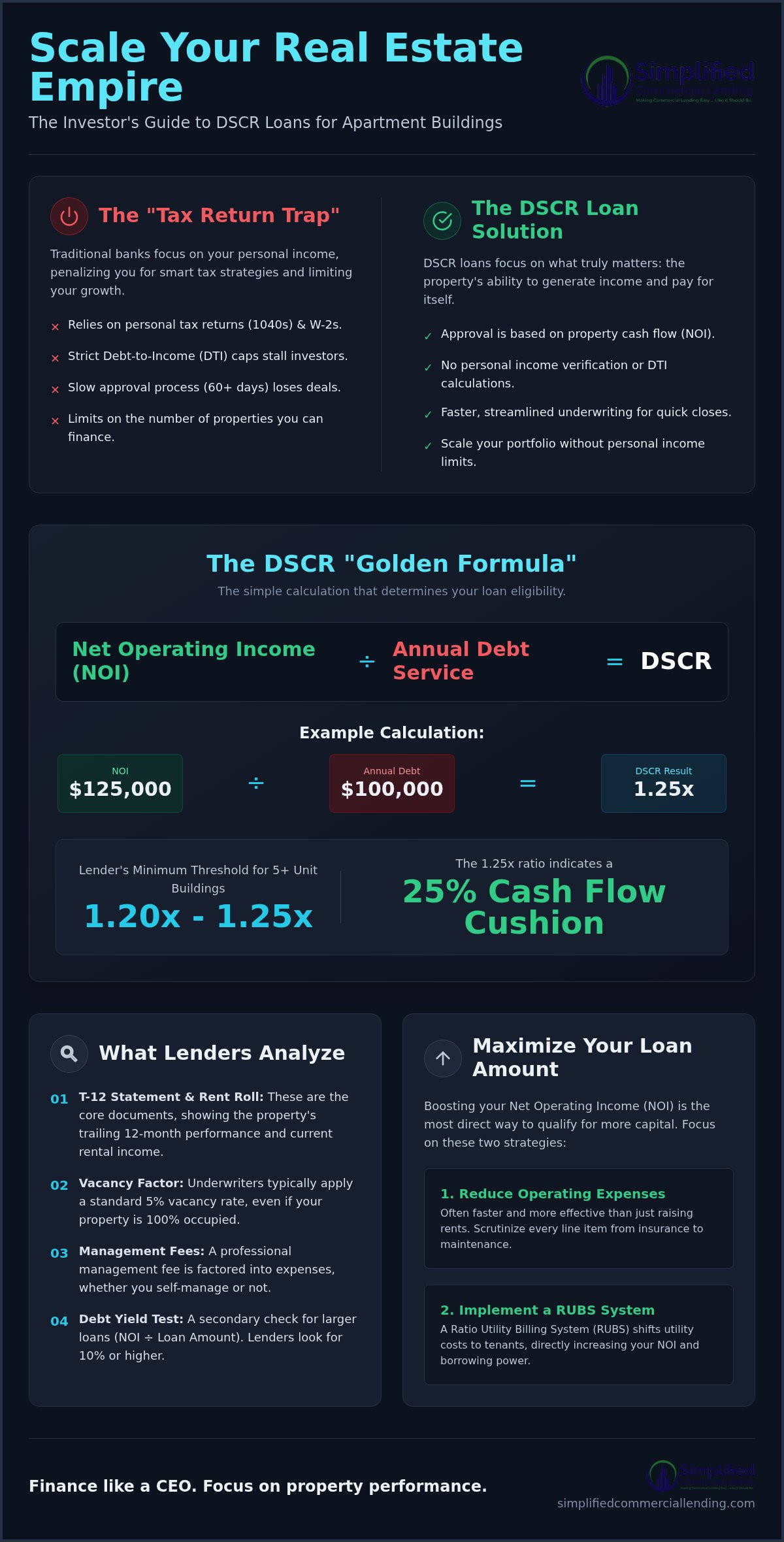
Your tax strategy and your financing goals are often on a direct collision course. Your accountant works hard to maximize deductions, lowering your taxable income so you keep more of what you earn. To a traditional loan officer, those same deductions make you look like a high-risk borrower with limited cash flow. It’s a frustrating paradox. You’re successfully building wealth, but the bank sees you as someone who can’t afford a new mortgage. This “Tax Return Trap” is the primary reason many investors stall out after their first few units.
The 2026 market demands a more agile approach. Traditional lending relies on Debt-to-Income (DTI), which measures your personal earnings against your personal debt. It’s a metric designed for homeowners, not business owners. A dscr loan for apartment building financing package ignores these personal constraints. Instead, it uses the Debt Service Coverage Ratio to focus on the asset’s ability to pay for itself. If the building’s income covers the mortgage, the deal moves forward. It’s that simple.
The Problem with Big Banks and Apartment Loans
Big banks operate on rigid, outdated checklists that don’t account for the reality of professional real estate investment. They treat depreciation as a real cash loss, effectively penalizing you for using legal tax benefits. This leads to capped loan amounts or flat-out denials once you own more than a few properties. Most retail lenders have a hard limit on how many active loans they’ll carry for one person. Their approval timelines are also notoriously slow. While you’re waiting 60 days for a committee to review your file, a faster investor with non-bank capital has already closed on the deal.
Why DSCR is the Disruptive Solution for Multi-Family
DSCR lending is the ultimate shortcut for the independent entrepreneur. Underwriting is based 100% on the building’s Net Operating Income (NOI). This means you don’t need to provide W2s, pay stubs, or years of tax history to prove your worth. By utilizing multi family residential investment loans, you can scale your portfolio without the ceiling of personal income limits. It’s about property profit potential, not your personal creditworthiness. This approach allows you to secure a dscr loan for apartment building quickly, tapping into capital that moves at the speed of your business. You gain the freedom to leverage the equity in your existing buildings to fund new acquisitions without the traditional paperwork headache.
Calculating the DSCR for Your Apartment Building
The math behind a dscr loan for apartment building is refreshingly simple. Unlike traditional mortgages that obsess over your personal debt, this formula focuses entirely on the property’s ability to pay its own way. The Golden Formula is: Net Operating Income (NOI) divided by your Annual Debt Service. If your building generates $125,000 in NOI and your annual mortgage payments are $100,000, your ratio is 1.25x. This number tells the lender you have a 25% cushion above the break-even point.
For multi-family assets with 5 or more units, lenders typically look for a threshold between 1.20x and 1.25x. In the 2026 market, underwriters are particularly focused on realistic vacancy adjustments. They’ll often apply a standard 5% vacancy factor and account for professional management fees, even if you manage the units yourself. They also compare your “In-Place Rent” (what tenants currently pay) against “Market Rent” (what they could pay). While market rents show potential, lenders usually base the loan amount on the actual cash flowing through the building today.
Larger apartment complexes may also face a “Debt Yield” test. This is your NOI divided by the total loan amount. It’s a secondary safety check that ensures the lender could recover their investment if they had to take over the property. Aiming for a debt yield of 10% or higher puts you in a strong position for the best possible rates.
Maximizing Your NOI to Qualify for More Capital
Net Operating Income serves as the rhythmic heartbeat of your commercial loan application, signaling the true financial health of your asset to every potential lender. To boost this figure, look beyond just raising rents. Reducing operating expenses is often faster and more effective. Implementing a Ratio Utility Billing System (RUBS) can significantly improve your coverage ratio by shifting utility costs back to the tenants. This move directly increases your NOI, which in turn increases the total loan amount you can secure. If you’re ready to see how your property stacks up, you can start your property analysis here with an expert guide.
DSCR vs. Traditional Multi-Family Loans
The difference in documentation is night and day. While a traditional bank demands a mountain of personal tax returns and W2s, a DSCR loan is essentially a “No Doc” solution for your personal finances. You focus on the rent roll and the P&L; we focus on the funding. This streamlined approach means you can close in 21 to 30 days, compared to the 60-day slog of a retail bank. Additionally, these loans offer total flexibility for entity vesting. You can hold the title in an LLC, Corporation, or Trust, protecting your personal assets while you scale. This speed and protection make it the preferred choice for investors who refuse to let red tape slow their momentum.
Apartment Building Financing: No Money Down Myth vs. Reality
You’ve likely seen the headlines promising 100% financing for multi-family deals. While a true “zero down” scenario is rare in institutional lending, achieving a “low out-of-pocket” acquisition is entirely possible. The secret isn’t finding a lender who doesn’t want a down payment. It’s finding a lender who accepts creative sources for that capital. By using a portfolio line of credit for rentals, you can tap the equity in your current holdings to cover the down payment on a new building. This turns your existing portfolio into an ATM for growth without selling a single asset.
In 5+ unit apartment deals, seller carrybacks are a powerful tool. A seller might agree to hold a second mortgage for 10% or 15% of the purchase price. This reduces the cash you need to bring to the table. When you combine this with a dscr loan for apartment building, the property’s cash flow covers both the primary and secondary debt. Cross-collateralization takes this a step further. Instead of a cash down payment, you use the equity in other properties as security. It’s a sophisticated move that traditional banks rarely offer, but non-bank lenders embrace.
Creative Strategies for Apartment Building Financing with No Money Down
The “Equity Tap” method involves refinancing smaller residential units to fund the purchase of larger multi-family assets. It’s a logical progression for investors ready to level up. You can also structure a “Master Lease Option” to control a property’s operations and income before the actual purchase. This allows you to improve the NOI and qualify for better terms later. Understanding specific dscr loan requirements helps you identify which buildings have the highest leverage potential before you even make an offer. Focus on the numbers, and the capital will follow.
The Power of Gap Financing and Mezzanine Debt
Professional investors often use gap financing or mezzanine debt to bridge the distance between their first-position loan and the total purchase price. This creates a “Capital Stack” where multiple layers of funding work together. You might secure a 75% LTV dscr loan for apartment building and then use private capital for the remaining 25%. When you pitch these deals to non-bank lenders, focus on the property’s performance and your track record. They value pragmatism over protocol. This makes them much more likely to approve creative structures that retail banks would reject immediately. Your job is to present a deal where the cash flow is undeniable.
How to Secure a DSCR Loan for Your Next Building: A Step-by-Step Guide
Securing a dscr loan for apartment building financing requires a fundamental shift in how you present your deal. You aren’t selling a lender on your personal income; you’re selling them on the property’s operational excellence. Because these loans are asset-based, the quality of your data is your most powerful leverage. Lenders in 2026 prioritize the property’s history and its future profit potential over your personal tax returns. This process moves significantly faster than traditional banking, but it demands precision from the start.
Step 1: Property Performance Audit
Before you even call a broker, conduct a “Pre-Flight” check by running your own DSCR calculations. Lenders will immediately scrutinize your Rent Roll to verify current occupancy, lease expiration dates, and any tenant concessions. They also require a Trailing 12 Months (T-12) Profit and Loss statement to understand the building’s true operational costs, including maintenance and utilities. Ensure the property meets the minimum unit count of 5 or more to qualify for commercial terms. During the audit, identify “Value-Add” opportunities, such as planned renovations or utility bill-backs, that will increase your future NOI. When the commercial appraisal is ordered, the lender will focus on the “As-Is” value versus the “As-Stabilized” value to determine your total funding limit.
Step 2: Preparing the No-Doc Application
Since this is a no-doc process, you can skip the mountain of personal financial paperwork. You’ll primarily need a clean credit report, your LLC formation documents, and the property’s financial package. Organizing a professional Schedule of Real Estate Owned (REO) is vital because it proves you have a track record of successful management. Your experience as a landlord can often lower your required DSCR. This experience signals to the underwriter that you know how to navigate tenant issues and maintain property value, which reduces their perceived risk. By keeping your personal finances separate and focusing on the LLC’s strength, you maintain the “No-Doc” advantage that makes these loans so efficient.
Step 3: Closing and Funding Your Deal
The final phase involves navigating environmental and physical inspections to ensure the asset is structurally sound and free of liabilities. This is the stage where you finalize the specific terms of your commercial property loan. Many savvy investors use a short-term bridge loan for the initial acquisition and then transition into permanent dscr loan for apartment building financing once the building is stabilized and rents are optimized. This two-step approach allows you to capture distressed assets and turn them into long-term wealth generators. If you have a multi-family deal on the table right now, you can request a rapid deal review to see exactly how much capital you can unlock.
Scale Faster with Simplified Commercial Lending
Traditional banking committees move at a glacial pace. In a competitive market, waiting sixty days for an approval isn’t just an inconvenience; it’s a deal-killer. Simplified Commercial Lending operates as a national broker with a singular focus: speed. We provide the personalized, expert guidance you need to navigate complex dscr loan for apartment building structures without the institutional red tape. Whether you’re looking at a small multi-family property or a 100+ unit complex, we bridge the gap between your ambition and the capital required to achieve it.
We give you direct access to non-bank capital that traditional retail lenders simply can’t touch. These funding sources aren’t bound by the same rigid regulations as your local branch. They prioritize property performance and your experience as an operator over your personal tax history. This flexibility allows us to secure financing for high-growth investors who have been “capped out” by mainstream banks. We know a good deal won’t wait, so we’ve built a system that moves as fast as you do.
Why Investors Choose Our No-Doc Solutions
The “No-Doc” advantage is about more than just avoiding paperwork. It’s about maintaining your momentum. With no tax returns and no personal income verification, you avoid the headaches that typically stall commercial acquisitions. Our streamlined processing works across your entire portfolio, from multi-family assets to specialized short term rental financing. This approach empowers you to act like a cash buyer. When you can prove property performance quickly, you win the trust of sellers and close more deals. It’s a pragmatic solution for the modern entrepreneur who values results over protocol.
Your Next Step to Portfolio Growth
Scaling your portfolio shouldn’t feel like a second full-time job. Our onboarding process for new apartment acquisitions is designed to be as simple as possible. We focus on the property’s financials first, allowing us to provide custom loan sizing in under 48 hours. This rapid feedback loop lets you know exactly where you stand before you sink time and money into deep due diligence. You get the clarity you need to make bold moves with confidence. If you’re ready to stop jumping through bank hoops and start closing, Get your apartment building loan quote today. Let’s get your next dscr loan for apartment building across the finish line.
Take Control of Your Multi-Family Growth
The days of letting personal debt-to-income ratios stall your progress are over. By focusing on property cash flow rather than your individual tax returns, you can finally scale your portfolio at the speed of your business. You now have the blueprint to calculate your coverage, leverage existing equity, and navigate the “no-doc” application process with confidence. A dscr loan for apartment building isn’t just a financial product; it’s a strategic tool designed for the modern entrepreneur who values results over red tape.
Simplified Commercial Lending is a national commercial mortgage brokerage dedicated to helping you bypass traditional industry bottlenecks. We specialize in multi-family and portfolio scaling, allowing you to close deals without tax returns in 30 days or less. Don’t let another prime acquisition slip away while waiting on a bank committee. It’s time to move toward a more efficient way of building wealth through high-performing assets.
Get a custom DSCR loan quote for your apartment building today and take the first step toward securing your next multi-family asset. Your future portfolio is waiting for you to take action.
Frequently Asked Questions
Can I use a DSCR loan for a 10-unit apartment building?
Yes, you can certainly use a dscr loan for apartment building projects involving 10 units. These buildings fall under commercial multi-family guidelines, where lenders prioritize the property’s Net Operating Income over your personal tax returns. This asset-based approach allows you to secure financing for larger complexes that traditional banks might find too complex. It’s a perfect solution for investors moving from small residential units into significant commercial holdings without the typical paperwork hurdles.
Do DSCR loans for apartments require a personal guarantee?
Most standard DSCR loans require a personal guarantee from the primary stakeholders. This means you’re personally responsible if the property can’t meet its obligations. However, non-recourse options are frequently available for experienced investors or larger multi-family assets. These programs limit the lender’s recovery to the property itself, providing a vital layer of personal asset protection. You should always clarify the recourse terms with your broker before signing the final loan commitment.
What is the minimum credit score for a multi-family DSCR loan?
The minimum credit score for a multi-family DSCR loan is usually 640. While you can qualify at this level, you’ll likely face higher interest rates and lower leverage. To unlock the best terms and LTVs, aim for a score of 680 or higher. Investors with scores above 720 often receive top-tier pricing. Your credit history acts as a secondary safety check, even though the building’s cash flow remains the primary focus.
How much down payment is required for an apartment building financing no money down deal?
A true “no money down” deal is rare, but you can achieve low out-of-pocket acquisitions by using creative capital. Standard dscr loan for apartment building requirements typically call for a 20% to 25% down payment. You can bridge this gap by using a portfolio line of credit or negotiating a seller carryback. These strategies allow you to preserve your cash while still meeting the lender’s equity requirements for the primary commercial mortgage.
Are DSCR loans for apartment buildings non-recourse?
Many DSCR programs for 5+ unit apartment buildings offer non-recourse financing. This structure is a major advantage for professional investors because it protects personal assets from lender seizure in the event of a foreclosure. While non-recourse loans may have slightly stricter underwriting or require higher reserves, the liability protection is often worth the trade-off. It’s a sophisticated way to manage risk while aggressively scaling your apartment portfolio across the country.
How long does it take to close a multi-family DSCR loan?
You can expect to close a multi-family loan in approximately 21 to 30 days. This rapid timeline is a direct result of the “no-doc” nature of the application process. Because the lender isn’t spending weeks auditing your personal tax returns and debt-to-income ratios, they can focus entirely on the property’s appraisal and rent roll. This speed gives you a massive competitive advantage when bidding against investors using slow, traditional bank financing.
Can I use a DSCR loan for a mixed-use building with apartments?
Yes, mixed-use buildings are eligible for DSCR financing if the residential apartment units represent the majority of the property. Most lenders require that at least 50% to 60% of the square footage or gross income comes from the apartments rather than the commercial storefronts. As long as the residential cash flow is strong, you can use these loans to acquire versatile assets that provide multiple streams of income from different tenant types.
What happens if the apartment building’s DSCR falls below 1.0?
If the ratio falls below 1.0, the property is technically “underwater” on its monthly debt service. Standard lenders usually require a minimum of 1.15 to 1.25 for approval. However, some aggressive programs will finance a sub-1.0 building if you can demonstrate a clear “value-add” strategy to raise rents quickly. You may also need to provide additional cash reserves to prove you can cover the shortfall during the property’s stabilization phase.