Your personal tax returns shouldn’t be the ceiling for your real estate empire. For most traditional banks, however, those documents are the only thing they care about. If you’re managing a dozen different mortgages with a dozen different due dates, you’re probably drowning in paperwork instead of finding new deals. You’ve likely hit the “financing wall” where your debt-to-income ratio makes the next acquisition feel impossible. Partnering with a specialized commercial mortgage broker for investors can change that narrative instantly by shifting the focus from your personal income to your property’s performance.
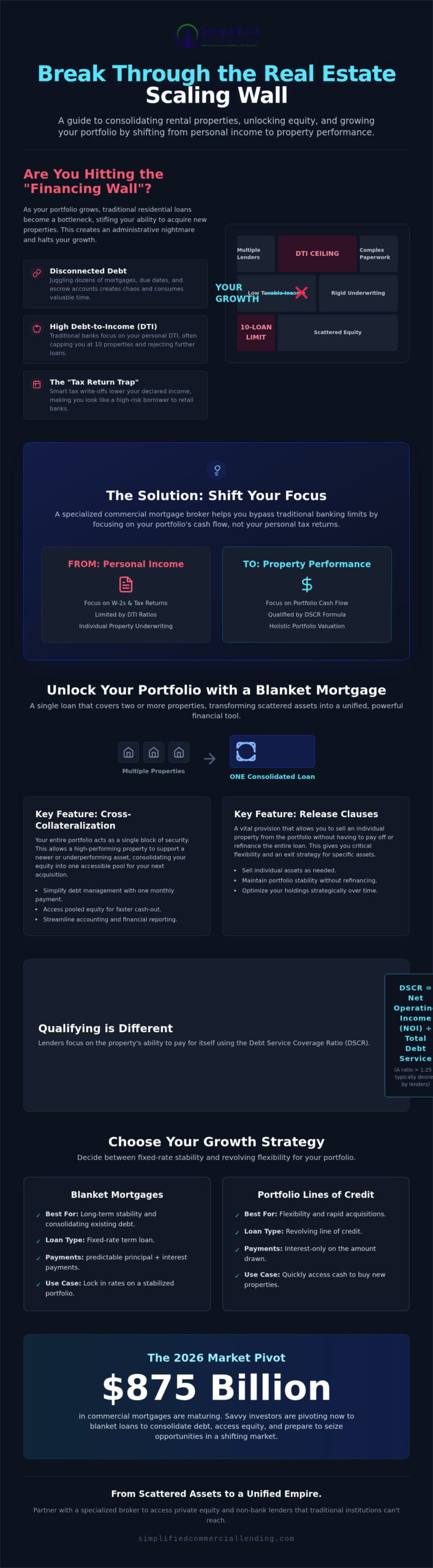
It’s frustrating to watch opportunities pass by because of rigid institutional norms. We’re here to show you a better way. This guide explains how to consolidate your rental properties into a single, streamlined loan to unlock equity and scale your portfolio. You’ll learn how to navigate the 2026 market, where nearly $875 billion in commercial mortgages are maturing and savvy investors are pivoting to blanket loans. We’ll preview the exact steps to simplify your debt management, lower your interest costs, and get fast access to cash for your next big move.
Key Takeaways
- Stop letting personal debt-to-income ratios stall your growth. Learn how to bypass traditional banking bottlenecks that cap your property count.
- Consolidate multiple properties into a single loan to simplify your monthly management. Discover how release clauses give you the flexibility to sell individual assets without refinancing the entire portfolio.
- Working with a specialized commercial mortgage broker for investors provides access to private equity and non-bank lenders that traditional institutions can’t reach.
- Shift your focus from personal tax returns to property performance using the DSCR formula. This approach ensures your ability to scale is based on your assets’ cash flow, not your personal income.
- Decide between fixed-rate stability and revolving flexibility by comparing blanket mortgages to portfolio lines of credit. Gain the fast access to cash needed to secure your next acquisition in 2026.
The Scaling Wall: Why Individual Mortgages Stifle Investor Growth
Scaling a real estate portfolio is exhilarating until the logistics start to bite back. Most investors begin their journey with standard residential loans, which work perfectly for the first few acquisitions. However, as you approach your fifth or tenth property, the friction becomes undeniable. You aren’t just managing real estate anymore; you’re managing a mountain of disconnected debt. This is the “scaling wall,” a point where traditional financing methods actually work against your growth. To break through, you need to transition from a hobbyist borrower to a professional portfolio manager who understands how to leverage a Blanket mortgage to unify scattered assets.
The Administrative Burden of Scattered Debt
Managing twenty separate mortgage payments is an operational nightmare. Each loan comes with its own due date, its own escrow account, and its own unique insurance requirements. This fragmentation doesn’t just eat up your time; it complicates your entire accounting process. When every property is tied to a different lender, your financial reporting becomes a tangled mess of statements and spreadsheets. This inefficiency does more than cause headaches. It blocks your ability to move quickly. If a prime deal hits the market tomorrow, can you accurately assess your total equity across ten different lenders in minutes? Probably not. That delay is often the difference between winning a bid and losing it to a more organized competitor.
Traditional Banking vs. Commercial Flexibility
Traditional banks are built for the average homeowner, not the ambitious entrepreneur. They rely on rigid debt-to-income (DTI) ratios that often cap out after you reach ten properties. Even worse, many investors fall into the “tax return trap.” You’ve spent years working with your CPA to maximize legal write-offs and lower your taxable income, which is a smart business move. But when you walk into a retail bank, those low income numbers make you look like a high-risk borrower. They see your deductions as a lack of cash flow rather than strategic tax planning.
This is exactly why a commercial mortgage broker for investors is a vital ally. Instead of focusing on your personal tax returns, these professionals look at the property’s performance. Traditional banks fear high-volume rental owners because they cannot fit complex, multi-property risks into their narrow underwriting boxes. A broker bypasses these institutional bottlenecks by connecting you with lenders who prioritize the Debt Service Coverage Ratio (DSCR) of your entire portfolio. It’s a shift from proving your personal worth to proving your business’s value. Stop begging banks for permission to grow and start using debt structures designed for your success.
Defining the Blanket Mortgage: A Single Solution for Multiple Assets
A blanket mortgage is a single loan that covers two or more pieces of real estate. Instead of juggling ten different closing dates and ten different lenders, you bundle your assets under one lien. This strategy is a game-changer for single-family rental (SFR) owners looking to professionalize their operations. Understanding Blanket Mortgages is about recognizing that your properties are stronger together than they are apart. It transforms a scattered collection of houses into a unified business asset.
How Cross-Collateralization Works for You
Cross-collateralization is the engine behind these loans. It treats your entire portfolio as a unified block of security. This means a high-performing property can help “carry” a newer or underperforming asset in the eyes of a lender. You’re effectively consolidating your equity into a single, accessible pool. This makes pulling out cash for your next acquisition much simpler. You also gain the massive administrative win of a single monthly payment. No more tracking dozens of due dates or insurance renewals. It’s cleaner. It’s faster. It’s built for growth.
The Importance of Release Clauses
Never sign a blanket loan without a partial release clause. This is a vital provision that lets you sell an individual property without triggering a full loan payoff. In plain English, it gives you an exit strategy for specific assets while keeping the rest of your financing intact. You should look for a “release price” typically ranging from 110% to 120% of the property’s allocated value. This ensures you can trim your portfolio or flip a specific asset whenever the market timing is right. Without this clause, your entire portfolio is essentially locked until the loan is paid in full.
The real power of this structure lies in the underwriting. A commercial mortgage broker for investors doesn’t care about your personal debt-to-income ratio. They care about the Debt Service Coverage Ratio (DSCR). This metric measures whether the property’s income covers the debt. By shifting the focus to property-level cash flow, you stop being limited by your personal tax returns. This is how professional investors bypass the “scaling wall” and continue to acquire assets even when traditional banks say no. If you want to unlock the true value of your rentals, consulting with a portfolio specialist can help you design a loan that grows with you.
Blanket Mortgages vs. Portfolio Lines of Credit: Which Wins?
Choosing the right debt structure is a strategic decision that depends entirely on your current investment phase. You shouldn’t just look for the lowest rate. You need to look for the highest utility. A blanket mortgage provides a fixed-rate foundation for long-term stability. A portfolio line of credit offers the revolving liquidity required for high-velocity growth. Understanding the trade-offs between these two is how you maintain a healthy Debt Service Coverage Ratio (DSCR) while continuing to expand. A commercial mortgage broker for investors can help you weigh these options based on your specific 2026 goals.
Term Debt vs. Revolving Credit
Blanket mortgages function as term debt. They usually feature fixed interest rates for 5, 10, or even 30 years. This predictability is vital if your goal is maximizing monthly cash flow. You know exactly what your debt service looks like for the next decade. In contrast, a portfolio line of credit is revolving. You only pay interest on what you use. This is the ultimate tool for the “buy, rehab, rent, refinance” (BRRRR) method. It gives you the speed to close deals in cash-like fashion. If you are currently in an aggressive acquisition phase, a Portfolio Line of Credit: Scale Rentals Without Tax Returns provides the flexibility that a rigid term loan cannot match.
Cost Analysis: Closing Fees and Points
The math often favors consolidation. Closing ten individual refinances means paying ten separate sets of appraisal fees, title costs, and legal bills. A blanket loan collapses these into a single event. While the initial origination fee might look larger because of the loan size, the per-unit cost is almost always lower. A savvy commercial mortgage broker for investors will look for ways to minimize “junk fees” that often hide in commercial term sheets. Watch out for heavy prepayment penalties or yield maintenance clauses. These can be expensive if you plan to sell off assets quickly. Always prioritize transparency in your term sheet to ensure your simplified loan doesn’t come with complicated surprises later. Consolidating debt isn’t just about a single payment; it’s about reducing the total friction of your financial life.
Qualifying for a Blanket Loan: DSCR and Property Requirements
Qualifying for a blanket mortgage is different than getting a standard home loan. Lenders stop looking at your paycheck and start looking at your assets. The primary metric is the Debt Service Coverage Ratio (DSCR). This formula is simple: divide your net operating income by your total debt service. In 2026, most lenders require a minimum DSCR of 1.25x for multifamily properties. For other commercial property types, expect a higher requirement ranging from 1.30x to 1.40x. For a deeper dive into specific benchmarks, see our DSCR Loan Requirements: 2026 Portfolio Scaling Guide. This shift in focus allows you to include single-family rentals, multi-family units, and even short-term rentals in a single package. Typically, a blanket mortgage makes the most financial sense once you reach a portfolio of 3 to 5 properties.
The No-Doc Advantage: Scaling Without Tax Returns
The biggest hurdle for high-growth investors is the “tax return trap.” You’ve used legal deductions to lower your taxable income, but traditional banks see that as a lack of ability to pay. A commercial mortgage broker for investors bypasses this by using a no-doc approach. We don’t ask for your personal tax returns. Instead, we focus on the property’s performance. Asset-based lending evaluates the income-generating potential of the real estate rather than the borrower’s personal salary. If the rent covers the mortgage and expenses with a healthy margin, the deal works. It’s a pragmatic way to lend that rewards smart acquisitions rather than high W-2 earnings. This allows you to keep your tax strategy intact while continuing to build your empire.
Minimum Credit and Liquidity Standards
While the property is the star of the show, your financial health still plays a supporting role. To secure the best 2026 interest rates, which can start as low as 5.87% for prime scenarios, you’ll generally need a credit score of 680 or higher. Lenders also look for “reserves.” This is cash or liquid assets kept in the bank to cover 6 to 12 months of debt service. It acts as a safety net for vacancies or unexpected repairs. Finally, your track record matters. Lenders want to see property management experience. They’re more likely to offer competitive terms to an investor who has already proven they can handle the “tenants and toilets” side of the business. If you’re ready to see how your current portfolio measures up, get a custom rate quote today and start your next phase of growth.
Choosing the Right Commercial Mortgage Broker for Investors
Don’t limit your growth to a single bank’s balance sheet. A traditional bank has one playbook and one set of rigid rules. If your portfolio doesn’t fit their narrow criteria, you’re stuck. A commercial mortgage broker for investors acts as a resourceful navigator who bypasses these institutional bottlenecks. We provide access to private equity, insurance funds, and non-bank lenders that aren’t accessible to the general public. This “Simplified” approach is designed to remove the friction of commercial paperwork and focus entirely on your results. For a complete look at the 2026 lending landscape, explore our Commercial Property Loan Guide: How to Finance Your Investment in 2026.
Direct Lenders vs. Specialized Brokers
Direct lenders are essentially single-store shops. They sell only what they have on the shelf. A specialized commercial mortgage broker for investors is more like a global sourcing agent. We find the specific lender whose appetite matches your asset type, whether it’s single-family rentals or multi-family complexes. Beyond just finding a rate, a broker adds value by “packaging” your deal. We know exactly what underwriters need to see to reach a “Yes” quickly. This includes highlighting your property management experience and the stability of your rent roll. A tech-forward brokerage also provides a significant speed advantage. We close deals in weeks, while traditional banks often measure their process in months.
Take Action: Consolidate and Conquer
The path to a unified strategy starts with a few simple documents. You don’t need a mountain of personal tax returns to get started. Focus on your assets instead. Here is what you’ll need to begin the consolidation process:
- A current rent roll: Detail the income for every property in the proposed pool.
- Mortgage statements: Provide the current balance and terms for each existing loan.
- Property insurance: Have your current coverage details ready for review.
The timeline is efficient. You can expect an initial quote within 48 hours and a full closing typically within 30 to 45 days. This speed allows you to lock in rates and move on to your next acquisition without the typical banking headache. Stop begging traditional institutions for permission to scale. Move from scattered debt to a unified, professional strategy that treats your portfolio like the high-performing business it is.
Break Through the Scaling Wall in 2026
Scaling your real estate empire requires more than just finding the next deal. It requires a debt strategy that keeps up with your ambition. By consolidating your scattered assets into a single blanket mortgage, you eliminate the administrative friction that stalls most portfolios. You stop letting rigid banking limits dictate your future and start leveraging the actual cash flow of your properties. Consolidating your debt isn’t just about simplicity; it’s about making your portfolio bankable as a unified business asset.
Working with a specialized commercial mortgage broker for investors gives you the edge needed to navigate the 2026 market. We prioritize property performance over personal tax returns. Our asset-based lending approach means we focus on results rather than red tape. We provide national coverage across all 50 states to ensure you never hit a geographic or institutional wall. No tax returns are required, and we specialize in DSCR solutions that traditional banks simply won’t touch.
It’s time to move from managing debt to building wealth. Scale your portfolio today-get a quote from Simplified Commercial Lending. Your next acquisition is waiting, and we’re here to help you secure it with speed and confidence.
Frequently Asked Questions
What is a blanket mortgage and how does it work?
A blanket mortgage is a single loan that covers two or more real estate assets. Instead of managing ten different mortgages, you consolidate them into one monthly payment. It works through cross-collateralization, where all properties in the pool serve as security for the debt. This structure allows you to unlock equity from the entire portfolio at once. It’s an essential tool for investors who want to streamline operations and increase their total borrowing power.
Can I include short-term rentals or Airbnbs in a blanket loan?
Yes, you can include short-term rentals and Airbnbs in a blanket mortgage. We specialize in short-term rental financing that accounts for the unique income streams of vacation properties. While traditional banks often struggle to value seasonal or nightly rental income, our asset-based approach focuses on the actual cash flow. As long as the portfolio meets the required Debt Service Coverage Ratio (DSCR), your short-term rentals are eligible for consolidation into a single loan.
Do blanket mortgage lenders require personal tax returns?
No, specialized blanket mortgage lenders don’t typically require personal tax returns. At Simplified Commercial Lending, we prioritize the property’s performance over your personal income. We use a no-doc approach that looks at the Debt Service Coverage Ratio (DSCR) to ensure the rental income covers the debt. This allows you to scale your portfolio without worrying about debt-to-income ratios or the “tax return trap” that often stops investors at traditional banks.
What is the minimum number of properties needed for a blanket mortgage?
Most lenders require a minimum of two properties, but a blanket mortgage usually makes the most financial sense once you have three to five assets. Consolidating fewer than three properties might not provide enough administrative or cost savings to justify the commercial closing fees. However, once you reach a larger volume, the benefits of unified debt management and lower per-unit costs become significant. A commercial mortgage broker for investors can help determine if your current portfolio size is ready.
Can I sell a single property if it is part of a blanket mortgage?
Yes, you can sell individual properties by utilizing a partial release clause. This provision allows you to pay off a specific portion of the loan to “release” one property from the lien without refinancing the entire portfolio. Most lenders set a release price between 110% and 120% of the property’s allocated value. It provides the flexibility to trim your portfolio or flip a specific asset while keeping your primary financing structure intact and undisturbed.
How does a DSCR loan differ from a traditional commercial mortgage?
A DSCR loan focuses specifically on the property’s ability to cover its own debt service, whereas traditional commercial mortgages might involve more scrutiny of the borrower’s global cash flow. While both are commercial in nature, the DSCR model is more streamlined for residential portfolio investors. It bypasses personal income verification and focuses on the property’s Net Operating Income. This makes it a faster and more flexible option for those working with a commercial mortgage broker for investors.
Are interest rates higher for blanket mortgages than individual loans?
Interest rates for blanket mortgages are generally competitive with individual commercial loans. While they might be slightly higher than standard owner-occupied residential rates, the gap is often offset by lower closing costs and increased efficiency. In 2026, prime rates for these products can start as low as 5.87% for strong portfolios. The final rate depends on your total Loan-to-Value (LTV) ratio, the DSCR of the portfolio, and your overall experience as an investor.
What happens if one property in the blanket portfolio underperforms?
Because blanket mortgages are cross-collateralized, the stronger properties in your portfolio can “carry” an underperforming asset. The lender looks at the aggregate Debt Service Coverage Ratio of the entire pool rather than the individual performance of a single house. As long as the total income from all properties meets the loan requirements, one vacancy or underperforming unit won’t trigger a default. This provides a safety net that individual mortgages on each property simply cannot offer.