Why are you letting a tax return designed to save you money at the IRS stop you from buying your next investment property? It’s a frustrating paradox. You use smart depreciation strategies to lower your tax bill, only for a traditional bank to tell you that you don’t earn enough to qualify for a new mortgage. This is where cash flow based lending changes the game. Instead of obsessing over your W-2 or personal debt-to-income ratio, this modern approach focuses on the revenue your property actually generates. It’s about property performance, not your personal paycheck.
You’ve likely felt the sting of slow approval times and the bureaucratic red tape of conventional underwriting. We know that in a competitive market, speed and scalability are your most valuable assets. You’ll discover how to leverage your property’s income to secure financing and bypass the hurdles of traditional bank bureaucracy. We’ll break down the mechanics of property-level underwriting, explain how to eliminate personal DTI limits, and show you the path to closing faster so you can scale your portfolio without limits.
Key Takeaways
- Stop letting personal debt to income ratios stall your growth. Learn how cash flow based lending decouples your personal finances from your property’s potential.
- Master the DSCR formula to understand exactly how lenders evaluate your property’s revenue. We show you how to use gross rents or short-term rental data to drive loan approvals.
- Cut your closing times in half by moving away from traditional bank bureaucracy. Discover why documentation like rent rolls beats years of tax returns for fast financing.
- Scale your investment portfolio without the property caps found in conventional financing. Use your existing equity to secure multi-family loans or portfolio lines of credit designed for growth.
- Prepare your assets for maximum funding by cleaning up property level accounting. Proactive preparation ensures you’re ready to act when the right investment opportunity appears.
Beyond Personal Income: The Shift to Cash Flow Based Lending
Traditional banks view real estate through a narrow, outdated lens. They see you as a consumer rather than a business owner. This mindset forces you into the restrictive cage of personal Debt-to-Income (DTI) ratios. If your personal bills are high or your salary doesn’t match your scaling ambitions, the bank simply says no. It doesn’t matter if the property you’re buying is a goldmine. Cash flow based lending flips this script entirely. In the context of commercial and investment real estate, this means underwriting focuses on the property’s ability to pay for itself. The asset is the star of the show, not your personal W-2.
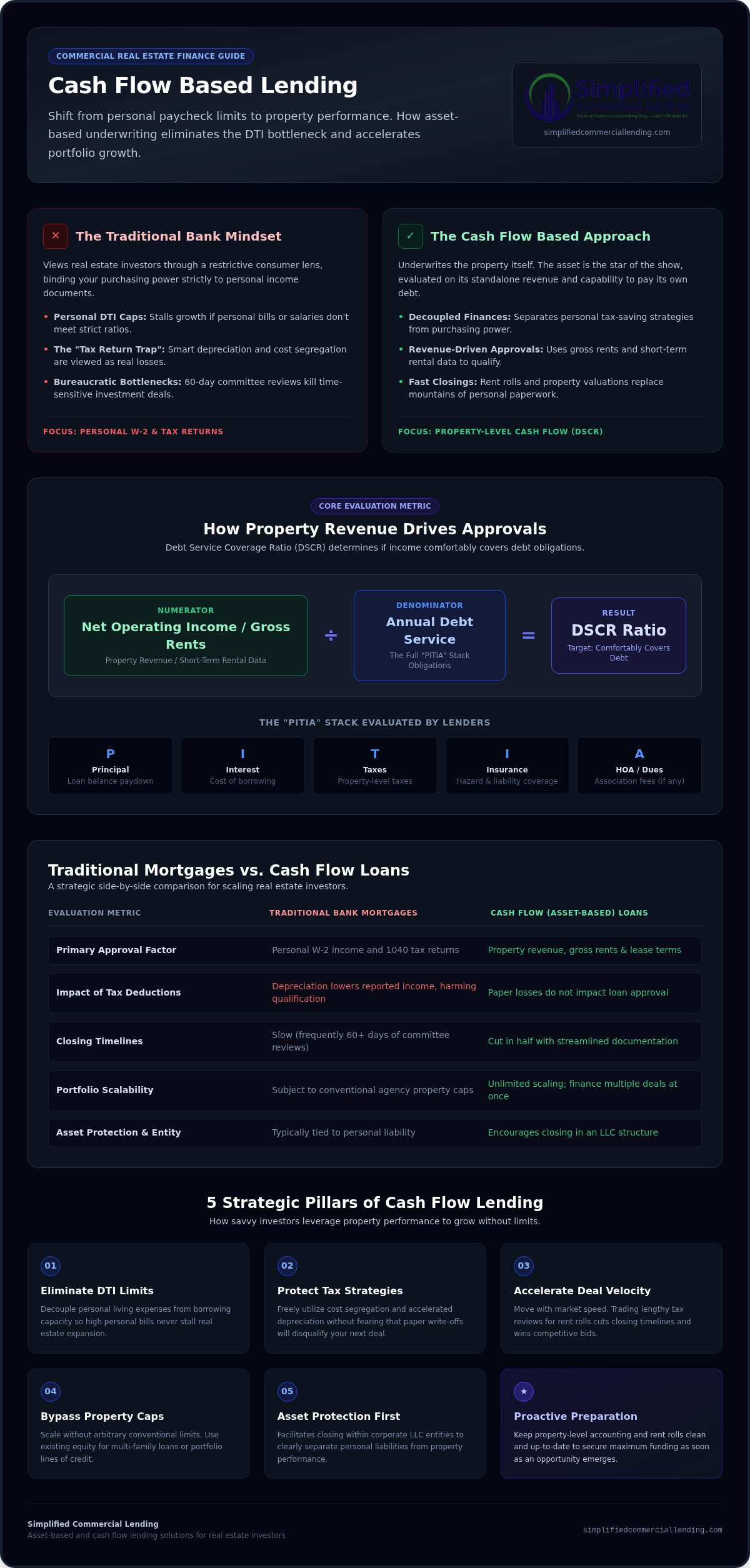
Most savvy investors fall into the “Tax Return Trap.” You use smart depreciation strategies and cost segregation to shield your income from the IRS. It’s a brilliant move for wealth preservation, but it’s a disaster for conventional mortgage applications. Traditional lenders see those paper losses as real losses. They look at your 1040 and see an investor who, on paper, earns very little. By shifting the focus toward property-level performance, you decouple your purchasing power from your tax strategy. The primary risk metric becomes the debt service coverage ratio, which measures if the property’s income can comfortably cover the mortgage payments.
The Problem with Traditional Bank Underwriting
Institutional lenders are built for stability, not for the high-speed world of real estate investing. They demand years of tax returns, months of bank statements, and endless explanations for every minor financial move. This bureaucracy creates a massive bottleneck that can kill deals. If you’re trying to grow a portfolio, you can’t afford to wait 60 days for a committee to decide if your personal income is stable enough. Conventional underwriting is often too rigid to understand the nuances of a growing investment business, leading to unnecessary rejections based on personal DTI limits.
Why Real Estate Investors Prefer Asset-Based Solutions
Modern investors need a resourceful navigator, not a gatekeeper. Asset-based solutions offer the flexibility required to win in competitive markets. Speed is the most obvious benefit; closing a loan based on property revenue is significantly faster than waiting on a full documentation review. It allows you to move with the urgency the market demands. Consider these core advantages:
- Unlimited Scalability: You aren’t limited by the property caps common in agency financing. If the deal cash flows, it can be financed.
- Asset Protection: These loans encourage closing in an LLC, which helps separate your personal liability from your investment performance.
- Simplified Documentation: You trade the mountain of personal paperwork for a streamlined process focused on rent rolls and property value.
This shift allows you to stop begging for permission from a local bank manager. You gain the freedom to finance multiple properties simultaneously, leveraging the strength of your portfolio rather than the size of your paycheck.
The Mechanics of DSCR: How Property Revenue Drives Approvals
If you’ve shifted your mindset away from personal income, you need a new yardstick for success. In the world of cash flow based lending, that yardstick is the Debt Service Coverage Ratio (DSCR). It’s the primary metric lenders use to determine if a property is a sound investment or a financial liability. While a traditional bank looks at your paycheck to see if you can afford a mortgage, an asset-based lender looks at the property’s lease agreement to see if the asset can afford itself.
Underwriting standards for income-producing properties are outlined in the OCC Commercial Real Estate Lending handbook, which emphasizes the stability of rental income as a core risk factor. To qualify, your property must demonstrate it can handle the “PITIA” stack: Principal, Interest, Taxes, Insurance, and any HOA dues. If the revenue left over after these expenses is sufficient, you’re in the clear. It’s a transparent, numbers-driven process that removes the guesswork from the approval cycle.
Calculating Your Property’s Debt Service Coverage Ratio
DSCR is the ratio of Net Operating Income to debt obligations. If your property generates $2,000 in monthly rent and the total mortgage payment is $2,000, your DSCR is 1.0. This is the “break-even” point where the property is self-sufficient. However, most lenders prefer a ratio of 1.25 or higher. This extra 25% provides a safety net for vacancies, repairs, and professional management fees. Some specialized programs allow for ratios as low as 0.75 if you have strong liquid reserves, but a higher ratio always unlocks better terms and lower costs.
Short-Term Rentals and Airbnb Cash Flow
Traditional banks usually panic when they see the seasonal fluctuations of vacation rentals. They struggle to wrap their heads around a property that earns $8,000 in July but only $2,000 in November. We don’t share that hesitation. By using specialized market data projections or 12-month historical revenue statements from your booking platforms, we can project a property’s annual performance rather than focusing on a single month’s snapshot. This allows you to qualify based on the high-yield potential of the short-term market.
Simplified Commercial Lending utilizes short term rental financing to bridge the gap between volatile revenue and stable long-term wealth. If you’re unsure how your current or target property stacks up, you can connect with our team to run a quick DSCR analysis. Understanding your numbers today ensures you’re ready to pull the trigger on your next acquisition tomorrow.
Traditional Mortgages vs. Cash Flow Loans: A Strategic Comparison
Traditional banks sell “affordability” through low interest rates, but they often hide the true cost of your time and growth. A conventional mortgage process typically drags on for 45 to 60 days. In a fast-moving market, that delay is a deal-killer. Cash flow based lending operates on an entirely different timeline, often closing in just 21 to 30 days. You trade a slightly higher interest rate for the certainty of a fast closing and the ability to leverage your equity more aggressively. While big banks obsess over your personal debt-to-income ratio, asset-based lenders prioritize the property’s ability to generate profit.
The impact on your personal credit is another major differentiator. Conventional loans live on your personal credit report, cluttering your debt profile and making it harder to qualify for a car or a primary home. Business-purpose cash flow loans are underwritten to the property or your LLC. This keeps your personal credit utilization clean. It separates your private life from your professional portfolio, giving you a level of financial privacy that institutional banks simply don’t offer.
Documentation: The “No-Doc” Advantage
In 2026, “no-doc” doesn’t mean a lack of due diligence. It means a shift in focus. We don’t need your W-2s, 1040s, or personal financial statements to prove the deal works. Instead, the process relies on property-level appraisals and third-party rent schedules. This is why no doc rental property loans have become the preferred tool for serious portfolio builders. You provide the lease and the property details; we provide the capital. It’s a streamlined exchange that values your time as much as your equity.
Scalability and the 10-Loan Limit
Have you hit the “Fannie Mae Wall” yet? Conventional lending guidelines generally cap individual borrowers at 10 financed properties. Once you reach that limit, the bank shuts the door, regardless of how much cash you have in the bank. Cash flow based lending has no such hard cap. Because the debt is tied to the asset’s performance, you can scale to 20, 50, or 100 units without hitting a bureaucratic ceiling. You are treated as a business entity rather than a consumer, allowing your portfolio to grow as large as your ambitions allow. Stop letting a bank’s arbitrary limits dictate your net worth.
How to Qualify and Scale Using Your Existing Equity
Scaling isn’t just about finding the next deal. It’s about unlocking the capital hidden in your current assets. To move from one or two units to a massive portfolio, you need a repeatable process. Cash flow based lending provides the framework, but your preparation provides the fuel. You must treat your properties as a business rather than a collection of houses.
First, you must prove the revenue. A professional rental market analysis shows lenders that your income projections aren’t just wishful thinking. Next, tidy up your property-level accounting. Ensure your lease agreements are signed, dated, and reflect current market rates. Lenders look for organized investors who treat their properties like a business, not a hobby. Once your house is in order, evaluate your equity. A cash-out refinance allows you to pull capital from a seasoned asset to fund the down payment on your next acquisition. Finally, consolidate those assets to streamline your management and borrowing power.
Tapping Equity with a Portfolio Line of Credit
Moving to the next level often requires a portfolio line of credit for rentals. This isn’t a one-time loan; it’s a revolving fund that grows with you. By using cross-collateralization, you can group multiple properties together to secure better terms and higher limits. You can draw funds to close quickly on a new distressed property, renovate it, and then refinance it back into the line. It turns your stagnant equity into a proactive tool for acquisition, allowing you to act while other investors are still waiting for bank approvals.
Preparing Your “No-Doc” Application
While we don’t demand your tax returns, we do need to verify the asset’s health. Your “no-doc” application package should focus on the property’s vitals. You’ll need current lease agreements, proof of insurance, and your LLC formation documents. The centerpiece of the process is the DSCR appraisal. This specific type of appraisal includes a rent schedule to confirm the property’s income potential compared to market standards.
Don’t ignore your credit score, though. Even in cash flow based lending, your FICO score acts as a baseline for trust. It doesn’t determine how much you can borrow, the property’s income does that, but it does dictate your interest rate and LTV limits. Keep your personal credit clean to unlock the most aggressive leverage possible. If you’re ready to see how much equity you can unlock, apply for a portfolio review today.
Scale Your Future with Simplified Commercial Lending
Traditional banking is a slow lane in a high-speed world. It’s built for consumers, not for creators of wealth. Simplified Commercial Lending acts as your proactive navigator in the non-bank space. We bridge the gap between your ambition and the rigid hurdles of institutional underwriting. By focusing on cash flow based lending, we move the conversation away from your personal tax returns and toward the actual strength of your assets.
Our expertise extends far beyond the single-family space. Whether you’re acquiring a 50-unit multi-family complex, a retail strip, or a warehouse asset, the logic remains the same. Does the property generate enough revenue to support itself? If the answer is yes, we have the tools to finance it. We specialize in streamlining the process for diverse asset classes, ensuring that your commercial ventures aren’t held back by residential-style red tape.
Expert Guidance for Complex Portfolios
A one-size-fits-all bank approach fails because your portfolio isn’t generic. You need a partner who understands the nuances of different markets and property types. Working with a broker who identifies the specific dscr loan requirements for your asset class saves you weeks of frustration. We value pragmatism over protocol. This means we look for reasons to say yes, finding creative ways to structure financing that recognizes the true value and revenue of your property. We don’t just follow the rules; we navigate the system to find the best path for your capital.
Ready to Stop Showing Tax Returns?
You’ve spent years building your equity. Now it’s time to put that equity to work without the constant interrogation of a bank manager. The path to faster closings, higher leverage, and unlimited scalability is clear. You can stop worrying about debt-to-income limits and start focusing on your next acquisition. By decoupling your personal income from your investment performance, you gain the freedom to grow at your own pace. It’s about property performance, not your personal paycheck.
Don’t let another deal slip away because of a slow approval or a paper loss on your tax returns. Take control of your financial narrative and leverage the power of property-level underwriting. It’s time to work with a navigator who knows the shortcuts to success. Get your custom cash flow lending quote today and see how fast your portfolio can truly grow.
Take Command of Your Investment Scaling Strategy
The path to a massive real estate portfolio shouldn’t be blocked by a traditional bank’s obsession with your personal paycheck. By embracing cash flow based lending, you shift the focus to where it belongs: the performance of your assets. You’ve learned that underwriting based on property revenue allows you to bypass the tax return trap and scale without the artificial limits of personal debt to income ratios. Whether you’re targeting short term rentals or multi family complexes, the revenue your property generates is now your greatest qualifying asset.
We provide national coverage for all US investment properties with a streamlined process where no tax returns are required. This isn’t just about getting a loan; it’s about gaining a resourceful partner who understands the speed of the modern market. Stop letting bureaucratic red tape slow your momentum. It’s time to leverage your existing equity and property income to build the wealth you’ve envisioned. Bypass the bank and scale your portfolio today. Your next acquisition is waiting for a navigator who knows how to say yes.
Frequently Asked Questions
What is the minimum DSCR ratio required for a cash flow based loan?
Standard lenders look for a 1.25x ratio to offer the most favorable terms. This means the property’s gross income exceeds all debt obligations by 25%. However, programs exist for ratios as low as 0.75x if you have strong liquid reserves and a lower loan to value ratio. We prioritize the property’s ability to remain self-sufficient while providing you with the leverage needed to grow your portfolio.
Can I get a cash flow loan for a short-term rental or Airbnb?
Yes, we offer specialized financing for short-term rentals and Airbnb properties. Traditional banks often struggle with the seasonal nature of vacation rental income, but we utilize third-party revenue projections or 12-month historical revenue to qualify the loan. This allows you to leverage the high-yield potential of the short-term market without the need for traditional lease agreements or personal income verification.
Do I need to provide any personal income documentation for a no-doc loan?
You don’t need to provide W-2s, pay stubs, or federal tax returns. Because cash flow based lending focuses on the asset, these loans are legally exempt from the consumer ability to repay rules that bog down traditional mortgages. We verify the property’s revenue through lease agreements or appraisal rent schedules. This approach keeps your personal financial life private and allows you to move at the speed of a professional investor.
How do interest rates for cash flow lending compare to traditional mortgages?
Expect a spread of approximately 0.50% to 1.50% above conventional conforming mortgage rates. This small premium reflects the increased flexibility and the no-doc nature of the underwriting process. You’re trading a slightly higher rate for significantly faster closing times and the ability to scale without the personal debt-to-income constraints that typically stop investors in their tracks.
Is there a limit to how many properties I can finance with cash flow lending?
There is no arbitrary limit on the number of properties you can finance. Conventional agency financing often cuts borrowers off once they reach 10 financed properties, regardless of their financial strength. cash flow based lending treats your real estate investments as a business. As long as each new acquisition meets the required debt service coverage benchmarks, you can continue to expand your portfolio indefinitely.
What types of properties qualify for cash flow based commercial loans?
We finance a wide variety of income-producing assets across the country. This includes single-family investment properties, multi-family residential buildings, and various commercial assets like retail centers, warehouses, and hotels. Our goal is to provide a comprehensive financing solution that matches the diversity of your investment strategy. If the property generates consistent rental revenue, it likely qualifies for our specialized property-level underwriting.
How long does it typically take to close a cash flow based loan?
Closing typically occurs within 21 to 30 days. This is roughly half the time required by traditional institutional banks, which often take 45 to 60 days to navigate their bureaucratic committee reviews. Our streamlined process focuses on the property’s vitals rather than your personal history. This speed allows you to secure deals in competitive markets where sellers prioritize buyers who can perform quickly.
Do I need to have my properties in an LLC to qualify?
We strongly encourage and often require closing in an LLC or corporate entity. Financing through an LLC provides a layer of asset protection that personal mortgages can’t match. It also helps keep the debt off your personal credit report, which preserves your credit utilization for other needs. We act as a navigator to help you structure your business entity correctly for the most favorable lending terms.