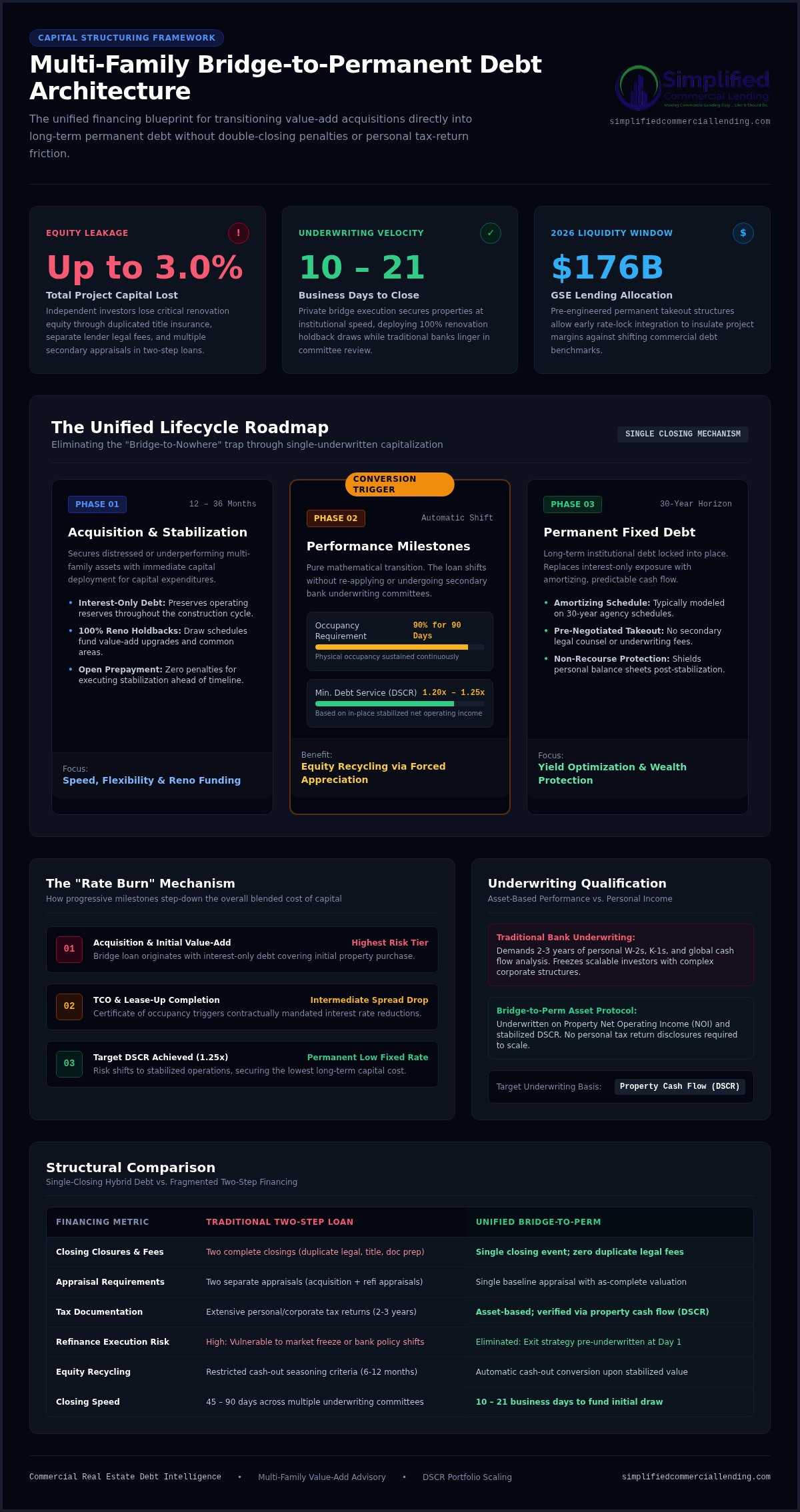
Why pay for the same property twice just to get the financing you need? Many independent investors lose up to 3.0% of their total project capital by paying for two separate sets of closing costs, legal fees, and appraisals. It’s a massive, unnecessary drain on your equity before you’ve even finished renovations. Using multi family bridge to permanent loans allows you to bypass these redundant fees and the frustration of traditional banks demanding years of personal tax returns while you’re trying to manage a stabilization project.
You need a more efficient way to scale your portfolio. This guide shows you how to secure a single, predictable path from acquisition to long-term stability with a streamlined financing solution. You’ll discover how to qualify based on property cash flow (DSCR) rather than personal income and how to bypass the documentation hurdles that slow down institutional giants. We’re breaking down the 2026 strategy for securing transitional capital that automatically shifts into fixed-rate debt once your 90-day occupancy targets are met.
Key Takeaways
- Stop paying for the same closing costs twice and keep more equity in your deal from the start.
- Learn how to qualify for financing based on property performance rather than your personal tax returns.
- Discover how multi family bridge to permanent loans provide a seamless transition from renovation to long-term hold.
- Understand the “rate burn” phenomenon and how it lowers your blended cost of capital over time.
- Master the 2026 strategy for scaling your portfolio without the delays of traditional bank underwriting.
What is a Multi Family Bridge to Permanent Loan?
A multi family bridge to permanent loan is a high-performance hybrid financing vehicle designed for the full lifecycle of a property investment. It covers the acquisition, the stabilization period, and the eventual long-term hold. This isn’t just a loan; it’s a pre-engineered exit strategy. Many investors struggle with the “bridge to nowhere” trap, where they secure short-term debt but have no guaranteed path to a permanent refinance. This structure solves that by aligning the two phases from day one.
In 2026, this has become the preferred vehicle for independent entrepreneurs. Traditional banks have tightened their belts, often requiring extensive personal tax documentation that slows down the deal. By contrast, these asset-based solutions prioritize the property’s potential. You get the speed of a private lender with the security of a long-term institutional exit. It’s a direct response to a market where speed and predictability are the only metrics that matter.
Bridging the Gap: The Stabilization Phase
The bridge phase provides the initial capital needed to secure the asset. These terms usually run between 12 and 36 months, offering enough breathing room to execute a value-add business plan. During this window, you’ll likely use commercial bridge loans to fund light renovations, such as flooring upgrades, modern lighting, or improved landscaping. This phase is built for speed and flexibility.
- Interest-Only Payments: Most bridge components use interest-only structures to keep your overhead low during construction.
- Renovation Holdbacks: Lenders often fund 100% of your renovation costs through scheduled draws.
- Fast Execution: Private bridge capital can often close in as little as 10 to 21 business days.
Stabilization is defined as reaching a minimum of 90% physical occupancy sustained for at least 90 consecutive days.
The Permanent Exit: Long-Term Security
The permanent phase is your reward for a successful stabilization. Once the property is performing, the loan converts into long-term, fixed-rate debt. This transition is seamless because the permanent takeout was already underwritten at the start. You don’t have to go through a full secondary closing with a new lender, which saves you from paying double for appraisals and legal fees. In the 2026 market, with GSE lending capacity reaching $176 billion, having an early rate-lock option is a massive advantage for protecting your margins against interest rate fluctuations.
Your Debt Service Coverage Ratio (DSCR) determines the final permanent loan amount. Lenders typically look for a DSCR between 1.20x and 1.25x on a 30-year amortizing schedule. By focusing on the property’s cash flow rather than your personal W-2, you can scale your portfolio much faster than traditional banking allows.
How the Bridge-to-Permanent Mechanism Works
The brilliance of multi family bridge to permanent loans lies in their unified structure. You aren’t just signing for a loan; you’re mapping out the entire lifecycle of your asset. Traditional financing forces you to close twice, which means paying twice for title insurance, legal counsel, and appraisals. A single-closing mechanism eliminates these redundancies. This streamlined approach lowers your blended cost of capital by removing the friction points that typically drain an investor’s cash reserves.
Consider the “Rate Burn” phenomenon. As your property reaches milestones like a Temporary Certificate of Occupancy (TCO) or stabilized occupancy, the interest rate automatically steps down. The lender rewards your progress by lowering the cost of debt as the risk profile shifts. This aligns with Federal Reserve CRE guidance, which emphasizes managing transitional risk through prudent underwriting. You can even find non-recourse options that protect your personal assets while you navigate the higher-risk renovation phase.
The Conversion Trigger: When Bridge Becomes Perm
Conversion isn’t a mystery; it’s a math problem. Once your property hits the target Debt Service Coverage Ratio (DSCR), usually between 1.20x and 1.25x, the permanent phase kicks in. An updated appraisal at this stage often reveals significant forced appreciation. If the value has jumped enough, you might even recycle your initial equity. This allows you to pull cash out at the point of conversion to fund your next acquisition. Ensure your loan includes “open prepayment” during the bridge phase. This flexibility lets you trigger the conversion the moment you hit your numbers without facing heavy penalties.
Single-Closing vs. Two-Step Financing
Two-step financing is a relic of old-school banking. It creates “deal fatigue” for investors who are trying to manage multiple properties at once. Why submit two applications and go through two separate underwriting processes when you can do it once? By choosing a single-closing path, you eliminate redundant fees and save thousands in closing friction. If you’re ready to bypass the bureaucracy and scale faster, you should explore how to finance your next multifamily project with a partner who understands asset-based lending. One set of documents and one streamlined approval process keep your momentum high and your costs low.
Bridge-to-Permanent vs. Separate Loans: A Cost Comparison
Choosing multi family bridge to permanent loans isn’t just about convenience. It’s a calculated move to protect your Internal Rate of Return (IRR). When you opt for separate loans, you’re essentially volunteering to pay for the same work twice. Every appraisal, legal review, and title search eats into your margins. Research indicates that investors who secure uncoordinated bridge and permanent loans lose between 1.5% and 3.0% of their total project capital to transaction friction. Over a 10-year horizon, this initial loss compounds, significantly reducing your total wealth accumulation. A unified structure locks in your long-term spread early, which is essential when benchmarks like the 10-year Treasury yield remain volatile, as seen with the 4.95% to 5.01% range in mid-September 2026.
The efficiency of a combined loan also mitigates interest rate risk. If you wait to secure a permanent loan until after stabilization, you’re at the mercy of the market. You could finish your renovations only to find that rates have spiked, making your takeout debt much more expensive than you projected. By coordinating the bridge and permanent phases from the start, you secure a predictable path that protects your cash flow from day one to year ten.
Calculating the Real Savings
The savings start with the origination fees. Instead of paying 1.0% to 2.5% twice, you typically pay a single, combined fee. This keeps more cash in your pocket for the actual renovation. You also benefit from exit fee waivers. Many standalone bridge lenders charge a 1.0% exit fee if you refinance elsewhere. A bridge-to-perm partner waives this fee because you’re staying within their ecosystem. This synergy allows for a much faster conversion process, meaning you reach stabilized equity sooner. Recycled equity can be used for your next acquisition by pulling cash out of the deal once the property hits its stabilized value.
Why Traditional Banks Struggle with This Hybrid Model
Traditional institutions are built on rigid silos. They have a “construction desk” and a “mortgage desk,” and these two departments rarely talk to each other. This creates a disconnect that forces you to re-apply for your own deal halfway through the project. It’s a process designed for the bank’s safety, not your growth. Even worse is the “Tax Return Trap.” Banks require years of personal tax documentation and W-2s, which often don’t reflect the true cash flow potential of an independent investor. This is where Multi-Family Residential Investment Loans: The 2026 Guide to Non-Bank Financing proves that asset-based underwriting is the superior choice. By focusing on the property’s DSCR, you bypass the bureaucratic bottlenecks of institutional giants and keep your portfolio moving.
Qualifying for Multifamily Financing Without Tax Returns
Traditional banks live in the past. They demand mountains of personal tax returns and W-2s that don’t tell the full story of your investment success. If you’re a high-growth entrepreneur, your tax returns often show heavy depreciation and write-offs. This makes you look “weak” to a standard underwriter even if your properties are thriving. Asset-based underwriting flips this script entirely. By using multi family bridge to permanent loans, you shift the focus from your personal bank account to the property’s performance. Lenders care about the Net Operating Income (NOI) and your ability to execute a stabilization plan. It’s a pragmatic approach that values results over protocol.
In 2026, the rise of non-QM and private lending has made this “no-tax-return” model the gold standard for independent investors. You don’t need to prove your personal debt-to-income ratio. Instead, you prove the property’s ability to pay for itself. The flexibility of multi family bridge to permanent loans means you can present a stabilization plan that lenders trust based on market data rather than your personal tax bracket. You aren’t just a number in a spreadsheet; you’re a partner with a viable business plan.
The Power of DSCR-Based Lending
The Debt Service Coverage Ratio (DSCR) is the primary metric for these deals. For a successful bridge-to-perm conversion, lenders typically look for a healthy DSCR between 1.20x and 1.25x on a 30-year amortizing schedule. During the bridge phase, underwriters use “pro-forma” income. This is the projected rent after you complete your value-add improvements. It allows you to secure funding based on where the property is going, not just where it is today. To master these details, check out our DSCR Loan Requirements: 2026 Portfolio Scaling Guide for a deeper dive into the numbers.
Documentation: What You Actually Need
If you aren’t showing tax returns, what are you showing? The lender needs to see the property’s current rent roll and the last 12 months of operating statements. They also look closely at your Schedule of Real Estate Owned (SREO). This document verifies your experience managing similar assets across the country. While your taxable income is less relevant, a clean credit history still matters. It proves you’re a responsible borrower who respects the capital. This “no-doc” approach is the ultimate advantage for investors scaling a portfolio line of credit for rentals. It allows you to move at the speed of the market without being tethered to a bank’s slow-moving bureaucracy.
If you’re tired of institutional red tape, you can apply for multifamily financing now and get a decision based on your property’s potential.
Simplified Commercial Lending: Your Bridge-to-Permanent Partner
Stop letting institutional giants dictate your growth speed. While corporate lenders are stuck in a cycle of endless committees and rigid protocols, we focus on the only thing that actually builds wealth: your property’s cash flow. Simplified Commercial Lending acts as your bold navigator through the complexities of the 2026 market. We provide the capital you need for 5+ unit buildings, apartment complexes, and mixed-use properties without the traditional tax return headache. Our approach to multi family bridge to permanent loans is designed for the independent entrepreneur who values pragmatism over protocol.
We serve investors nationwide. Whether you are acquiring a distressed asset or repositioning a stabilized property, we offer a single, streamlined path from the first bridge draw to the final permanent payment. You get direct access to capital and a process built for speed. In a competitive market where deals are won or lost in days, you can’t afford the 60 to 90-day delays of a conventional bank. We close private bridge capital in as little as 10 to 21 business days, ensuring you never miss a value-add opportunity.
Why Investors Choose Our Streamlined Process
Our philosophy is simple: we provide direct answers and punchy communication. We understand that your time is your most valuable asset. By removing the “Tax Return Trap” and focusing on asset-based underwriting, we empower you to move faster than competitors tied to traditional banks. You don’t have to explain your personal depreciation or write-offs to us. We look at the property’s potential and your ability to execute. For a full breakdown of how to navigate these options, see our Commercial Property Loan Guide: How to Finance Your Investment in 2026.
Start Your Multifamily Journey Today
Getting started shouldn’t be a chore. You can get a quote based on your property’s cash flow in minutes. Our roadmap provides absolute certainty from acquisition to long-term hold. We specialize in multi family bridge to permanent loans that eliminate the need for redundant closings and secondary appraisals. We handle the heavy lifting of the transition so you can focus on finding the next deal. There are no redundant fees and no secondary closings to drain your equity. It’s time to bypass the industry bottlenecks and secure the financing you deserve. Scale your portfolio today with Simplified Commercial Lending and experience a partnership built for results.
Secure Your Multifamily Future with Certainty
The 2026 investment landscape belongs to the entrepreneurs who prioritize speed and efficiency over institutional protocol. By mastering multi family bridge to permanent loans, you eliminate the friction of double closing costs and the exhaustion of the “Tax Return Trap.” You now have the roadmap to use a single-closing mechanism that protects your IRR while transitioning seamlessly from renovation to a long-term hold. This strategy isn’t just about saving money; it’s about gaining the agility to outpace competitors who are still waiting on traditional bank approvals.
Simplified Commercial Lending is ready to act as your resourceful navigator. As No-Doc Financing Experts, we offer Property Cash Flow Focused Underwriting that values your results over your personal tax bracket. Our team of National Commercial Lending Experts understands the speed required to win in today’s market. Stop letting bureaucracy dictate your portfolio’s growth. Scale your multifamily portfolio without tax returns, get started with Simplified Commercial Lending today. Your goals are attainable, and the right financing partner makes the journey effortless. Build your legacy with confidence.
Frequently Asked Questions
What is the typical interest rate for a multifamily bridge loan in 2026?
Prevailing interest rates for multifamily bridge loans in 2026 generally range from 8.5% to 12.5%. These rates are typically priced as a floating spread over the Secured Overnight Financing Rate (SOFR). For Class B or C transitional assets, you’ll often see fixed short-term capital between 9.0% and 11.5%. These rates reflect the higher risk of the stabilization phase compared to the lower rates found in long-term permanent debt.
Can I convert a bridge loan to permanent financing without a new appraisal?
You’ll almost always need a new appraisal to trigger the conversion to permanent financing. The lender must verify the property’s stabilized value and current Net Operating Income (NOI) to calculate the final Debt Service Coverage Ratio (DSCR). This updated valuation is what allows you to potentially recycle equity or pull cash out. While some programs use an initial “subject to completion” value, a final walkthrough or desk review remains a standard requirement.
Do I need to show personal tax returns for a multifamily bridge-to-perm loan?
You don’t need to show personal tax returns when using multi family bridge to permanent loans with an asset-based lender like Simplified Commercial Lending. Underwriting focuses entirely on the property’s cash flow and your track record as an investor. This “no-doc” approach is ideal for entrepreneurs with complex filings or significant depreciation. Instead of 1040s, you’ll provide rent rolls, operating statements, and a schedule of real estate owned to prove the deal’s viability.
What is the minimum unit count for a multifamily bridge-to-permanent loan?
The minimum unit count for these commercial products is typically five units. Multifamily residential investment loans are categorized as commercial assets once they hit the 5-unit threshold. This includes traditional apartment buildings, mixed-use properties with a residential majority, and portfolios of smaller buildings. If you’re looking to finance a 1-4 unit property, you’d generally use a single-family investment loan rather than a commercial multifamily bridge structure designed for larger assets.
How long does the ‘bridge’ phase typically last before conversion?
The bridge phase usually lasts between 12 and 36 months. This window gives you enough time to complete renovations, increase rents, and reach the required 90% occupancy for stabilization. Many investors aim to convert as soon as they hit their Debt Service Coverage Ratio (DSCR) targets. If your project finishes early, you can often trigger the permanent phase ahead of schedule, provided your loan includes an open prepayment feature during the bridge term.
Is there a prepayment penalty when converting from bridge to permanent debt?
In a coordinated bridge-to-permanent program, the prepayment penalty for the bridge phase is typically waived or significantly reduced upon conversion. Standalone bridge loans often carry exit fees of 1.0% or minimum interest clauses. By using a unified strategy, you align the exit of the short-term debt with the start of the long-term facility. This prevents you from paying a penalty just for successfully reaching the stabilization milestone and moving to a fixed rate.
What happens if my property doesn’t reach stabilized occupancy by the end of the bridge term?
If you haven’t reached 90% occupancy by the end of the term, you can often request an extension. Standard bridge loans in 2026 typically offer 6-month extension options for a fee of 0.25% to 0.50% of the loan amount. You must demonstrate that the project is still moving forward and that the delay is manageable. If you still can’t stabilize, you might need to refinance into another short-term bridge to avoid a maturity default.
Can I use a bridge-to-permanent loan for a short-term rental multifamily property?
Yes, you can use multi family bridge to permanent loans for short-term rental (STR) properties. Underwriters will analyze the property’s historical Airbnb or VRBO income rather than traditional long-term leases. This is a powerful way to acquire a building, renovate it for STR use, and then lock in permanent debt based on the higher cash flow generated by nightly stays. It requires a lender who understands the specific nuances of the short-term rental market.