What if your tax returns were actually the biggest obstacle standing between you and your next ten properties? For most ambitious investors, the traditional banking system feels like a trap where the more you write off to save on taxes, the harder it becomes to qualify for a new loan. It’s a frustrating cycle that stops growth in its tracks. You need a way to scale rental portfolio without tax returns if you want to stay competitive in 2026.
You’ve likely felt the sting of a denied application because of a debt-to-income ratio that doesn’t account for your actual business savvy. We agree that your personal tax history shouldn’t dictate your future empire. This guide will show you how to break free from the documentation trap by using the property’s own cash flow to secure funding. You’ll discover the exact financing strategies to expand your real estate empire using asset-based performance instead of personal income paperwork. We’ll explore how DSCR loans and portfolio lines of credit lead to faster closing times and a repeatable system for acquiring properties that traditional lenders simply can’t match.
Key Takeaways
- Escape the “Tax Return Trap” where depreciation and expenses hurt your ability to qualify for traditional bank mortgages.
- Master the specific strategies needed to scale rental portfolio without tax returns by prioritizing property cash flow over personal debt-to-income ratios.
- Unlock the power of DSCR loans to finance single-family and multi-family assets based on their actual income potential rather than your personal tax history.
- Consolidate your equity with portfolio lines of credit to create a ready-to-use “war chest” for rapid, repeatable property expansion.
- Partner with specialized commercial brokers to access streamlined closing processes and lenders that value asset performance over bureaucratic red tape.
The Tax Return Trap: Why Traditional Banks Stall Your Growth
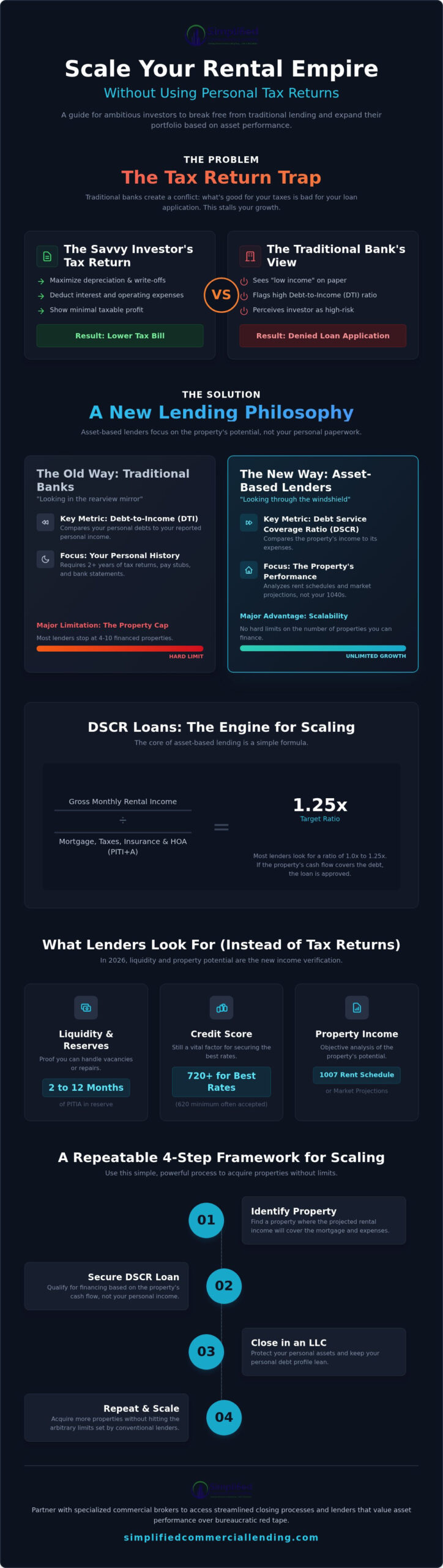
Traditional banks judge your future by looking through a rearview mirror. They demand two years of personal tax returns to decide if you qualify for a loan. This creates a massive conflict for the modern investor. You work hard to maximize depreciation, interest deductions, and operating expenses to lower your tax bill. While the IRS sees a savvy business owner, the bank sees a borrower with “low income” and high risk. This paradox is the primary reason investors struggle to scale rental portfolio without tax returns.
A perfect tax return for the IRS shows minimal profit. A perfect loan application for a local bank shows maximum profit. You can’t have both. If you play the bank’s game, you pay more in taxes. If you play the tax game, you’re barred from new acquisitions. This “Tax Return Trap” forces you into a slow, methodical growth path that doesn’t match your ambitions. It’s a bureaucratic bottleneck that ignores the actual value of your assets.
Understanding Debt-to-Income (DTI) vs. DSCR
Traditional lenders live and die by the Debt-to-Income (DTI) ratio. This formula compares your personal debt payments to the gross monthly income shown on your 1040s. If your tax write-offs are aggressive, your DTI will look bloated. Asset-based lenders replace this outdated metric with the Debt Service Coverage Ratio (DSCR). Instead of scrutinizing your personal salary, they focus on the property’s performance. They want to know if the rent covers the mortgage, taxes, and insurance. They look at the “windshield” of future property income rather than the “rearview mirror” of your personal history.
The Problem with Conventional Loan Limits
Fannie Mae and Freddie Mac have rigid ceilings that haven’t changed much in 2026. Most traditional lenders stop once you hit 10 financed properties; many even cut you off after four. These limits exist because traditional paper is built for homeowners, not entrepreneurs. The documentation required is intrusive and slow. You’re asked for endless pay stubs, bank statements, and tax transcripts for every entity you own. This red tape creates a psychological toll. It turns a simple acquisition into a months-long interrogation. For an active investor, this isn’t just a nuisance. It’s a ceiling that makes unlimited scaling impossible with traditional financing.
DSCR Loans: The Engine for Scaling Without Tax Returns
Debt Service Coverage Ratio (DSCR) loans are the ultimate engine for anyone who wants to scale rental portfolio without tax returns. While traditional banks get bogged down in your personal 1040s, DSCR lenders focus entirely on the property’s ability to pay its own way. The core formula is straightforward: (Gross Monthly Rental Income) / (PITI + HOA). In 2026, most lenders look for a ratio between 1.0x and 1.25x. If the property’s cash flow covers the debt, the loan is often approved without a single pay stub.
You can close these loans in the name of an LLC. This strategy provides essential asset protection and keeps your personal debt profile lean. It is the most efficient way to scale rental portfolio without tax returns while maintaining a professional distance between your personal life and your business empire. By removing the borrower’s personal income from the equation, you eliminate the most common bottleneck in real estate growth.
What Lenders Look for Instead of Tax Returns
In 2026, liquidity is the new income verification. Lenders typically require 2 to 12 months of PITIA in reserves to ensure you can handle vacancies or repairs. Your credit score remains a vital factor; while scores as low as 620 are often accepted, the best rates go to those above 720. To verify income, lenders rely on a 1007 Rent Schedule for long-term rentals or specialized market projection reports for vacation properties. These documents provide an objective look at market potential that a tax return simply can’t capture.
Financing Different Asset Classes
The flexibility of DSCR extends far beyond single-family homes. Investors are increasingly using multi-family residential investment loans to acquire larger assets without the red tape of traditional commercial banking. This same logic applies to short term rental financing, where projected nightly rates drive the deal. The 2026 market favors speed. Shifting toward “no-doc” commercial products allows you to move as fast as the opportunities appear. If you’re ready to see how these numbers work for your next acquisition, explore your options with an expert navigator who understands the non-bank landscape.
Portfolio Lines of Credit: Tapping Equity for Rapid Expansion
Individual DSCR loans are excellent for targeted acquisitions, but they can become a management burden as your holdings grow. If you own five or more properties, a portfolio line of credit for rentals offers a more streamlined path to growth. This financing vehicle allows you to consolidate multiple assets into a single facility, unlocking “dead equity” that would otherwise sit idle. It is a strategic way to scale rental portfolio without tax returns because it prioritizes the collective value of your business over your personal income history.
The primary advantage of this approach is speed. In a competitive 2026 market, waiting 45 days for a traditional cash-out refinance on a single property can cost you a deal. With a portfolio line, you move from “applying” to “drawing” funds in a fraction of the time. Once the line is established, your equity becomes a liquid war chest. You can deploy capital instantly for down payments on new acquisitions or to fund renovations across your existing assets.
Blanket Loans vs. Individual DSCR Loans
Individual loans come with individual closing costs, appraisals, and legal fees. These expenses eat into your ROI every time you buy. A blanket portfolio line minimizes this overhead by covering multiple properties under one set of terms. It’s the ultimate scaling tool because it offers unmatched flexibility. You can add new properties to the collateral pool to increase your borrowing limit or release specific assets when you’re ready to sell. This agility is essential for investors who want to scale rental portfolio without tax returns while maintaining tight control over their cash flow.
Qualifying for a Portfolio Line
Lenders typically require a minimum portfolio value and a property count of at least five units. They aren’t looking at your 1040s; instead, they analyze the historical performance of your rentals and your property management track record. A portfolio line of credit functions as a revolving credit facility that allows you to draw funds against your real estate equity as needed. This shift from personal underwriting to business-level performance is what makes rapid expansion possible. If your assets are performing well, the path to your next ten properties is wide open.
A Repeatable 4-Step Framework for Scaling in 2026
Scaling from a few units to a massive empire requires a system, not just luck. In the 2026 market, the most successful investors have moved away from bank-dependent growth. They use a specific sequence to scale rental portfolio without tax returns while keeping their capital liquid. This framework turns your real estate into a self-funding machine that doesn’t rely on your personal salary.
- Step 1: Optimize Cash Flow. Audit your current assets to ensure they meet the latest dscr loan requirements. Lenders in 2026 typically look for a ratio of 1.2x or higher to provide the most aggressive leverage.
- Step 2: Build a War Chest. Execute a cash-out refinance on your seasoned assets. Use the proceeds to create a dedicated fund for future down payments.
- Step 3: Fast-Track Acquisitions. Leverage non-bank lenders for “no-doc” purchases. This allows you to close deals based on property performance rather than personal income history.
- Step 4: Consolidate for Leverage. Once you have 5 or more individual loans, roll them into a portfolio line. This lowers your total management overhead and prepares you for the next round of growth.
The Modern BRRRR Method
The traditional BRRRR method often hits a wall when the investor runs out of personal income to support new debt. The modern version solves this. You buy and rehab using short-term capital, then refinance into long-term DSCR debt. Because these loans don’t require tax returns, your W-2 status is irrelevant. You can repeat this cycle every 6 to 12 months. This is the fastest way to scale rental portfolio without tax returns in today’s environment.
Market Selection for High-DSCR Returns
Your strategy only works if the math makes sense. Focus on national markets with high rent-to-value (RTV) ratios. You need properties where the rent comfortably exceeds the mortgage, taxes, and insurance. Focus on landlord-friendly jurisdictions that prioritize property rights. Avoid “appreciation-only” markets where low cap rates make it impossible to pass the DSCR test. If you’re ready to put this framework into action, speak with a lending expert today to map out your 2026 acquisition plan.
Partnering for Success: Why Non-Bank Lending Wins
You’ve mastered the strategy. Now you need the execution. A commercial mortgage broker is your secret weapon in the 2026 market. Traditional banks have a limited menu and strict, often illogical, rules. A broker opens the door to “shadow” lenders. These are private institutional funds that don’t advertise to the general public. They don’t care about your W-2. They care about the asset. They want to see a property that performs, not a personal tax return that shows a high salary.
Simplified Commercial Lending specializes in these non-bank relationships. We understand the nuances of asset-based underwriting. We know which lenders are currently aggressive on LTV and which ones offer the best terms for short-term rentals versus multi-family units. We help you scale rental portfolio without tax returns by matching your specific needs with the right capital source. This isn’t just about finding a loan; it’s about building a sustainable pipeline for your future growth.
Speed is your greatest advantage. Traditional closings can drag on for 60 days as banks pore over your personal bank statements. Our “no-doc” process is designed for efficiency. We focus on the property’s cash flow and your credit profile. This streamlined approach means faster closings and fewer last-minute surprises. You can move from a signed contract to a funded deal while your competitors are still hunting for old tax transcripts. We act as your resourceful navigator, bypassing the common industry bottlenecks that slow down independent entrepreneurs.
The Advantage of National Reach
Local banks are usually tied to local economies. If you want to diversify into a new state, you often have to start a new relationship from scratch. That’s a massive bottleneck. Our national reach allows you to scale across state lines without changing your lender or your process. You enjoy consistent underwriting standards for your entire national portfolio. National expertise helps investors diversify geographically to protect their wealth against localized market downturns. You can acquire assets in any market that meets your DSCR requirements without learning a new set of banking rules.
Ready to Scale?
The “no tax return” path is the fastest route to real estate wealth in 2026. It removes the arbitrary ceilings imposed by traditional institutions. You don’t have to choose between tax efficiency and growth anymore. You can have both. Move beyond the limits of traditional banking. Start building based on your property’s performance. Your next acquisition shouldn’t be stalled by a stack of paperwork. Take control of your expansion today. Get a custom quote for your portfolio today and see how fast you can grow.
Take Control of Your Real Estate Future
Scaling your business in 2026 requires a fundamental shift in mindset. You’ve seen how the traditional banking system uses your tax efficiency against you; it’s a cycle that rewards low growth and punishes ambition. By pivoting to asset-based lending, you replace restrictive DTI limits with the actual cash flow of your properties. This shift allows you to focus on what matters most: the performance of your investments.
Whether you’re leveraging individual DSCR loans or consolidating with a portfolio line of credit, the goal remains the same. You need speed and scalability. These strategies empower you to scale rental portfolio without tax returns while maintaining the flexibility to move on new opportunities instantly. Our national expertise ensures you have a resourceful navigator to guide you through fast, efficient closings for all your commercial and rental assets. Your growth shouldn’t be limited by a tax transcript.
Ready to break through the bureaucratic ceiling? Scale your portfolio today with our no-doc lending solutions and start building the empire you envisioned. The tools for unlimited expansion are within your reach. Don’t let traditional paperwork slow your momentum.
Frequently Asked Questions
Can I really get a rental loan without showing my personal tax returns?
Yes, you can absolutely secure financing without providing personal tax returns by utilizing Debt Service Coverage Ratio (DSCR) loans. These products are specifically designed for investors who want to scale rental portfolio without tax returns by focusing on the property’s income rather than the borrower’s personal salary. Lenders evaluate the rental revenue against the mortgage payment to determine eligibility. This approach allows you to bypass the debt-to-income hurdles that often stop traditional bank applications.
What is the minimum credit score for a no-doc DSCR loan?
The minimum credit score for a no-doc DSCR loan is generally 620 in the 2026 market. While some specialized lenders may accept scores as low as 580 for borrowers with significant assets, you’ll find the best interest rates and terms available for scores of 720 and above. Your credit history serves as a primary risk indicator when personal income documentation is removed from the underwriting process. Maintaining a strong score ensures maximum leverage and lower reserve requirements.
Do no-doc loans for rental properties have higher interest rates?
Yes, interest rates for no-doc rental loans are typically 0.5 to 2 percentage points higher than conventional residential mortgages. As of September 2026, DSCR loan rates generally range between 6.12% and 6.49% for domestic investors. You’re trading a slightly higher rate for the ability to close faster and avoid intrusive personal documentation. Most investors find that the increased speed and the removal of the DTI ceiling far outweigh the incremental cost of the interest.
How many properties can I have in a portfolio line of credit?
Most portfolio lines of credit require a minimum of five properties to establish the initial facility. Once the line is open, many lenders allow you to add an unlimited number of residential or commercial assets to increase your borrowing capacity. This structure is the ultimate tool for those who want to scale rental portfolio without tax returns across a large national footprint. It consolidates your equity into a single revolving credit source for rapid, repeatable acquisitions.
Is a down payment required for a DSCR loan if I don’t have tax returns?
A down payment is required, typically ranging from 20% to 25% of the purchase price. For most single-family DSCR purchase loans in 2026, the maximum loan-to-value (LTV) ratio is capped at 80%. If you’re looking for a cash-out refinance on an existing asset, the LTV usually sits between 70% and 75%. While you don’t need tax returns, you must demonstrate “skin in the game” through equity and provide proof of 2 to 12 months in reserves.
Can I use an LLC to buy a rental property with no-doc financing?
Closing in the name of an LLC is not only allowed but often encouraged by non-bank lenders. Using an entity provides a layer of asset protection and helps keep your personal credit profile clean for future financing needs. Traditional banks often struggle with LLC borrowing for residential assets, but commercial brokers specialize in these structures. This flexibility is essential for professional investors who prioritize privacy and long-term business security over personal liability.
How long does it take to close a no-doc commercial loan?
You can typically expect to close a no-doc commercial or rental loan in 21 to 30 days. This is significantly faster than the 45 to 60 day timelines common with traditional banks that require extensive manual underwriting of personal tax transcripts. Because the process focuses on the property appraisal and market rent schedules, there are fewer bureaucratic hurdles to clear. This speed advantage allows you to compete with cash buyers and win deals in high-demand markets.
What happens if the property’s cash flow doesn’t cover the mortgage (DSCR < 1.0)?
If the property’s cash flow doesn’t cover the debt service, you may still qualify through a “no-ratio” DSCR loan. These products are designed for properties with high growth potential but lower current rents. You’ll likely face stricter requirements, such as a higher credit score or a larger down payment of 25% to 30%. While standard DSCR loans look for a ratio of 1.0 or higher, no-ratio options provide a flexible path for opportunistic acquisitions.