Why should your accountant’s clever tax deductions stop you from buying your next three properties? If you’ve approached a traditional bank for a cash out refinance investment property no tax returns, you’ve likely hit a wall. Big institutions love your high credit score, but they hate your 1040s. They see your paper losses and call you unloanable. It’s a frustrating, slow process that treats successful entrepreneurs like a liability rather than the savvy investors they are.
You know your rentals are profitable, and we agree that your personal tax filings shouldn’t dictate your portfolio’s growth. This guide shows you how to bypass the bureaucratic red tape and move at the speed of the market. You’ll learn how to unlock your equity using cash-flow-based lending that prioritizes property performance over your personal income history. We’ll preview the 2026 LTV caps, the streamlined 30 day closing process, and how to access liquid capital for reinvestment without providing endless stacks of personal financial paperwork.
Key Takeaways
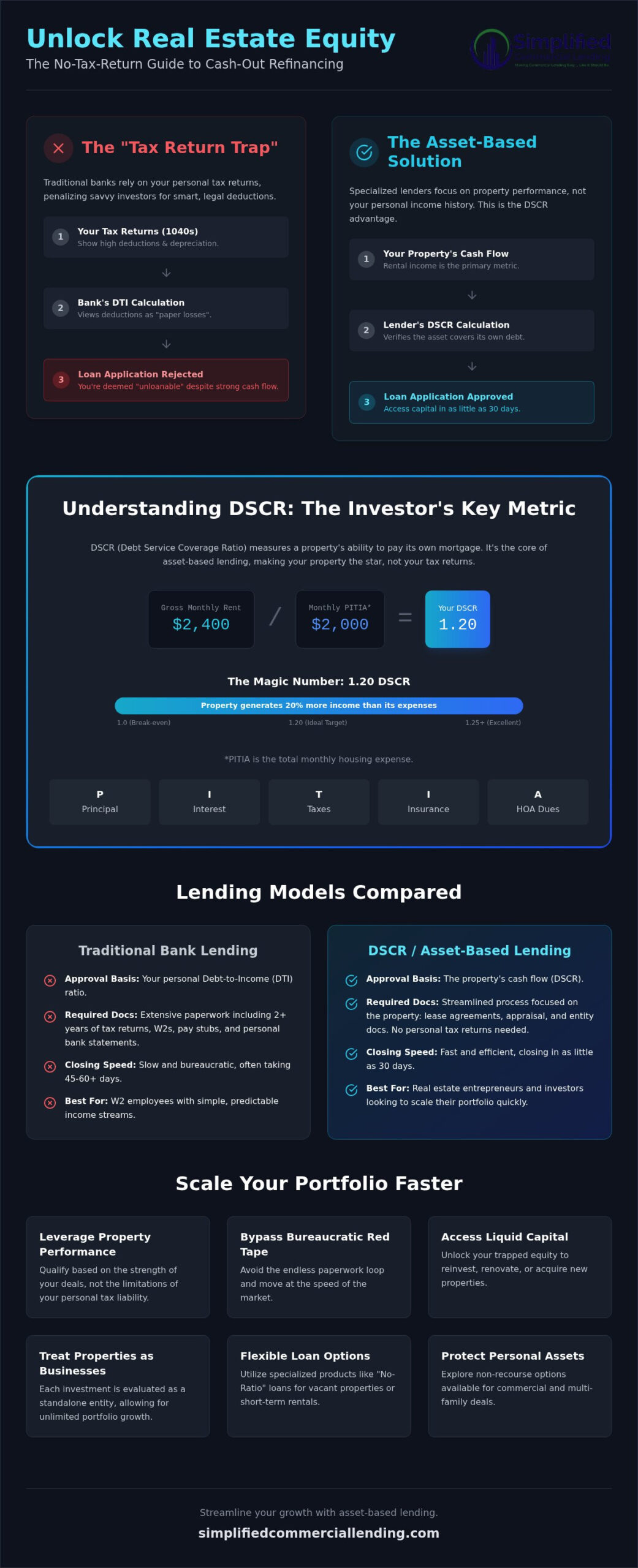
- Escape the “Tax Return Trap” where legal write-offs and high deductions make you appear unloanable to traditional big banks.
- Master the Debt Service Coverage Ratio (DSCR) to qualify for a cash out refinance investment property no tax returns based on property cash flow.
- Compare specialized lending options like DSCR and bank statement loans to find the most efficient path for your specific portfolio needs.
- Navigate 2026 seasoning requirements and LTV caps to unlock equity and secure liquid capital in as little as 30 days.
- Learn how to leverage property performance to scale your real estate empire without the burden of endless personal financial paperwork.
Why Traditional Banks Decline Investment Cash-Out Refinances
Traditional banks are built for the predictable. They prefer W2 employees with simple financial lives and steady paychecks. If you’re a real estate entrepreneur, you likely don’t fit that mold. Most investors trying to secure a cash out refinance investment property no tax returns find themselves hitting a wall of rejection. Banks see your complex tax filings and see risk, not opportunity. This disconnect exists because institutional lenders aren’t equipped to handle the nuances of self-employment or the strategic ways investors manage their wealth.
The Problem with Debt-to-Income (DTI) Ratios
The core of the issue lies in how big banks calculate your ability to repay. They rely on a rigid mortgage underwriting process that prioritizes your Debt-to-Income (DTI) ratio above all else. When they review your 1040s, they see every legal deduction you’ve taken to protect your profits. While depreciation and business expenses are smart tax moves, banks view them as actual losses. They see a “paper loss” and decide you’re unloanable, despite your actual cash flow being strong. It’s a frustrating, endless paperwork loop that wastes your time and stalls your growth. You’re left explaining the same numbers to different underwriters who don’t understand the real estate business.
The Rise of Asset-Based Lending in 2026
By 2026, savvy investors have largely moved away from these institutional bottlenecks. They’ve turned to asset-based lending, a model that prioritizes the value and performance of the property over your personal salary. Instead of asking for two years of tax returns, these lenders focus on DSCR loan requirements to evaluate the deal. This shift recognizes that an investment property is a standalone business that should be judged on its own merits. Asset-based lending is the ultimate engine for capital velocity, allowing you to pull equity and reinvest without the baggage of personal income verification. It treats you like a partner in a business deal, not just another number in a credit queue.
No-doc lending isn’t the “wild west” of the past; it’s a sophisticated response to a modern market. It represents a fundamental shift from personal income verification to property-level cash flow analysis. Lenders now look at the Debt Service Coverage Ratio (DSCR) to ensure the rental income covers the mortgage payment. This allows you to scale your portfolio based on the strength of your acquisitions rather than the limits of your personal tax liability. If the property performs, the loan makes sense. It’s that simple. By focusing on the asset’s cash flow, you can unlock equity that would otherwise be trapped by a conservative bank’s DTI requirements.
The DSCR Advantage: Underwriting Cash Flow, Not Tax Returns
If traditional banks focus on your personal history, DSCR lenders focus on the asset’s future. The Debt Service Coverage Ratio (DSCR) is the primary metric used to approve a cash out refinance investment property no tax returns. It measures the property’s ability to cover its own debt. This approach empowers you to treat each property as a standalone business. Instead of digging through your personal spending habits, lenders analyze the property’s income potential. It’s a cleaner, faster way to qualify for capital.
Lenders calculate this by comparing Gross Monthly Rent against the PITIA. This includes Principal, Interest, Taxes, Insurance, and any HOA fees. For most lenders, a 1.20 DSCR is the “magic number.” This means the property generates 20% more income than the cost of the mortgage. If your property meets this threshold, you’re often cleared for higher LTVs and better terms. In the commercial and multi-family space, you can even access non-recourse options. These protect your personal assets by limiting the lender’s recovery to the property itself if the deal underperforms.
Calculating Your Property’s DSCR
The math is refreshingly simple. Use this formula: Monthly Rent / Monthly Debt Service. If your rental brings in $2,400 and the PITIA is $2,000, your DSCR is 1.20. What if the property is temporarily vacant or undergoing a transition? “No-Ratio” loans exist for these specific scenarios. These programs ignore the ratio entirely, focusing instead on your credit and the property’s overall equity. This flexibility is vital for short term rental financing, where income can fluctuate seasonally. Specialized DSCR calculations for Airbnb or VRBO properties often use historical data or market reports to verify income.
Why DSCR is Superior for Scaling
DSCR loans remove the glass ceiling imposed by conventional lenders. Fannie Mae and Freddie Mac typically limit you to ten financed properties. DSCR lenders don’t have these rigid caps. You can finance 50 or 100 units as long as the numbers work. You can also close these loans in the name of an LLC. This provides a layer of liability protection that traditional residential mortgages often forbid. It separates your personal credit from your business assets, ensuring your personal life remains private. If you’re ready to move past personal limits, you can explore customized cash-flow solutions that match your ambition.
Comparing No-Doc Refinance Options for Investors
Choosing the right financing path depends on your specific business structure. Not every investor has the same needs, and the market in 2026 offers several distinct ways to execute a cash out refinance investment property no tax returns. You aren’t limited to a single program. Instead, you can select the tool that matches your asset type and your personal liquidity. Whether you have one single-family rental or a massive commercial complex, there is a streamlined solution that ignores your 1040s.
For those managing commercial assets, No-Income Verification (NIV) loans represent the purest form of no-doc lending. These programs don’t look at your personal income or even your bank statements. They rely almost entirely on the property’s value and your credit score. It’s the ultimate path for investors who value privacy and speed above all else. If the asset has the equity and the market is strong, the deal moves forward.
DSCR vs. Bank Statement Loans
The choice between DSCR and bank statement loans usually comes down to where your “proof” of income lives. DSCR focuses exclusively on the property; it doesn’t care if you’re personally profitable. It’s the gold standard for long-term rentals and multi-family units. Bank statement loans are different. They look at 12 to 24 months of your personal or business deposits to establish a qualifying income. This is often the better choice if your property’s cash flow is tight, but your overall business is booming. Expect DSCR loans to offer slightly more competitive interest rates and higher LTVs, often capping at 75%, while bank statement loans might require more skin in the game.
The Portfolio Line of Credit Alternative
If you own five or more properties, a series of individual refinances can be slow and expensive. A portfolio line of credit for rentals provides a more sophisticated alternative. It allows you to tap into the aggregate equity of your entire holdings at once. You can pull capital from multi family residential investment loans without having to reset the mortgage on every single building. This flexibility is a game changer for scaling. These lines often come with interest-only draw periods, meaning you only pay for the capital you’re actively using to fund your next acquisition. It’s about maintaining capital velocity and keeping your momentum high.
Step-by-Step: Qualifying for a No-Tax-Return Cash-Out Loan
Qualifying for a cash out refinance investment property no tax returns isn’t about proving your personal income; it’s about proving the deal works. While big banks often drag out the process for 60 days or more, a streamlined asset-based approach can close in under 30 days. You don’t need to show personal pay stubs or 1040s. Instead, you need to follow a specific roadmap to ensure your property meets 2026 standards. This process is designed for speed and focuses on the actual performance of your investment.
- Step 1: Determine Property Value: Confirm you have at least 25% to 30% equity in the asset.
- Step 2: Verify Seasoning: Most lenders require you to own the property for at least six months before pulling cash based on a new appraised value.
- Step 3: Prepare Your Rent Roll: Your current lease agreements are your “new” tax returns. They provide the evidence of income the lender needs.
- Step 4: Review Your Credit: You’ll need a minimum FICO score of 660, though a score of 700 or higher unlocks the best interest rates and highest leverage.
- Step 5: Order the Appraisal: You must use a DSCR-specific appraisal that includes a 1007 Rent Schedule to verify market rates.
Understanding Loan-to-Value (LTV) Limits
LTV limits are usually stricter for cash-out refinances than for standard purchases. In the 2026 market, you can typically expect a cap of 70% to 75% for residential rentals when you aren’t providing tax documentation. These limits can shift when you move into commercial property loans, where the asset class and property condition play a larger role in the lender’s risk assessment. Your credit score is the primary lever here; a higher score allows you to push toward that 75% LTV maximum, putting more liquid capital in your pocket.
The Importance of the Rent Schedule
The 1007 Rent Schedule is the most critical part of your appraisal. It’s where the appraiser determines the “Market Rent” for your specific neighborhood. Lenders use this number to calculate your DSCR. If your actual rent is $2,800 but the appraiser says market rent is $2,400, the lender will likely use the lower figure for underwriting. This can impact your loan amount. Conversely, if your property is currently under-rented but the market rent is high, a strong appraisal can help you qualify for better terms. It’s the ultimate reality check for your property’s earning potential.
Ready to see how much equity you can unlock? Start your cash-out qualification today and get a clear picture of your portfolio’s potential.
Scaling Your Portfolio with Simplified Commercial Lending
Traditional banks want to slow you down. They thrive on protocol and paperwork. We thrive on results. Simplified Commercial Lending acts as a bold innovator for self-made investors who are tired of the institutional “no.” When you need a cash out refinance investment property no tax returns, you need a partner who understands the rhythm of the market. Our national reach means we can finance your deals across the United States, providing a consistent, high-energy experience regardless of where your assets are located. We’ve stripped away the bureaucratic hurdles to create a process that moves from initial scenario to closing in under 30 days.
This speed isn’t just a convenience; it’s a competitive advantage. In a fast-moving market, waiting 60 days for a big bank to “maybe” approve your loan is a recipe for missed opportunities. We prioritize pragmatism over protocol. Our team provides expert guidance whether you’re managing a handful of single-family rentals or a massive commercial portfolio. We look at the strength of your assets, not the deductions on your tax filings. We focus on property performance to help you maintain your momentum.
Beyond Single-Family: Multi-Family and Commercial
Scaling often means moving into larger, more complex asset classes. We don’t just stop at residential units. Our expertise extends to retail centers, warehouses, and even hotels. If you have equity trapped in these assets, we can help you unlock it without the traditional document grind. We also offer specialized programs for single family residential investment loans to keep your foundation strong. You can close all these loans in an LLC or Corporate name to ensure your personal liability is protected.
Ready to Tap Your Equity?
The market doesn’t wait for anyone. Acting while your equity is high and rates are predictable is a strategic move for any serious investor. You don’t have to guess if you qualify or worry about a hit to your credit score just to get an answer. We offer a “Scenario Review” that allows us to look at your deal for a cash out refinance investment property no tax returns without a hard credit pull. It’s a transparent, results-driven way to see what’s possible for your portfolio. Don’t let your accountant’s strategies limit your future growth. Get a custom cash-out quote from Simplified Commercial Lending today and take control of your capital velocity.
Take Control of Your Portfolio’s Velocity
You’ve seen how the “tax return trap” can stall your growth and why traditional banks often fail independent investors. By shifting your focus to property-level cash flow, you can bypass the bureaucratic hurdles that treat your legal tax deductions like a liability. A cash out refinance investment property no tax returns is the ultimate tool for maintaining capital velocity and scaling your real estate empire on your own terms.
Simplified Commercial Lending is here to act as your expert guide. We offer lending for 1-4 unit residences, multi-family properties, and commercial assets across the nation. Because there is no DTI or personal income verification required, we can move at the speed of your ambition. Our streamlined process leads to closings in as little as 21 days, giving you the liquid capital you need when you need it. Stop letting rigid institutional rules dictate your success and start leveraging the true value of your assets.
Unlock your property equity today with a no-doc cash-out refinance and build the portfolio you’ve always envisioned.
Frequently Asked Questions
Can I really get a cash-out refinance without showing any tax returns?
Yes, you can secure a cash out refinance investment property no tax returns by using a Debt Service Coverage Ratio (DSCR) loan. These programs allow lenders to focus on the property’s rental income relative to its mortgage payment rather than your personal 1040s. This process is specifically designed for self-employed investors who qualify based on the asset’s performance. It removes the barrier of high tax deductions that often disqualify savvy borrowers at traditional banks.
What is the minimum credit score for a no-doc investment loan?
You generally need a minimum FICO score of 660 to qualify for these programs in the 2026 market. While some specialized lenders might consider lower scores with significant compensating factors, a score of 700 or higher is typically required to access the highest LTVs and most competitive interest rates. Maintaining a strong credit profile ensures you can leverage the maximum amount of equity from your rental portfolio without unnecessary hurdles.
How long do I need to own a property before I can do a cash-out refinance?
Most lenders require a seasoning period of at least six months before you can pull cash out based on the property’s current market value. If you’ve owned the property for less than six months, the loan amount is often limited to a percentage of your original purchase price plus documented renovation costs. After the six-month mark, you can typically access up to 75% of the new appraised value to fund your next acquisition.
Are interest rates higher for no-tax-return loans?
Interest rates for no-tax-return loans are usually 0.5% to 1.5% higher than traditional, full-documentation mortgages. This reflects the increased risk the lender assumes by not verifying your personal income history. However, many investors find this cost is easily offset by the speed of closing and the ability to scale their portfolios without the rigid debt-to-income restrictions found at institutional banks. It’s a trade-off for significantly higher capital velocity.
Can I use a no-doc cash-out refinance for an Airbnb or VRBO?
Yes, short-term rentals like those on Airbnb or VRBO are eligible for no-doc cash-out refinancing. Lenders will evaluate the property’s income using either a 12-month look-back of actual earnings or a market rent survey from a qualified appraiser. This flexibility makes DSCR loans an ideal tool for investors looking to tap into the high equity often found in well-performing vacation rentals while avoiding the stress of personal income verification.
Is there a limit to how many properties I can refinance without tax returns?
There is no hard limit on the number of properties you can finance using these asset-based programs. Unlike conventional Fannie Mae or Freddie Mac loans, which often cap an investor at ten financed properties, asset-based lenders look at each deal individually. As long as every property in your portfolio meets the minimum Debt Service Coverage Ratio requirements, you can continue to expand and refinance your holdings indefinitely to build wealth.
Can I close a no-doc loan in the name of my LLC?
You can absolutely close these loans in the name of an LLC or Corporation. In fact, many commercial lenders prefer this structure because it clearly separates your personal liabilities from your business assets. Closing in an entity name provides an extra layer of privacy and protection while allowing you to build credit for your real estate business. It’s a professional approach that aligns with the needs of serious, self-made real estate entrepreneurs.
What documents are required if I am not providing tax returns?
While you don’t need tax returns, you still must provide documentation to verify the asset’s health. Lenders typically require:
- Current lease agreements or a certified rent roll
- Two months of bank statements for reserves
- A property appraisal with a 1007 rent schedule
- Entity documents for your LLC
These items ensure the cash out refinance investment property no tax returns meets all necessary performance standards and safety requirements for 2026.