What if your personal salary had absolutely nothing to do with your next property acquisition? Most investors hit a glass ceiling after their third or fourth purchase because traditional banks can’t see past debt-to-income ratios and personal tax returns. If you’re wondering how to finance multiple airbnb properties without getting bogged down in red tape, you’ve likely realized that the old rules of residential lending no longer apply to your ambitions. It’s frustrating to watch your growth stall just as the global short-term rental market is projected to hit $165.7 billion in 2026.
You deserve a financing partner that values property performance over your W-2. This guide will show you how to bypass traditional banking limits and scale your portfolio using property-led commercial financing. We’ll break down the shift toward DSCR loans, where underwriting focuses on cash flow rather than your personal income. You’ll discover a clear path to owning 5, 10, or 20+ properties by leveraging professional tools like portfolio lines of credit and no-doc commercial loans. It’s time to stop acting like a consumer and start financing like a mogul.
Key Takeaways
- Identify the “DTI wall” that stops most investors and learn how to break through it using commercial-grade lending solutions.
- Discover how to finance multiple airbnb properties by shifting your focus from personal salary to property-specific cash flow metrics.
- Leverage portfolio lines of credit to aggregate your existing rentals into a powerful engine for rapid, equity-driven growth.
- Move your portfolio into LLC-based financing to separate your personal life from your business and unlock higher borrowing potential.
- Explore the “No Doc” advantage that allows independent entrepreneurs to bypass tax return scrutiny and close on new deals in record time.
Why Traditional Mortgages Fail for Scaling Airbnb Portfolios
Most investors start their journey with a conventional mortgage. It works for the first house. It might even work for the second. But eventually, you hit a hard ceiling known as the Debt-to-Income (DTI) wall. Traditional lenders are built for consumers, not entrepreneurs. They calculate your ability to pay based on your personal salary, not the revenue your properties generate. Even if your rentals are highly profitable, the bank sees the total debt load as a liability that your W-2 income must support. By 2026, the global short-term rental market has matured into a $165.7 billion industry, yet many local banks still treat these investments like risky hobbies.
If you’re wondering how to finance multiple airbnb properties, you have to stop thinking like a homebuyer. Conventional “Second Home” loans often require you to occupy the property for part of the year. They aren’t designed for professional hosts who need to scale quickly. The shift in 2026 is toward asset-based lending models that prioritize the property’s performance over the owner’s personal financial history. This approach removes the friction that stops most portfolios from growing past three or four units.
The Trap of Personal Income Verification
Traditional banks thrive on W-2s and clean tax returns. As an entrepreneur, you likely use smart tax strategies to maximize deductions and depreciation. While this is great for your bank account, it’s a nightmare for traditional underwriting. Your high-deduction strategy makes you look “poor” on paper, even if you’re rich in assets. You shouldn’t be penalized for being tax-efficient. This is where “No Doc” commercial solutions become essential. They allow you to bypass the endless request for personal tax returns and focus entirely on the deal at hand. It’s about speed and pragmatism, not bureaucratic checklists.
Conventional Loan Limits and STR Income
Many banks simply won’t count projected Airbnb revenue toward your qualifying income. If they do, they often use a conservative 75% of a long-term rental rate, which is significantly lower than your actual earning potential. This creates a massive gap in your borrowing power. Additionally, the widely cited 10-loan limit for conventional financing is a real barrier for those using Fannie Mae or Freddie Mac products. The complexity of short-term rental regulations across different states often scares traditional loan officers who prefer the simplicity of a standard residential mortgage. To learn how to finance multiple airbnb properties effectively, you must transition to commercial-grade financing that understands the specific cash flow dynamics of the short-term market.
Leveraging DSCR Loans for Rapid Short-Term Rental Growth
Scaling a portfolio requires a fundamental shift in strategy. If you’re looking for how to finance multiple airbnb properties, the Debt Service Coverage Ratio (DSCR) loan is your most powerful tool. Unlike traditional mortgages that scrutinize your paycheck, DSCR loans focus on the property’s ability to pay for itself. This is the “No Doc” advantage. You don’t need to hand over stacks of personal tax returns or explain every line item on your W-2. Lenders care about one thing: does the rental income cover the mortgage payment?
This model allows for virtually unlimited acquisitions. Because each loan is underwritten based on the individual asset, your personal debt-to-income ratio doesn’t trigger a hard stop. You can close deals as fast as you can find them. Most non-bank commercial lenders now use specialized market analytics tools to project income for new acquisitions. This means you can secure financing for a property before it even has a booking history. It’s a pragmatic approach built for the modern entrepreneur.
Understanding the DSCR Calculation
It is the ratio of a property’s annual net operating income to its annual mortgage debt service. Most lenders look for a 1.2x ratio to offer the most competitive terms. This means if your mortgage, taxes, and insurance cost $2,000 a month, the property needs to generate at least $2,400 in net income. If a property is currently vacant, don’t worry. Professional lenders use localized market data to estimate the potential revenue, allowing you to buy and launch new units without existing cash flow history. To see if your next deal qualifies, review our DSCR Loan Requirements: 2026 Portfolio Scaling Guide.
Benefits for Multiple Property Owners
One of the biggest perks of this lending style is the ability to close in the name of an LLC. This provides a layer of asset protection that personal mortgages simply don’t offer. It also keeps your personal credit report cleaner as you scale to 5, 10, or 20 properties. The efficiency is another major factor. While traditional banks might drag you through a 60-day cycle, commercial lenders often close in 30 days or less. This speed is vital when you’re competing for high-demand vacation rentals in 2026. If you’re ready to move past the limits of local banks, exploring short term rental financing options can help you lock down your next acquisition while your competitors are still waiting on paperwork.
Scaling with Portfolio Lines of Credit: Tapping Equity to Grow
A Portfolio Line of Credit (PLOC) is a commercial credit facility secured by the equity in your existing rental properties. Unlike a traditional mortgage that is tied to a single house, a PLOC looks at your entire collection of assets as a single engine for growth. This is a game changer for investors who have hit the limit on individual loans. It allows you to pull cash out of your current winners to fund new acquisitions without the hassle of a full cash out refinance on every single door. If you want to know how to finance multiple airbnb properties at scale, you have to look at your existing equity as a liquid asset.
Many investors make the mistake of using a HELOC on their primary residence. This puts your personal roof at risk and often comes with low borrowing limits that won’t support a professional portfolio. A commercial PLOC is different. It’s an asset backed tool designed for the professional host. By aggregating your Airbnbs into one facility, you can access capital based on the combined value of your holdings. This is how successful operators bridge the gap between their third and tenth properties without needing a massive influx of outside cash.
Unlocking Capital from Your Current STRs
As your first few properties appreciate and pay down their debt, you sit on a mountain of “dead” equity. A PLOC brings that money back to life. You can draw from the line to cover a down payment on property number four or five. It’s significantly more flexible than a traditional mortgage because you only pay interest on the money you actually use. For those who want to move fast, explore our Portfolio Line of Credit: Scale Rentals Without Tax Returns to see how equity can become your primary fuel for expansion.
Managing Multiple Assets Under One Facility
Managing a growing empire is exhausting if you have ten different lenders and ten different due dates. A “Blanket Loan” or portfolio facility simplifies your life by consolidating multiple properties into a single monthly payment. This streamlined approach makes your accounting cleaner and your scaling smoother. You also gain the flexibility to add or remove properties from the facility as you trade up for larger assets. Professional investors prefer this because it treats their business like a business, not a series of disconnected home purchases. When you understand how to finance multiple airbnb properties through portfolio level debt, the ceiling on your growth simply disappears.
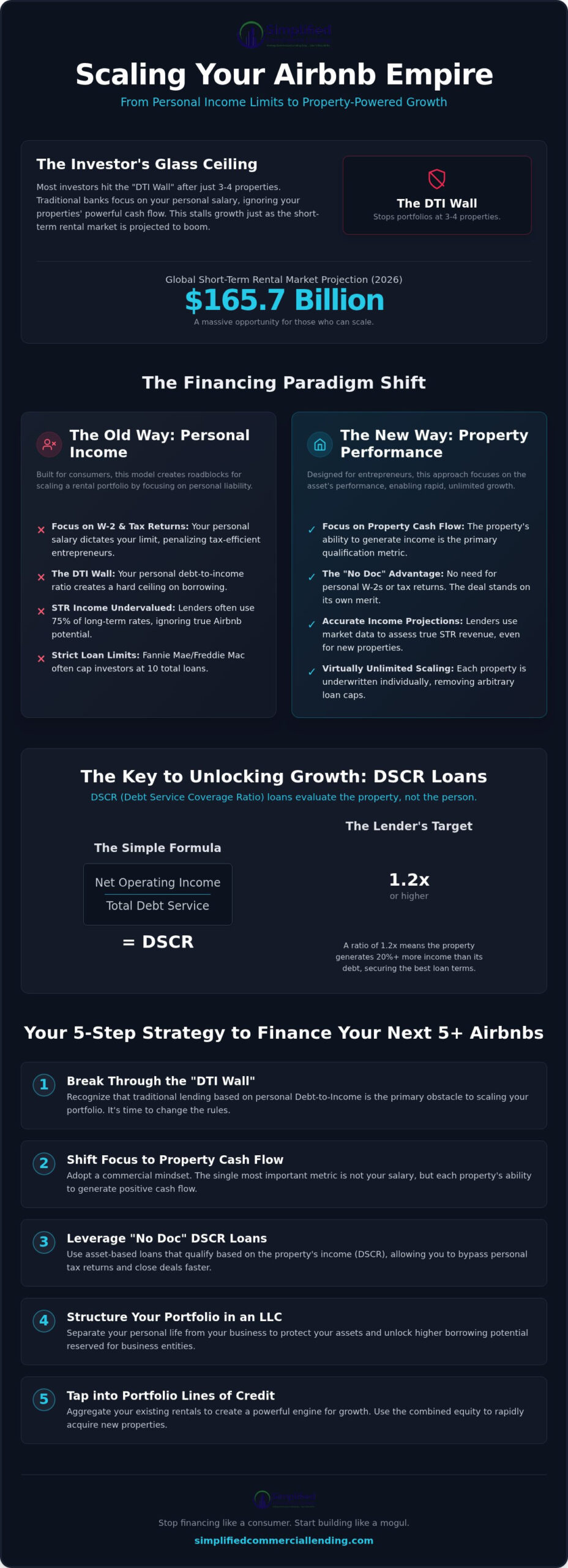
A 5-Step Strategy to Finance Your Next 5 Airbnbs
Scaling isn’t a guessing game. It’s a sequence. If you’ve been wondering how to finance multiple airbnb properties without hitting a wall, you need a strategy that moves beyond the “one house at a time” mindset. The 2026 market requires a professional approach to debt management that prioritizes the velocity of your capital over traditional home-buying habits.
- Step 1: Audit your current equity and property performance. Identify exactly how much “dead” equity is sitting in your first few units and which properties are performing well enough to back a new loan.
- Step 2: Shift from personal debt to LLC-based commercial loans. Stop signing for properties in your own name. Moving assets into an LLC protects your personal credit score and separates your business liabilities.
- Step 3: Secure a DSCR loan for the next acquisition to preserve DTI. Use property-led financing for your fourth or fifth unit. This keeps your personal debt-to-income ratio clean for future needs or emergencies.
- Step 4: Consolidate matured assets into a portfolio line of credit. Once you have a handful of stabilized properties, group them into a single credit facility to simplify your overhead and unlock liquidity.
- Step 5: Reinvest the unlocked capital into higher-yield markets. Take the cash from your portfolio line and pounce on emerging 2026 vacation destinations where the ROI is highest.
Preparing Your Portfolio for Professional Debt
Even “No Doc” lenders appreciate clarity. Clean up your property-level P&L statements to show exactly how much cash your units produce. Lenders want to see a business, not a messy bank statement. Ensure your LLC is properly structured for commercial lending before you apply. Professionalizing your books isn’t about proving your personal income; it’s about proving your business model works. This preparation makes the transition from consumer loans to commercial debt much smoother.
The Velocity of Money Strategy
Speed wins in competitive markets. If you find a property that needs work, use short-term bridge loans for “fix-and-flip” Airbnbs. This allows you to acquire the asset, renovate it, and get it listed quickly. Once the property is stabilized and showing a guest revenue history, refinance into permanent DSCR debt. This strategy keeps your capital liquid. It allows you to move into the next deal without waiting years for equity to build naturally. Always maintain a cash reserve for 2026 market fluctuations to stay resilient while you grow. If you’re ready to start step one, explore our short term rental financing to fund your next acquisition.
Simplified Commercial Lending: Your Partner in Scaling STRs
Scaling a short-term rental business is a high-stakes game. You don’t need a lender that treats you like a consumer. You need a partner that speaks the language of occupancy rates and RevPAR. Simplified Commercial Lending was built specifically for the independent entrepreneur. We specialize in “No Doc” solutions because we know your tax returns don’t tell the full story of your success. If your properties are profitable, that should be enough to secure your next loan.
Understanding how to finance multiple airbnb properties requires looking at the asset first. Our underwriting focuses on property cash flow. We use real-world data and market projections to verify what a property can earn. This approach allows us to bypass the rigid debt-to-income limits that stop traditional banks in their tracks. We prioritize your growth over bureaucratic checklists. This is the disruptive alternative to the slow, detached world of institutional banking.
Why Choose a Commercial Broker Over a Bank?
Traditional banks are often bound by strict geographic limits and rigid federal guidelines. They struggle to value Airbnb revenue correctly, often defaulting to lower long-term rental estimates. As a commercial broker, we provide access to a nationwide network of non-bank lenders. These institutions are specifically designed to fund short-term rental portfolios. We have the expertise to structure multi-property deals that local banks would reject. Whether you are looking for single family investment property loans or a complex portfolio line of credit, we find the right fit for your specific strategy. Explore our guide on Short Term Rental Financing: Top Loan Options for Investors in 2026 to see the full range of professional debt tools available to you.
Ready to Scale Your Portfolio?
The 2026 market moves fast. You cannot afford to wait 60 days for a local bank to analyze your personal history. We prioritize speed and flexibility. We close commercial loans in weeks, not months. Our nationwide reach means we can help you expand into new markets without you needing to find a new lender every time you cross a state line. We handle the complexity of the financing so you can focus on finding the next high-yield property.
Starting the process is simple and direct. We don’t need a mountain of paperwork to give you an answer. To get started today, simply gather your property addresses and a basic summary of their performance. We value pragmatism over protocol. If the numbers work, the deal works. Get your custom portfolio rate quote today and see how fast your business can truly grow when you have the right partner in your corner.
Scale Your Portfolio Beyond the Banking Glass Ceiling
The transition from a hobbyist to a professional mogul requires firing your traditional bank. You’ve learned that personal income limits and rigid DTI ratios are designed to keep you small. To master how to finance multiple airbnb properties in 2026, you must leverage asset-based lending that prioritizes property performance over your W-2. By shifting to DSCR loans and utilizing portfolio lines of credit, you unlock the ability to acquire assets as fast as you can find them.
Simplified Commercial Lending acts as your savvy expert guide in this competitive market. We offer specialized STR cash-flow underwriting and nationwide commercial lending expertise to help you bypass bureaucratic bottlenecks. Our approach means no personal tax returns are required; we look at the strength of your deals, not your salary. Stop letting paperwork stall your momentum and start building the empire you envisioned.
Scale your Airbnb portfolio with a No-Doc DSCR loan from Simplified Commercial Lending today. Your next acquisition is closer than you think. Build with confidence and leave the rigid institutional norms behind.
Frequently Asked Questions
Can I get a loan for multiple Airbnbs at the same time?
Yes, you can secure financing for several properties simultaneously by using commercial debt structures. Unlike traditional banks that often limit you to one closing at a time, commercial lenders specialize in multi-asset deals. You can use a portfolio line of credit to cross-collateralize your existing equity or apply for multiple individual DSCR loans at once. This approach is essential for investors who need to pounce on several high-yield opportunities in a competitive 2026 market.
Do I need tax returns to finance an Airbnb investment?
No, you don’t need to provide personal tax returns when using property-led commercial financing. Simplified Commercial Lending specializes in “No Doc” solutions that focus on the property’s cash flow rather than your personal salary. This is a game changer for entrepreneurs who use high-deduction strategies that make them look “poor” on paper. We prioritize the performance of the asset, allowing you to scale without the bureaucratic headache of traditional income verification.
What is a DSCR loan and how does it help with Airbnbs?
A DSCR loan stands for Debt Service Coverage Ratio and it measures a property’s ability to cover its own mortgage debt through rental income. For Airbnb investors, this is the gold standard because it counts short-term rental revenue toward the qualification. Instead of looking at your W-2, lenders use data from professional tools to project income. It’s the most efficient way to learn how to finance multiple airbnb properties without hitting personal debt limits.
How many Airbnb properties can I finance with one lender?
There is virtually no limit to the number of properties you can finance with a single commercial lender. Traditional banks often cap you at 10 loans due to federal regulations, but commercial partners operate under different rules. By using a portfolio line of credit, you can aggregate dozens of units into a single credit facility. This allows you to scale to 20, 50, or even 100 properties while maintaining a streamlined relationship with one expert financing partner.
Can I use a portfolio line of credit for short-term rentals?
Yes, a portfolio line of credit is a primary tool for scaling short-term rental businesses. It allows you to tap the equity in your existing Airbnbs to fund new acquisitions or renovations. This facility treats your entire collection of properties as a single collateral pool, providing a flexible source of capital. It’s significantly more effective than a traditional HELOC because it doesn’t put your primary residence at risk and offers much higher borrowing limits for professional investors.
What is the minimum down payment for a commercial Airbnb loan in 2026?
In 2026, most commercial lenders require a minimum down payment of 20% to 25% for short-term rental properties. While some niche programs might offer lower entry points for highly qualified borrowers, a 20% stake is the industry standard for maintaining a healthy DSCR. This ensures the property has enough equity to weather market fluctuations while still allowing you to leverage your capital across multiple deals. Higher down payments can also unlock more competitive interest rates.
How does Airbnb income affect my ability to get more loans?
Airbnb income is the primary driver for your growth when using commercial financing. Unlike traditional lenders who might ignore or discount short-term revenue, commercial partners use your actual or projected guest income to qualify you for more debt. As your properties show a strong track record of cash flow, your borrowing power actually increases. This creates a positive feedback loop, making it easier to understand how to finance multiple airbnb properties as your portfolio matures.
Can I finance an Airbnb under an LLC?
Yes, and we highly recommend financing your Airbnbs under an LLC. Most commercial loans are structured specifically for business entities to provide asset protection and separate your personal credit from your investments. This structure is a requirement for many portfolio lines of credit and DSCR products. It allows you to build a professional business profile that isn’t tied to your personal debt-to-income ratio, which is vital for long-term scaling and risk management in the rental industry.