Why should your personal tax returns dictate the growth of your commercial empire? If you’ve ever been blocked by a traditional bank because of a high debt-to-income ratio or a complex personal financial history, you know how frustrating the institutional “no” can be. The reality is that your personal 1040s have very little to do with the actual success of a grocery-anchored strip mall or a neighborhood shopping plaza. That’s why savvy investors are turning to dscr loans for retail centers to bypass the bureaucratic red tape and focus on the asset’s performance instead.
We agree that the property’s cash flow should do the heavy lifting in any commercial deal. In this 2026 guide, you’ll learn how to leverage that income to secure high-leverage financing without showing a single tax return. We’ll preview the specific DSCR math required for retail assets, look at current market LTV trends, and show you exactly how to close faster than your competition. It’s time to stop jumping through hoops and start scaling your portfolio with speed and precision.
Key Takeaways
- Stop letting personal debt-to-income ratios block your growth by shifting the focus to your property’s net operating income.
- Discover how dscr loans for retail centers allow you to secure high-leverage financing without providing a single tax return.
- Master the retail DSCR formula to accurately calculate how tenant mix and lease terms impact your funding potential.
- Learn the specific 2026 benchmarks for credit scores and loan-to-value ratios that national lenders use to evaluate retail assets.
- Streamline your acquisition process by bypassing traditional bank bottlenecks and underwriting your deals based on pure cash flow.
What Are DSCR Loans for Retail Centers?
Traditional banks usually focus on your personal 1040s. They want to see your W2s, your tax returns, and your personal debt history. DSCR loans for retail centers flip this script entirely. Instead of scrutinizing your lifestyle or personal income, lenders look at the asset itself. The Debt Service Coverage Ratio (DSCR) is a metric that measures the property’s ability to pay for itself. If the shopping center’s net operating income covers the annual debt service, the loan is viable. It’s a simple, asset-based approach that values property performance over personal financial history. While residential DSCR is common for single-family rentals, commercial-asset DSCR for retail is more specialized. It requires a deeper look at lease expirations and tenant credit, but the core principle remains the same: the property is the borrower. This allows you to keep your personal finances private and focus on the numbers that matter for the deal.
The “No-Doc” Advantage for Retail Investors
The “no-doc” label specifically refers to the removal of personal income verification. For a savvy investor, this means you don’t have to worry about how your business write-offs look to a traditional underwriter. You aren’t penalized for being a successful entrepreneur with a complex tax structure. This flexibility allows you to close deals in weeks rather than months. In the fast-moving retail market, being able to move quickly is often the difference between winning a prime location and losing it to a cash buyer. You can scale your retail portfolio as fast as you can find profitable properties, unburdened by restrictive personal debt limits. It’s about removing the friction that slows down your growth.
Retail Center vs. Other Commercial Assets
Lenders view retail cash flow through a different lens than multi-family or industrial properties. While multi family residential investment loans rely on many short-term residential leases, retail centers thrive on long-term commercial contracts. A well-balanced tenant mix creates a safety net. If a local boutique closes, the national anchor tenant keeps the lights on and the mortgage paid. This multi-tenant diversity reduces the risk of a total income loss. Lenders are often willing to offer better terms to centers anchored by high-credit tenants like grocery chains. These businesses provide a reliable, predictable stream of income that supports a strong coverage ratio. Unlike office spaces that may struggle with remote work trends, neighborhood retail centers provide essential services that require a physical presence. This “internet-resistant” quality makes them prime candidates for DSCR financing in 2026.
Calculating DSCR for Retail Properties: The NOI Formula
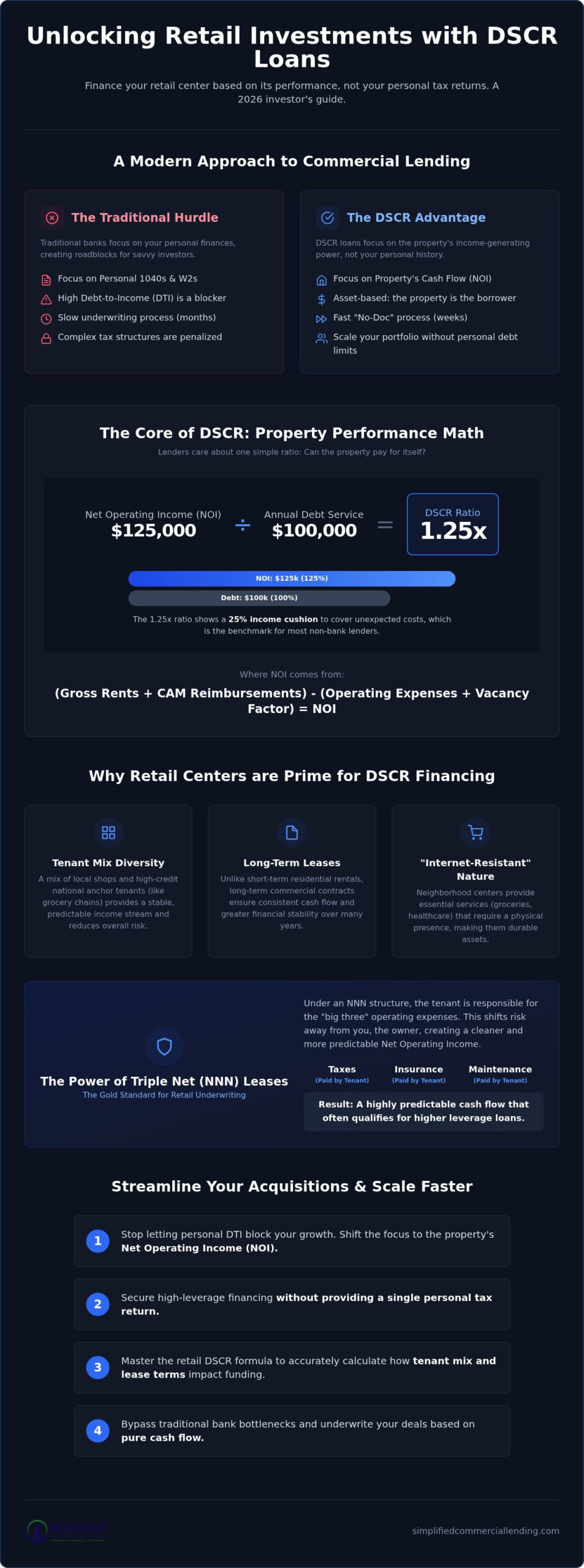
Success in retail investing comes down to a simple math problem. To qualify for dscr loans for retail centers, you need to understand the Debt Service Coverage Ratio formula: Net Operating Income (NOI) divided by your Annual Debt Service. While traditional SBA 7(a) loans might get bogged down in your personal tax history, DSCR lenders care only about this ratio. If your property generates $125,000 in annual profit and your mortgage payments are $100,000, your DSCR is 1.25x. This 1.25x benchmark is the magic number for most non-bank lenders. It proves the asset has a 25% cushion to handle unexpected costs or tenant turnover.
Calculating NOI for a shopping center is more nuanced than a single-family rental. You start with Gross Rents and add in Common Area Maintenance (CAM) reimbursements. In retail, tenants often pay their share of property taxes, insurance, and utilities. These reimbursements are vital because they offset your operating costs. You then subtract your actual expenses and a vacancy factor to find your stabilized NOI. This clean, performance-based number is what drives your loan approval. If you want to see how your current property numbers stack up, you can calculate your potential leverage with our expert team today.
How NNN Leases Impact Your DSCR
Triple Net (NNN) leases are the gold standard for retail underwriting. Under an NNN structure, the tenant handles the “big three” expenses: taxes, insurance, and maintenance. Lenders love these deals because they shift the risk of rising costs away from you, the owner. This creates a cleaner NOI that isn’t subject to inflation or sudden tax hikes. When dscr loans for retail centers are underwritten, an NNN-heavy tenant mix often allows for higher leverage because the cash flow is significantly more predictable.
Factoring in Vacancy and Credit Loss
Lenders are pragmatists. Even if your center is 100% occupied today, an underwriter will typically apply a 5% to 10% vacancy factor to your NOI. They also look at credit loss, which is the risk that a smaller “mom and pop” tenant might default on their rent. National anchor tenants with strong credit reduce this perceived risk. If you’re looking at a property with high vacancy but great potential, using a commercial property loan to bridge that gap can help you stabilize the asset before long-term financing kicks in. This proactive approach ensures your DSCR remains strong even during tenant transitions.
Retail-Specific Underwriting: Tenants, Leases, and Risk
Underwriting for dscr loans for retail centers goes far beyond the basic math of the NOI formula. Lenders aren’t just looking at the bottom line; they are looking at who is signing the checks. The tenant mix is the heartbeat of any retail asset. A center filled with national, credit-rated tenants is viewed as a low-risk cash machine. Conversely, a center full of local “mom and pop” shops requires a more nuanced strategy. Lenders scrutinize the rent roll to determine how likely that income is to continue for the life of the loan. They want to see a balance that ensures the mortgage gets paid even if one or two smaller tenants hit a rough patch.
Anchor tenants are the pillars of this stability. Grocery stores, national pharmacies, or big-box retailers bring massive balance sheets to the deal. Because these companies are credit-rated, lenders view their rent as nearly guaranteed. This stability often translates into more favorable loan terms and higher leverage. However, the length of these leases is just as important as the names on them. Lenders look closely at lease expiration dates to assess rollover risk. If your major tenants have leases expiring in the next 18 months, it creates a “cliff” that could jeopardize the property’s ability to service debt. This is why the Weighted Average Lease Term (WALT) is a critical metric in retail underwriting.
Anchor Tenant Stability vs. Local Boutiques
National tenants provide the credit floor, but unanchored strip centers are still excellent candidates for financing. If your center relies on local boutiques, you can mitigate the perceived risk by maintaining a higher DSCR ratio. While a grocery-anchored center might glide through with a 1.25x ratio, an unanchored center might need to show 1.35x or higher to provide the lender with a safety buffer. Savvy investors focus on the “stickiness” of their local tenants. A long history of renewals and strong sales per square foot can often outweigh the lack of a national brand name.
Tenant Concentration Risk
Concentration risk is a major red flag. If a single tenant provides more than 25% to 30% of your total rental income, your loan eligibility could be at risk. If that one tenant moves out, the property’s DSCR could instantly drop below 1.0x. Diversification is your best defense. If you find yourself with a concentrated rent roll, consider scaling your strategy. Using a portfolio line of credit for rentals allows you to group multiple retail assets together. This spreads the risk across different locations and tenant bases, making your overall portfolio much more attractive to asset-based lenders who value stability over personal tax returns.
Loan Requirements and the Application Process
Securing dscr loans for retail centers is significantly faster than chasing a traditional bank mortgage. Because we prioritize the asset’s performance, the paperwork is streamlined. You can typically expect a Loan-to-Value (LTV) range between 65% and 75%. While some programs consider credit scores in the low 600s, a score of 680 or higher generally unlocks the most competitive terms in 2026. The beauty of this process lies in what we don’t ask for. You won’t need to provide personal tax returns, W2s, or complex personal financial statements. Instead, the focus stays on the property’s ability to generate cash. If the deal makes sense on paper, we move quickly.
The timeline from your initial quote to a fully funded retail center is often measured in weeks, not months. This speed gives you a massive advantage in competitive markets where sellers want certainty. To get started, you’ll need a clear snapshot of the property’s current standing. For a more detailed breakdown of general non-bank standards, you can review our DSCR loan requirements guide. Ready to see what your property qualifies for? You can apply for a retail center loan quote right now to lock in your leverage.
The Essential Due Diligence Checklist
While we skip the tax returns, we do require a deep dive into the property’s operational health. Your due diligence package should include a detailed rent roll that lists tenant start dates, lease expiration dates, and square footage. We also look at property operating statements from the last one to two years to verify income and expenses. Because retail centers involve physical structures and public access, lenders will also require:
- A Phase I Environmental Report to ensure the land is clear of contaminants.
- A Property Condition Assessment (PCA) to evaluate the roof, HVAC, and parking lot.
- Executed lease agreements for all current tenants to verify NNN reimbursements.
Navigating the Appraisal for Retail Centers
Commercial appraisals for retail centers differ from residential valuations. Appraisers primarily use the Income Approach, which values the property based on the NOI we discussed earlier. They will also look at the Sales Comparison Approach to see what similar centers are selling for in your market. A common hurdle is the “Market Rent” vs. “Actual Rent” debate. If your tenants are currently paying below-market rates, the appraiser might value the property based on current income rather than potential upside. Being prepared with a strong P&L and documented market comps helps ensure the appraisal reflects the true value of your investment.
Scaling Your Retail Portfolio with Simplified Commercial Lending
Scaling a commercial empire requires a financing partner that values your ambition over your tax returns. Traditional banks often view retail centers through a lens of fear and bureaucracy. They get bogged down in your personal debt-to-income ratios and slow your momentum with endless requests for paperwork. At Simplified Commercial Lending, we act as your savvy expert guide. We bypass these industry bottlenecks by focusing on the performance of the asset itself. Our national reach allows us to connect you with non-bank lenders who specialize in dscr loans for retail centers, ensuring your financing is as agile as your investment strategy.
The “Simplified” approach isn’t just a name; it’s a commitment to removing the friction from your growth. We understand that your time is better spent finding your next anchor tenant or negotiating a value-add deal than sitting in a bank lobby. By prioritizing property cash flow, we help you leverage the equity in your existing assets to acquire new ones. Whether you’re looking to refinance a stabilized strip mall or secure capital for a new acquisition, we provide the disruptive alternatives to institutional norms that independent investors deserve.
Moving Beyond the Single Asset
Transitioning from a single strip mall to a massive shopping center is a major milestone. To manage this growth, you need more than just a one-off loan. We specialize in portfolio lines of credit that allow you to group multiple retail assets under a single, streamlined facility. This approach simplifies your debt management and makes it easier to secure dscr loans for retail centers across your entire portfolio. Non-bank lenders are often the only ones willing to fund these “internet-resistant” retail opportunities, giving you the freedom to dominate your local market without the constraints of traditional banking logic.
Getting Started: Your Path to Faster Funding
Speed is the ultimate currency in the 2026 commercial market. While your competitors are busy filing three years of tax returns, you can be at the closing table. To start your journey, all you need is a current rent roll and a property P&L statement. We don’t need your personal 1040s to see the value in a high-performing retail asset. Our team is ready to help you navigate the complexities of tenant concentration and lease rollover risk to secure the best possible terms. Ready to finance your retail center? Get a no-obligation quote today.
Take Control of Your Retail Portfolio Growth
The days of letting a personal tax return dictate your investment potential are over. By shifting the focus from your personal income to the property’s net operating income, you unlock a level of scaling that traditional banking simply can’t match. You’ve learned that a strong tenant mix and a solid coverage ratio are the real keys to securing capital. Leveraging dscr loans for retail centers allows you to move at the speed of the market; you’ll close deals while your competition is still stuck in the underwriting queue. Our asset-based approach means we prioritize the numbers that actually matter: your property’s performance and its long-term stability.
Simplified Commercial Lending is your partner in bypassing institutional red tape nationwide. We offer a streamlined path to funding with no tax returns or W-2s required. Whether you’re acquiring a grocery-anchored plaza or refinancing an unanchored strip center, our team is ready to help you navigate the process with confidence and precision. Secure your retail center financing without tax returns, Apply Now. Your next big deal is waiting, and we’re here to help you cross the finish line.
Frequently Asked Questions
Is a DSCR loan better than an SBA loan for a retail center?
DSCR loans offer a speed and privacy advantage that SBA 7(a) programs can’t match. While SBA loans often require personal tax returns and extensive global cash flow analysis, DSCR underwriting focuses solely on the retail center’s performance. This makes them better for investors who need to close quickly in a competitive market or those who want to keep their personal finances separate from their business assets.
What is the minimum DSCR required for an unanchored strip mall?
Most lenders require a minimum ratio between 1.25x and 1.35x for unanchored strip malls. Because these properties lack a high-credit anchor tenant like a grocery store, the risk is perceived as slightly higher. Maintaining a stronger coverage ratio provides a safety buffer for the lender against tenant turnover. If your property’s net operating income is at least 30% higher than the debt service, you’ll likely secure more favorable terms.
Can I get a DSCR loan for a retail center with high vacancy?
Standard dscr loans for retail centers typically require the property to be stabilized, meaning occupancy is high enough to cover the mortgage. If your center has significant vacancy, you might first need a bridge loan to fund the acquisition and tenant improvements. Once you’ve filled the vacant units and established a consistent rent roll, you can transition into a long-term DSCR product based on the new, higher income levels.
Do retail center DSCR loans require personal guarantees?
Most commercial DSCR products include a personal guarantee, though it’s often a limited or “bad boy” carve-out for specific high-leverage deals. Unlike traditional bank loans that scrutinize your personal debt-to-income ratio, these asset-based loans use your credit score primarily as a measure of character rather than a source of repayment. This allows you to secure funding based on the property’s strength while still maintaining your role as the professional sponsor.
How does the “Income Approach” appraisal work for retail properties?
The income approach determines value by dividing the property’s Net Operating Income (NOI) by a market-appropriate capitalization rate. For a retail center, the appraiser analyzes current lease rates, expense reimbursements, and historical vacancy to find a stabilized income figure. This method is the primary valuation tool for lenders because it reflects the property’s actual earning potential rather than just the physical cost of the bricks and mortar.
Are tax returns ever required for commercial DSCR loans?
No, tax returns and W-2s are not required for a true no-doc commercial DSCR loan. The underwriting process relies on the property’s profit and loss statements, current rent rolls, and executed lease agreements. This is a game-changer for self-employed entrepreneurs who use legal deductions to reduce their taxable income, as it prevents their personal tax strategy from interfering with their ability to secure high-leverage property financing.
What are the typical closing costs for a retail center DSCR loan?
Closing costs generally include loan origination fees, third-party reports, and legal expenses. For a retail asset, you should budget for a Phase I environmental report, a property condition assessment, and a commercial appraisal. These costs ensure the lender is protected and the asset is physically sound. While these fees vary based on the loan size and complexity, they are a standard part of professional commercial property financing.
Can I use a DSCR loan to refinance and pull cash out of my retail property?
Yes, cash-out refinancing is a primary strategy for scaling a retail portfolio. If your property has increased in value through rent growth or debt paydown, you can use dscr loans for retail centers to tap into that equity. Many investors use these funds as a down payment for their next acquisition. This allows you to grow your empire using the property’s own success rather than injecting fresh personal capital into every deal.