Why are you letting a personal debt-to-income ratio stall a business that generates six figures in bookings? It’s a common trap for ambitious investors. You’ve built a successful short-term rental business, yet traditional banks treat you like a liability because they won’t recognize your Airbnb or Vrbo income. You’re likely tired of the endless paperwork and the slow closing times that cost you prime properties in high-demand markets.
We agree that the old way of lending is broken for the modern entrepreneur. This guide teaches you how to secure high-leverage financing using portfolio loans for vacation rental properties. You’ll learn to qualify based on property cash flow and future potential instead of your personal tax returns. With the U.S. short-term rental market projected to reach 1.77 million listings in 2026, the opportunity to scale has never been more competitive or more rewarding.
We’re going to show you how to leverage your existing equity to bypass traditional institutional bottlenecks and minimize personal disclosure. We’ll explore the latest DSCR requirements and the streamlined path to building a massive portfolio without the typical bureaucratic headaches. It’s time to start lending based on where your business is going, not where your personal finances were two years ago.
Key Takeaways
- Learn how portfolio loans for vacation rental properties leverage property equity and cash flow so you can scale without traditional bank hurdles.
- Master the use of the Debt Service Coverage Ratio (DSCR) to qualify for financing based on real property performance instead of personal income.
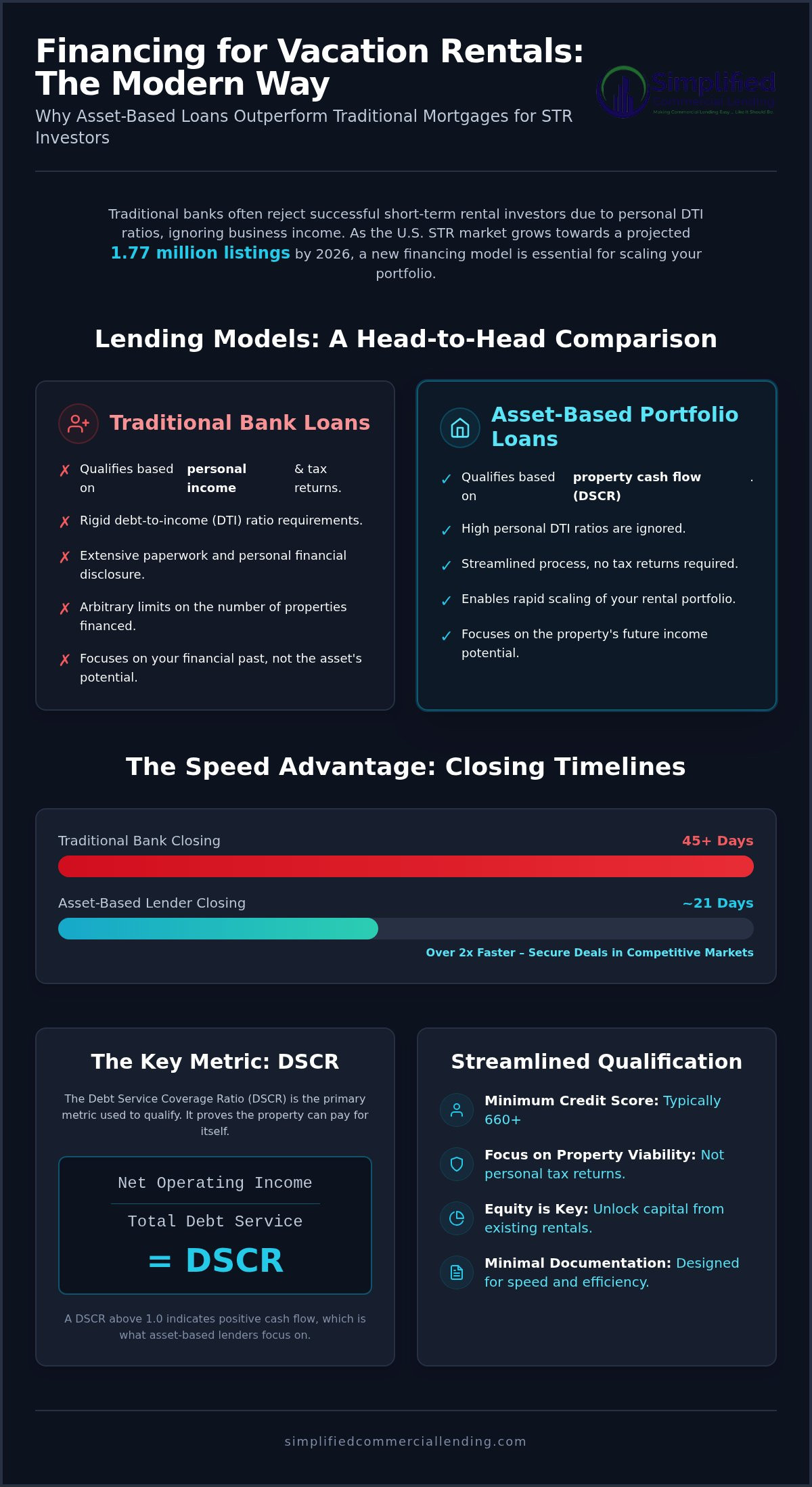
- Secure funding in as little as 21 days to stay competitive in fast-moving markets where traditional 45-day bank cycles fall short.
- Discover how to unlock capital from your existing short-term rentals using portfolio lines of credit to fund your next acquisition.
- Qualify for high-leverage investment loans with a streamlined underwriting process that requires no tax returns and ignores high DTI ratios.
The Evolution of Vacation Rental Financing in 2026
The vacation rental market has matured into a sophisticated asset class. In 2026, we’ve moved past the era of “second home” financing where investors often struggled to fit into boxes designed for primary residences. Today, the short-term rental (STR) space is a professionalized industry. Institutional capital has flooded the market, creating specialized financial products that treat your Airbnb or Vrbo listing like the business it is. This evolution has made portfolio loans for vacation rental properties the gold standard for anyone looking to grow beyond a single unit.
Traditional debt-to-income (DTI) ratios are becoming a relic of the past for serious players. If you’re scaling a portfolio, your personal income shouldn’t be the ceiling for your growth. Asset-based lending has taken center stage because it prioritizes the property’s performance over your personal tax returns. This shift allows you to secure financing based on the actual cash flow the asset generates, rather than what you reported to the IRS last year.
The Problem with Traditional Banking in 2026
Banks haven’t kept up with the speed of the modern travel market. Their rigid underwriting processes still demand years of tax returns. This often punishes entrepreneurs who use legal deductions to minimize their taxable income. If your 1040 shows a low net income because of smart accounting, a traditional bank sees a risk. We see a savvy business owner who understands cash flow.
Standard institutions also impose arbitrary limits on how many properties you can finance. Once you hit a certain threshold, they usually shut the door. Their 45-day closing cycles are also simply too slow. In a market where demand for STRs is projected to grow by 4.1% this year, losing a deal because of a slow appraiser or a picky underwriter is a costly mistake you can’t afford to make.
Why Investors are Choosing Non-Bank Lenders
Speed is the new currency in real estate. Non-bank lenders operate with a sense of urgency that matches the competitive vacation rental landscape. By utilizing a non-conforming mortgage, investors can sidestep the red tape of government-backed guidelines. This flexibility allows for faster closings, often in 21 days or less, giving you a massive advantage in high-demand areas where sellers won’t wait for a bank’s committee to meet.
These lenders focus on the business case. Whether you’re buying a mountain cabin or a luxury beachfront condo, the decision rests on the property’s potential. This modern approach to portfolio loans for vacation rental properties means you can scale as fast as your equity allows. You get to skip the personal paperwork drag and focus on what matters: finding the next high-yield property.
Asset-Based vs. Traditional Mortgages: A 2026 Comparison
Traditional banks want to know your life story before they’ll cut a check. They dig into your personal debt, your W2 income, and your spending habits. For an active investor, this is a massive bottleneck. Traditional mortgages are designed for stable employees, not for entrepreneurs building a vacation rental empire. Asset-based lending flips this script. It prioritizes the property’s potential over your personal financial history, making portfolio loans for vacation rental properties the superior choice for rapid growth.
Qualification Criteria: You vs. The Property
Banks focus on your ability to pay back a loan using your personal paycheck. They use rigid debt-to-income (DTI) ratios that often count your existing rental mortgages as liabilities without fully crediting the income they produce. If you’re self-employed, their tax return requirements can be a nightmare. Non-bank lenders take a different path. They focus on Net Operating Income (NOI). If the property’s projected revenue covers the debt, the deal moves forward.
Credit scores still matter in 2026, but the threshold is more realistic. Most asset-based programs look for a minimum score of 660. While SBA loan programs are excellent for traditional small businesses, they often lack the specialized underwriting needed for the seasonal nature of short-term rentals. Asset-based lenders understand that a beach house makes more in July than January, and they underwrite accordingly.
The True Cost of Capital
You’ll likely pay a higher interest rate for a portfolio loan than a primary residence mortgage. In 2026, investment property rates typically sit 1% to 2% higher than standard home loans. You might also see higher origination fees or points at closing. Don’t let the sticker price scare you. The real metric is your return on investment (ROI). A slightly higher rate is a small price to pay for the ability to close a deal in 21 days instead of 45.
Speed is a competitive advantage. If a bank takes six weeks to tell you “no” because of a technicality in your tax returns, you’ve lost the property and the revenue it would have generated. Asset-based loans offer a “no-doc” advantage that keeps your personal paperwork to a minimum. This streamlined process allows you to scale without DTI caps. You can own ten, twenty, or fifty properties as long as each one pays for itself. If you’re ready to stop jumping through bank hoops, it’s time to explore modern financing options that value your property’s performance as much as you do.
Understanding DSCR: The Key Metric for Vacation Rental Loans
Debt Service Coverage Ratio is the ratio of annual net operating income to debt obligations. It’s the most critical number in your financial toolkit. While traditional banks obsess over your personal paycheck, asset-based lenders focus on this specific ratio to determine if a property can pay for itself. In the world of portfolio loans for vacation rental properties, a strong DSCR is your ticket to better interest rates and higher leverage. It transforms your rental from a personal liability into a self-sustaining business entity.
Lenders in 2026 don’t just guess about your potential earnings. They use sophisticated data from specialized market analytics platforms to project seasonal income accurately. This is vital for properties that don’t have a long operating history. The “magic number” for most programs is a DSCR of 1.0, meaning the property’s net income exactly covers the mortgage, taxes, and insurance. However, some flexible institutional programs allow for ratios as low as 0.85 if you have strong cash reserves or a high credit score.
How STR Income is Calculated for Loans
Underwriters look at two main data points: your trailing 12-month history or future revenue projections. For a new purchase, they’ll rely heavily on localized market data to see what comparable properties earn. They also factor in property management fees, which is a standard deduction even if you plan to self-manage. Since professional property managers now control 69% of the U.S. market, lenders use these fees to ensure the business remains viable if you ever decide to step away from daily operations. “No-Doc” doesn’t mean they ignore the asset; it means they’re doing due diligence on the property’s performance instead of your personal tax returns.
Improving Your DSCR to Secure Better Rates
If your ratio is hovering near the 1.0 mark, you can take active steps to boost it and unlock better terms. Reducing operational fat is the fastest way to increase your net operating income. You might also consider a larger down payment. In 2026, moving from a 20% to a 25% down payment significantly lowers your debt obligation, which naturally raises your DSCR. To dive deeper into the specific numbers you’ll need, review our DSCR Loan Requirements: 2026 Portfolio Scaling Guide. This strategy allows you to maintain aggressive leverage while staying within the safe zones that institutional lenders prefer.
How to Qualify for a Vacation Rental Loan Without Tax Returns
Forget the mountain of paperwork required by traditional banks. Qualifying for portfolio loans for vacation rental properties is a fast, logic-driven process that respects your time. It bypasses the 1040 grind and focuses on four clean steps designed for the professional investor. If the property’s numbers work, the deal works. Here is how you move from identification to closing without showing a single tax return.
- Step 1: Property Identification and Performance Analysis. You find a high-potential asset. We use real-time market data to verify that the projected revenue outweighs the debt.
- Step 2: Credit and Liquidity Verification. This is the “Lite” version of underwriting. We confirm you have a 660+ credit score and enough liquid cash for the down payment and six months of reserves.
- Step 3: Appraisal and Rent Schedule. An appraiser evaluates the property and completes a Form 1007 or a specific short-term rental equivalent. This confirms the income potential.
- Step 4: Entity Formation. You set up an LLC or Corporation. This establishes your professional borrowing status and keeps the loan off your personal credit report.
The Role of the LLC in Investment Loans
Why do we insist on an LLC? It’s about asset protection and underwriting simplicity. When you borrow through an entity, the lender treats the loan as a business-to-business transaction. This bypasses many of the consumer protection regulations that slow down traditional mortgages. It also keeps your personal assets shielded from property-specific liabilities. For a deeper look at how this structure helps you grow, read our guide on Single Family Residential Investment Loans: The 2026 Investor Guide to Scaling.
Required Documentation for No-Doc Loans
The term “no-doc” refers to the absence of personal income documentation, not a total lack of paperwork. You’ll still need to provide a few key items to verify the business case. Expect to provide two months of bank statements to prove you have the funds for the closing and reserves. You’ll also need your basic personal identification and a credit authorization form. If the property is already operating, provide the last 12 months of income reports from your management platform or professional manager. This streamlined list allows us to move at the speed of the market. If you’re ready to skip the red tape, apply for a no-doc loan today and get a decision based on your property’s potential.
Strategic Scaling: Portfolio Lines of Credit for STRs
Scaling a vacation rental business one house at a time is slow. It forces you to restart the underwriting process every few months. Professional investors in 2026 use portfolio loans for vacation rental properties to consolidate their debt and move faster. Instead of managing five separate mortgages with five different lenders, you can bring them under one roof with a portfolio line of credit. This approach turns your equity into a revolving fund for new acquisitions, allowing you to strike when a deal appears without waiting on a bank’s committee.
Cross-collateralization is a powerful tool in this space. It allows you to use the collective value of your rentals to secure higher leverage on a new purchase. The pro is clear: you can buy more with less cash down. The con is that your properties are linked. If one asset underperforms, it can impact the terms of the entire portfolio. For the rapidly growing investor, this trade-off is often the key to moving from five doors to fifty in a single year. It treats your real estate as a unified business rather than a collection of isolated houses.
Unlocking Equity in Your Current Portfolio
Don’t let your equity sit idle while you search for your next down payment. A cash-out refinance allows you to pull capital from your best-performing assets without selling them. This is how you fuel your next acquisition. 2026 is the year of the rental portfolio line of credit because it offers the flexibility that traditional term loans lack. You only pay interest on the funds you use, making it an efficient way to manage your cash flow. Learn more about how to use a Portfolio Line of Credit: Scale Rentals Without Tax Returns.
Working with a Specialized Mortgage Broker
Retail banks speak the language of W2s and personal credit cards. We speak the language of ROI and occupancy rates. Working with a specialized broker gives you access to non-bank institutional capital that traditional institutions simply cannot reach. This capital is more flexible and values the future cash flow of your business over your personal tax history. We act as your navigator through these complex markets, ensuring you have the right debt structure to support long-term growth. It’s time to stop thinking like a homeowner and start thinking like a mogul. Scale your portfolio today with Simplified Commercial Lending and build the empire you’ve envisioned.
Take Control of Your Vacation Rental Growth
The short-term rental market is moving fast. You can’t afford to be held back by traditional banking’s rigid rules and slow timelines. By switching to asset-based financing, you prioritize your business’s future over your personal financial history. Remember that your property’s cash flow is your greatest asset. Whether you use DSCR metrics to qualify for a single purchase or leverage equity through portfolio loans for vacation rental properties to scale rapidly, the tools for success are within reach.
We specialize in no-doc underwriting that ignores your tax returns and focuses on property performance. As national brokers, we provide access to institutional capital across the United States. This ensures you have the speed and flexibility needed to win in competitive markets. Ready to take the next step? Get a Custom Quote for Your Next Vacation Rental Loan and start building your legacy today. Your ambition deserves a financial partner that works as hard as you do.
Frequently Asked Questions
Do I need a 20% down payment for a vacation rental loan?
Yes, most investment programs require a down payment between 20% and 25%. While some high-credit borrowers may find options at 15%, a larger down payment significantly improves your debt service coverage ratio. This provides an immediate equity cushion and helps you secure more favorable interest rates. It’s a strategic move for investors looking to maintain a stable and scalable portfolio in a competitive market.
Can I use Airbnb or Vrbo income to qualify for a DSCR loan?
Absolutely. We qualify properties based on their actual short-term rental history or projected revenue from professional market analytics providers. This approach is the core benefit of portfolio loans for vacation rental properties. It ensures that your ability to borrow is tied to the asset’s performance rather than your personal paycheck. We recognize the high-yield potential of the STR market and underwrite accordingly to support your growth.
What is the minimum credit score for a no-doc rental property loan?
You typically need a minimum credit score of 660 to qualify for no-doc investment financing. While we don’t require personal tax returns, we do verify your credit history and liquid reserves to ensure you can handle the debt service. A higher score often unlocks better leverage and lower origination fees. This streamlined verification process allows us to focus on the business case of the property rather than your personal debt-to-income ratio.
How long does it take to close on a vacation rental loan in 2026?
Our goal is to close your loan in 21 days or less. Traditional banks often take 45 days or more because of their slow underwriting cycles and rigid institutional requirements. By removing the need for personal income documentation, we move at the speed of the modern real estate market. This rapid execution gives you a massive advantage when bidding on high-demand properties where sellers value a quick and certain closing.
Are interest rates higher for short-term rental properties?
Yes, interest rates for investment properties are generally 1% to 2% higher than primary residence mortgages. This slight premium accounts for the higher risk profile of rental income. However, the flexibility of asset-based lending allows you to scale much faster than traditional financing ever would. Most professional investors find that the increased cash flow from a well-located vacation rental more than offsets the slightly higher cost of capital.
Can I get a loan for a vacation rental in an LLC name?
Yes, we specialize in closing loans for business entities like LLCs and Corporations. This structure is essential for asset protection and professional portfolio management. Using an LLC also simplifies the process for portfolio loans for vacation rental properties by treating the loan as a business-to-business transaction. It keeps the debt off your personal credit report, allowing you to maintain a lower personal DTI for other financial goals.
Do I need to show my personal income if the property is profitable?
No, you don’t need to provide personal income verification if the property meets the required DSCR. We focus on the property’s net operating income to ensure it can cover the mortgage, taxes, and insurance payments. This “no-doc” advantage is perfect for self-employed entrepreneurs or investors with complex tax returns. If the property’s cash flow is strong, that is the primary documentation we need to move your deal to the closing table.
What happens if the property is currently vacant or a new build?
We can qualify vacant properties or new construction using projected revenue data from industry-standard market reports. Our underwriters look at comparable short-term rentals in the immediate area to estimate the asset’s future performance. This allows you to secure financing for a property that hasn’t yet established a booking history. As long as the market data supports a healthy coverage ratio, we can provide the high-leverage funding you need to launch.