Your tax returns are often the biggest obstacle to your next acquisition. For the modern investor, a thick stack of 1040s filled with strategic write-offs is a sign of a smart business, but to a traditional bank, it looks like a lack of income. It’s a frustrating paradox that stalls growth and lets prime vacation rentals slip away to competitors with deeper pockets or fewer deductions. You shouldn’t be penalized for being a savvy business owner. You deserve a lending partner that values the asset’s performance over your personal paper trail.
We understand the struggle of being denied a loan because your accountant did their job too well. This guide solves that bottleneck by showing you how to leverage airbnb financing no income verification. You’ll learn how to secure funding based on a property’s projected cash flow rather than your history with the IRS. We will explore the 2026 landscape of Debt Service Coverage Ratio (DSCR) loans, where 80% loan-to-value is still achievable for those who know how to navigate the private equity market. This briefing breaks down the exact steps to close faster, scale your portfolio, and treat your short-term rentals like the high-performing commercial assets they are.
Key Takeaways
- Stop letting tax write-offs block your growth by shifting from traditional DTI ratios to property-centric underwriting.
- Master the mechanics of airbnb financing no income verification to secure loans based on a property’s cash flow rather than your personal 1040s.
- Use third-party data projections to prove the earning potential of new vacation rentals and unlock financing without prior rental history.
- Understand the 2026 standards for credit scores and down payments to position yourself for the best private equity rates.
- Transition from single-property deals to a scalable empire by using portfolio lines of credit to tap into your existing equity.
Why Traditional Banks Fail Airbnb Investors (And the 2026 Alternative)
Banks love predictable W-2 income and stable pay stubs. They rely on rigid Debt-to-Income (DTI) ratios that don’t account for the reality of short-term rental investing. If you’re not a traditional employee, you’re often treated as a high-risk liability. This outdated perspective ignores the actual earning potential of your property. It forces you to jump through bureaucratic hoops that lead nowhere. By 2026, the gap between traditional banking and the modern rental market has only widened, leaving many savvy investors stranded without the capital they need to grow.
The Conflict Between Tax Strategy and Conventional Mortgages
Your accountant’s job is to minimize your tax liability. By using depreciation, travel expenses, and property maintenance write-offs, you lower your taxable income. While this is smart business, it’s often a death sentence for a conventional loan application. Big banks look at your net income on your tax returns, not your gross cash flow. If your paper income looks low because of these deductions, you’ll be denied despite having a profitable portfolio. Tax returns are a poor metric for rental success because they measure historical personal tax liability rather than future property performance. Traditional lenders also struggle with the seasonal nature of vacation rentals. They prefer the flat, predictable rent of a long-term tenant. They don’t know how to handle a property that earns $8,000 in July but $2,000 in November, leading to conservative appraisals that kill deals.
Introducing the No-Doc Investment Strategy
The 2026 real estate market demands speed and flexibility. Asset-based lending has emerged as the disruptive alternative to the bank’s “no.” In this model, the underwriting process shifts away from your personal 1040s and toward the property itself. This is where airbnb financing no income verification changes the game. Lenders evaluate the Debt Service Coverage Ratio (DSCR) to see if the property’s revenue can cover its own debt payments, taxes, and insurance.
This “no-doc” approach doesn’t mean there’s no documentation. It means the documentation is property-centric. Instead of proving how much you earned at a day job, you prove how much the house will earn on the short-term rental market. This strategy is faster, more flexible, and allows you to scale without being limited by your personal income bottlenecks. You can close deals in weeks rather than months, giving you a massive advantage in competitive vacation rental markets where speed is the ultimate currency.
Understanding DSCR: The Secret to No-Doc Airbnb Financing
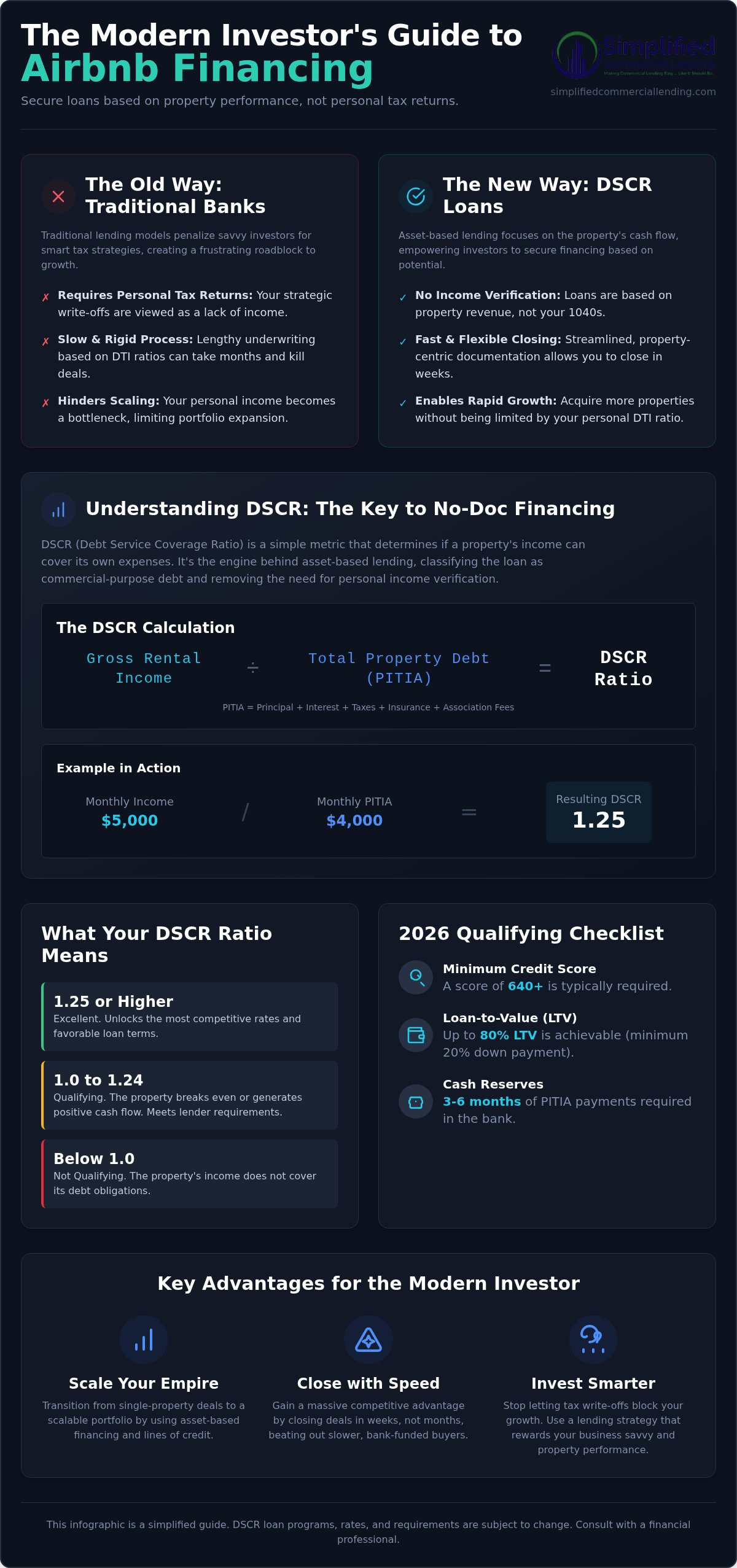
Debt Service Coverage Ratio (DSCR) is the engine behind modern real estate growth. It is a simple financial metric that compares a property’s annual gross rental income to its annual debt obligations. While traditional residential mortgages are governed by the federal ability-to-repay rule, DSCR loans are classified as commercial-purpose debt. This distinction is vital. It means the lender cares about the house’s ability to pay the bill, not yours. This is the foundation of airbnb financing no income verification, allowing you to bypass personal tax returns entirely.
Do not confuse this with hard money. Hard money is a short-term, high-interest bridge typically used for fix-and-flip projects based on the property’s after-repair value. In contrast, DSCR loans are long-term, 30-year debt solutions. They offer stable, competitive rates that are currently hovering between 6% and 8% for qualified 2026 investors. You get the speed of a private lender with the long-term security of a traditional mortgage.
How the DSCR Calculation Works
The math is refreshingly direct. To find the ratio, you take the Gross Rental Income and divide it by the PITIA, which includes the Principal, Interest, Taxes, Insurance, and any Association fees. For example, if your Airbnb generates $5,000 in monthly revenue and your total PITIA is $4,000, your ratio is 1.25. A ratio of 1.0 means the property breaks even. Most lenders view 1.0 as the “magic number” for eligibility, but hitting a 1.25 or higher often unlocks the most aggressive interest rates. Beyond the ratio, you’ll still need to meet basic DSCR loan requirements, such as a minimum credit score of 640 and cash reserves covering 3 to 6 months of payments.
Why DSCR is Preferred for Short-Term Rentals
This lending model is built for scale. Unlike conventional loans that cap you at ten properties, there is no limit to how many DSCR loans you can hold. You can also close these loans in the name of an LLC. This protects your personal credit and provides a layer of liability defense that every serious investor needs. Because the underwriting is asset-based, you can often secure higher leverage, with many programs offering up to 80% or 85% Loan-to-Value (LTV). This means you keep more of your capital for the next acquisition. If you are ready to stop trading tax returns for approvals, you can explore our Short Term Rental Financing to see how your property’s cash flow can work for you.
STR Projections vs. Long-Term Rents: Calculating Airbnb Income
How do you get a loan for a property that hasn’t hosted a single guest yet? Traditional banks would demand a signed 12-month lease before they even consider the income. For airbnb financing no income verification, the process is entirely different. Lenders look forward, not backward. They use sophisticated market data to predict future performance. This allows you to secure funding for a vacant property or a primary residence you’re converting into a high-yield vacation rental without needing a history of tax returns.
The Role of Market Data and Projections
Modern underwriting relies on specialized market analysis platforms to justify loan amounts. Lenders use these reports to verify the Average Daily Rate (ADR) and expected occupancy levels in your specific market. If the data shows a strong seasonal demand with high nightly rates, that figure becomes the foundation of your loan. Data-backed projections are the new pay stubs for the modern investor. These reports provide an objective view of the market that removes the guesswork from the approval process. Most 2026 lenders will apply a standard safety margin to these numbers, typically using a percentage of the projected gross revenue to ensure the debt is covered even during a slow season.
Managing the “Gap” Between STR and LTR Value
You’ll often find properties that generate significant monthly revenue as a short-term rental but would only rent for a fraction of that amount as a long-term residence. This creates a gap that can confuse traditional appraisers who only look at 12-month leases. Some lenders still insist on seeing Long-Term Rental (LTR) comparable rents as a safety net. To avoid this trap, ensure your lender uses a “Short-Term Rental Addendum” during the appraisal process. This specific document directs the appraiser to look at other vacation rentals in the area rather than just standard leases. It validates the higher income potential of your asset and keeps your ratio healthy.
What happens if the short-term income is high but the LTR value is too low to qualify? You need a lender that prioritizes the specialized rental data over traditional leases. Don’t let a conservative appraiser stall your momentum. You can compare the best Short Term Rental Financing options to find programs that allow for full usage of market-driven projections. This strategy is essential for properties in tourist-heavy markets where the vacation demand is massive. By focusing on the property’s highest and best use, you secure the leverage you need to outpace the competition.
Qualifying Requirements: What You Need Besides Tax Returns
While airbnb financing no income verification removes the hurdle of personal tax returns, lenders still require a clear picture of risk. They swap your 1040s for other metrics that prove you are a reliable borrower. In the 2026 market, the focus has shifted toward your credit health, your cash position, and the legal standing of the property. You don’t need to be a millionaire on paper, but you do need to show that you have skin in the game and a solid plan for the asset.
The most significant shift in modern lending is the requirement for an LLC or corporate entity. Because these are commercial-purpose loans, most private equity lenders will not close in an individual’s name. This structure protects both you and the lender. Beyond the entity, you must meet specific liquidity standards. Most programs require 3 to 6 months of PITIA (Principal, Interest, Taxes, Insurance, and Association fees) held in a liquid account. This ensures you can handle the low season without missing a payment.
The Importance of Credit and Experience
Your FICO score is the primary lever for your interest rate. While the minimum score for most DSCR programs is 640, hitting a 700 or higher can lower your rate by a full percentage point. If you are a first time investor, don’t worry. You can still qualify for a no-doc loan, though you might be capped at a 75% Loan-to-Value (LTV) rather than the standard 80%. If you have a track record as a host, keep your performance data ready. Showing a history of high occupancy and 5-star reviews can sometimes help you secure more aggressive terms or higher leverage on your next acquisition.
Property Eligibility Standards
The property itself must meet strict criteria to qualify as collateral. Lenders typically look for a minimum loan amount of $100,000. Single-family homes and small multi-family units are the easiest to finance, but condo-tels and non-warrantable condos are also eligible under specific DSCR programs. A non-warrantable condo is one that doesn’t meet standard residential criteria, often because it has a high concentration of short-term rentals. In our world, that’s a feature, not a bug.
Legality is the final, non-negotiable hurdle. Lenders will verify local short-term rental regulations before funding. They check compliance with municipal data-sharing mandates and platform accountability rules to ensure your business can operate legally. If the property is in a zone where rentals are prohibited, the deal won’t move forward. If you have a property in mind and want to see if it qualifies, apply for a quote today to get a fast, asset-based evaluation.
Scaling Your Airbnb Portfolio with Simplified Commercial Lending
Scaling your short-term rental empire requires more than just good hospitality. It requires a financial strategy that moves as fast as the market. While traditional banks might stop you after two or three properties due to DTI limits, asset-based lending allows you to grow without a ceiling. By utilizing airbnb financing no income verification, you can leverage the cash flow of your current units to secure your next deal. This is about momentum. It’s about turning a single income stream into a diversified portfolio of high-performing assets without being slowed down by personal income bottlenecks.
The speed of the 2026 market doesn’t wait for bank committees. Asset-based loans typically close much faster than conventional mortgages because the focus remains on the property’s appraisal and earning potential. This efficiency allows you to strike quickly when a prime vacation rental hits the market, giving you a massive advantage over buyers stuck in the traditional “paperwork whirlpool.”
Tapping Equity for Your Next Purchase
Your existing properties are often sitting on untapped wealth. A cash-out refinance strategy allows you to pull equity from a high-performing Airbnb and use those funds as a down payment for a new acquisition. Equity replaces the need for new capital, allowing your portfolio to fund its own expansion. For investors with multiple properties, a blanket loan can consolidate several assets into a single mortgage. This simplifies your monthly obligations and often unlocks better terms. If you want a more flexible tool, a portfolio line of credit for rentals gives you on-demand access to capital based on your total equity. You can move from one property to a dozen without ever needing to show a tax return.
Why Simplified Commercial Lending is Your Best Partner
Simplified Commercial Lending acts as your expert guide through the mechanics of airbnb financing no income verification. Working with a broker who specializes in non-bank private equity gives you an unfair advantage. We don’t just have one set of rules. We have access to a massive network of lending partners, each with different appetites for risk and property types. You submit one application, and we find the specific program that fits your scaling strategy.
We understand the nuances of the 2026 market, from AirDNA projections to local regulatory shifts. We empower you to bypass the “Tax Return Trap” entirely. While your competitors are stuck in a cycle of bank bureaucracy, you can focus on finding the next great location. Our process is designed for the independent entrepreneur who values results over protocol. We move at the speed of your ambition, ensuring that financing is never the bottleneck in your growth story.
Unlock Your Next Acquisition Without the Red Tape
The 2026 market doesn’t reward those who wait on traditional bank approvals. You’ve seen how asset-based lending shifts the focus from your personal tax returns to the property’s earning potential. By mastering airbnb financing no income verification, you can bypass the “Tax Return Trap” and scale your portfolio with confidence. Use modern market data to prove your property’s value and treat your investments like the high-performing businesses they are.
Stop letting bureaucracy dictate your success. Whether you’re targeting single-family homes or multi-family STRs, we provide the capital you need without the red tape. You can Get a No-Doc Airbnb Loan Quote Today and move toward closing in as little as 21 days. With no tax returns required, your next acquisition is closer than you think. The status quo of finance is over; it’s time to build your empire on your own terms.
Frequently Asked Questions
Do I need a 2-year history of hosting on Airbnb to qualify for a no-doc loan?
No, you don’t need a two-year hosting history to qualify for this type of funding. Most asset-based lenders prioritize the property’s earning potential over your personal resume. While some programs offer better terms to seasoned hosts, first-time investors can still secure airbnb financing no income verification. We look at the data for the specific address you’re buying. If the market projections are strong, the loan is viable regardless of your personal experience.
Can I get a DSCR loan for an Airbnb if the property is currently vacant?
Yes, you can secure financing for a vacant property. We use specialized third-party data providers to project what the property will earn once it is listed on short-term rental platforms. This forward-looking underwriting is exactly what makes no-doc loans so powerful for new acquisitions. You don’t need to wait for a tenant or a guest history to prove the asset’s value. We fund the purchase based on what the house is capable of doing in the future.
Are interest rates higher for Airbnb loans with no income verification?
Interest rates for DSCR loans are generally 1% to 2% higher than conventional investment mortgages. In 2026, you can expect rates to land between 6% and 8% depending on your credit score and the property’s cash flow. This premium covers the increased flexibility and the removal of the personal income verification process. Most investors find the slightly higher rate is a fair trade-off for faster closing and easier scaling of their rental portfolios.
Can I use my personal credit score if the loan is in an LLC name?
Yes, you will still use your personal credit score even when the loan is closed in an LLC name. The lender requires a personal guarantee from the members of the corporate entity. This means your FICO score remains a key factor in determining your interest rate and down payment requirements. A score of 640 is usually the minimum, but aiming for 700 or higher will unlock the most competitive terms within our national network of lending partners.
What is the minimum down payment for a no-doc vacation rental loan in 2026?
The standard down payment for a no-doc vacation rental loan in 2026 is 15% to 20%. This translates to a Loan-to-Value (LTV) ratio of 80% to 85%. While some high-leverage programs exist, keeping 20% equity in the deal often secures a better interest rate. Remember that lenders also look for cash reserves. You’ll typically need to show enough liquidity to cover 3 to 6 months of mortgage payments, including taxes and insurance.
How does a lender verify the potential income of a new Airbnb listing?
Lenders verify potential income using market analysis reports from specialized short-term rental data aggregators. These reports analyze local occupancy rates and Average Daily Rates (ADR) for similar properties in your specific market. During the appraisal, a Short-Term Rental Addendum is often added to the report. This allows the appraiser to validate the high revenue potential of a vacation rental instead of comparing it only to standard 12-month long-term leases.
What happens if my property’s DSCR falls below 1.0?
If your DSCR falls below 1.0, it means the property’s projected income does not fully cover the debt service. You can still find financing, but you may face lower leverage or higher interest rates. Lenders prefer a ratio of 1.25 or higher to ensure there is a safety margin for maintenance and vacancies. If your ratio is low, you might need to increase your down payment to reduce the loan amount and improve the final ratio to meet lender standards.
Is there a limit to how many Airbnb loans I can have at once?
There is no hard limit to the number of Airbnb loans you can have at once. Unlike conventional mortgages that often cap an investor at ten properties, DSCR lenders focus on each asset individually. As long as every property in your portfolio cash flows and meets the ratio requirements, you can continue to scale. This makes airbnb financing no income verification the ultimate tool for investors who want to build a large, national rental empire without personal income bottlenecks.