What if the traditional bank you’ve trusted for years is actually the biggest bottleneck in your 2026 growth strategy? Most investors assume a bank is the safest bet for financing, but the reality of modern lending tells a different story. You’re likely tired of the endless tax return requests and rigid debt-to-income ratios that completely ignore how well your property actually performs. It’s frustrating to watch a perfect deal slip away because a loan committee is moving at a snail’s pace while you wait for an answer that might still be a “no.”
When weighing the choice of a commercial mortgage broker vs bank, you need to know which partner will actually help you scale your portfolio. We’ll show you how to bypass the red tape and access financing based on property cash flow rather than your personal salary. With $875 billion in commercial mortgages set to mature in 2026, the competition for capital is fierce. This guide previews the latest interest rates, compares loan-to-value flexibility, and reveals how specialized brokers provide the speed you need to dominate the rental market while others are still stuck in the paperwork pile.
Key Takeaways
- Learn how 2026 market volatility is forcing traditional banks to tighten standards and why you need a more flexible alternative to stay competitive.
- Compare the commercial mortgage broker vs bank models to see which one offers the speed and loan-to-value ratios required to hit your scaling goals.
- Master the “No-Doc” revolution by securing financing based on property cash flow rather than years of personal tax returns or W2 income.
- Determine if a broker’s market access is worth the fee by calculating the potential for faster portfolio growth and higher loan volume.
- Discover how to access portfolio lines of credit and asset-based loans that traditional institutions typically keep out of reach for independent investors.
The 2026 Commercial Financing Landscape: Why Banks Aren’t Always the Answer
The 2026 real estate market is defined by a massive wave of transitions. With approximately $875 billion in commercial mortgages set to mature this year, the competition for capital has reached a fever pitch. Investors are facing a Federal funds rate that held steady between 3.50% and 3.75% in mid-2026, while the 10-Year U.S. Treasury yield sits near 4.778%. These numbers create a complex environment where your choice of a commercial mortgage broker vs bank can make or break your ability to close. Banks are currently responding to these pressures by tightening their underwriting standards, often leaving independent investors out in the cold.
Institutional friction is the primary hurdle for the modern entrepreneur. Traditional banks are direct lenders, meaning they use their own balance sheets to fund your deal. This creates a bottleneck. If your project doesn’t fit their specific, rigid criteria, the answer is a flat no. Brokers, conversely, act as market navigators. They don’t just offer one product; they provide a gateway to a vast network of alternative capital sources that prioritize property performance over personal bureaucracy.
The Traditional Bank Model: Stability at a Cost
Banks fund loans using their own customer deposits. This makes them inherently risk-averse. They operate with a “Standard Box” mentality. If your investment property requires a bit of creative structuring, it likely won’t fit their criteria. Many investors mistakenly believe that relationship banking, such as having a business checking account, will smooth the process. In reality, modern compliance and tighter 2026 regulations often override local relationships. You may get a slightly better rate, but the cost is often months of delays and invasive documentation requirements that can kill a time-sensitive deal.
The Broker Model: A Single Gateway to Hundreds of Lenders
A commercial mortgage broker serves as your outsourced capital markets department. Instead of begging one bank for an approval, you hire a partner who shops your deal to hundreds of sources. This includes:
- Private equity firms looking for yield.
- Debt funds that specialize in rapid turnarounds.
- Non-bank lenders that focus exclusively on asset performance.
A broker knows how to structure your “story” to highlight property cash flow. They bypass the institutional friction that slows down traditional lenders. By moving toward asset-based lending models, they allow you to scale without the weight of personal debt-to-income ratios holding you back. This flexibility is exactly why the commercial mortgage broker vs bank debate is shifting in favor of the specialized broker in 2026.
Inside the Institutional Box: How Traditional Banks Evaluate Your Commercial Loan
Banks operate on a “Full Doc” basis. This means they want to see everything. They’ll typically demand two to three years of personal and business tax returns along with a detailed Personal Financial Statement (PFS). In the commercial mortgage broker vs bank comparison, this is where most investors hit a wall. Banks aren’t just looking at the property you want to buy; they’re analyzing your “Global Cash Flow.” They scrutinize every debt you carry, every business you own, and every dollar you spend to ensure you can cover the loan if the property fails.
Federal regulations in 2026 have made this process even more restrictive. With the Financial Crimes Enforcement Network (FinCEN) enacting new reporting mandates on March 1, 2026, banks have become hyper-cautious. They often cap their Loan-to-Value (LTV) at 65% or 70% to protect their balance sheets. While some investors look toward SBA funding programs for government-backed stability, those paths still require a mountain of paperwork. Most bank approvals now take between 60 and 90 days, which is often too slow for a competitive market.
The Paperwork Trap: Tax Returns and Personal Financial Statements
You likely use legal tax strategies to reduce your taxable income. This is smart for your bottom line but a nightmare for bank underwriting. Banks use your net income to calculate your Debt-to-Income (DTI) ratio. If your tax returns show low income due to heavy depreciation or business expenses, the bank sees a high-risk borrower. Traditional underwriting is the primary bottleneck for scaling because it prioritizes your past tax history over the property’s future potential. It’s a system designed for employees, not for entrepreneurs building a real estate empire.
Rigid Terms and Limited Leverage
Banks rarely offer interest-only periods or flexible repayment structures. They want predictable, amortizing payments that fit their internal risk models. This rigidity is especially problematic for short term rental financing. Banks often view Airbnb or VRBO income as too volatile and may ignore it entirely during underwriting. They prefer stable, long-term leases that fit their historical data. When deciding between a commercial mortgage broker vs bank, remember that banks are built for stability, not the agility required for modern investment strategies. If you’re ready to move past these institutional limits, you can see how asset-based lending works at simplifiedcommerciallending.com.
The Broker Advantage: Accessing Asset-Based and No-Doc Financing
When comparing a commercial mortgage broker vs bank, the most striking difference is the focus of the underwriting. Banks are obsessed with your past; brokers are focused on your property’s future. The “No-Doc” revolution has fundamentally changed how savvy investors operate in 2026. Instead of verifying every cent of your personal income, asset-based lending prioritizes the cash flow of the property itself. If the asset generates enough revenue to cover the debt, the deal moves forward. It’s a pragmatic approach that values results over red tape.
This shift allows you to leverage dscr loan requirements that traditional institutions often ignore. While a bank might reject you because of a high personal debt ratio, a broker finds lenders who only care if the property’s Debt Service Coverage Ratio (DSCR) meets their benchmark. This flexibility is vital for financing unconventional assets like warehouses, retail centers, or short term rentals that banks often deem too risky. Plus, you’ll move faster. Since brokers utilize digital lending platforms that can decrease processing times by as much as 40%, you can close deals while bank-bound competitors are still hunting for their 2024 tax transcripts.
Scaling with Portfolio Lines of Credit
Individual bank refinances are slow, tedious, and expensive. If you own five properties and want to tap their equity, a bank will likely make you perform five separate applications. A broker offers a more efficient path through a portfolio line of credit for rentals. This allows you to cross-collateralize your assets, tapping into a single, massive pool of liquidity. You gain the capital needed to pounce on new opportunities without the friction of repeated institutional approvals. It’s the ultimate tool for rapid scaling.
The Power of Non-Bank Lenders
Brokers are the gatekeepers to exclusive capital sources that don’t have retail branches on every corner. These include debt funds, private equity firms, and insurance companies. These lenders aren’t looking for a “Standard Box” borrower; they’re looking for yield. They understand real estate cycles and are more interested in your equity position and property performance than your personal W2. The commercial mortgage broker vs bank decision ultimately comes down to whether you want to be judged by your tax returns or your assets. For those building a legacy, the choice is clear.
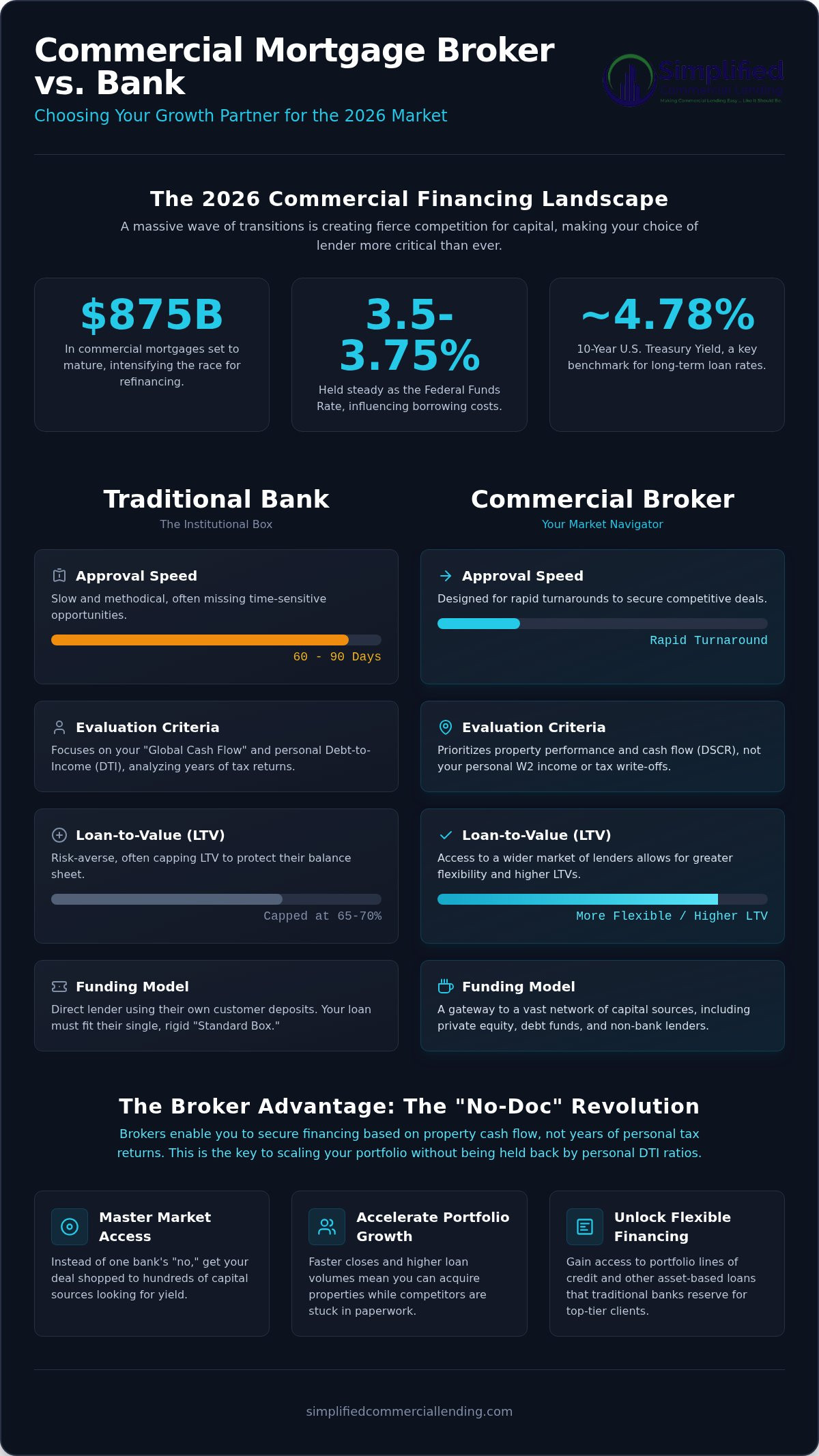
Broker vs. Bank: A Strategic Comparison for Real Estate Investors
Choosing between a commercial mortgage broker vs bank is a decision about your future capacity. If you prioritize the lowest possible upfront cost, a bank might seem attractive. However, if you prioritize the velocity of your capital, a broker is the clear winner. Banks are lenders of record; they want to hold your debt and manage the risk. Brokers are architects of capital; they want to build a structure that allows you to acquire more property. The choice ultimately depends on whether you want a single loan or a scalable system.
The “Fee” objection is the most common hurdle for new investors. You might hesitate at an origination fee. But consider the alternative. If a bank’s 90-day delay costs you a deal with $100,000 in instant equity, that “cheap” bank loan actually cost you six figures. A broker fee is an investment in market access that can lead to a 20% or 30% increase in your total portfolio size by year-end. You’re paying for the certainty of a closed deal rather than the hope of a bank approval.
There’s also the “Rejection Risk” to consider. When a bank says no, it’s often after a hard credit inquiry that stays on your report for two years. A broker pre-vets your deal across multiple lenders before a single credit pull is ever authorized. This protects your score and keeps your options open. If you want to see how this works in practice, you can start the process at simplifiedcommerciallending.com.
When to Use a Bank (The Low-Cost, Slow-Growth Path)
Banks are ideal for specific, low-risk scenarios. If you’re buying an owner-occupied property, have perfect credit, and boast a high W2 income, a bank will likely offer you the most competitive interest rate. This path is best for investors who aren’t in a rush and have simple financial profiles. If your primary goal is a local relationship with a branch manager rather than rapid expansion, stay with your bank. Just be prepared for the slower pace and higher documentation burden.
When to Use a Broker (The High-Speed, Scaling Path)
A broker is essential once your strategy becomes complex. This is especially true for investors managing single family residential investment loans across multiple states. Brokers solve the “Amperage” problem of scaling by distributing your loan volume across multiple capital sources rather than overloading a single bank’s exposure limits. They are also the best choice for multi family residential investment loans that require non-bank financing or creative LTV structures. They act as your advocate, ensuring your deal gets in front of the one lender out of a hundred who is hungry for your specific asset class.
Choosing Your Partner: How Simplified Commercial Lending Powers Portfolio Growth
Simplified Commercial Lending acts as the definitive antidote to the institutional friction found in traditional banking. When you analyze the commercial mortgage broker vs bank dynamic, the difference is clear. Banks are designed to say no to anything that doesn’t fit a rigid, outdated profile. We are designed to find the “yes” hidden in your property’s cash flow. By offering no-doc loans and asset-based financing, we empower you to scale your rental portfolio without the weight of personal income verification. Our national reach means your growth isn’t limited by geography. We fund deals across the country, providing the same high-speed service whether your asset is a single-family rental or a large-scale commercial project.
Stop begging banks for a seat at the table. It’s time to leverage your assets and take control of your investment future with a partner that understands the 2026 market. You need a navigator who knows how to bypass industry bottlenecks and treat you like the entrepreneur you are.
Our Process: From Application to Funding Without the Stress
We prioritize the property cash flow from day one. Our team evaluates the asset’s performance using the Debt Service Coverage Ratio (DSCR), which means your personal debt-to-income ratio stays out of the conversation. This “Simplified” roadmap is built on clear communication and aggressive timelines. While banks are still debating your 2024 tax filings, we’re already moving toward the closing table. Clients choose us for commercial property loans because they need a partner that can navigate the complexity of 2026 market volatility. We provide the speed, flexibility, and market access that traditional lenders simply can’t match.
Ready to Scale? Your Next Move
Your next step is simple. Schedule a consultation before you commit to a lender that might stall your growth. This initial strategy session allows us to look at your entire portfolio to see where you can tap equity using portfolio lines of credit. To get the fastest results, have your property data ready for review. This includes updated rent rolls, trailing twelve-month operating statements, and current lease agreements. Providing this data upfront allows us to build a loan package that speaks the language of non-bank lenders. Your portfolio deserves more than a standard bank box. It deserves a growth strategy that prioritizes your success over institutional protocol.
Take Control of Your 2026 Investment Strategy
The 2026 market doesn’t wait for bank committees to finish their coffee. You’ve seen how the commercial mortgage broker vs bank debate isn’t just about interest rates; it’s about the speed and flexibility you need to scale. Traditional banks often trap you in a cycle of endless paperwork and personal income scrutiny. By choosing a specialized broker, you shift the focus to what actually matters: the cash flow of your assets.
We provide national financing for multi-family, STRs, and commercial assets with underwriting based on property performance, not your personal W2. You can finally stop worrying about DTI ratios and start focusing on your next acquisition. If you’re ready to break free from the institutional box, it’s time to act. Don’t let a slow approval process be the reason you miss out on your next great deal.
Get a Simplified Quote: Scale Your Portfolio Without Tax Returns. No tax returns are required for our DSCR and asset-based loans. Your growth is within reach, and we’re here to help you navigate the path forward with confidence.
Frequently Asked Questions
Is it better to get a commercial mortgage from a bank or a broker?
The choice depends on your growth speed. Banks are often better for investors with simple financial profiles and high W2 income who aren’t in a rush. However, a broker is superior if you need to scale quickly. When comparing a commercial mortgage broker vs bank, brokers provide access to a wider market of non-bank lenders. This market access is essential for investors who need flexible terms that traditional institutions simply don’t offer.
Do commercial mortgage brokers charge higher interest rates than banks?
Not necessarily. While banks may offer lower base rates for borrowers who fit their narrow criteria, brokers access wholesale rates from private equity and debt funds. In 2026, the value of a broker lies in finding the most competitive rate for your specific asset class. This often offsets any fees by securing higher leverage or interest-only terms that a traditional bank would likely refuse to provide for an investment property.
Can I get a commercial loan without showing my personal tax returns?
Yes, you can secure financing without tax returns by using no-doc or DSCR loan products. These programs focus entirely on the property’s ability to generate income rather than your personal salary or business history. This approach is ideal for entrepreneurs who use legal tax deductions to lower their reported net income. It allows you to qualify based on the asset’s performance, bypassing the personal financial scrutiny required by traditional banks.
How much are typical broker fees for a commercial mortgage in 2026?
Fees vary based on the complexity and size of your transaction. Brokers typically earn a commission or origination points paid at the time of closing. This fee covers the cost of structuring the deal, sourcing the right lender, and managing the underwriting process. Many investors find this cost is justified by the significantly faster closing times and the ability to capture equity that would otherwise stay locked behind a bank’s bureaucracy.
Will a broker help me if my credit score is less than perfect?
Yes, brokers specialize in finding solutions for investors with diverse credit profiles. Unlike banks that use rigid automated scoring, brokers work with asset-based lenders who prioritize the property’s value and cash flow. If your asset is strong, a broker can often secure financing even if your credit score doesn’t meet the strict requirements of a traditional retail bank. They look for reasons to say yes rather than excuses to decline.
How long does it take to close a commercial loan with a broker vs. a bank?
Brokers can often close loans in as little as 30 to 45 days. Conversely, banks typically require 60 to 90 days due to their committee-heavy approval processes and intensive documentation reviews. When weighing a commercial mortgage broker vs bank, the speed advantage of a broker is critical. It allows you to close deals while your bank-bound competitors are still waiting for their initial underwriting feedback or hunt for old tax transcripts.
Why do banks reject so many commercial investment loan applications?
Banks reject applications because they fund loans using customer deposits, making them extremely risk-averse. They often decline deals involving unconventional properties, high leverage, or borrowers with complex tax returns. If a deal doesn’t fit their narrow “Standard Box,” it’s safer for them to say no. Brokers bypass this by matching your specific deal with non-bank lenders who are actively looking for your specific asset type and understand its value.
Can a commercial broker help me with a portfolio line of credit?
Yes, brokers are the primary source for portfolio lines of credit that allow you to tap equity from multiple properties simultaneously. This product is rarely offered by local banks to independent investors. A broker structures these lines by cross-collateralizing your rentals. This gives you a single pool of liquidity to fund new acquisitions or renovations without the friction of submitting separate loan applications for every single property you own.