What if your ability to buy your next investment property had absolutely nothing to do with your personal income? For most independent entrepreneurs, the dream of a massive portfolio often dies in a pile of tax returns and debt-to-income calculations at a local bank. It’s exhausting to have a profitable deal ready to go, only to be denied because your personal tax strategy doesn’t fit a rigid institutional mold. Utilizing a dscr loan for rental property changes the game by shifting the focus from your paycheck to your property’s performance.
We agree that the traditional mortgage process is broken for the modern investor. You shouldn’t be penalized for being a savvy business owner. In this guide, you’ll discover how to bypass personal income limits and scale your portfolio without providing a single tax return. We’re breaking down a 2026 framework for faster closing times via LLCs and financing that ignores your personal debt-to-income ratio entirely. It’s time to stop acting like a borrower and start acting like a CEO. You’ll learn exactly how to use property cash flow to fuel your growth while the big banks are still stuck on page one of your 1040s.
Key Takeaways
- Learn why traditional debt-to-income ratios typically stop your growth after property number three and how to break through that ceiling.
- Master the cash-flow math lenders use to evaluate a dscr loan for rental property without ever looking at your personal W-2s or tax returns.
- Review a 2026 case study of an investor scaling from three to ten units by leveraging property income instead of a personal salary.
- Identify the specific credit score and loan-to-value targets required to secure the most competitive financing in today’s market.
- Discover how closing under an LLC provides a scalable framework that protects your assets and accelerates your closing timeline.
The DTI Wall: Why Traditional Rental Property Loans Stop Working
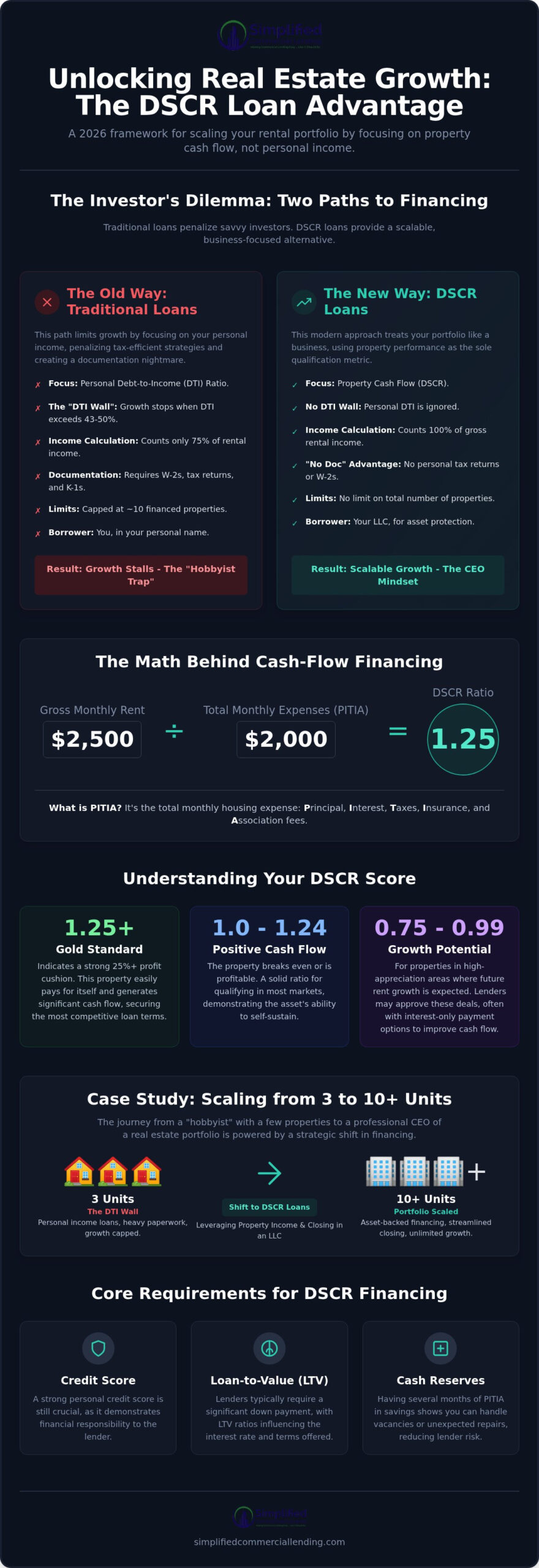
Most investors start with a dream of passive income. The first deal is exciting. The second feels like progress. By the third, you’re a local expert. Then you find the perfect fourth property, and the bank stops you cold. This is the “hobbyist investor” trap. Traditional lenders treat you like a consumer, not a business owner. A dscr loan for rental property provides the leverage you need to keep moving when the local bank says no. They use your personal Debt-to-Income (DTI) ratio, which is a metric designed for homeowners, not wealth builders.
Banks take your gross monthly income and compare it to your total debt. If that number exceeds 43% or 50%, your growth ends. For entrepreneurs, this is a disaster. You work hard to maximize tax deductions. Your tax returns might show a low net income to save money on IRS payments. The bank sees that low number and decides you can’t afford another mortgage. Traditional banks follow a rigid checklist that often ignores your actual success:
- They count 100% of the debt but only 75% of the rental income.
- They penalize you for legal tax deductions like depreciation.
- They cap your total number of financed properties regardless of profit.
It’s a frustrating paradox; your business is thriving, but your “on-paper” income makes you look unlendable. In 2026, the market demands a shift. You need to move from personal-backed debt to asset-backed financing to stay competitive.
The Limits of Conventional Financing for Investors
Fannie Mae and Freddie Mac place hard limits on the number of financed properties you can own. Even if you haven’t hit the 10-property cap, the documentation burden is immense. Providing years of tax returns, K-1s, and bank statements for every single deal is a full-time job. A Debt Service Coverage Ratio (DSCR) approach ignores your personal W-2 entirely. It looks at the property’s ability to pay for itself. This “No Doc” advantage is the only way to scale without drowning in red tape. It ensures your tax-saving depreciation strategies don’t come back to haunt your loan applications.
Transitioning from Hobbyist to Professional Scaler
Professional investors don’t borrow in their own names. They use “Business Purpose” loans. This allows you to close in the name of an LLC, which protects your personal assets while building a commercial track record. Recognizing that your personal income is a bottleneck is the first step toward real growth. Utilizing a dscr loan for rental property allows you to treat your portfolio like the business it is. Simplified Commercial Lending bridges this gap by focusing on the cash flow of the deal, not the history of the person behind it. We provide the speed and flexibility needed to scale your portfolio when traditional banks are stuck in the past.
What is a DSCR Loan? The Math Behind Cash-Flow Financing
A dscr loan for rental property is defined by a simple truth: the asset is the borrower. The Debt Service Coverage Ratio (DSCR) is the primary metric for asset-based rental loans, effectively replacing the personal debt-to-income ratio used by traditional banks. To calculate this number, lenders compare the Gross Rental Income to the property’s PITIA. PITIA represents the total monthly cost of Principal, Interest, Taxes, Insurance, and any Association fees.
If your property generates $2,500 in monthly rent and the PITIA is $2,000, your ratio is 1.25. This 1.25 figure is the “gold standard” for lenders in 2026 because it demonstrates a 25% profit cushion. However, don’t panic if your numbers are tighter. Programs exist for ratios as low as 0.75, allowing you to acquire properties in high-growth areas where current rents might not yet outpace mortgage costs. This flexibility is what allows professional investors to keep buying when others are forced to wait.
Understanding the 1.0 Threshold
A 1.0 ratio means your property is “1:1” or breaking even. It pays its own mortgage, but there is no extra cash at the end of the month. While traditional banks avoid these deals, asset-based lenders understand that in high-appreciation markets, the long-term equity gain often outweighs immediate monthly profit. To help these deals qualify, many investors opt for interest-only payment periods. This reduces the monthly debt obligation, instantly boosting your ratio and making a marginal deal lendable. If you want to see how these numbers apply to your next deal, you can run a scenario with our team to find the best fit.
Short-Term Rentals and Airbnb Specific Math
Scaling a vacation rental portfolio requires a different set of tools than a standard long-term lease. Traditional appraisals often miss the premium revenue generated by short-term stays. In 2026, savvy investors use Zonal AVMs to get instant rental estimates based on hyper-local, real-time data. Lenders now accept income projections from specialized short-term rental data providers or the 1007 Rent Schedule to justify short term rental financing. This specialized underwriting recognizes that a beach house or mountain cabin earns differently than a suburban bungalow. It allows you to leverage the actual market potential of a vacation home rather than being capped by conservative, long-term rent estimates.
Case Study: Scaling from 3 to 10 Rentals Using DSCR Financing
Meet Alex. In early 2026, Alex owned three profitable single-family rentals. He earned a solid $150,000 salary but carried $2M in existing mortgage debt. When a distressed 4-unit property hit the market, Alex was ready to move. His local bank wasn’t. Despite his high income and successful track record, the bank’s Debt-to-Income (DTI) formula labeled him “over-leveraged.” He was stuck at the DTI wall. Alex didn’t need a personal mortgage; he needed a professional strategy. By choosing a dscr loan for rental property, he shifted the underwriting focus from his debt to the 4-unit’s income potential.
Alex implemented a no doc commercial loan strategy that bypassed his personal financial history entirely. He closed the deal in just 21 days under a newly formed LLC. No tax returns were submitted. No W-2s were reviewed. The property’s projected cash flow did the talking. This single move took him from a hobbyist with three houses to a professional with seven total units.
Phase 1: The Tactical Refinance
To reach his goal of 10 units, Alex needed more liquid capital for down payments. He didn’t want to sell his existing winners, so he decided to tap equity from rental portfolio assets. In the 2026 lending environment, cash-out refinances for investment properties typically cap at 70% to 75% LTV. Alex refinanced two of his original single-family homes, pulling out enough cash to fund his next three acquisitions. Because these were business-purpose loans, the new debt didn’t negatively impact his personal credit utilization, keeping his scores high for future deals.
Phase 2: The Multi-Property Acquisition
With cash in hand, Alex moved to the final stage of his growth plan. Instead of applying for three separate loans, he utilized a portfolio line of credit for rentals scaling up. This allowed him to bundle his remaining acquisitions into a single “Blanket Loan.” This approach offered a massive advantage: one closing, one set of fees, and simplified management. By scaling rapidly, Alex achieved economies of scale in property management that simply aren’t possible with a scattered, three-property portfolio. He hit his 10-unit goal in less than six months, all by leveraging a dscr loan for rental property to ignore the bank’s bureaucracy.
DSCR Loan Requirements: Qualifying for Rental Property Financing in 2026
Qualifying for a dscr loan for rental property is more about the building’s potential than your personal history. In 2026, the criteria have evolved to favor liquidity and property performance. Your credit score remains a vital component, with the 680 to 720 range serving as the sweet spot for securing the most competitive dscr loan rates today. While you can qualify with a lower score, hitting that 720 mark often unlocks higher leverage and lower fees. Lenders want speed. You want leverage.
Loan-to-Value (LTV) ratios are the next hurdle. For new purchases, expect to bring a 20% to 25% down payment, as most lenders cap LTV at 75% to 80%. If you’re looking for a cash-out refinance to fund your next deal, that cap usually drops to 70% or 75%. Lenders also want to see that you aren’t buying on a prayer. They typically require 3 to 6 months of PITIA payments in liquid reserves. This ensures you can handle a sudden vacancy or a major repair without defaulting. Your experience level also plays a role; a landlord with a proven track record of managing rentals often receives more favorable terms than a first-time investor.
Property Type Eligibility
The scope of eligible properties is broader than many realize. You can use these loans for single-family homes, 2-4 unit residential properties, and even 5+ unit apartment buildings. The 2026 market has also seen a surge in “Condotels” and non-warrantable condos, which were previously difficult to finance. Even commercial assets like warehouses and retail centers can now fall under DSCR underwriting if the cash flow is strong enough. This versatility allows you to diversify your portfolio across different asset classes without changing your lending strategy.
The “No Doc” Documentation Checklist
The beauty of this process is the lack of paperwork. You won’t need to dig through years of tax returns or hunt down old W-2s. Instead, dscr loan requirements prioritize the asset’s ability to generate revenue over the borrower’s history. You’ll simply need your LLC organizational documents, a clean credit report, and a verified rent roll for the property. Because the income is the star of the show, the appraisal is the most critical part of your application. The appraiser doesn’t just look at the value; they complete a 1007 Rent Schedule to confirm the market rent. If the math works, the deal moves forward. You can check your eligibility and see current terms here.
Executing Your Growth Strategy with Simplified Commercial Lending
Scaling a portfolio isn’t just about finding properties. It’s about finding the right capital partner. While a direct lender offers a single set of rules, a broker like Simplified Commercial Lending acts as your navigator. We provide access to a national network of programs tailored for a dscr loan for rental property. If one lender tightens their criteria, we pivot to another that fits your specific scenario. This flexibility is the secret sauce for investors looking to move from five units to fifty without hitting a wall.
Our process is designed for speed. It starts with a simple scenario review. We look at your property’s potential income and compare it to current market terms. From there, we move to a custom quote that aligns with your 12-month acquisition goals. You won’t wait months for an answer. We focus on the deal’s merit, ensuring you can close quickly and keep your momentum. This asset-based approach allows you to structure a year’s worth of acquisitions in advance, knowing your personal DTI won’t be an issue.
The Advantage of LLC-Based Closing
Closing your loans in an LLC isn’t just about liability protection. It’s about building a commercial legacy that exists independently of your personal credit profile. This structure offers a layer of anonymity and significant tax advantages for the savvy entrepreneur. Simplified Commercial Lending specializes in streamlining these approvals. We understand the corporate documentation required and ensure your business-purpose loan is processed without the typical bureaucratic friction found at retail banks. It’s a professional framework that supports long-term scaling.
Ready to Scale? Your Next Steps
Your growth shouldn’t be limited by a bank’s lack of imagination. To start structuring your next 12 months of acquisitions, you need a clear picture of your current standing. Follow these steps to get started:
- Gather your current rent rolls for a comprehensive portfolio review.
- Identify the equity available in your existing assets for potential cash-out refinances.
- Request a custom quote based on your specific 2026 expansion goals.
- Submit your initial scenario through our portal for immediate processing.
Stop letting personal income limits dictate your professional success. The framework for a scalable, asset-backed portfolio is ready for you to use. Start your cash flow analysis today and see how a dscr loan for rental property can transform your investment trajectory. Apply now to secure your next deal and bypass the bureaucracy.
Your Blueprint for Infinite Scaling
The days of letting a traditional bank’s debt-to-income ratio dictate your financial future are over. You’ve seen how professional investors use a dscr loan for rental property to decouple their personal finances from their business growth. By focusing on property cash flow instead of your tax returns, you can move faster, close more deals, and build a commercial legacy under your LLC. This framework isn’t just a theory. It’s the 2026 standard for anyone serious about real estate wealth. You don’t need to wait for a raise to buy your next asset; you just need a property that performs.
Simplified Commercial Lending acts as your navigator through this modern landscape. We’re specialists in no-tax-return investment loans and provide national coverage for SFR and multi-family portfolios. Our team prioritizes fast, efficient closings so you never miss a profitable opportunity. It’s time to stop fighting the bureaucracy and start using the tools designed for your success. Bypass the bank and scale your portfolio with a DSCR loan from Simplified Commercial Lending today. Your next ten properties are within reach, and we’re ready to help you fund them.
Common Questions About DSCR Financing
What is the minimum DSCR ratio for a rental property loan in 2026?
A minimum ratio of 1.0 is the standard requirement for most lenders in 2026. This means the property’s gross rental income must at least equal the full mortgage payment including taxes and insurance. While a 1.25 ratio often unlocks the best pricing, some specialized programs accept ratios as low as 0.75 for properties in high-growth markets where appreciation is the primary goal.
Can I get a DSCR loan with no personal income or tax returns?
Yes, you can qualify for a dscr loan for rental property without providing personal income verification or tax returns. These are no-doc business-purpose loans that prioritize the property’s cash flow over your personal W-2 history. This allows you to scale your portfolio without the bureaucracy of traditional bank underwriting or the need to prove a personal salary.
Are DSCR loan interest rates higher than traditional mortgages?
DSCR loan interest rates are typically 0.5% to 1.5% higher than conventional residential mortgages. This reflects the increased risk of investment properties and the convenience of reduced documentation. Many investors find the slightly higher rate is a fair trade for the ability to close in an LLC and bypass personal debt-to-income limits that would otherwise stop their growth.
Do I need to close a DSCR loan under an LLC?
Closing under an LLC is highly encouraged and often required for these loans. Since these are business-purpose loans, lenders prefer the liability protection and professional structure of a corporate entity. This also helps you build a commercial credit profile that is separate from your personal financial history, making it easier to manage multiple assets as your portfolio expands.
How much down payment is required for a DSCR rental loan?
You should expect to provide a down payment of 20% to 25% for most purchase deals. While some high-leverage programs may allow for a smaller down payment with a high credit score, 80% LTV is the standard ceiling in 2026. For cash-out refinances, lenders generally cap the loan at 70% to 75% of the property’s appraised value to maintain a safety margin.
Can I use a DSCR loan for a short-term rental or Airbnb?
Yes, you can absolutely use this financing for vacation rentals and Airbnb properties. Lenders use specialized tools like AirDNA data or a 1007 Rent Schedule to project the property’s short-term income potential. This ensures your dscr loan for rental property is based on the actual revenue potential of a vacation home rather than a lower long-term lease estimate.
What is the maximum loan amount for a DSCR investment loan?
Standard DSCR programs typically offer a maximum loan amount of $3 million per property. For larger multi-family or commercial assets, this limit can extend much higher depending on the property’s cash flow and your experience level. Portfolio lines of credit can also be structured to cover multiple assets under a single, larger loan limit for professional scaling.
How long is the seasoning period for a DSCR cash-out refinance?
Most lenders require a seasoning period of six months before you can execute a cash-out refinance based on a new appraisal. This timeframe allows the property to establish a stable rental history and proves the market value. If you’ve made significant improvements to the property, some programs might allow for a shorter window, but 180 days remains the industry benchmark.