Why are traditional banks still stuck in the past when your portfolio is ready for 2026? If you have tried to scale beyond a four-plex, you have probably hit a wall. Most lenders demand two years of corporate tax returns and flat-out refuse to count your Airbnb revenue as qualifying income. It is frustrating to watch a high-performing property slip away because a loan officer does not understand your business model. You know the cash flow is there, but the red tape is in the way. Securing a 5-8 unit dscr with short term rental income should be a strategic move, not a bureaucratic battle.
This guide shows you exactly how to bypass personal debt-to-income limits and secure financing based on property performance. We are going to master the specific requirements to finance small multifamily properties using short-term rental income without showing a single tax return. You will get the 2026 breakdown on everything from the current 6.5% to 8.5% interest rate environment to the exact cash reserves you need to close. We are stripping away the confusion over market projection data and actual rental history so you can scale your portfolio faster and treat your buildings like the high-yield businesses they are.
Key Takeaways
- Learn why 5-8 unit properties are the ultimate scaling sweet spot as you move from residential to commercial asset classes.
- Master the math of DSCR underwriting to qualify using AirDNA projections or historical platform data instead of personal tax returns.
- Get the 2026 checklist for a 5-8 unit dscr with short term rental, including credit score floors and LTV limits for multifamily assets.
- Protect your investment by learning how lenders verify zoning and legality to ensure your building can legally operate as an STR.
- Follow a simple two-step process to secure a term sheet within 48 hours based on your property’s projected cash flow.
Why 5-8 Unit Properties are the STR Scaling Sweet Spot
Scaling a portfolio often starts with single-family homes or duplexes. But eventually, you hit a ceiling. Managing six separate properties means six roofs, six tax bills, and six insurance policies. It is an administrative nightmare that eats your time and drains your profits. Moving into the 5-8 unit space changes the game entirely. You gain massive efficiency of scale while entering a less crowded market. Most amateur investors stay under four units because they are intimidated by commercial lending. That is your opportunity to step into a professional asset class where the competition is thinner and the cash flow is thicker.
The 5-Unit Threshold Explained
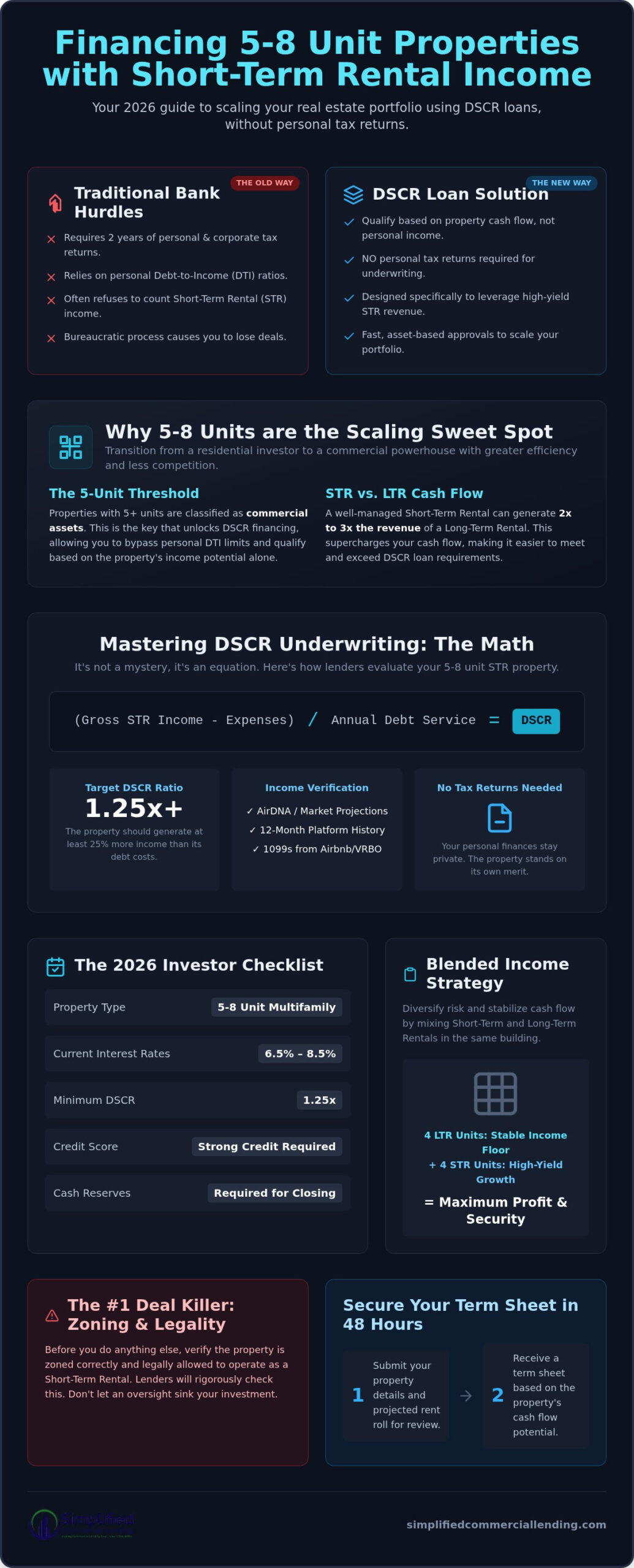
The mortgage world draws a hard line at five units. Anything with four units or fewer is considered residential, meaning lenders use your personal debt-to-income (DTI) ratio and tax returns to qualify you. Once you hit five units, the property becomes a commercial asset. This is where a 5-8 unit dscr with short term rental income comes into play. Instead of scrutinizing your personal bank statements, lenders look at the Debt Service Coverage Ratio (DSCR) to decide if the property itself earns enough to pay the bills. It is a no-doc approach that prioritizes property cash flow over your personal financial history. You get the freedom to grow without your tax returns holding you back.
STR vs. LTR Cash Flow in Small Multifamily
Traditional banks often struggle with 5+ unit buildings when you want to run them as short-term rentals. They want to see long-term leases and predictable, lower-yield numbers. But in 2026, the yield on a well-managed STR can be double or triple what a long-term tenant pays. A 6-unit building with just two high-performing STR units can sometimes cover the entire mortgage debt service. This yield engine allows you to achieve a much higher DSCR than a standard apartment building. Short-term rental yields are the preferred engine for 2026 portfolio growth because they maximize the revenue potential of every square foot. You aren’t just buying real estate; you are buying a high-velocity cash-flowing business. By using a 5-8 unit dscr with short term rental strategy, you bridge the gap between residential ease and commercial scale.
Underwriting the 5-8 Unit STR: How the Math Works
Underwriting a 5-8 unit building isn’t a mystery; it’s a math equation. While Fannie Mae multifamily financing often focuses on stabilized long-term rents, DSCR lenders look at the actual cash flow potential of your short-term units. The formula is straightforward: (Gross STR Income – Expenses) / Annual Debt Service. To secure the best rates in 2026, you generally want a ratio of 1.25 or higher. This means your property generates 25% more income than the cost of the mortgage, insurance, taxes, and association fees.
A common point of confusion is whether to use AirDNA data or actual rental history. If you are buying a vacant 6-unit building, lenders will often accept market projections from reputable data providers. However, if the property has been operating, most underwriters want to see the last 12 months of platform data. They will look closely at your expense ratios. Unlike long-term rentals, STR expenses include cleaning costs, platform fees from Airbnb or VRBO, and higher utility loads. Accounting for these accurately is the difference between a fast approval and a denied application.
Income Verification Without Tax Returns
The beauty of a 5-8 unit dscr with short term rental income is that your personal tax returns stay in the drawer. We don’t need to see your IRS transcripts to prove the building works. Instead, we use 1099s from booking platforms or verified screenshots of your host dashboard. This asset-based approach is why Simplified Commercial Lending can move so much faster than a local credit union. If you’re looking at a vacant acquisition, we can even utilize a “Lease-Up” strategy. This allows us to underwrite based on the property’s future potential once it’s fully furnished and listed. If you want to see how your specific numbers stack up, you can submit your rent roll for a quick review.
The Blended Income Strategy
One of the most effective ways to scale in 2026 is the blended rent roll. You don’t have to turn all eight units into Airbnbs. Many successful investors keep four units as long-term leases to provide a “floor” of guaranteed income while using the other four as high-yield STRs. This strategy diversifies your risk and makes the underwriter’s job easier. We calculate a weighted average DSCR that combines the stability of the long-term leases with the high-octane revenue of the short-term units. For a deeper dive into how these structures differ from standard loans, check out our guide on Multi-Family Residential Investment Loans: The 2026 Guide to Non-Bank Financing. This mix of income types often results in a stronger loan profile and better LTV options.
The Definitive 5-8 Unit DSCR Checklist for 2026
Commercial lending isn’t a “check the box” exercise like a standard mortgage. It is a business evaluation. To secure a 5-8 unit dscr with short term rental income, you need to prove the property is a stable, high-performing business. While residential loans focus on your personal paycheck, these loans focus on your preparation and the property’s potential. If you want the best rates, which currently sit between 6.5% and 8.5% in 2026, you need to meet specific financial benchmarks before you even submit an application.
Your credit score is the first gatekeeper. You should aim for a 680 or higher to unlock the most competitive pricing. While some programs allow scores as low as 640, they often come with higher interest rates and lower leverage. Speaking of leverage, expect your Loan-to-Value (LTV) limits to land between 65% and 75%. Because short-term rentals are more volatile than long-term leases, lenders want you to have more “skin in the game.” Additionally, you must show liquidity. Most lenders require 6 to 12 months of PITIA in a liquid account to ensure you can handle seasonal fluctuations in booking revenue.
Borrower Requirements Checklist
Closing a 5-unit or larger building requires a professional structure. You cannot close these in your personal name; you must use an entity like an LLC or a Corporation. This protects both you and the lender. You will also need to provide an Experience Affidavit. This document tracks your history with short-term rental platforms or multifamily management. Even though this is a “no-doc” loan, lenders still check for major personal delinquencies or bankruptcies. They want to know they are partnering with a savvy operator who understands Local Regulations And Zoning. Compliance is not optional in the commercial space.
Property Requirements Checklist
The property itself must meet professional standards to qualify for permanent financing. A standard residential appraisal won’t cut it. You will need a commercial appraisal that includes a specific STR income addendum. This addendum validates that the market supports your nightly rates and occupancy projections. Furthermore, the building’s physical state matters. It must have a condition rating of C4 or better. If the roof is failing or the electrical is outdated, you will likely be pushed into a bridge loan until repairs are made. For a deeper look at how these property standards differ from smaller buildings, see our Financing 5+ Unit Apartments: 2026 Investor Guide. This checklist ensures your 5-8 unit dscr with short term rental strategy is built on a solid foundation.
Zoning and Legality: The #1 Deal Killer for 5-8 Unit STRs
Zoning is where the most promising deals go to die. You might find a perfect 6-unit building with incredible cash flow projections, but if the local municipality doesn’t allow transient occupancy, the loan stops cold. Underwriters for a 5-8 unit dscr with short term rental will perform a deep dive into local ordinances before they ever issue a final approval. They aren’t just checking if the building is physically safe; they are verifying that your business model is legal. Many investors assume that because a building is multifamily, they can host guests. This is a dangerous mistake. Zoning refers to the structure, but use refers to the activity inside. If the city classifies STRs as commercial lodging and your building is in a residential-only multifamily zone, you have a problem.
The Permit Trap is another common hurdle in 2026. A city might grant you a one-year temporary permit, but a DSCR lender is looking at a 30-year horizon. If that permit can be revoked at any time by a city council vote, the lender may refuse to count the STR income entirely. They want to see that the use is “by right” or has a permanent vested status. Without this certainty, your high-yield projections won’t carry weight during the underwriting process.
Verifying STR Legality Step-by-Step
Don’t wait for the lender to find a problem. Start by checking the municipal code for “Transient Occupancy” definitions. You need to know exactly how your city defines a short-term stay. To satisfy a commercial underwriter, you should obtain a Zoning Verification Letter (ZVL). This official document from the city confirms that the property’s current or intended use is permitted under current law. Be aware of local STR caps too. If a city only allows a certain percentage of units to be short-term rentals, it can drastically impact your property valuation. Getting this right early prevents a wasted appraisal fee and weeks of lost time.
The Fallback Strategy
Smart investors always have a Plan B. If the underwriter decides the STR income is too risky or the regulations are in flux, you need a fallback. We recommend running your DSCR numbers based on long-term market rents. If the deal still pencils out at a 1.0 or 1.1 ratio with traditional tenants, you have a safety net. This is crucial if your property is in a “gray area” where regulations are currently being debated. Non-conforming short-term rental use represents a fundamental risk that can lead to immediate loan denial in the commercial sector. By preparing a dual-income analysis, you show the lender that the asset is viable regardless of political shifts. If you are unsure about your property’s zoning status, contact our team for a preliminary zoning review before you sign the contract.
How to Secure Your 5-8 Unit STR Loan with Simplified Commercial Lending
Theory is one thing, but execution is what builds a portfolio. When you’re ready to move past the four-unit ceiling, you need a partner that moves as fast as the market. Our process is designed to strip away the friction that usually kills commercial deals. We don’t care about your W-2s or your personal debt-to-income ratio. We care about the property’s ability to generate revenue. Securing a 5-8 unit dscr with short term rental income requires a specific workflow that traditional banks simply cannot match. We have refined this into four clear steps.
- Step 1: Submission. Send us your property address and your current or projected rent roll. We perform a quick analysis to see if the numbers meet the DSCR thresholds we discussed earlier.
- Step 2: Term Sheet. Within 24 to 48 hours, you will receive a term sheet. This document outlines your LTV, your interest rate, and exactly how many months of cash reserves you will need to keep in the bank.
- Step 3: Appraisal. Once you approve the terms, we order a commercial appraisal. This includes a specialized STR market analysis to validate your projected income against local data.
- Step 4: Closing. We move to the finish line, typically closing within 21 to 30 days. You close in your LLC name, keeping your personal credit and your commercial assets separate.
Why Investors Choose Our No-Doc Process
Speed is your greatest advantage in the 5-8 unit space. By bypassing the personal tax return requirement, you keep your financial privacy intact and avoid the months of back-and-forth typical of institutional banks. We provide access to a national network of non-bank capital sources specifically tailored for short-term rental assets. If you have a “blended” property with a mix of unit types, we have the expertise to structure those complex rent rolls. We understand that a 6-unit building with four Airbnbs is a business, not just a pile of bricks. This 5-8 unit dscr with short term rental approach allows you to scale without the red tape.
Ready to Scale to 5-8 Units?
Stop letting personal DTI limits hold back your commercial ambitions. You have the experience and the vision to manage larger assets. Now you just need the capital that matches your drive. Leverage the cash flow of your property to fund your next acquisition and build the legacy you have been planning. The jump from four units to eight is the most significant move an investor can make. We are here to make sure that jump is a calculated, successful step forward. Get a 5-8 Unit DSCR Quote Today and see how much leverage your property can truly provide.
Take Control of Your Commercial Growth in 2026
The transition from residential units to the 5-8 unit space is the fastest way to professionalize your portfolio. You now have the checklist to navigate the math of DSCR ratios and the nuances of municipal zoning. By focusing on property performance rather than your personal tax returns, you can bypass the rigid limits that stop most investors. Mastering the 5-8 unit dscr with short term rental strategy gives you a significant edge in a market that traditional banks still struggle to understand. You aren’t just buying property; you are scaling a high-yield business.
We are ready to help you move with speed and certainty. Our team provides specialized underwriting for STR and Airbnb income with national lending coverage for US investors. Best of all, there are no personal tax returns or W-2s required to qualify. It’s time to treat your real estate ambitions with the professional leverage they deserve. Stop waiting for a local bank to catch up to your vision and start building your legacy today.
Apply for a No-Doc 5-8 Unit DSCR Loan
Your next acquisition is within reach. Let’s get it closed and get you growing.
Frequently Asked Questions
Can I get a DSCR loan on a 6-unit building if I have never owned an Airbnb?
Yes, you can qualify without prior Airbnb experience, though some lenders may require you to hire a professional property management firm. Having a track record in standard multifamily management can also help bridge the gap. For a 5-8 unit dscr with short term rental, showing a solid business plan and a high credit score often outweighs a lack of personal platform history.
Do I need tax returns for a 5-8 unit multifamily loan?
No, you do not need to provide personal tax returns, W-2s, or pay stubs for this loan type. Qualification is based entirely on the property’s ability to generate cash flow and your personal credit score. This allows self-employed investors to scale their portfolios without being limited by the income reported on their IRS filings.
What is the minimum DSCR ratio required for a short-term rental property?
The standard minimum DSCR ratio is 1.0, which means the rental income must at least equal the mortgage payment. However, to secure the most competitive 2026 rates, you should aim for a 1.25 ratio or higher. A stronger ratio demonstrates that the property can comfortably handle operating expenses and seasonal fluctuations in booking revenue.
Can I use AirDNA projections to qualify for a 5-8 unit loan?
Yes, most lenders accept AirDNA projections, particularly for new acquisitions where no historical data exists. Underwriters will verify these market projections against a commercial appraisal that includes a specific STR income addendum. While 12 months of actual platform history is the gold standard, it is not a requirement for a purchase loan.
Are 5-8 unit DSCR loan rates higher than 1-4 unit rates?
Generally, yes. Loans for 5-8 unit properties are considered commercial assets and typically carry interest rates that are 0.25% to 0.75% higher than 1-4 unit residential loans. You are moving into a professional asset class with different risk profiles, but the significantly higher yield potential of a larger building usually offsets the slightly higher rate.
Can I close a 5-8 unit DSCR loan in my personal name?
No, you cannot close a 5-unit or larger loan in your personal name. These are commercial transactions that require you to vest the title in a legal entity like an LLC or a Corporation. This structure provides essential liability protection and aligns with the professional standards of commercial debt markets.
What happens if the local city bans Airbnbs after I close my loan?
Your loan will remain in place, but you must ensure the property stays profitable to meet your debt obligations. If a ban occurs, you will likely need to pivot the building to long-term rentals or medium-term executive stays. This is why we emphasize running a fallback analysis during underwriting to ensure the building remains viable under different regulatory scenarios.
How much cash reserves are required for a small multifamily DSCR loan?
Most lenders require between 6 and 12 months of PITIA (Principal, Interest, Taxes, Insurance, and Association fees) in liquid reserves. These funds must be verified in a bank or brokerage account before closing. For a 5-8 unit dscr with short term rental, these reserves protect you against the inherent volatility of the vacation rental market.