The 10-property limit is not a legal ceiling; it is a sign that you have outgrown your bank’s imagination. If you have been told that your portfolio is maxed out despite having strong cash flow and equity, you are likely bumping against rigid conventional lending guidelines rather than your own potential. Understanding the 5-10 property financing rule workaround is the key to transitioning from a hobbyist to a professional mogul. You should not be penalized for your success by lenders who are obsessed with personal debt-to-income ratios and endless piles of tax returns.
It is frustrating to have the capital and the deals ready, only to be stalled by a mountain of paperwork and restrictive bank policies. We agree that your property’s performance should speak louder than your personal W-2. In this guide, you will discover how to bypass these institutional bottlenecks using professional commercial tools like DSCR loans and portfolio lines of credit. We are going to show you exactly how to secure financing that prioritizes property cash flow over personal income. You will learn how to close faster, simplify your documentation, and finally clear the path to owning 20, 50, or even 100 properties.
Key Takeaways
- Understand why the 10-property limit is a conventional banking preference rather than a legal barrier to your portfolio growth.
- Identify the 5-10 property financing rule workaround by utilizing DSCR loans that focus on property income instead of your personal paycheck.
- Learn how to leverage portfolio lines of credit to tap into existing equity and fund multiple new acquisitions simultaneously.
- Transition to entity-based financing through an LLC to streamline your paperwork and remove personal debt-to-income constraints.
- Discover the speed and efficiency of commercial lending where personal tax returns are replaced by property-level performance metrics.
What is the 5-10 Property Financing Rule and Why Does it Exist?
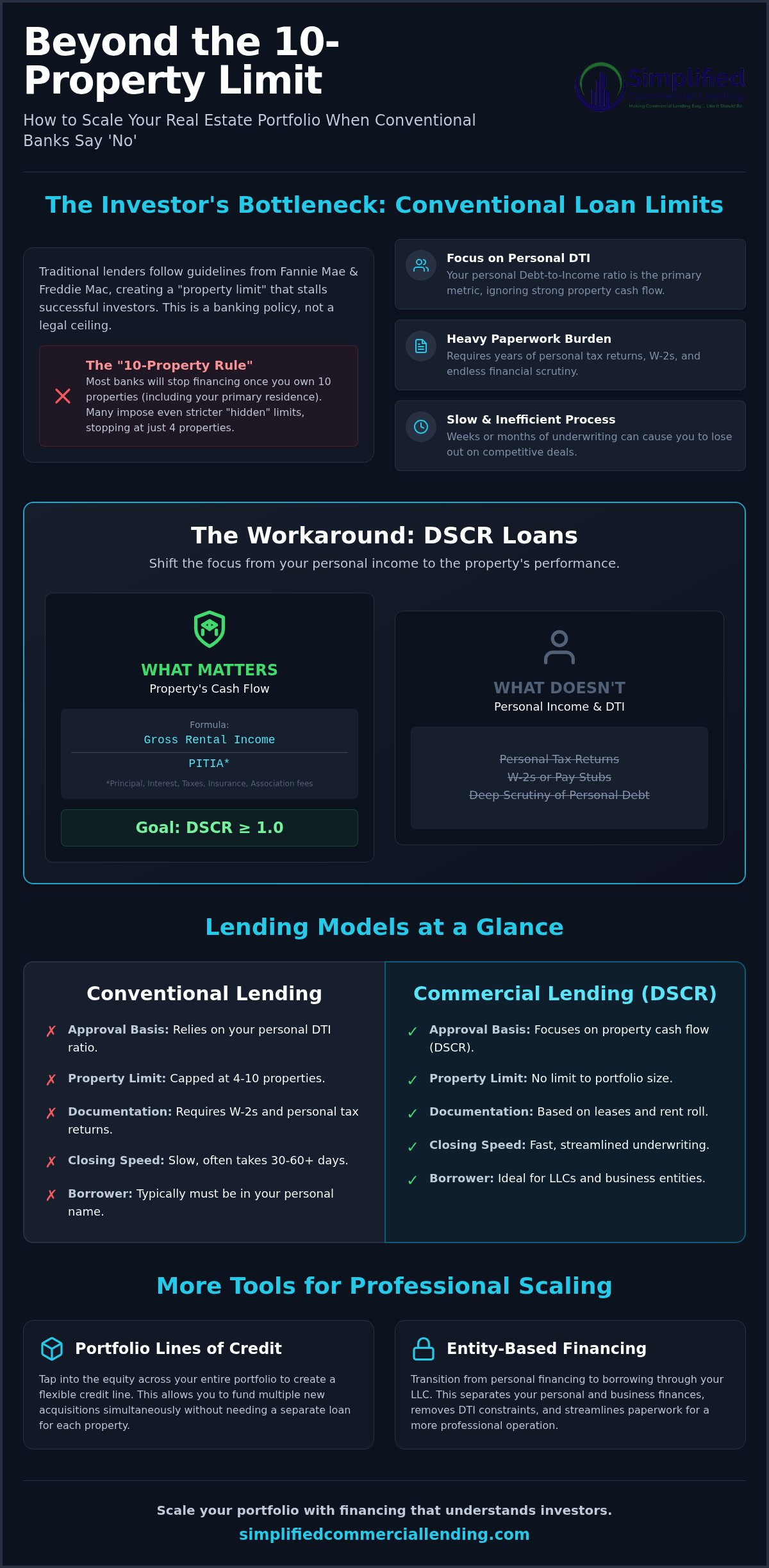
The 5-10 property financing rule is a conventional banking guideline that caps the number of financed residential properties an individual can own at ten. This tally isn’t limited to your rentals; it includes your primary residence and any second homes. Traditional lenders enforce this limit because they intend to sell these loans to Fannie Mae or Freddie Mac. If a bank exceeds these limits, the loan becomes non-conforming, which makes it much harder for the institution to offload the debt to the secondary market. This creates a massive bottleneck for investors who are ready to scale but find themselves suddenly locked out of traditional capital.
While the federal limit is technically ten, many local institutions stop at four. This “hidden” limit exists because the underwriting requirements become significantly more complex once you cross that threshold. For properties five through ten, Fannie Mae requires higher credit scores and massive liquidity reserves. Many banks simply don’t want the extra work or the perceived risk. This is where a 5-10 property financing rule workaround becomes essential for your survival as a professional investor. Without a pivot in strategy, your momentum dies just as your portfolio starts to generate real ROI.
The Mechanics of Conforming Loan Limits
Fannie Mae and Freddie Mac set the standards for what they call “conforming” loans. They view an investor with more than ten loans as a high-risk entity. Even if your properties are highly profitable, the system is designed to favor the single-home buyer. The most punishing part of these rules is the reserve requirement. By the time you reach property ten, you might need to prove you have six months of mortgage payments, taxes, and insurance for every single property in your portfolio. This requirement ties up vital capital that should be used for your next down payment.
Why Traditional Banks Say ‘No’ After Property #4
Local banks often apply “overlays,” which are internal rules even more restrictive than federal guidelines. They look at your debt-to-income (DTI) ratio across your entire financial life. If your tax returns show heavy depreciation or business expenses, a traditional underwriter might see a loss where you see a tax-efficient profit. They struggle to calculate rental income accurately from a complex Schedule E. Instead of helping you grow, they treat your success as a liability. This bureaucratic friction is exactly why professional investors move toward commercial-grade solutions.
The DSCR Loan Workaround: Scaling Without Property Limits
Traditional banks look at your personal income to decide if you can afford another mortgage. Professional investors look at the property’s income. A Debt Service Coverage Ratio (DSCR) loan is the premier 5-10 property financing rule workaround because it completely changes the underwriting focus. Instead of scrutinizing your W-2s or debt-to-income (DTI) ratio, lenders evaluate the cash flow of the asset you are buying. If the rental income covers the mortgage and expenses, the deal moves forward. It is that simple.
Why does your property count disappear as a factor? Commercial lenders operate outside the restrictive Fannie Mae and Freddie Mac ecosystem. They don’t have a 10-property ceiling because they aren’t bound by the same secondary market risk profiles. This allows you to scale your empire to 20, 50, or even 100 properties without ever hearing the word “no” based on portfolio size. You can even finance multiple properties at the same time to accelerate your growth.
The “No Doc” advantage is the real game-changer for 2026. You don’t need to provide years of personal tax returns or undergo a deep audit of your personal finances. This streamlined approach means faster closing times, often saving weeks compared to conventional underwriting. In a competitive market, speed is your greatest asset. If you are ready to move, explore our commercial lending options to see how fast you can close your next deal.
How DSCR Ratios Replace Personal DTI
The math behind these loans is transparent. Lenders calculate the ratio by dividing the Gross Rental Income by the PITIA (Principal, Interest, Taxes, Insurance, and Association fees). If the result is 1.0 or higher, the property is “breaking even” or cash-flowing. Most lenders view 1.0 as the magic number for approval. For a full breakdown of what you need to qualify, check our DSCR Loan Requirements: 2026 Portfolio Scaling Guide.
Benefits for High-Volume Investors
DSCR loans offer flexibility that conventional mortgages cannot match. You can close deals in the name of an LLC, which provides essential asset protection and keeps your personal credit report clear of multiple mortgages. This structure is also the preferred tool for short term rental financing, where traditional banks often struggle to value fluctuating AirBnB income. By treating your investments like a business, you unlock the ability to scale without limits.
Portfolio Lines of Credit: Consolidating for Growth
Most investors believe they need a separate loan for every single house they buy. They don’t. A Portfolio Line of Credit is a single financial facility backed by multiple properties in your collection. It serves as a powerful 5-10 property financing rule workaround because it stops the cycle of endless individual applications. Instead of managing ten different lenders and ten different due dates, you consolidate your debt into one streamlined relationship. This shift in strategy transforms your portfolio from a collection of houses into a unified business asset.
The “Equity Unlock” is where the real growth happens. Your existing 5-10 properties likely have significant equity that is currently sitting idle. A portfolio line allows you to tap into that value to fund your next batch of acquisitions. It turns your current success into a revolving source of capital. You can buy, renovate, and stabilize new properties using the line, then roll them into the facility once they are performing. It is a repeatable system for scaling that traditional banks simply cannot offer.
Management becomes significantly easier when you move to this model. You deal with one monthly payment and one point of contact. If you decide to sell a specific property to capture profit, “release clauses” allow you to remove that single asset from the line without disrupting the rest of your financing. This level of flexibility is essential for staying agile in a shifting 2026 market. It is about maintaining control while you expand your footprint.
Portfolio Line of Credit vs. Individual Mortgages
Consider the math of closing costs. Closing ten individual loans means paying ten sets of appraisal fees, title insurance, and processing costs. A portfolio line often consolidates these expenses into a single event, saving you thousands in upfront capital. Underwriting speed is another major advantage. Once your line is established, adding new properties is a much faster process. You can move at the speed of the deal, not the speed of a bank’s bureaucracy. Learn more about the implementation steps in our guide to the Portfolio Line of Credit: Scale Rentals Without Tax Returns.
Using Blanket Loans as a Strategic Workaround
Blanket loans offer another way to bypass conventional limitations. These loans treat your entire portfolio as a single commercial asset, which effectively ignores the 10-property rule used by residential lenders. Cross-collateralization is the secret weapon here; it allows properties with high equity to support newer acquisitions that might have tighter margins. This is the primary strategy used for multi family residential investment loans. It allows you to think bigger and move beyond the constraints of individual home financing.
Moving from Personal to Entity-Based Financing
Stop letting your personal credit report dictate your business growth. When you rely on conventional loans, every property you buy increases your personal liability and tightens your debt-to-income (DTI) ratio. This eventually leads to a hard “no” from banks, even if your rentals are highly profitable. Moving to entity-based financing is a foundational 5-10 property financing rule workaround. It shifts the responsibility from you as an individual to your business as a professional entity. Commercial lenders prefer lending to LLCs because it demonstrates a level of sophistication and professional organization that individual borrowers often lack.
Separating your personal and professional debt is vital for long term scaling. By using an LLC, you keep your personal credit report clean, which preserves your ability to secure personal financing for your own home or other needs. It also creates a clear boundary for asset protection. In the eyes of a commercial underwriter, a business entity is a more stable borrower than an individual whose financial health might fluctuate. If you want to move beyond the limits of traditional banking, start your commercial loan application here to see how entity-based lending changes your trajectory.
Step 1: Establishing Your Investment Entity
Approval in the commercial world starts with a clean setup. You need a dedicated Employer Identification Number (EIN) and a robust Operating Agreement. These documents prove to a lender that your business is a separate legal person capable of holding debt. Entity-based loans don’t appear on your personal credit report as “multiple financed properties,” which keeps your financial profile flexible. For investors with high-equity portfolios, non-recourse loan options are available, meaning the lender’s only collateral is the property itself rather than your personal assets. This setup is the ultimate shield for your personal wealth while you grow your empire.
Step 2: Building a ‘Cash Flow First’ Track Record
Commercial underwriters care about performance over personal history. You can document property success through profit and loss statements and rent rolls rather than relying on years of personal tax returns. Having professional property management in place also signals to lenders that the asset is being handled with institutional care. This is why savvy 2026 investors are shifting toward no doc rental property loans. These products allow you to scale based on the math of the deal, not the history of your W-2. It is about proving the property works, which is the only metric that truly matters for professional growth.
Partnering with Simplified Commercial Lending for National Scaling
Hitting the 10-property wall is a milestone, not a dead end. When you reach this limit, you need more than just a lender; you need a navigator who understands the professional landscape. A specialized broker acts as your ally by opening doors to capital that traditional banks cannot access. We provide the essential 5-10 property financing rule workaround by connecting your portfolio to institutional investors who value cash flow over conventional red tape. This partnership allows you to stop worrying about bank limits and start focusing on your next acquisition.
Our national reach is a significant advantage for investors looking to diversify. We help you scale across all 50 states, ensuring your growth isn’t tethered to a single geographic market. Local banks often fear out-of-state assets, but we embrace them. We specialize in matching the right debt structure to your specific goals, whether you are focused on single-family rentals or expanding into multi-family complexes. Our process is designed to be as fast as the market, moving you from application to funding with maximum efficiency.
Our Suite of Non-Conforming Solutions
We offer a comprehensive selection of products tailored for the high-volume investor. Our DSCR loans and portfolio lines of credit are specifically designed to bypass the 10-property ceiling. We handle complex scenarios that traditional underwriters often reject, such as short-term rental income or properties held in sophisticated LLC structures. Our commitment to “No Tax Return” financing means we prioritize property-level performance. This allows you to keep your personal financial life private while your business grows on its own merits. We focus on the math of the deal, providing the flexibility you need to stay competitive in 2026.
Ready to Scale Past the 10-Property Limit?
Managing a growing empire is easier when you have a single point of contact for your entire national portfolio. You don’t have to restart the relationship every time you find a new deal. We maintain a deep understanding of your portfolio’s health, making subsequent closings even faster. You can get a quote today without the anxiety of a hard credit pull or the burden of a mountain of paperwork. We are here to prove that scaling to 20, 50, or 100 properties is entirely attainable with the right strategy. Get started with Simplified Commercial Lending today and unlock the capital your portfolio deserves.
Take Control of Your Portfolio Growth
You now have the blueprint to move beyond the artificial ceilings of conventional banking. By pivoting to commercial-grade strategies, you transform from a restricted borrower into a professional business owner. The 5-10 property financing rule workaround is not about finding a loophole; it is about choosing the right tools for a scaling empire. Whether you utilize DSCR loans to focus on asset income or a portfolio line of credit to tap into existing equity, the path to owning 20, 50, or even 100 properties is wide open. Your growth should be limited by your ambition, not by a bank’s rigid guidelines.
Simplified Commercial Lending is your partner in this journey. We provide expertise in No-Doc commercial financing that lets you skip the tax return headache and focus on property performance. With national service across all 50 states and specialized DSCR products for 1-4 and 5+ unit properties, we have the flexibility you need to stay competitive. Scale your portfolio without tax returns at Simplified Commercial Lending and leave the institutional red tape behind. Your next deal is waiting, and we are ready to help you close it with speed and confidence.
Frequently Asked Questions
Is the 10-property limit a law or a bank rule?
The 10-property limit is a guideline set by Fannie Mae and Freddie Mac, not a federal law. It exists because these institutions want to limit their risk exposure in the secondary mortgage market. Traditional banks follow these rules so they can sell your loan after closing. If you want to grow beyond this, you must step outside the conventional lending box and into the world of commercial finance.
Can I get a loan for an 11th property if my DTI is low?
No, you cannot get an 11th conventional loan even with a perfect debt-to-income ratio. The conventional system has a hard ceiling that ignores your personal financial strength once you reach ten financed properties. This is why investors pivot to commercial products like DSCR loans. These options prioritize the property’s performance over your personal DTI, allowing you to scale your portfolio indefinitely without hitting an arbitrary wall.
Do commercial loans for rentals require personal tax returns?
No, professional commercial loans for rentals typically don’t require personal tax returns. These are often referred to as “no-doc” loans because the underwriter focuses on the property’s ability to generate income. You won’t have to provide stacks of W-2s or undergo a deep audit of your personal spending. This streamlined approach makes the process faster and keeps your private financial life separate from your professional investment business.
What is the minimum credit score for a DSCR loan workaround?
Most lenders look for a minimum credit score between 620 and 660 to qualify for a DSCR loan. While a higher score often leads to better interest rates, the primary focus remains on the property’s cash flow. This 5-10 property financing rule workaround is designed for investors who have the experience and the assets but may not fit the rigid credit profiles required by traditional residential banks.
Can I use an LLC to bypass the 5-10 property financing rule?
Yes, using an LLC is a highly effective 5-10 property financing rule workaround. Commercial lenders actually prefer lending to entities rather than individuals. Loans closed in an LLC name don’t typically appear on your personal credit report or count toward the ten-property limit used by conventional banks. This structure provides essential asset protection while keeping your personal financial profile clean for future personal needs or acquisitions.
Are interest rates significantly higher for DSCR loans compared to conventional?
Interest rates for DSCR loans are usually slightly higher than conventional mortgages, typically by 0.5% to 1.5%. You are paying for the flexibility, speed, and the removal of personal income verification. For most professional investors, the ability to close deals faster and bypass restrictive property limits far outweighs the slightly higher cost of capital. It is a strategic trade-off that allows for much faster portfolio growth.
How many properties can I have on a single portfolio line of credit?
There is no set limit on how many properties you can include on a portfolio line of credit. You can start with as few as five properties and continue adding assets as your empire grows. The size of the line is determined by the total equity and cash flow of the combined portfolio. This scalability makes it the ideal tool for investors moving from 10 properties to 50 or more.
Does my primary residence count toward the 10-property limit?
Yes, your primary residence counts toward the 10-property limit if it has a mortgage. Any financed residential property where you are listed as a borrower is included in the total tally. This includes second homes and vacation properties. If you have a personal mortgage and nine rentals, you have reached the conventional limit. This is the exact moment when you need to transition to commercial-grade financing strategies.