Why are you still digging through years of tax returns to prove you can afford a property that pays for itself? In 2026, savvy investors are ditching the traditional paperwork and moving toward asset based rental loans to stay competitive. It’s a bold shift that prioritizes the property’s potential over your personal debt-to-income ratio. This approach turns the property itself into your resume, allowing the cash flow to do the qualifying.
You’ve likely felt the sting of a bank rejecting a profitable deal because your personal income doesn’t fit their rigid, outdated box. It’s exhausting to watch a prime investment slip away while you’re stuck in a 45-day underwriting cycle. We agree that the old way of lending is broken for the independent entrepreneur who needs to move fast and scale without limits.
This comparison shows you how to leverage property cash flow to bypass personal income hurdles. We’ll break down the differences between asset-based financing and traditional mortgages, focusing on how you can close in as little as five business days and build a portfolio that isn’t capped by your W-2. It’s time to stop being a borrower and start being an acquirer.
Key Takeaways
- Shift the underwriting focus from your personal income to the property’s cash flow to unlock more capital for your next deal.
- Use asset based rental loans to bypass traditional debt-to-income (DTI) restrictions and scale your portfolio without hitting bank-imposed limits.
- Learn why the Debt Service Coverage Ratio (DSCR) is the only metric that matters for investors who prioritize tax efficiency over showing high personal income.
- Slash your closing timelines by moving from 45-day traditional cycles to streamlined processes that can wrap up in as little as two weeks.
- Discover why property lease agreements and rental income are the only “resumes” you need to secure financing in the 2026 market.
What Are Asset Based Rental Loans? The Investor’s Shortcut
Most traditional bank loans feel like a colonoscopy of your personal finances. They demand years of tax returns, every W-2 you’ve ever signed, and a detailed explanation of every minor transaction in your bank statement. Asset based rental loans change the game by shifting the focus away from you and onto the property. In this model, the “asset” isn’t just the physical bricks and mortar; it’s the monthly cash flow that the building generates.
It’s vital to distinguish this from asset depletion loans. Those products often require you to have massive liquid bank balances to “deplete” over the life of the loan. Most active real estate entrepreneurs have their cash tied up in deals, not sitting idle in a savings account. That’s where the modern “No-Doc” advantage comes in. We prioritize the property’s ability to pay for itself. This makes it a true shortcut for anyone looking to grow a rental empire without the weight of traditional documentation.
The Property as the Primary Borrower
In an asset-based scenario, you should think of the property as the entity applying for the loan. Lenders look at the rental income first. Your personal salary is a secondary concern. This represents a fundamental shift from borrower-centric to asset-centric underwriting. It’s a move that recognizes the property as a self-sustaining business unit.
By focusing on how the asset performs, you bypass the debt-to-income (DTI) limits that usually stop investors after their fourth or fifth property. Traditional banks see your existing mortgages as liabilities that hurt your DTI. We see them as proof of a successful portfolio. This is the preferred method for scaling because it treats your investments as a business rather than a personal debt. It allows you to keep growing as long as the properties keep performing.
Why 2026 is the Year of the Asset-Based Loan
The 2026 real estate market is fast and unforgiving. Traditional institutional banks haven’t kept pace with the needs of the independent investor. They’ve remained rigid and bureaucratic while the investment world has moved toward agility. Asset-based lending provides a streamlined path that bypasses the slow, methodical lectures of corporate bankers.
Savvy investors are using these loans to stay competitive in a high-demand environment. When you can close a deal in two weeks while your competition is still waiting for a bank to verify their 2024 tax returns, you win. Speed is your greatest leverage in 2026. This isn’t just about getting a loan; it’s about having the flexibility to move on a profitable multi-family or single-family asset the moment it hits the market. Pragmatism wins over protocol every time. If the property’s income covers the debt, your personal tax write-offs shouldn’t stand in the way of your growth.
Underwriting Decoded: DSCR vs. Traditional Income Verification
Traditional banks are obsessed with your personal life. They want to know why you bought a latte three Tuesdays ago and demand a paper trail for every cent you’ve earned. In 2026, the “golden metric” for smart investors has shifted. It’s no longer about your Debt-to-Income (DTI) ratio; it’s about the Debt Service Coverage Ratio (DSCR). While traditional mortgages fail investors because they cap growth based on personal earnings, asset based rental loans focus on what actually matters: the cash flow of the real estate.
Let’s clear up a common myth. “No-doc” doesn’t mean no verification. It means we don’t verify your personal tax returns. We still verify the asset. We look at the lease agreement, the appraisal, and the market rent. Unlike hard money loans which are often high-interest short-term fixes, DSCR loans provide long-term stability based on the property’s performance. You’re proving the property is a viable business, not that you’re a perfect employee.
The DSCR Calculation: How Properties Qualify
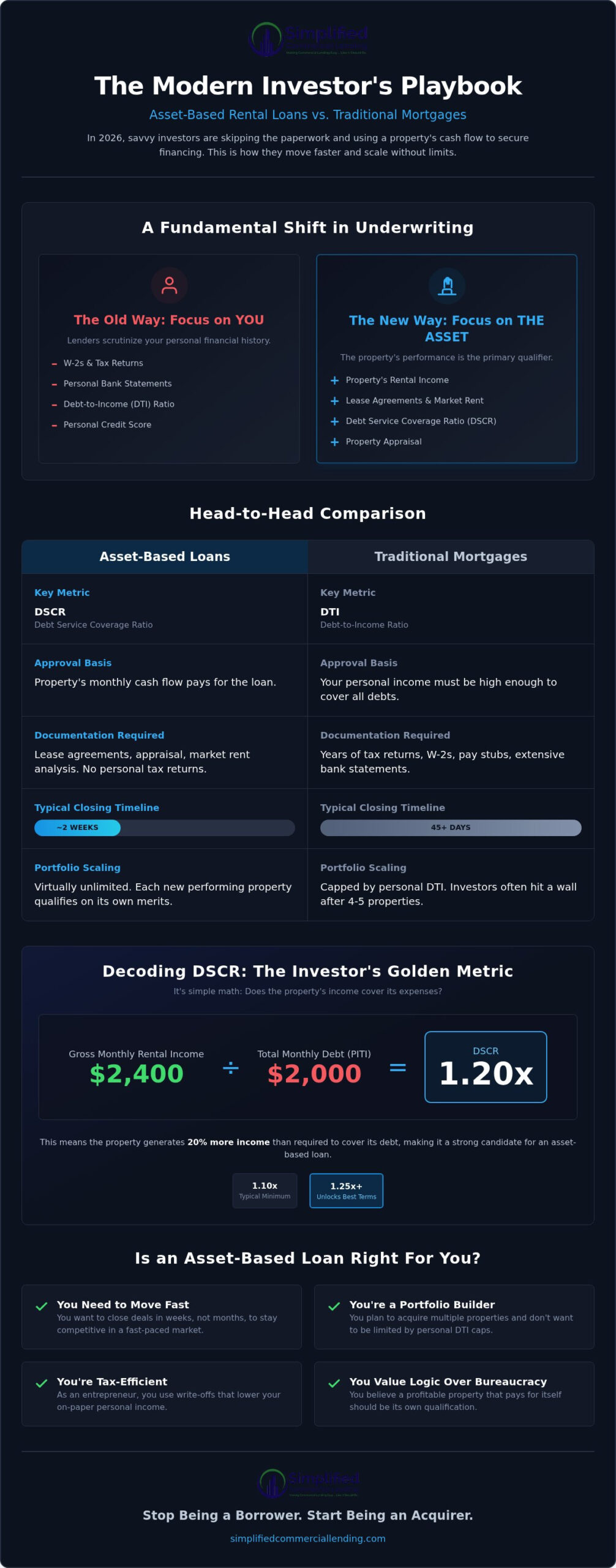
The math is refreshingly simple. Take your monthly rental income and divide it by the PITI (Principal, Interest, Taxes, and Insurance). If your property generates $2,400 a month and the debt costs $2,000, you have a 1.20 DSCR. This means the property earns 20% more than it costs to own. For most programs in 2026, a ratio of 1.1x is the floor, but hitting 1.25x or higher often unlocks the most aggressive terms. In some high-equity scenarios, we even see “No-Ratio” programs. These allow for financing even if the cash flow doesn’t fully cover the debt, provided your down payment is large enough.
Moving Beyond the W-2 Mindset
Are you self-employed? Then you know the frustration. Your accountant is great at finding legal write-offs to lower your tax bill. But when you walk into a traditional bank, those same write-offs make you look “unbankable.” They see “paper losses” where you see a tax-efficient business. Asset-based lending solves this problem instantly. We don’t care about your tax returns. We care if you’ve found a property that makes sense. It’s about empowering you to qualify based on your business savvy rather than a paycheck. If you’re tired of the W-2 box, it might be time to explore how property-first underwriting works for your specific portfolio. You shouldn’t be penalized for being a successful, tax-efficient entrepreneur.
Head-to-Head: Asset Based Loans vs. Traditional Mortgages
Traditional banking is a game of paper. Investment banking for the modern entrepreneur is a game of numbers. When you stack these two options side-by-side, the divide is clear. Conventional mortgages rely on a mountain of personal documentation, including two years of tax returns, pay stubs, and exhaustive bank statements. In contrast, asset based rental loans focus on the lease agreement and the property’s appraisal. You’re effectively trading a “checklist of doom” for a streamlined process that values your deal-finding ability over your W-2 history.
The biggest barrier for growing investors is the “10-loan limit.” Traditional lenders, backed by Fannie Mae or Freddie Mac, usually cap the number of financed properties you can own. Once you hit that wall, you’re stuck. A collateral-based loan treats each property as an independent business unit. This means your portfolio can grow to 20, 50, or 100 units without your personal debt-to-income ratio ever becoming an obstacle. It’s the difference between owning a hobby and running a scalable enterprise.
Speed and Efficiency Comparison
In the 2026 market, speed is a currency. Conventional loans take 30 to 45 days to crawl through bureaucratic underwriting. Private lenders specializing in asset based rental loans can close in 5 to 15 business days. This efficiency comes from a simplified appraisal and title process designed for commercial-style assets rather than primary residences. Think about the opportunity cost of a slow closing. If a 45-day wait causes you to miss out on a discounted multi-family deal, the “cheaper” bank loan actually costs you thousands in lost equity. Speed allows you to act while others are still scanning tax returns.
The Cost of Flexibility
Let’s be transparent about the numbers. You’ll pay for this speed and flexibility through slightly higher interest rates. In 2026, DSCR loan rates typically range from 6.5% to 8.5%, while conventional investment rates usually sit 0.50% to 1.00% higher than primary residence loans. You might also encounter origination fees between 0.5% and 2% of the loan amount. However, savvy investors look at the ROI, not just the rate. If a faster closing allows you to secure a property with better cash flow or a lower purchase price, the interest rate spread becomes a minor cost of doing business. You’re paying for the ability to scale without limits and the freedom from institutional red tape.
Is an Asset Based Rental Loan Right for You?
Choosing between a bank and an asset-based lender isn’t just about comparing interest rates. It’s about your business model. Are you an investor who maximizes every legal tax deduction? If your accountant is doing their job, your “on-paper” income might look too low for a traditional underwriter. Asset based rental loans are built for this exact scenario. We don’t care about your tax write-offs. We care about the property’s performance.
This path is also essential if you’re targeting specific asset classes. In 2026, the rental market has diversified. You need a lender who understands that a short-term rental in a vacation hub is a high-yield business, not just a house. Our financing covers a broad spectrum of property types, ensuring you have the right tool for every deal:
- Single-family investment properties
- Multi-family residential complexes
- Commercial assets
- Short-term rentals and Airbnbs
When to Stick with a Traditional Mortgage
Traditional mortgages still have a place. If you’re buying a primary residence to live in, you can’t use an asset-based rental loan. These products are strictly for investment purposes. Also, if you have a high W-2 income and you’re only buying your first or second rental, a conventional bank might offer the lowest possible interest rate. Don’t ignore your credit score, either. Even in asset-based lending, a strong credit profile often secures better LTV (Loan-to-Value) terms. Banks win on cost; we win on execution.
When to Pivot to Asset-Based Financing
You need to pivot when the bank’s “no” stands in the way of a “yes” from a seller. Consider the “Opportunity Buy.” If a distressed multi-family property hits the market and the seller demands a three-week close, a traditional bank will fail you. They simply can’t move that fast. Asset-based financing is the tool for the “Complex Income” investor. If you operate through multiple LLCs and receive various K-1s, a bank will spend months untangling your entities. We look at the lease and the appraisal instead.
Finally, consider the “Portfolio Play.” If you have equity trapped in several different houses, a portfolio line of credit can unlock that capital for your next acquisition. This is how you scale from a few houses to a real empire. If you’re ready to stop jumping through bank hoops and start closing deals, apply for an asset-based solution today and see how much faster your portfolio can grow.
Scale Your Portfolio with Simplified Commercial Lending
Stop letting institutional red tape dictate the ceiling of your success. Simplified Commercial Lending acts as your savvy expert guide in a 2026 market that rewards speed over protocol. We’ve built our reputation on bypassing the bottlenecks that keep most investors stuck in the small-scale trap. Whether you’re looking to acquire your first multi-family complex or expand a national portfolio, our approach puts the property’s performance at the center of the deal. We don’t just offer loans; we act as an advocate for your success.
The “No Doc” advantage is the engine behind our asset based rental loans. We’ve stripped away the need for personal tax returns and debt-to-income scrutiny. This isn’t just about convenience; it’s about competitive leverage. When you can secure financing based on a property’s cash flow, you’re free to pursue as many profitable deals as your business savvy can find. We specialize in single-family, multi-family, and commercial assets, providing a streamlined path to capital that traditional banks simply can’t match. It’s a personality that values pragmatism over protocol.
Scaling requires more than just one-off deals. It requires a strategy for liquidity. We help you tap into the equity of your existing portfolio through flexible Portfolio Lines of Credit. Instead of waiting for a slow refinance on a single unit, you can leverage your entire collection of assets to fuel your next acquisition. It’s a proactive way to keep your momentum high and your capital working. We understand the specific frustrations of independent investors who feel underserved by mainstream systems.
Our National Reach and Expertise
We serve independent entrepreneurs across the United States. Our expertise isn’t limited to standard rentals. We understand the nuances of the modern market, from cash-flow-rich short-term rentals to large-scale warehouses. If the asset has a solid income stream, we have the tools to finance it. This national reach ensures that your growth isn’t limited by local banking regulations or geographic boundaries. We’re a knowledgeable ally for those who value results over bureaucracy.
Ready to Skip the Tax Return Hassle?
Our intake process is built for the busy investor. We start with the property information. We want to see the lease agreements and the appraisal values first. Your personal details come later, once we’ve established that the deal makes sense. This results-driven flow ensures you get a term sheet without the usual bank headache. We’ve cut the funding cycle down to the essentials, moving you from application to closing with high-energy efficiency. Stop waiting for a “yes” from a lender who doesn’t understand your business. Get a custom quote for your next rental property and start scaling your portfolio on your own terms.
Take Control of Your Portfolio’s Future
The 2026 real estate market doesn’t wait for slow bank approvals. You’ve seen how asset based rental loans shift the power back to the investor by focusing on what truly matters: property performance. By ditching the DTI limits and tax return scrutiny of traditional mortgages, you’re free to scale as fast as your deals allow. It’s about treating your rentals like the businesses they are and moving with the speed the market demands.
You shouldn’t be penalized for being a tax-efficient entrepreneur. Whether you’re targeting a single-family home or a larger multi-family asset, you need a lending partner that values results over red tape. Our national 2026 lending programs are designed to get you to the closing table without the bureaucratic headache. We prioritize your property’s cash flow so you can focus on finding the next big opportunity instead of scanning years of paperwork.
Ready to see what your properties can actually do? You can skip the tax returns and close in as little as 21 days with a team that understands your vision. See How Much Your Rental Cash Flow Can Borrow and start building your empire today. You’ve got the deals; we’ve got the capital to make them happen.
Frequently Asked Questions
Do I need a high credit score for an asset based rental loan?
You typically need a credit score of 620 or higher to qualify for the best terms. While your credit history matters for determining your interest rate and leverage, it isn’t the primary focus of the underwriting. We prioritize the property’s ability to generate revenue over your personal credit utilization or debt history.
Can I get an asset based loan for a property I plan to live in?
No, these loans are strictly for investment purposes. You cannot use asset based rental loans for a primary residence or any owner-occupied property. If you intend to live in the home, you must seek a traditional residential mortgage that follows standard consumer lending regulations.
What is the minimum DSCR required for most rental loans in 2026?
A Debt Service Coverage Ratio (DSCR) of 1.1x is the standard floor for most 2026 programs. This means the property’s gross rental income must be at least 110% of the monthly debt payment. Investors who show a ratio of 1.25x or higher often unlock the most aggressive interest rates and higher loan-to-value limits.
Are asset based loans the same as hard money loans?
No, they serve different investment strategies. Hard money is a short-term, high-interest tool used for bridge financing or fix-and-flip projects. Asset-based rental loans are long-term, 30-year products designed for buy-and-hold investors who want to build stable, monthly cash flow over time.
How many properties can I finance using an asset-based approach?
There is no limit to the number of properties you can finance. Traditional banks usually cap investors at 10 financed properties, which stalls growth for ambitious entrepreneurs. Because we underwrite each property as an independent business, you can scale your portfolio to 50 or 100 units without hitting a ceiling.
What types of properties qualify for asset based rental financing?
We provide financing for single-family homes, multi-family residential buildings, and various commercial assets. This also includes short-term rentals like Airbnbs. As long as the property is used for business purposes and generates verifiable rental income, it’s a candidate for our national lending programs.
Do I need to show bank statements for a no-doc rental loan?
Yes, you still need to provide bank statements, but for a different reason than traditional banks. We don’t use them to calculate your personal income. Instead, we use them to verify you have the liquid funds for your down payment and the required closing reserves. It’s a check on your liquidity, not your salary.
How fast can an asset based rental loan close compared to a bank?
You can close in as little as 5 to 15 business days. Conventional bank loans frequently take 30 to 45 days to crawl through the underwriting process. This speed allows you to secure deals in competitive markets where sellers value a fast, certain closing over a slightly lower interest rate.