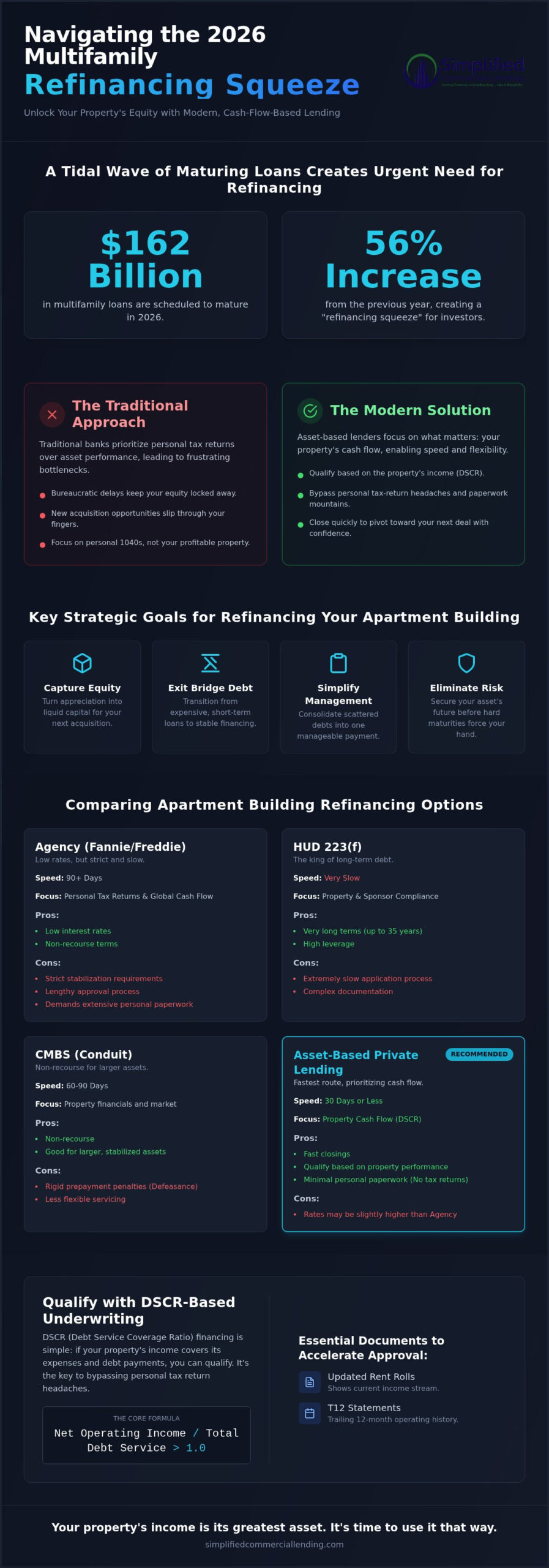
Did you know that approximately $162 billion in multifamily loans are scheduled to mature in 2026? That is a massive 56% increase from last year. This surge is creating a “refinancing squeeze” for investors who locked in low rates years ago and now face a much tighter lending market. You likely feel the weight of this shift. It is exhausting to deal with big banks that prioritize your personal tax returns over the actual performance of your assets. You know your property is profitable, yet bureaucratic delays keep your equity locked away while new acquisition opportunities slip through your fingers.
It is time to stop letting traditional paperwork dictate your growth. This guide explores the most effective apartment building refinancing options available in 2026. You will learn how to unlock property equity and optimize your portfolio using modern, cash-flow-based strategies that bypass the tax-return headache. We will preview the latest market rates, explain how to streamline your monthly debt service, and show you how to close quickly so you can pivot toward your next deal with confidence. Your property’s income is its greatest asset; it is time to start using it that way.
Key Takeaways
- Learn why the 2026 market shift makes this the ideal time to capture equity and move away from restrictive bridge loans.
- Compare the pros and cons of various apartment building refinancing options, from low-rate Agency loans to high-leverage HUD programs.
- Discover how to qualify for financing based on property cash flow instead of your personal tax returns through DSCR-based underwriting.
- Identify the essential documentation you’ll need, like updated rent rolls and T12 statements, to accelerate your approval process.
- Find out how a national, non-bank approach helps you bypass traditional bureaucratic delays and close your next deal faster.
Why Refinance Your Apartment Building in 2026?
The 2026 market isn’t just another economic cycle. It is a high-stakes deadline. With approximately $162 billion in multifamily loans maturing this year, a 56% increase from 2025, the pressure to secure new terms is real. Many investors are currently caught in a “refinancing squeeze.” They are moving from 3% interest rates into a market where 6% or 7% is the new baseline. Waiting for rates to drop might seem logical, but the cost of a missed balloon payment is far higher than the cost of capital today.
Smart investors are looking at apartment building refinancing options as a tool for offense, not just defense. You can use this transition to:
- Capture equity: Turn your property’s appreciation into liquid capital for your next acquisition.
- Exit bridge debt: Transition away from expensive, short-term bridge loans into stable, permanent financing.
- Simplify management: Consolidate scattered debts into a single, manageable monthly service.
- Eliminate maturity risk: Secure your asset’s future before hard maturities in the CMBS or bank markets force your hand.
The 2026 Multifamily Market Landscape
Cap rates are in flux, and traditional banks are tightening their belts. This has led to a significant shift from bank-led lending to private debt solutions. Liquidity is now the primary driver for success. If you have equity locked in a building, it isn’t working for you. In a market where traditional refinancing often stalls due to bureaucratic red tape, private and non-bank lenders are stepping in to provide the speed and flexibility that independent entrepreneurs need to scale. They prioritize the asset’s performance over your personal 1040s.
Identifying Your Refinancing Goal
Your strategy determines your product. Are you looking for a rate-and-term refinance to lower your overhead, or do you need a cash-out refinance to fuel growth? For those managing multiple properties, a portfolio line of credit for rentals can be a game-changer. It allows you to tap into the collective equity of your holdings without the headache of individual tax-return hurdles. Evaluating different apartment building refinancing options today ensures you aren’t left scrambling when your current loan term ends. Efficiency is your best hedge against market volatility. Don’t wait for the bank to call you. Call the shots yourself.
Comparing Apartment Building Refinancing Options
Not all loans are created equal. When you are Comparing apartment building refinancing options, you’re essentially choosing between speed, cost, and documentation. While the interest rate is a major factor, the hidden costs of a slow closing or a personal guarantee can outweigh a slightly higher coupon. You need a strategy that matches your timeline and your risk tolerance. In 2026, the ability to pivot quickly is often more valuable than shaving ten basis points off a rate.
You generally have four main paths to consider:
- Agency Loans: Fannie Mae and Freddie Mac offer low rates and non-recourse terms but have strict stabilization requirements.
- HUD 223(f): This is the king of long-term debt with 35-year terms, though the application process can be slow.
- CMBS: Conduit loans are excellent for non-recourse needs on larger assets but come with rigid prepayment penalties.
- Asset-Based Private Lending: This is the fastest route, prioritizing property cash flow over personal income verification.
Agency vs. Private Lending: The Real Trade-offs
The trade-off usually comes down to days, docs, and dollars. Agency approvals often exceed 90 days, which can be a lifetime in a shifting market. Private lenders can fund in 30 days or less. Documentation is equally distinct. Agencies demand years of personal tax returns and a deep dive into your global cash flow. Private lenders look at your rent rolls and the property’s specific performance. If you want to scale without a mountain of paperwork, private debt is often the superior tool for apartment building refinancing options.
When to Choose a Bridge-to-Perm Strategy
If your building is still in a lease-up phase, don’t rush into permanent debt. A bridge-to-perm strategy lets you use short-term capital to finish renovations or hit target occupancy. These loans often feature interest-only periods that keep your cash flow healthy during the transition. Once stabilized, you can roll the debt into long-term multi family residential investment loans. This path ensures you don’t leave money on the table by financing an underperforming asset.
Getting a clear picture of your potential for Multi-Family Residential Investment Loans starts with a quick conversation.
Unlocking Equity with No-Doc and DSCR Refinancing
Traditional banks often treat seasoned investors like first-time homebuyers. They demand stacks of tax returns, personal financial statements, and W2s that don’t reflect the true health of your business. If your personal income reporting is complex due to legal tax strategies, you might find yourself disqualified despite owning a high-performing asset. This is where apartment building refinancing options like DSCR loans change the game. A Debt Service Coverage Ratio (DSCR) loan prioritizes the property’s cash flow over your personal debt-to-income ratio. If the building generates enough income to cover the new mortgage payment, the deal works.
The calculation is straightforward. Divide your property’s Net Operating Income (NOI) by the annual debt service. For example, if your building nets $125,000 and the mortgage costs $100,000, your DSCR is 1.25x. Most non-bank lenders look for a ratio between 1.15x and 1.25x to ensure the asset is self-sustaining. This “No-Doc” approach means you stop defending your personal 1040s and start focusing on your property’s performance. It’s the ultimate tool for scaling a portfolio quickly without the bureaucratic headache.
The Power of Asset-Based Underwriting
Asset-based underwriting is about durability. Lenders want to see that the property can stand on its own two feet. To maximize your loan proceeds, you must present a clean, updated rent roll and a trailing 12-month (T12) statement. Highlighting recent rent increases or reduced vacancies can significantly boost your valuation. This streamlined method is why savvy investors prefer this path for both multifamily assets and single family residential investment loans. While national initiatives like Federal Multifamily Financing Programs are useful for specific long-term preservation goals, asset-based private lending offers the raw speed needed to capture equity and reinvest it immediately.
Privacy and Speed for the Independent Investor
Your business should be a separate entity from your personal life. No-doc loans provide a layer of privacy that traditional banking lacks. You don’t have to expose every detail of your financial history to a local loan committee. Instead, you bypass the red tape and move directly toward a closing. Most traditional banks take months to deliberate; asset-based lenders focus on closing on your timeline. This speed allows you to pivot toward new acquisitions while other investors are still waiting for a callback. Don’t let a bank’s rigid protocol stall your momentum.
Key Requirements for Multifamily Refinancing
Preparation is the difference between a quick closing and a stalled application. Lenders in 2026 are highly selective. They look for durability in cash flow and precision in reporting. Before you explore specific apartment building refinancing options, you must audit your own asset. This proactive approach ensures you present a clean deal that moves through underwriting without friction. Follow these four essential steps to get your property refinance-ready.
Step 1: Update your rent roll and T12. Your Trailing 12-Month (T12) statement is the property’s financial autobiography. It shows every dollar earned and spent. Ensure it’s accurate and reflects the current rental market. Step 2: Review physical condition. Capital expenditures (CapEx) matter. If your roof is failing or the HVAC systems are aged, lenders will hold back funds. Address deferred maintenance now to protect your valuation. Step 3: Evaluate your credit score. Even with no-doc loans, your credit remains a proxy for your reliability as a borrower. Step 4: Determine your LTV. Loan-to-Value ratios for cash-out refinances currently hover between 65% and 75%. Knowing your equity position helps you set realistic expectations for loan proceeds.
Documentation Checklist for 2026
You don’t need tax returns for asset-based lending, but you do need organization. Have these documents ready in a digital folder before you make the first call. It saves weeks of back-and-forth communication. Being organized signals to the lender that you are a professional operator who values efficiency.
- Updated operating statements and property tax records.
- Current lease agreements and a detailed occupancy history.
- Entity documents, including your LLC Operating Agreement and EIN.
- A summary of recent property improvements or renovations.
Understanding DSCR Loan Requirements
Your Debt Service Coverage Ratio is the most critical number in your application. Most top-tier terms require a minimum ratio of 1.20x to 1.25x. However, don’t just look at the gross rent. Lenders apply a standard vacancy factor, often 5%, and management fees to your Net Operating Income. If your ratio is tight, consider small operational wins. Can you reduce utility costs or increase ancillary income through parking or storage fees? These small adjustments can significantly improve your qualifying ratio and lower your interest rate. Ready to see where your property stands? Check your refinance eligibility today.
How to Streamline Your Refinance with Simplified Commercial Lending
Traditional banking is often slow, rigid, and obsessed with the wrong data. At Simplified Commercial Lending, we do things differently. We take a “Property First” approach to every deal. This means we start with your building’s performance, not your personal 1040s. By focusing on asset-based metrics, we cut through the bureaucratic noise that typically stalls most apartment building refinancing options. You deserve a partner who understands that your property’s income is the real driver of the deal.
We provide you with direct access to a massive national network of non-bank lending partners. These aren’t retail banks with local committees; they are aggressive capital sources that specialize in the nuances of multifamily investing. Whether you are seeking a long-term hold or a flexible bridge solution, our team provides expert guidance through the entire commercial property loan landscape. We don’t do fluff. We don’t do “maybe.” We deliver direct, punchy communication that respects your time and your ambitions.
From Application to Funding: What to Expect
Our process is built for speed. It starts with an initial consultation where we identify your asset’s true potential. We analyze your T12 and rent roll to find the maximum leverage available in the current market. Once we move into the processing phase, forget about the typical paper-pushing. We use a streamlined system to gather essential documentation and move straight toward underwriting. You won’t be left wondering where your deal stands. We close with confidence, putting capital in your hand so you can get back to growing your business.
Ready to Scale Your Portfolio?
Waiting for “perfect” rates is a trap. In the 2026 market, the cost of waiting often far exceeds the cost of the refinance itself. Locked-up equity is dead money. By refinancing now, you create the liquidity needed to fund your next acquisition and stay ahead of the competition. Don’t let traditional banking hurdles keep your portfolio stagnant. Take the first step today. Contact our team for a direct, no-obligation scenario review. We’ll show you exactly what is possible for your property without the tax-return headache. It’s time to stop fighting the red tape and start scaling.
Take Control of Your Portfolio’s Future
The 2026 market doesn’t wait for anyone. With billions in maturities looming, the “refinancing squeeze” is a reality that requires a proactive strategy. You now understand how asset-based underwriting and DSCR loans allow you to bypass the traditional bank hurdles that often stall independent investors. By focusing on your property’s actual performance rather than your personal tax history, you can unlock the equity needed to fuel your next acquisition. Choosing the right apartment building refinancing options is about securing the speed and flexibility your business deserves.
We are here to help you navigate this transition without the bureaucratic headache. Our process is built for efficiency, offering closings in as little as 30 days with no tax returns required. We prioritize asset-based underwriting because we believe your property’s success should be the primary qualifying factor. It is time to stop defending your past and start financing your future.
Scale your portfolio today; get your no-obligation refinance quote from Simplified Commercial Lending. Your next big deal is within reach. Let’s get to work.
Frequently Asked Questions
What is the typical LTV for apartment building refinancing?
Typically 70% to 80% depending on the program. For cash-out refinancing on 5+ unit properties, Agency loans often reach 75% to 80%. Conventional bank loans usually cap at 70% to 75% for cash-out scenarios. If you are looking at smaller 2-4 unit properties using DSCR-based apartment building refinancing options, expect a range between 70% and 75%. High-leverage options exist for borrowers with exceptional credit and strong property performance.
Can I refinance an apartment building without showing my tax returns?
Yes, you can qualify using no-doc or DSCR-based loans that focus entirely on property cash flow. These programs prioritize the building’s Net Operating Income rather than your personal 1040s or W2s. This is an ideal solution for investors with complex tax structures or those who want to keep their personal financial life private. Underwriting centers on the rent roll and trailing 12-month statements to ensure the asset can cover its own debt service.
How long does the multifamily refinancing process take?
Timelines vary by lender, but asset-based private loans can close in as little as 30 days. In contrast, traditional bank loans often take 45 to 60 days due to committee reviews. Government-backed programs like HUD 223(f) can take six months or longer. To speed up your apartment building refinancing options, have your entity documents, current rent rolls, and property tax records ready for review before you begin the application process.
What is a good DSCR ratio for an apartment building refinance?
A ratio of 1.25x is generally considered the industry standard for top-tier terms. This means the property’s net income is 25% higher than the annual mortgage payment. Some programs, like HUD refinancing, may allow ratios as low as 1.15x. Lenders use this number to gauge the property’s ability to handle economic vacancies or rising expenses. Improving your ratio by reducing operating costs can help you secure more favorable interest rates and higher leverage.
Are there non-recourse options for multifamily refinancing?
Non-recourse debt is common for larger multifamily assets, particularly through Agency and CMBS programs. These loans are secured only by the property itself, meaning the lender cannot pursue your personal assets in the event of a default. However, most non-recourse loans include “bad boy” carve-outs for fraud or gross negligence. Smaller properties or conventional bank loans under $5 million often require a personal guarantee, though some private debt funds offer non-recourse terms for a premium.
Can I use a portfolio line of credit to refinance multiple apartment buildings?
Yes, a portfolio line of credit allows you to consolidate multiple properties into a single financing facility. This is an efficient way to unlock equity across your entire holdings without refinancing each building individually. It simplifies your monthly debt service and provides a ready source of capital for future acquisitions. These lines are often underwritten based on the collective cash flow of the portfolio, making them a powerful tool for scaling your investment footprint quickly.
What are the closing costs associated with commercial refinancing?
Closing costs typically range from 3% to 5% of the total loan amount. These expenses cover lender fees, title insurance, legal costs, and government recording fees. You will also need to budget for third-party reports, such as appraisals, environmental assessments, and property condition assessments. While these costs are higher than residential loans, they are a necessary part of securing long-term, stable capital for commercial assets. Many investors choose to roll these costs into the new loan balance.