What if your personal tax returns had absolutely nothing to do with your ability to buy a 20-unit apartment complex? For years, traditional banks have forced independent investors through a gauntlet of paperwork, often rejecting perfectly profitable deals because of personal debt ratios. It’s frustrating to watch a high-performing asset slip away just because you don’t fit into a rigid institutional box. You know the property cash flows, but the bank only cares about your W-2. It is time to stop letting legacy banking rules stall your growth.
This guide is your roadmap to mastering no doc apartment building loans in 2026. We will show you how to secure your first multifamily property without the standard banking headaches that stop most investors in their tracks. You’ll discover why the 5-unit rule is your gateway to commercial freedom and how to use the Debt Service Coverage Ratio (DSCR) to qualify based on property cash flow instead of your personal salary. We are pulling back the curtain on non-bank lending options that prioritize speed and flexibility over endless documentation. By the end of this article, you will have a clear, actionable strategy to scale your portfolio using smart, asset-based financing that keeps your momentum moving forward.
Key Takeaways
- Understand the 5-unit rule to move beyond residential limits and tap into the scaling potential of commercial financing.
- Stop hunting for tax returns and qualify for no doc apartment building loans based on the actual cash flow of the property.
- Simplify complex commercial metrics like DSCR and LTV to make faster, more profitable investment decisions.
- Learn the exact steps to partner with non-bank lenders who value your property’s performance over your personal financial history.
What Are Apartment Building Loans and How Do They Work?
An apartment building loan is a specific type of Commercial mortgage designed for properties with five or more units. These aren’t just larger versions of a standard home loan. They are sophisticated financial tools secured by the real estate and the income it produces. For many beginners, the “commercial” label feels like a barrier. It shouldn’t. It’s actually your biggest opportunity. In 2026, non-bank lenders have stepped in to fill the gaps left by traditional institutions. They provide the flexibility you need to scale, often through no doc apartment building loans that prioritize property potential over your personal paperwork.
The Difference Between Residential and Commercial Financing
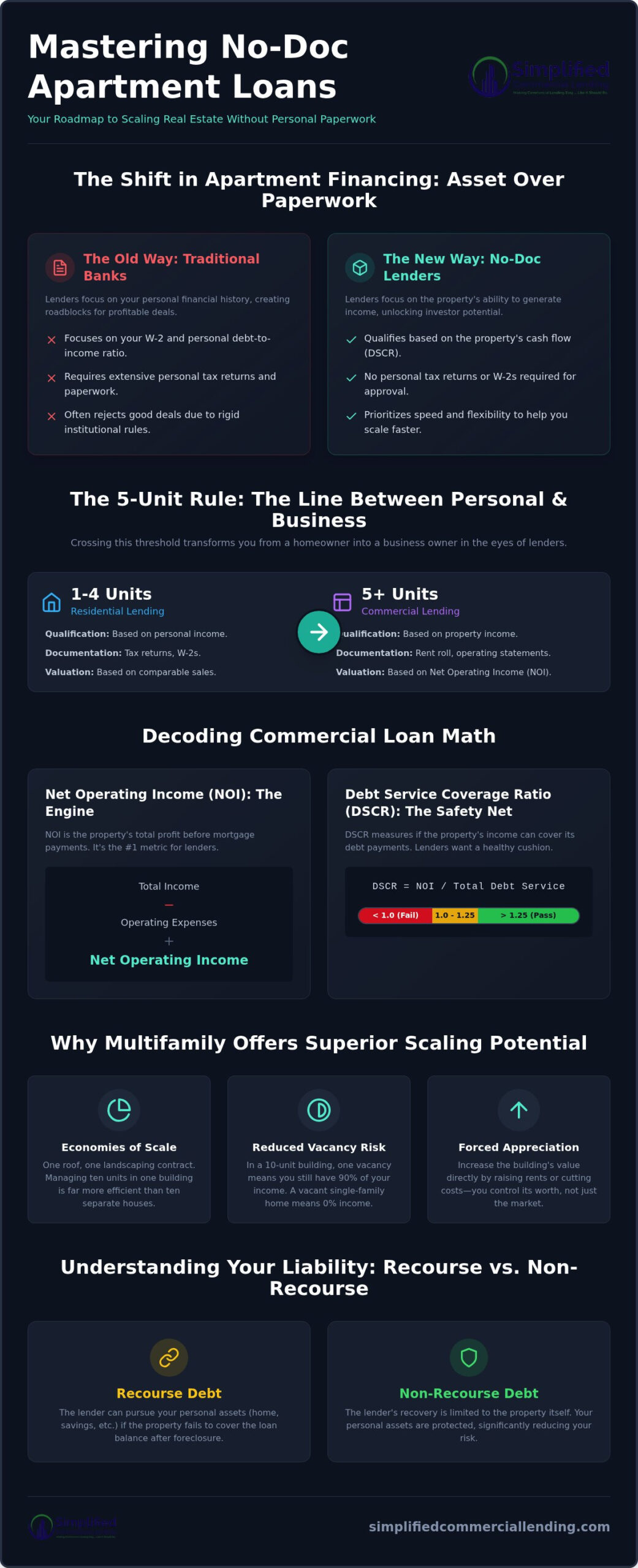
The magic number in real estate is five. If a property has one to four units, it falls under residential lending rules. Once you hit that fifth unit, you enter the commercial arena. This shift changes everything about how you get funded. In the residential world, lenders obsess over your debt-to-income ratio and your personal salary. In the commercial world, you are a business owner. The lender’s underwriting focus moves away from your W-2 and onto the building’s rent roll. They want to know if the property can pay for itself and still have a profit margin left over. This is exactly why no doc apartment building loans are so powerful for investors who have great deals but complex personal tax situations.
Why Beginners Should Start with Multifamily
Scaling with single-family homes is a slow, repetitive grind. Moving into multifamily properties offers immediate advantages that houses simply cannot match. Consider these three factors:
- Economies of Scale: It’s significantly more efficient to manage ten units under one roof than ten separate houses scattered across a city. You have one roof to repair and one landscaping contract to sign.
- Reduced Vacancy Risk: If your single-family rental goes empty, your income drops to zero. If one unit in a ten-plex sits vacant, you still have 90% of your revenue coming in. Your cash flow remains stable.
- Forced Appreciation: Residential values depend on what the neighbor’s house sold for. Commercial values depend on net operating income. If you increase the rent or decrease expenses, you directly increase the building’s value. This allows you to manufacture equity and secure better financing terms.
The 5-Unit Rule: Why Your First Apartment Loan is Different
Crossing the line from four units to five is more than just adding one tenant. It is a complete shift in legal and financial identity. Lenders no longer see you as a person buying a house; they see a business entity acquiring a revenue-generating asset. This is where Commercial Real Estate Loans come into play. For many investors, this transition is the perfect time to explore no doc apartment building loans. These products align with the commercial reality that the building’s performance is the primary security for the debt. You aren’t just a landlord anymore. You’re a business owner.
As you step into this arena, you must understand the difference between recourse and non-recourse debt. Recourse debt allows a lender to pursue your personal assets if the property fails to cover the loan. Non-recourse debt generally limits the lender’s recovery to the property itself. While many beginners start with recourse options, the ultimate goal for most is to move toward non-recourse structures as their portfolio grows. If you are currently managing smaller properties and preparing for this shift, reviewing our guide on multi family residential investment loans can help you bridge the gap before you make the leap to 5+ units.
Commercial Underwriting 101
In commercial lending, Net Operating Income (NOI) is the star of the show. It is the total income left after all operating expenses are paid, but before you pay the mortgage. Your personal debt-to-income ratio matters much less here than it does in residential deals. Lenders will scrutinize your Rent Roll to see exactly who is paying what. They will also analyze your Operating Statement to see where every dollar goes. They want to ensure the business is viable on its own merits. This heavy focus on the asset’s performance is exactly what makes no doc apartment building loans so efficient for investors who want to scale without being held back by personal tax history.
Managing the Transition from 1-4 Units
Residential landlords often stumble when they buy their first 5-plex because they bring old habits to a new game. You cannot use a standard homeowner’s policy for a commercial building; you need specific commercial coverage. You also need to move beyond basic spreadsheets and adopt professional accounting practices. Most importantly, you need to prepare your mindset for a more professional approach. You are running a company now, and your financing should reflect that. To ensure you have the right capital structure for this growth, you can explore asset-based financing options that prioritize your property’s potential over traditional banking hurdles.
Multifamily Financing Options for New Investors
Traditional banks often treat apartment financing like a root canal. They want years of tax returns, personal financial statements, and a detailed history of your life. While Fannie Mae Multifamily guidelines provide excellent long term rates, the rigid qualifying process can take months. For a new investor, that delay is a deal killer. You need options that match the speed of the market. In 2026, the most successful entrepreneurs are moving away from institutional red tape. They are choosing flexible, non-bank alternatives that prioritize the asset over the individual.
There are four primary ways to fund your first deal without the banking headache:
- Asset-Based Loans: These focus almost exclusively on the property’s value and income potential. Your personal income is secondary.
- DSCR Loans: This is the gold standard for scaling. If the property’s rent covers the mortgage and expenses, you are halfway to an approval.
- Bridge Loans: Use these for short term needs. They are perfect for buildings that need repairs or better management before they qualify for long term debt.
- Portfolio Lines of Credit: These allow you to leverage your existing rental properties to create a pool of ready cash for your next acquisition.
No-Doc and Low-Doc Apartment Loans
Did you know that being a savvy investor can actually hurt your borrowing power at a big bank? You take legal deductions to lower your tax bill. The bank sees those deductions as a lack of income. It is a trap that stops many great investors from growing. no doc apartment building loans solve this problem by ignoring your 1040s. Instead, lenders verify income by looking at the property’s actual or projected cash flow. This allows you to qualify for larger buildings based on the strength of the deal itself. If you want to skip the tax return grind, explore our resources on no doc rental property loans to see how the process works.
Portfolio Lines of Credit for Scaling
You don’t always need to find fresh cash for a down payment. If you already own a few single family rentals, you might be sitting on a gold mine of equity. A portfolio line of credit for rentals allows you to tap into that equity without selling your assets. This creates a flexible fund you can use to pounce on an apartment deal the moment it hits the market. Speed is your greatest advantage in 2026. Non-bank lenders can often close these lines in a fraction of the time it takes a traditional institution to even open a file. It’s about having the liquidity to act while others are still filling out forms. Using no doc apartment building loans in combination with a portfolio line can help you scale from a few houses to a massive complex in record time.
Decoding Commercial Loan Requirements: Beginner’s Math
Commercial lending is a numbers game. Once you understand the math, the intimidation factor disappears. While no doc apartment building loans remove the personal income barrier, they replace it with a focus on property performance and your financial stability as a sponsor. You don’t need a finance degree to succeed, but you must master four key metrics to get your deal across the finish line. These numbers tell the lender if the building is a business or a liability.
How to Calculate DSCR Like a Lender
Debt Service Coverage Ratio (DSCR) is defined as the property’s Net Operating Income divided by the total annual debt service. It is the most critical number in your application. For example, if your 6-unit building generates $10,000 in monthly profit after expenses and your mortgage payment is $8,000, your DSCR is 1.25. Most lenders in 2026 look for a ratio between 1.20 and 1.25. This margin ensures the property can still pay its bills even if a tenant leaves or expenses spike. If you want to see how different property types impact these numbers, check out the latest dscr loan requirements to see where your deal stands.
LTV and Down Payment Expectations
Loan-to-Value (LTV) is the percentage of the property’s appraised value the lender is willing to fund. For beginners in 2026, expect an LTV between 70% and 80%, which translates to a 20% to 30% down payment. If you are buying a distressed property to renovate, you might hear the term Loan-to-Cost (LTC). LTC focuses on the total project cost, including construction, rather than just the current “as-is” value. A professional appraisal is mandatory in the commercial world to verify these figures. Lenders rely on these third-party reports to justify the loan amount and ensure the asset’s value supports the debt.
You still need a decent credit track record and liquid cash. In 2026, most no-doc lenders require a credit score between 620 and 680 for the best terms. They also want to see liquidity, which means having enough cash in the bank after closing to cover 6 to 12 months of mortgage payments. These reserves prove you can handle a rainy day without the building going into foreclosure. Ready to see if your numbers work for a new acquisition? Apply for an asset-based loan today and get a clear picture of your borrowing power.
How to Secure Your First Apartment Loan in 2026
Securing your first commercial deal doesn’t have to be a bureaucratic nightmare. It requires a strategic shift in how you present yourself and the property. In 2026, the path to closing is built on speed and asset performance. You don’t need to wait for a bank to scrutinize your personal life. Follow these four steps to get funded fast:
- Step 1: Find the right asset. Look for properties with strong existing cash flow or a clear path to increasing rents through better management.
- Step 2: Partner with an expert. Connect with a commercial broker who specializes in no doc apartment building loans.
- Step 3: Organize the property data. Prepare a current Rent Roll and a 12-month Profit & Loss statement. These are the building’s resume.
- Step 4: Secure pre-approval. Get a commitment based on the property’s potential, not just your personal income history.
Finding the Right Lending Partner
Walking into a local bank branch is the most common mistake beginners make. Retail banks are built on rigid institutional norms. They want your tax returns and a perfect W-2. Simplified Commercial Lending acts as a disruptive alternative for the independent entrepreneur. We provide a bridge to private equity and non-bank lenders who value speed over protocol. A professional broker acts as your savvy navigator. They know which lenders are currently aggressive on 5-unit buildings and who will bypass traditional industry bottlenecks. This access is your competitive advantage in a fast-moving market.
The Application and Closing Process
Expect a closing window of 30 to 45 days. This isn’t a residential mortgage; it’s a business transaction. During this time, the lender will order several third-party reports. A professional appraisal verifies the value. A Phase I Environmental report ensures the land is clean. Inspections confirm the physical state of the building. To ensure a smooth no doc apartment building loans closing, have your entity documents ready. This includes your LLC operating agreement and your EIN. Keep your liquidity in place. Don’t make any major personal purchases during the escrow period. Your goal is to remain a stable sponsor for a high-performing asset. When the reports come back clean and the numbers align, you’re ready to take title and start scaling your portfolio.
Scale Your Portfolio Without the Red Tape
The transition from small residential rentals to large apartment complexes is the fastest way to build generational wealth. By understanding the 5-unit rule and mastering basic metrics like DSCR, you move from being a landlord to a true business owner. You don’t have to let traditional banking hurdles or endless tax return requests slow your momentum. no doc apartment building loans give you the freedom to qualify based on the property’s actual performance rather than your personal debt-to-income ratio. This shift allows you to focus on finding great deals instead of digging through old paperwork.
It is time to stop fighting with big banks and start working with a partner who understands the needs of independent entrepreneurs. We specialize in asset-based underwriting and fast closings for 5+ unit buildings without requiring any personal tax returns. This streamlined approach keeps your capital moving and your portfolio growing. Ready to see what your next deal looks like? Get a No-Doc Multifamily Loan Quote Today and take the first step toward your commercial goals. Your growth shouldn’t be limited by institutional red tape. Start building your legacy today.
Frequently Asked Questions
Can I get an apartment building loan with no experience?
Yes, you can secure financing with no experience by leveraging the strength of the property and a professional management team. While traditional banks might hesitate, asset-based lenders focus on the building’s cash flow rather than your personal track record. Having a seasoned property manager on your team can often satisfy lender requirements for operational expertise. This allows you to focus on finding high-performing assets while the management team handles the daily logistics of tenant relations.
How much down payment do I need for a 5-unit apartment building?
You should expect to provide a down payment of 20% to 30% for a 5-unit apartment building. Unlike residential loans that allow for lower down payments, commercial financing requires more equity from the investor. In 2026, most beginners find that 25% is the standard requirement to secure competitive terms. This equity provides a safety net for the lender and ensures you are committed to the property’s long-term success and financial stability.
What is a DSCR loan and how does it help beginners?
A DSCR loan measures a property’s ability to cover its debt using its own rental income. It helps beginners because the lender prioritizes the building’s cash flow over your personal salary or debt-to-income ratio. If the rent exceeds the mortgage and operating costs, the deal is considered viable. This makes no doc apartment building loans an ideal choice for investors who are self-employed or have complex tax situations that might disqualify them at a traditional bank.
Do I need to show my personal tax returns for a commercial loan?
You do not need to provide personal tax returns when applying for no doc apartment building loans. These products use alternative documentation to verify the viability of the investment. Instead of your 1040s, the lender will scrutinize the property’s Rent Roll, Profit and Loss statement, and the Debt Service Coverage Ratio. This streamlined process removes the frustration of endless paperwork and allows you to scale your portfolio based purely on the strength of your acquisitions.
What is the minimum credit score for an apartment building loan?
The minimum credit score for most apartment building loans falls between 620 and 680. While these are asset-based loans, lenders still use your credit history to gauge your reliability as a sponsor. Scoring above 740 will typically unlock the most favorable interest rates and lower down payment requirements. If your score is on the lower end, you may still qualify, but expect to provide additional liquidity or a larger down payment to offset the risk.
How long does it take to close on a multifamily commercial loan?
Closing on a multifamily commercial loan typically takes 30 to 45 days. This timeline is significantly faster than government-backed HUD loans, which can take six months or longer. The process includes ordering a commercial appraisal, a physical inspection, and a Phase I Environmental report. Staying organized with your LLC documents and property financial statements will help keep the process moving. Non-bank lenders prioritize efficiency, allowing you to close deals before your competition even gets a pre-approval.
Can I use a portfolio line of credit to buy an apartment building?
You can absolutely use a portfolio line of credit to fund the down payment for an apartment building. This strategy allows you to tap into the equity of your existing rental houses without selling them. It provides a pool of ready cash that makes you a more competitive buyer in a crowded market. By leveraging your current assets, you can scale into larger multifamily properties faster than if you were saving for each down payment individually.
Are apartment building loan rates higher than residential rates?
Commercial apartment loan rates are generally 0.5% to 2% higher than standard residential mortgage rates. This premium exists because commercial loans are considered higher risk and lack the heavy government subsidies found in the single-family market. However, the ability to scale and the tax benefits of multifamily ownership often far outweigh the slightly higher interest cost. Focus on the net cash flow of the building rather than just the interest rate to determine the deal’s profitability.