What if you could scale your real estate portfolio without ever showing a single personal tax return to a bank? For most investors, the traditional lending process feels like a hurdle race designed to slow you down. You’re likely tired of big banks demanding mountains of personal paperwork for properties that should stand on their own financial feet. It’s exhausting to deal with slow approval times and the constant confusion between residential rules and true 5+ unit commercial financing.
You deserve a streamlined path that prioritizes property performance over your personal income history. This guide masters the essential apartment building loan requirements for 2026, giving you the tools to qualify for multi-family financing without the typical bureaucratic headache. We’ll show you how to leverage property-first underwriting to secure the capital you need for larger acquisitions.
In this checklist, we’ll identify the exact DSCR and liquidity targets lenders look for today. You’ll learn how to distinguish between different asset-based programs and find the fastest route to closing your next 5+ unit deal.
Key Takeaways
- Understand why property cash flow and the Debt Service Coverage Ratio (DSCR) now outweigh your personal income in the eyes of commercial lenders.
- Identify the modern 2026 credit and liquidity benchmarks you need to hit to qualify for the most aggressive multi-family rates.
- Navigate the specific apartment building loan requirements for 5+ unit properties that allow you to bypass the restrictive rules of residential lending.
- Streamline your application with a precise documentation checklist focused on property performance rather than personal tax history.
- Learn how to leverage a national network of non-bank capital to scale your portfolio faster than traditional institutional norms allow.
The Fundamental Shift: Property Underwriting vs. Personal Income
Scaling a real estate portfolio often hits a wall when you deal with traditional residential lenders. They look at your paycheck. They scrutinize your debt to income ratios. But when you cross the threshold into multi-family assets, the game changes. In the world of commercial finance, the property is the primary borrower. This is the core of a Commercial mortgage; the asset’s ability to generate revenue determines your success.
Traditional banks use Debt-to-Income (DTI) to measure your personal ability to pay. Commercial lenders use the Debt Service Coverage Ratio (DSCR). This shift means your personal expenses matter far less than the building’s Net Operating Income. For 2026, the standard for non-bank, asset-based lending has moved even further away from the borrower. It’s about the deal, not just the person behind it. Understanding these apartment building loan requirements is the first step toward true financial leverage.
Why 5 Units is the Magic Number
The jump from four units to five isn’t just about adding one more door. It’s a regulatory leap from residential to commercial territory. Properties with 1 to 4 units follow Fannie Mae and Freddie Mac guidelines. Once you hit 5 units, you enter the commercial space. This changes how your property is valued. Residential appraisals rely on “comps” or what the neighbor’s house sold for last month. Commercial appraisals use the “income approach.”
- Income Valuation: Value is derived from the cash flow the building produces.
- Personal Leverage: Your personal DTI doesn’t stop the deal if the property is profitable.
- Scalability: You can buy a 20-unit building with the same personal effort as a duplex.
This shift benefits investors with high personal leverage. If you’ve already tapped out your residential loan limit, commercial financing opens a new door. The property’s performance carries the weight of the debt.
The Death of the Tax Return Requirement
In 2026, savvy investors are leaving big banks behind. Why? Because the “onerous tax return request” is becoming a relic of the past. Modern no doc rental property loans allow you to scale without showing your 1040s. Lenders now prioritize the Profit and Loss (P&L) statement of the asset over your personal tax history. This is a massive advantage in a competitive market.
Asset-based underwriting is fast. It bypasses the months of forensic accounting required by institutional banks. When you don’t have to prove every dollar of personal income, you can close deals in weeks instead of months. These updated apartment building loan requirements focus on the rent roll and current occupancy. If the building’s numbers work, the loan works. It’s a pragmatic approach that values results over protocol.
Property Requirements: The Cash Flow Standard
Lenders care about one thing above all else: Can the property pay for itself? This is the core of apartment building loan requirements in 2026. While institutional banks might get bogged down in your personal history, asset-based lenders look at the Rent Roll and the Profit and Loss statement first. They want to see a stabilized asset that generates consistent cash. Your building’s ability to cover its own debt is the ultimate litmus test for approval.
The Debt Service Coverage Ratio (DSCR) is the most critical metric in this process. It measures the relationship between the property’s annual net income and its mortgage payments. If your building doesn’t hit the target ratio, the deal simply won’t close. Beyond the numbers, lenders also evaluate the physical state of the asset. Expect a Phase I Environmental Report to be a standard requirement to ensure the land is free of liabilities. If you’re unsure if your property meets these standards, you can connect with an expert advisor to review your building’s financials before you apply.
Calculating Your Target DSCR
Most lenders look for a DSCR between 1.20x and 1.25x for multi-family assets. This means the property should produce 20% to 25% more income than the debt payment requires. You can calculate this easily: divide your Net Operating Income (NOI) by your Annual Debt Service. While Fannie Mae conventional loan requirements often set the floor for these metrics, private capital can sometimes offer more flexibility for unique assets.
Want to improve your ratio? Focus on expense management or strategic rent increases. Even small efficiency gains in utility costs or property management fees can push a borderline deal into the approved category. High-performance buildings often secure better interest rates and higher leverage.
Occupancy and Operational History
Lenders generally require a building to be “stabilized” before offering long-term financing. In 2026, this usually means maintaining at least 90% occupancy for a 90-day period. You’ll need to provide a current Rent Roll and at least 2 years of historical P&L statements to prove the income is reliable. This history helps lenders verify that the building’s performance isn’t just a temporary spike.
What if the property has high vacancy or deferred maintenance? These are often classified as “Value-Add” deals. Requirements for these properties are different. Lenders may look at the pro-forma or future income potential rather than just the past. However, you’ll need a clear renovation budget and a proven track record to secure these funds. For these projects, the lender’s focus shifts to your ability to execute the business plan and bring the property to stabilization.
Borrower Qualifications: Credit, Liquidity, and Experience
While the property’s cash flow is the star of the show, your profile as a borrower still matters. Lenders need to know you’re a reliable captain for the ship. In 2026, the industry has settled on a 680 credit score as the baseline for competitive pricing. It isn’t just about the number. It’s about showing a history of managing debt responsibly. If your score is lower, you aren’t necessarily disqualified, but expect to pay more in interest or bring more cash to the table.
Beyond credit, your net worth is a major factor in apartment building loan requirements. Ideally, your total net worth should equal or exceed the loan amount. This gives the lender confidence that you have the financial depth to handle unexpected repairs or market shifts. Your track record with multi family residential investment loans also plays a heavy role in the final terms you’re offered. High-experience borrowers often unlock lower rates and higher leverage.
Net Worth and Liquidity Benchmarks
Lenders distinguish between your “hard assets” like real estate and your “liquid assets” like cash, stocks, or bonds. You can’t pay a plumber with equity. That’s why you’ll typically need 6 to 12 months of debt service sitting in a liquid account after you’ve paid your down payment. This 10-20% liquidity reserve is non-negotiable for most non-bank lenders. It acts as a safety net for the property during times of high vacancy or emergency repairs.
Are you short on cash but high on equity? Many savvy investors use a portfolio line of credit for rentals to meet these liquidity requirements. This allows you to tap the value of your existing properties to satisfy the lender’s reserve rules without selling your assets. It’s a proactive move that keeps your capital working while proving you have the necessary reserves to close the deal.
The Experience Factor
What if this is your first 5+ unit deal? Don’t panic. You can mitigate a lack of direct multi-family experience by hiring a professional property management company with a strong local presence. Lenders often view a pro manager as a “proxy” for your own experience. It reduces their perceived risk because they know the asset is in expert hands.
It’s also a win if you’ve already managed single-family rentals. Most lenders count years of SFR ownership toward your multi-family experience. Keep in mind that your level of experience directly impacts your Loan-to-Value (LTV) maximums. A seasoned pro might secure 80% LTV, while a newcomer might be capped at 70% or 75% to hedge against the learning curve. Experience builds trust, and trust builds better loan terms.
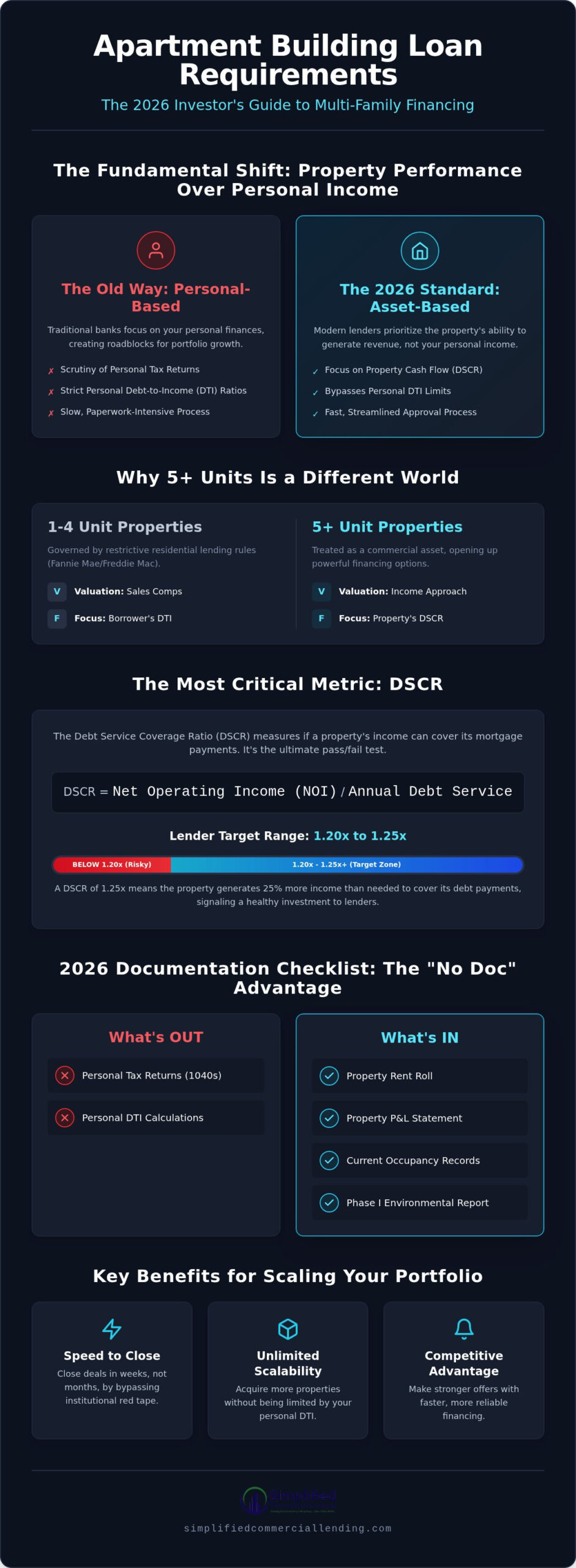
2026 Apartment Loan Documentation Checklist
Organizing your paperwork shouldn’t feel like a full-time job. In 2026, the most efficient lenders have trimmed the fat from apartment building loan requirements. You need a “Property Package” that tells the building’s story. This includes a current Rent Roll and two years of Profit and Loss (P&L) statements. You’ll also need a Personal Financial Statement (PFS). This is a simple snapshot of what you own and what you owe. It proves you have the financial stability to manage a commercial asset. If you’re buying through an LLC, have your Operating Agreement and EIN ready. Finally, include the Purchase Contract and your Property Management Plan. These documents prove you have a professional strategy, not just a property.
Gathering these items early puts you ahead of the competition. Modern underwriting is about clarity and speed. When your property package is complete and professional, lenders can move toward a commitment letter much faster. This transparency builds trust and helps you avoid the “analysis paralysis” common in traditional banking. If you want to see how your current portfolio stacks up, you can request a custom loan quote to get a clear picture of your options.
The “No Tax Return” Shortcut
Skip the personal tax return grind. While you still need the property’s financial history, you can leave your personal 1040s in the drawer. This shortcut dramatically accelerates the dscr loan requirements verification process. You aren’t being judged on your personal tax deductions. You’re being judged on the asset’s performance. The “No-Doc” advantage is the primary path to 2026 agility for the independent investor.
Third-Party Reports
Once your initial package is reviewed, the lender orders third-party reports. The Appraisal is the most significant hurdle. Unlike residential deals, commercial appraisals focus on valuation through the income approach. You’ll also need a Property Condition Assessment (PCA). This report identifies future capital expenditures, like a roof replacement or HVAC upgrades. Lenders use this to ensure the building won’t drain your cash reserves unexpectedly. Lastly, expect standard title and insurance requirements tailored for 5+ unit buildings. These are mandatory to protect everyone’s interest in the deal. These updated apartment building loan requirements ensure that the property is a safe bet for both you and the lender.
Scaling Your Portfolio with Simplified Commercial Lending
Traditional banks are built on protocol. They prioritize checking boxes over closing deals. This is where many investors stall. Simplified Commercial Lending acts as your resourceful navigator. We bypass the institutional bottlenecks that turn a standard acquisition into a six-month ordeal. By focusing on asset-based lending, we eliminate the need for global cash flow analysis and personal income verification. We don’t just offer a service; we act as an ally for the independent entrepreneur.
As a national broker, we provide access to a deep pool of non-bank capital and private equity. This isn’t just about finding a loan. It’s about finding the right structure for your specific goals. While local banks are often bogged down by regional limits and heavy paperwork, we offer a streamlined path to 5+ unit financing across the United States. We help you navigate the 2026 apartment building loan requirements without the typical bureaucratic headaches.
The Simplified Advantage
We provide direct access to products that ignore your personal debt-to-income (DTI) ratios. Our process is built for speed. While institutional banks might take over 90 days to fund a multi-family deal, we target closing times of 30 to 45 days. You get expert guidance from commercial property loan specialists who understand the nuances of asset-based underwriting. We value pragmatism over protocol, ensuring your capital is ready when you find the right property.
- Asset-First Focus: We prioritize property cash flow over your personal 1040s.
- National Reach: We serve US investors in all 50 states.
- Portfolio Leverage: We specialize in tapping equity from existing assets to fund new acquisitions.
Ready to Scale?
Scaling requires agility. You can leverage the equity in your existing portfolio to fund new apartment acquisitions. This allows you to grow without needing massive amounts of fresh liquid cash for every down payment. It’s a strategic move that turns your current assets into a launchpad for future growth. In 2026, the most successful borrowers are those who move away from rigid bank norms and embrace flexible, property-first financing.
Are you ready to see what’s possible? Submit your property for a quick DSCR analysis today. Our team will review your rent roll and P&L to provide a clear path forward. Connect with a loan officer to get a pre-approval based on your property’s performance. Let’s master the apartment building loan requirements together and get your next deal across the finish line.
Take Control of Your Multi-Family Future
The landscape of apartment lending has shifted. You no longer have to be held back by the rigid, document-heavy rules of traditional institutional banks. By focusing on property performance and asset-based underwriting, you can bypass the traps that slow down your growth. Mastering the apartment building loan requirements for 2026 is about recognizing that your building’s cash flow is your greatest leverage.
You’ve seen how DSCR targets, liquid reserves, and professional property packages unlock capital. Now it’s time to put that knowledge into action. You can move faster, skip the personal tax return grind, and close deals while your competition is still stuck in the paperwork phase. The path to a larger portfolio is open to those who prioritize agility and property-first financing.
See if your property qualifies for a No-Doc Apartment Loan today. We provide national coverage for all 50 states and closings in as little as 30 days with no personal tax returns required. Your next acquisition is ready. Let’s build your legacy together.
Frequently Asked Questions
What is the minimum down payment for an apartment building loan?
Most commercial multi-family loans require a minimum down payment of 20% to 25%. While specific mission-driven or FHA programs can allow for as little as 15% down, the 25% benchmark is the standard for market-rate acquisitions. This level of equity protects both you and the lender from market volatility. Higher down payments can also help you secure a lower interest rate by reducing the lender’s perceived risk on the deal.
Can I get an apartment loan without showing my personal tax returns?
Yes, you can absolutely secure an apartment loan without showing personal tax returns by utilizing asset-based lending programs. These specific apartment building loan requirements prioritize the property’s Net Operating Income over your personal 1040s. It’s a game-changer for independent entrepreneurs who have significant write-offs that lower their taxable income. This approach focuses on the building’s ability to cover its own debt, allowing for a much faster and less intrusive approval process.
What credit score is needed for a 5+ unit multi-family loan in 2026?
A credit score of 680 or higher is the current 2026 industry standard for 5+ unit multi-family loans. While some lenders might consider a 660 for highly profitable assets, the 680 benchmark unlocks the most competitive rates and terms. Your credit score serves as a secondary indicator of financial responsibility, giving the lender confidence that you’ll manage the property’s finances with the same care you’ve shown in your personal history.
How much liquidity do I need to keep in the bank after closing?
Lenders typically require you to maintain 6 to 12 months of debt service payments in the bank as post-closing reserves. This liquidity ensures you have a safety net to cover unexpected repairs or high vacancy periods without missing a mortgage payment. These funds must be in liquid accounts, such as cash, stocks, or bonds. It’s a non-negotiable part of the process for non-bank lenders who want to see a well-capitalized borrower.
Does the lender care about my personal debt-to-income (DTI) ratio?
Most commercial lenders don’t care about your personal debt-to-income (DTI) ratio for 5+ unit properties. Instead, they focus on the Debt Service Coverage Ratio (DSCR) of the asset itself. Since the property is viewed as a standalone commercial business, your personal monthly expenses don’t impact the underwriting. This allows you to continue scaling your portfolio even if your personal DTI would disqualify you from a traditional residential mortgage.
What is the standard DSCR requirement for apartment buildings?
The standard DSCR requirement for apartment buildings in 2026 is generally between 1.20x and 1.25x. This means the building’s net income should be 20% to 25% higher than the annual mortgage payments. While some affordable housing programs may accept a ratio as low as 1.15x, the 1.25x mark is the safest target for market-rate properties. Meeting these apartment building loan requirements proves the asset is self-sustaining and profitable.
How long does it take to close a commercial apartment loan?
Closing a commercial apartment loan with a non-bank lender typically takes 30 to 45 days. This is significantly faster than institutional banks, which often drag the process out for 90 days or more. The speed comes from a more focused underwriting process that skips the forensic accounting of your personal life. When you’re in a competitive bidding situation, the ability to close in 45 days can be your strongest negotiating tool.
Can I use a portfolio line of credit as a down payment for an apartment?
You can definitely use a portfolio line of credit to fund the down payment for a new apartment building. This strategy allows you to leverage the equity in your existing rental properties to provide the cash needed for your next acquisition. It’s a highly efficient way to scale without needing to save for a new down payment from scratch. This method keeps your capital working and accelerates your journey toward a larger portfolio.