Why are you still letting a bank’s stack of tax return requests dictate how fast you grow your multifamily portfolio? With $162 billion in multifamily loans maturing in 2026, the window for smart refinancing and new acquisitions is wide open, but only for those who can move fast. You need an apartment building loan calculator that prioritizes the property’s performance rather than your personal financial history. It’s frustrating to watch a prime deal slip away while a traditional underwriter gets bogged down in 20th-century bureaucracy.
You already know that institutional financing often feels like a hurdle race where the finish line keeps moving. You’ve likely felt the sting of slow underwriting or the headache of trying to calculate exactly how much equity you can pull from a 5+ unit asset. It’s time to stop guessing and start using data-driven tools that mirror how modern lenders actually view your deals.
We’re going to strip away that complexity and help you master the math behind multifamily financing. You’ll learn how to calculate your loan potential based on property cash flow, ensuring every deal you touch actually pencils out. This guide covers the latest 2026 DSCR requirements and predicts your monthly P&I payments so you can scale your portfolio with confidence and speed.
Key Takeaways
- Use an apartment building loan calculator to move beyond simple monthly payments and evaluate a property’s true cash flow potential.
- Learn why the Debt Service Coverage Ratio (DSCR) is the most critical metric for approval, requiring property income to exceed debt by at least 25%.
- Compare various debt structures, from interest-only options to balloon payments, to find the best fit for your 2026 investment strategy.
- Understand current Loan-to-Value (LTV) limits and how market indexes like SOFR influence your long-term multifamily ROI.
- Discover how to scale your portfolio quickly using financing solutions that prioritize property performance over personal tax returns.
Beyond the Monthly Payment: Why You Need an Apartment Building Loan Calculator
An apartment building loan calculator is more than a simple math tool. It’s your first line of defense against a bad investment. While a residential calculator tells you if you can afford a house, a commercial tool tells you if the property can afford itself. This is the fundamental shift in “penciling a deal.” You aren’t just looking for a monthly payment. You’re looking for a spread between income and debt that justifies the risk of a 5+ unit asset. In the 2026 market, where interest rates and occupancy levels are shifting, guessing is a recipe for disaster. You need to know your numbers before you ever step foot in a bank or talk to a broker.
Commercial lending is a different beast entirely. It’s less about your personal tax returns and more about the property’s performance. Traditional banks might get bogged down in your personal history, but savvy investors use an apartment building loan calculator to prove the deal’s merit. If the building doesn’t generate enough cash to cover the mortgage and expenses with room to spare, the loan won’t happen. By mastering these calculations early, you position yourself as a professional who understands the mechanics of wealth, not just someone looking for a loan.
Why Multifamily Math Differs from Single-Family
If you’re moving from house flipping or single-family rentals into the 5+ unit space, prepare for a change in perspective. Lenders for multi family residential investment loans prioritize the rent roll over your W-2. Why does this happen? Because the property is the primary source of repayment. In the commercial world, value is a direct function of Net Operating Income (NOI). If you increase the rent or decrease expenses, the building’s value climbs. Your personal credit still matters, but the building’s ability to generate cash is the star of the show. This allows you to scale much faster than you ever could with traditional residential mortgages.
The Role of Amortization in Your Cash Flow
Most investors start with a 30-year mindset. In multifamily, a 25-year amortization is equally common. A shorter schedule means higher monthly payments but faster equity growth. You also need to prepare for the structure of a Commercial mortgage, which often includes balloon payments. Unlike a standard home loan, these don’t always stay in place for 30 years. They usually have a 5, 7, or 10-year term where the remaining balance becomes due. A reliable calculator helps you plan for that “exit” or refinance date long before it arrives. It’s about seeing the full lifecycle of the debt, not just next month’s bill.
The Math of Multifamily: Key Variables That Determine Your Loan Amount
Plugging numbers into an apartment building loan calculator is the first step toward a successful closing. However, the output is only as reliable as the data you provide. In the 2026 lending environment, lenders have shifted their focus toward tighter risk management. You’ll find that Loan-to-Value (LTV) ratios generally hit a ceiling between 75% and 80%. This means you need more skin in the game than you might have required a few years ago. Lenders use this buffer to protect themselves against market volatility, making your equity contribution a critical part of the equation.
Interest rates also play a starring role in your debt service. Most non-bank and commercial lenders now peg their rates to indexes like the Secured Overnight Financing Rate (SOFR). Because these indexes can fluctuate, your monthly payment might look different depending on the day you lock your rate. Understanding various multifamily loan options helps you decide whether a fixed-rate or adjustable-rate structure fits your long-term strategy. If you’re ready to see how these variables apply to your specific project, you can explore customized financing options that bypass traditional bank hurdles.
Understanding Interest-Only (IO) Periods
Interest-only periods are a powerful tool for investors, especially in value-add scenarios. By paying only the interest for the first two to five years, you maximize your monthly cash flow while you renovate units or raise rents. When the IO period ends, your payment will jump as principal begins to amortize. You must use your calculator to model this “payment shock” to ensure the property’s increased income can handle the full P&I load. IO periods aren’t just about lower payments; they’re about strategic capital allocation during the most critical phase of your investment.
The Impact of Vacancy and Reserves
Lenders never take your gross potential income at face value. They apply a “haircut,” typically between 5% and 10%, to account for vacancy and credit loss. Even if your building is 100% occupied today, the bank assumes someone will eventually move out or fail to pay. Additionally, they’ll factor in replacement reserves, which is money set aside for big-ticket items like roofs or HVAC systems. These subtractions happen before the lender calculates what you can borrow. Net Operating Income is Gross Income minus Operating Expenses. By accounting for these “hidden” costs in your apartment building loan calculator, you’ll get a realistic view of your borrowing power before a lender even looks at your file.
Comparing Loan Structures: Amortization, Balloon Payments, and Interest-Only Options
Traditional banks love their red tape. They’ll ask for three years of personal tax returns and then take 60 days to tell you “no.” If you want to scale in 2026, you need a faster path. Non-bank commercial property loans offer the speed and flexibility that institutional lenders lack. These lenders focus on the asset’s ability to generate revenue. This shift in perspective allows you to secure financing based on the property’s current and projected performance rather than your personal debt-to-income ratio. It’s the difference between a partner who wants to see you grow and a bureaucrat who only sees risk.
Your choice of structure depends on your hold period. Permanent financing is great for long-term stability, but bridge loans are the better tool for properties needing immediate renovation. A bridge loan provides the capital to fix up a building, raise the rents, and then refinance into a lower-rate permanent loan. Use your apartment building loan calculator to compare these paths. Modeling the cost of short-term debt against the eventual “forced appreciation” of the property helps you decide if the extra interest is worth the potential equity gain.
Fixed-Rate vs. Hybrid Terms
Most apartment loans don’t stay fixed for 30 years. You’ll likely encounter hybrid structures like 5/1 or 7/1 ARMs. These offer a fixed rate for the first few years before adjusting annually. This is where you must stress-test your deal. Use an apartment building loan calculator to see what happens if rates climb by 2% at the end of the fixed period. If the property still cash flows, you’ve got a winner. A pro tip for calculating your “break-even” rate: slowly increase the interest rate in your model until the monthly income just barely covers the debt. That’s your safety ceiling.
The Reality of Balloon Payments
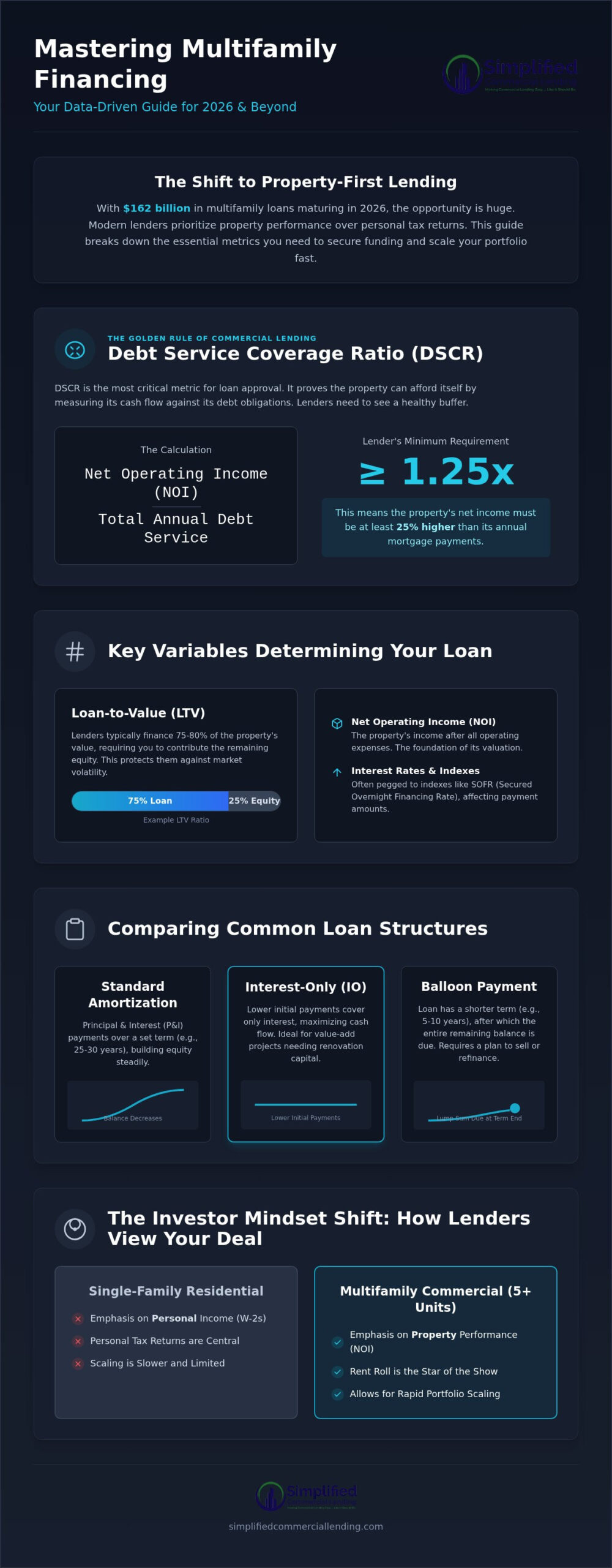
Don’t expect a “set it and forget it” mortgage. Most multifamily debt features a balloon payment, meaning the entire balance is due at the end of a 5, 7, or 10-year term. With a massive $162 billion in multifamily loans maturing in 2026 alone, having a clear exit strategy is mandatory. You must track your dscr loan requirements carefully to ensure you can refinance when the time comes. Lenders will look at your Debt Service Coverage Ratio (DSCR) to decide if you qualify for a new loan. If your property’s income has grown, you can often pull out equity during this refinance to fund your next acquisition.
Calculating DSCR: The Golden Rule for Apartment Financing
If you want to know what a lender really thinks of your deal, look at the Debt Service Coverage Ratio (DSCR). This isn’t just a number; it’s the heartbeat of your investment. While personal credit scores still matter, the DSCR determines if the property can stand on its own two feet. In the 2026 market, lenders typically look for a minimum DSCR between 1.20x and 1.25x. This means for every dollar of mortgage payment, the property needs to generate at least $1.25 in net income. That 25% cushion protects everyone if rents dip or expenses spike. It’s the ultimate safety net for multifamily debt.
An apartment building loan calculator allows you to reverse-engineer your success. Instead of asking “How much can I get?”, you input your property’s income and let the math tell you the maximum loan amount that hits the lender’s required ratio. This shift in strategy puts you in control. You stop begging for approval and start presenting a business case that makes sense. By the time you speak to a broker, you already know if the deal pencils out. You’re no longer guessing; you’re executing a plan based on hard data.
Step-by-Step DSCR Calculation
Calculating this ratio is straightforward once you have your property data ready. Follow these steps to verify your loan potential:
- Step 1: Determine your Annual Net Operating Income (NOI). This is your total annual rent minus all operating expenses like taxes, insurance, and management.
- Step 2: Calculate the Annual Debt Service. This is the total of your principal and interest payments for the full year.
- Step 3: Divide NOI by Annual Debt Service. For example, if your NOI is $125,000 and your debt is $100,000, your ratio is exactly 1.25x.
- Step 4: Adjust the loan amount. If your ratio is below 1.20x, you’ll need to lower the loan amount in your calculator until you hit the required benchmark.
Why DSCR Beats Tax Returns for Scaling
Scaling a portfolio requires speed and flexibility. Traditional banks kill momentum by digging through years of personal tax returns and W-2s. DSCR lending focuses on the asset’s performance instead of your personal income history. It’s a “no-doc” approach that prioritizes property cash flow over personal bureaucracy. DSCR lending turns your property into the primary borrower, freeing you from the constraints of personal debt-to-income ratios. When you use an apartment building loan calculator to verify your ratio upfront, you slash underwriting time. You can close faster and move on to the next deal while your competitors are still scanning old tax documents.
Ready to see how your property stacks up? Calculate your loan potential today and skip the bank bureaucracy to grow your portfolio faster.
Secure Your Next 5+ Unit Deal with Simplified Commercial Lending
You’ve done the math. You’ve spent time with the apartment building loan calculator to see what’s possible. Now you need a partner who moves as fast as you do. Simplified Commercial Lending is built for the independent entrepreneur who is tired of the traditional banking runaround. We don’t care about your personal tax returns from three years ago. We care about the property you’re buying today. By focusing on property cash flow, we remove the documentation bottlenecks that kill momentum and let you focus on what matters: closing the deal.
Our “No Tax Return” advantage is a game-changer for multifamily residential investment loans. It means less time scanning files and more time hunting for your next asset. We provide national coverage across the United States, financing diverse commercial assets with a focus on 5+ unit buildings. Whether you’re looking to acquire a new complex or refinance a maturing loan in the 2026 market, our process is designed for speed and pragmatism. We move from your initial calculation to a funded loan with a streamlined underwriting process that respects your time.
Leverage Your Equity to Scale
Scaling a portfolio isn’t just about buying new properties; it’s about using the assets you already own. If you have equity sitting idle in your current buildings, you’re missing out on growth. A portfolio line of credit for rentals allows you to tap into that value without the hassle of a traditional bank refinance. You can calculate your “cash-out” potential to see exactly how much capital you can deploy for your next acquisition. Working with a broker who understands the independent entrepreneur mindset means you get creative solutions that institutional lenders simply can’t offer.
Ready to Move Beyond the Calculator?
An apartment building loan calculator is a great starting point, but it can’t capture every nuance of your specific deal. Every building has a story, and every market has its own quirks. It’s time to get a professional sizing of your deal to see the exact terms you qualify for. You can expect simple, direct communication and a team that values results over protocol. We don’t hide behind dense legalese or slow committees. We provide the leverage you need to dominate the multifamily space in 2026. Get your apartment loan quote today and take the next step toward a larger, more profitable portfolio.
Take Control of Your Multifamily Growth in 2026
The 2026 market belongs to the proactive investor. You now have the tools to evaluate deals with the same precision as a professional underwriter. By mastering the apartment building loan calculator, you’ve learned to prioritize property cash flow and Debt Service Coverage Ratios over personal financial hurdles. You don’t have to stay stuck in a bank’s slow underwriting queue anymore.
We provide a streamlined path that bypasses traditional bureaucracy. Our DSCR-based underwriting focuses on the asset’s performance, which means no tax returns are required for many of our products. With national 50-state coverage, you can scale your portfolio across the country with total confidence. It’s time to stop letting paperwork slow down your progress and start focusing on your ROI.
Get a No-Doc Apartment Loan Quote Now
Your next 5+ unit deal is waiting. Stop guessing and start funding your future today. You’ve got the math; now get the leverage you deserve to build a lasting legacy.
Frequently Asked Questions
What is the typical down payment for an apartment building loan in 2026?
You should expect a down payment of 20% to 25% for most multifamily deals in 2026. Most commercial lenders cap their Loan-to-Value (LTV) at 75% or 80% to ensure there’s enough equity in the deal. If you use an apartment building loan calculator, you’ll see how a larger down payment improves your DSCR. While some government programs offer higher leverage, private lenders prefer this 20% equity stake to protect against market shifts.
Can I get an apartment building loan without showing my personal tax returns?
Yes, you can secure financing using no-doc or DSCR-based loans that prioritize property income over personal history. These programs focus on the asset’s ability to cover the debt rather than your personal tax returns. It’s a faster way to scale because it bypasses traditional bank bureaucracy. You’ll just need to provide the building’s current rent roll and historical expenses. This approach allows you to grow your portfolio without exposing every detail of your personal finances.
How does a balloon payment work on a 10-year multifamily loan?
A balloon payment means your loan balance isn’t fully paid off by the end of the term. Even if your payments are calculated on a 25-year schedule, the remaining principal becomes due in full at the 10-year mark. You’ll typically refinance into a new loan or sell the property before that date. It’s a standard feature in commercial debt that keeps lenders’ risk windows manageable while offering you lower monthly payments during the term.
What is a good DSCR ratio for an apartment building investment?
A DSCR of 1.25x is the standard benchmark for most commercial lenders in 2026. This means the property earns 25% more than the annual mortgage payment. Some flexible programs might go down to 1.20x for strong assets in high-demand markets. If your calculations show a ratio below 1.20x, you may need to increase your down payment or find ways to boost the property’s income to qualify for the loan amount you want.
Does the calculator include property taxes and insurance in the monthly payment?
A basic apartment building loan calculator often only shows Principal and Interest (P&I), but professional sizing must include taxes and insurance. These are critical operating expenses that directly reduce your Net Operating Income. Lenders always factor these costs in before calculating your final DSCR. Ensure you’ve subtracted these annual costs from your gross income to get a realistic view of your borrowing power. Including these figures prevents surprises during the formal underwriting process.
Can I use the equity in my current apartment building to buy another one?
You can use a portfolio line of credit or a cash-out refinance to tap into your existing equity. This is the most efficient way for independent entrepreneurs to scale their portfolios quickly in 2026. By pulling out capital from an appreciated asset, you can fund the down payment on your next 5+ unit deal. It turns your current property’s success into the engine for your next acquisition without requiring additional out-of-pocket cash from your personal accounts.
What is the difference between a bridge loan and a permanent apartment loan?
A bridge loan is a short-term solution, usually 12 to 36 months, used for properties that need immediate renovation or stabilization. It provides the speed to close quickly before you move into permanent financing. Permanent loans are long-term debt, often 5 to 10 years, with more stable interest rates. You use the bridge to get across to a point where the property is fully occupied and qualifies for better, long-term commercial terms.
How long does it typically take to close a no-doc multifamily loan?
You can typically close a no-doc multifamily loan in 30 to 45 days. Because these loans don’t require the exhaustive review of personal tax returns, the underwriting process is significantly faster than a traditional bank. The timeline mostly depends on how quickly the third-party reports, like appraisals and environmental studies, are completed. It’s the ideal choice when you need to meet a tight closing deadline or want to beat out competitors on a deal.