Your personal tax returns shouldn’t dictate whether a profitable hospitality asset gets funded. Yet, if you’ve approached traditional banks recently, you already know the drill: sluggish loan committees, endless document checklists, and strict covenants that treat hotels like liabilities. Securing commercial hotel financing shouldn’t require jumping through bureaucratic hoops that ignore your asset’s real earning potential.
You understand your property’s daily operations, revenue metrics, and operating margins better than an underwriter analyzing two-year-old personal filings. It’s frustrating when conventional institutions stall viable acquisitions or refinances because they misunderstand hospitality cash flow.
You don’t have to stay stuck in that cycle. In this guide, you’ll discover how to secure commercial hotel financing in 2026 using asset-based non-bank debt that evaluates property performance rather than personal tax returns. We examine modern debt structures, outline how forward-thinking lenders evaluate hospitality cash flow, and show you how to close complex commercial property loans efficiently.
Key Takeaways
- Understand how modern commercial hotel financing evaluates hybrid operational cash flow rather than relying on outdated lending frameworks.
- Discover how lenders use key performance metrics like RevPAR, ADR, and DSCR to determine property-level debt capacity.
- Bypass exhausting personal tax return scrutiny and committee delays by leveraging asset-based non-bank debt structures.
- Follow a practical five-step blueprint to organize historical operating statements and move efficiently from submission to closing.
- Partner with specialized commercial lenders capable of delivering agile, asset-focused capital solutions across the nation.
Understanding Commercial Hotel Financing in 2026
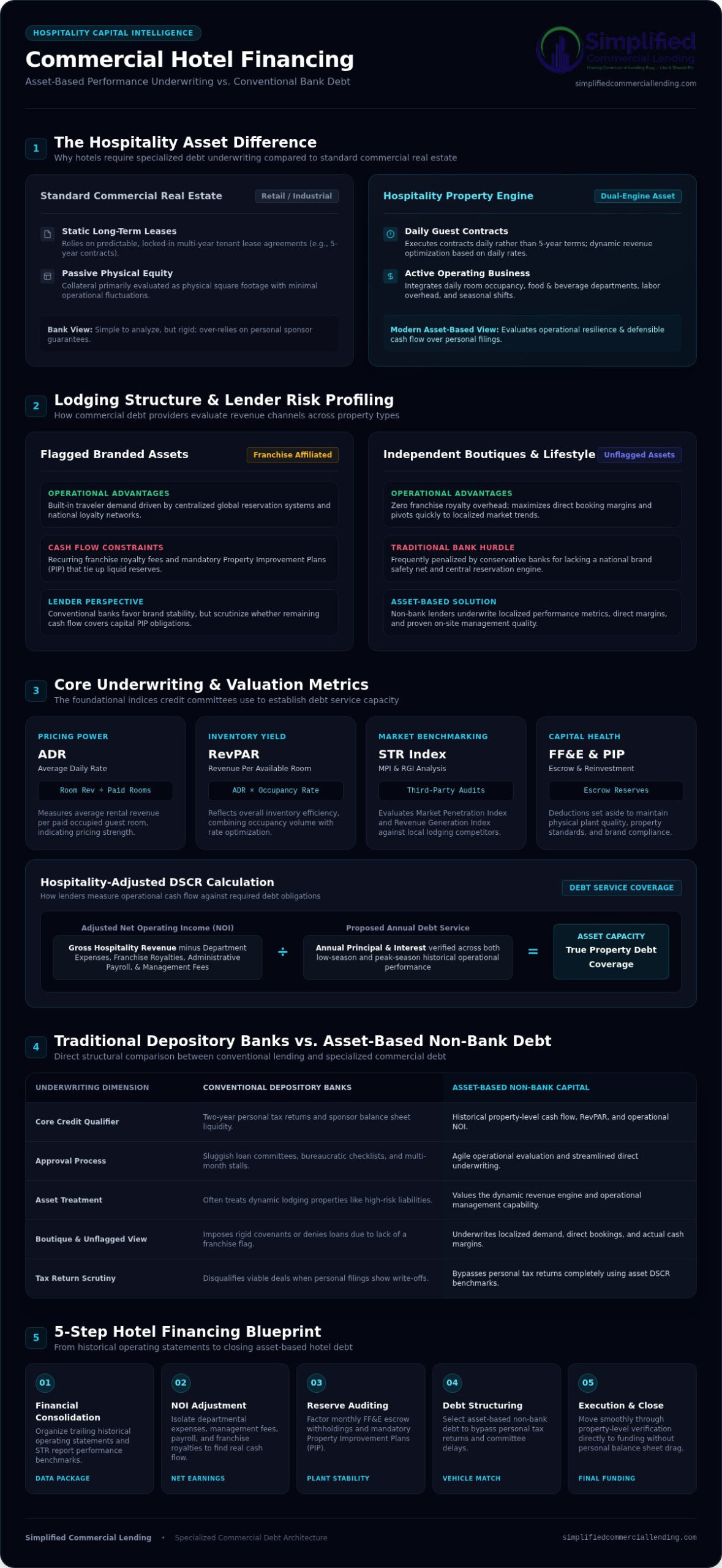
Commercial hotel financing differs fundamentally from standard commercial real estate debt. Hospitality properties don’t rely on predictable five-year leases; they execute daily contracts with guests. Securing commercial hotel financing requires lenders to analyze operational resilience, looking past passive brick-and-mortar equity to see if the property generates consistent, defensible cash flow.
The Hybrid Nature of Hospitality Real Estate Debt
Hospitality properties are dual-engine assets. You aren’t just financing physical square footage; you’re funding an active operating enterprise. Academic programs like the Nolan School of Hotel Administration have long analyzed how daily occupancy, food and beverage operations, and labor overhead create a dynamic financial ecosystem.
Standard commercial loans for retail strip centers or industrial warehouses rely on static tenant leases. In contrast, hotel debt depends entirely on daily revenue optimization and expense management. This daily fluctuation causes conservative depository banks to impose rigid debt covenants and demand exhaustive personal tax disclosures. Agile non-bank lenders take a different approach. By focusing on commercial property loans that evaluate property-level net cash flow, they underwrite the asset’s true operational strength instead of the sponsor’s personal balance sheet.
Flagged vs. Independent Boutique Hotels: How Lenders View Risk
A lender’s risk assessment depends heavily on how your lodging asset drives its revenue:
- Flagged Branded Assets: Properties tied to national franchise systems bring built-in demand through central reservation systems and loyalty networks. Conventional lenders prefer this perceived stability, but franchise fees and mandated property improvement plans can severely constrain working capital.
- Independent Boutiques and Lifestyle Properties: Unflagged hotels avoid royalty fees and adapt quickly to local market trends. While traditional banks often penalize independent assets for lacking a brand safety net, asset-based commercial lenders evaluate localized performance metrics, direct booking margins, and operational leadership to structure competitive debt.
Core Hotel Underwriting Metrics: RevPAR, ADR, and DSCR
Traditional banks often stumble when underwriting lodging deals because they treat balance sheets like standard commercial leases. In contrast, modern commercial hotel financing evaluates performance using specialized hospitality benchmarks. Underwriters dissect operational data to confirm your property maintains healthy cash flow through seasonal shifts and broader economic cycles.
Deconstructing ADR and RevPAR for Lenders
Hotel lenders rely on two foundational indices to evaluate top-line strength: Average Daily Rate (ADR) and Revenue Per Available Room (RevPAR). While ADR measures average rental income per paid occupied room, RevPAR multiplies that rate by overall occupancy to show total inventory yield. Understanding the basics of revenue management helps you present these metrics effectively. Credit teams examine third-party Smith Travel Research (STR) reports to review your Market Penetration Index (MPI) and Revenue Generation Index (RGI), verifying that your property consistently captures its fair share of local lodging demand.
Hospitality-Adjusted Debt Service Coverage Ratio (DSCR)
Debt service calculations for hotels account for unique operational overhead. Net Operating Income (NOI) is derived only after deducting department expenses, franchise royalties, administrative payroll, and professional management fees. Underwriters then divide this adjusted NOI by the proposed annual principal and interest payments to establish coverage.
Because occupancy fluctuates throughout the year, capital providers verify that historical cash flow covers debt service across low and high seasons alike. Reviewing standard dscr loan requirements provides insight into how commercial lenders measure property earnings against debt obligations without relying on your personal tax filings.
FF&E Reserves and Property Improvement Plans (PIP)
Physical plant quality directly impacts operational earnings. Lenders factor ongoing capital reinvestment into their risk models through two specific mechanisms:
- FF&E Escrow Accounts: Underwriters typically mandate ongoing reserves, often set aside monthly from gross revenues, to fund future replacements of furniture, fixtures, and equipment.
- Mandatory Brand PIPs: For flagged properties, lenders review franchise inspection reports to size renovation escrows directly into your loan structure, ensuring guest rooms and public spaces meet updated brand standards.
If you need capital structured around your property’s actual performance rather than rigid personal income rules, partnering with Simplified Commercial Lending gives you access to flexible debt advisory tailored to complex hospitality assets.
Comparing Capital Vehicles: Traditional Banks vs. Non-Bank Commercial Debt
Choosing the right capital partner determines how quickly you scale. When securing commercial hotel financing, you face a clear choice: wait on slow depository institutions or partner with agile non-bank lenders. Each vehicle treats underwriting, documentation, and sponsor equity with fundamentally different priorities.
Conventional Bank and Depository Institution Constraints
Traditional banks operate under rigid institutional layers and geographic lending quotas. They typically demand several years of personal tax returns, audited business filings, and extensive global debt coverage calculations. If your tax strategy maximizes depreciation and operational write-offs, conventional underwriters often penalize your borrowing capacity. Slow loan committees meet infrequently, stretching timelines for months while competitive acquisition opportunities slip away.
Non-Bank Commercial Loans and Asset-Based Structures
Non-bank lenders prioritize the hotel’s revenue profile over your personal tax returns. By assessing property-level net cash flow, these capital sources evaluate operational health without dragging personal wealth into the equation.
- Asset-Focused Underwriting: Approvals center on trailing twelve-month performance and property income instead of personal tax returns.
- Execution Speed: Streamlined credit decisions eliminate corporate committee delays, allowing you to secure deals quickly.
- Non-Recourse Availability: Non-bank structures frequently offer non-recourse terms to protect your personal assets.
Securing an agile commercial property loan helps you avoid the bureaucratic hurdles that routinely stall bank applications, giving you the flexibility to acquire or refinance hospitality real estate on your schedule.
Mezzanine Debt and Preferred Equity in the Capital Stack
What happens when senior lenders cap their leverage parameters? Mezzanine debt and preferred equity fill the capital gap without forcing you to surrender operational control. Mezzanine loans sit directly behind senior debt, secured by ownership pledges in the borrowing entity rather than a primary real estate mortgage. An experienced non-bank debt advisor coordinates these junior positions with primary lienholders under clean intercreditor agreements, completing your capital stack while keeping your equity intact.
Step-by-Step Guide: How to Secure Commercial Hotel Financing
Securing commercial hotel financing doesn’t have to turn into an administrative slog. By following a structured process, you can move efficiently from initial evaluation to the closing table without getting bogged down by institutional red tape.
- Step 1: Organize Financial Records. Gather your trailing twelve-month (T12) operating statements, balance sheets, and historical profit-and-loss reports. Underwriters want transparent insight into revenue line items and operational overhead.
- Step 2: Pull Independent Market Data. Secure recent STR reports and independent market studies. Showing local occupancy trends, ADR stability, and market share proves property viability immediately.
- Step 3: Define Total Capital Needs. Clarify your exact capital allocation upfront. Account for purchase price or payoff amounts alongside PIP reserves, FF&E improvements, and working capital cushions.
- Step 4: Run a Nationwide Debt RFP. Work with an experienced commercial brokerage to present your debt request across nationwide non-bank capital sources, securing competitive terms based strictly on property performance.
- Step 5: Finalize Due Diligence and Closing. Coordinate the commercial appraisal, Phase I environmental review, and property condition reports to execute final loan documents efficiently.
Structuring the Hotel Loan Submission Package
A well-prepared loan package speeds up credit decisions. Credit teams want to see that your property runs smoothly and that you have competent operational leadership. Include trailing three-year financial audits if available, detailed capital expenditure schedules, and copies of professional third-party management agreements. Demonstrating ongoing facility upkeep assures lenders that revenue won’t be disrupted by deferred maintenance.
Leveraging Existing Equity Across Commercial Portfolios
Need liquidity for a large acquisition down payment or a franchise-mandated PIP? You don’t have to sell profitable properties to raise equity. Many smart hospitality operators unlock liquidity across existing rental portfolios using asset-based debt solutions.
Securing a portfolio line of credit for rentals allows you to pull working capital from performing residential or multi-family properties without submitting personal tax returns. This cross-collateralization strategy keeps your revenue-generating portfolio intact while providing the required cash injection for your hotel transaction.
Ready to structure your next acquisition? Apply for commercial hotel financing today to connect with lenders that underwrite property cash flow instead of your personal balance sheet.
Strategic Hotel Debt Solutions: Why Work with Simplified Commercial Lending
Scaling a hospitality portfolio shouldn’t be derailed by legacy banking rules. Commercial hotel financing works best when your debt partner operates with the same speed and pragmatism as your investment team. Simplified Commercial Lending serves as a nationwide commercial mortgage brokerage dedicated to eliminating conventional financing roadblocks through agile, non-bank capital solutions.
Property Cash Flow Underwriting Without Personal Tax Returns
Traditional banks frequently stall viable acquisitions because of aggressive tax write-offs on your personal filings. If you leverage depreciation across existing assets, conventional underwriters often conclude you don’t qualify for new debt. We reject that outdated standard.
Our asset-based underwriting looks directly at property performance. By evaluating hotel net operating income, historical occupancy, and daily operational margins, we verify debt capacity without requiring personal tax returns. This structure frees active entrepreneurs from artificial personal borrowing ceilings. It also accelerates your transaction timeline, replacing endless corporate committee reviews with straightforward, asset-focused credit approvals.
Nationwide Reach with Diverse Commercial Debt Structures
Every lodging deal presents unique operational demands. A stabilized flag requires a different capital structure than a boutique property undergoing a comprehensive room renovation. We deliver tailored debt options across the United States to support your specific investment strategy:
- Senior Debt Placement: Customized commercial property loans secured directly by real estate cash flow.
- Mezzanine Capital: Subordinated debt layers designed to optimize leverage parameters without diluting your operating equity.
- Flexible Working Capital: Cross-collateralized credit facilities designed to release equity from existing real estate assets.
Whether you’re executing a rapid acquisition, repositioning an underperforming hotel, or completing a recapitalization, having an agile capital partner makes all the difference. Stop letting slow depository lenders dictate your timeline. Apply for Commercial Hotel Financing with Simplified Commercial Lending to fund your next hospitality transaction with speed and confidence.
Scale Your Hospitality Portfolio with Agile Capital
Traditional banking bottlenecks don’t have to dictate the pace of your expansion. When securing commercial hotel financing, your property’s operational strength should lead the conversation. By evaluating deals through real-world lodging metrics like RevPAR, ADR, and property-adjusted DSCR, you can unlock debt structures tailored to how hotels actually generate income.
Simplified Commercial Lending provides a nationwide commercial mortgage network designed for forward-thinking investors. We underwrite property net cash flow directly, eliminating the need for personal tax returns and avoiding sluggish committee delays. Whether you need senior debt for an acquisition or flexible portfolio lines of credit to extract equity from existing assets, we provide the tools to scale efficiently.
Take charge of your capital strategy. Connect with Simplified Commercial Lending to finance your commercial hotel property today and move forward with total confidence.
Frequently Asked Questions
What is commercial hotel financing and how does it differ from standard commercial real estate loans?
Commercial hotel financing is specialized commercial debt tailored for lodging properties where revenue stems from daily guest bookings rather than long-term leases. Standard commercial mortgages rely on predictable, multi-year tenant rent rolls. Hotel financing accounts for dynamic daily rates, fluctuating seasonal occupancy, and hospitality labor overhead, requiring underwriters to evaluate active operational performance alongside the underlying real estate value.
Can I secure hotel financing without providing personal income tax returns?
Yes, you can secure hotel loans using asset-based non-bank debt that eliminates personal tax return requirements. Instead of scrutinizing your personal write-offs, depreciation deductions, or outside business filings, asset-focused commercial lenders qualify the deal based on property-level cash flow. This keeps the approval process focused directly on the hotel’s operational ability to service debt.
What debt service coverage ratio (DSCR) do lenders require for hotel properties?
Most commercial lenders look for a debt service coverage ratio between 1.25x and 1.40x for lodging assets. Because hotels experience seasonal shifts, underwriters analyze trailing twelve-month operational performance. They calculate net operating income after deducting operating costs, franchise royalty fees, administrative expenses, and ongoing capital reserves to verify reliable debt coverage year-round.
How do lenders evaluate independent boutique hotels compared to flagged franchise properties?
Lenders view flagged hotels as lower operational risks because national franchise networks provide centralized reservation systems and loyalty member traffic. Independent boutique properties lack this brand umbrella, so underwriters examine local market penetration indices, direct booking histories, and management track records. Agile non-bank lenders evaluate localized cash flow strength to structure debt without penalizing unflagged assets.
Can equity from an existing residential or multi-family rental portfolio be used to buy a hotel?
Yes, you can leverage equity across an existing residential or multi-family rental portfolio to fund your hotel acquisition equity. By securing a portfolio line of credit, you unlock liquidity from performing rental properties without selling them. These facilities evaluate portfolio cash flow rather than personal tax returns, providing rapid liquidity for your hospitality down payment.
What are the main costs included in a hotel loan beyond the real estate purchase price?
Beyond the primary real estate purchase price, commercial hotel financing packages frequently fund brand-mandated Property Improvement Plans (PIPs) and initial operating escrows. Underwriters also structure loan proceeds to cover Furniture, Fixtures, and Equipment (FF&E) reserve requirements, third-party feasibility studies, environmental reviews, and working capital buffers to support operations during seasonal occupancy swings.
How long does it typically take to close a commercial loan on a hotel asset?
Closing a commercial hotel loan generally takes between 45 and 90 days, depending largely on your chosen capital source. Traditional depository institutions often stretch past 90 days due to bureaucratic loan committees and exhaustive personal balance sheet audits. Working with non-bank commercial lenders shortens closing timelines because underwriting focuses on property performance and third-party inspection reports.