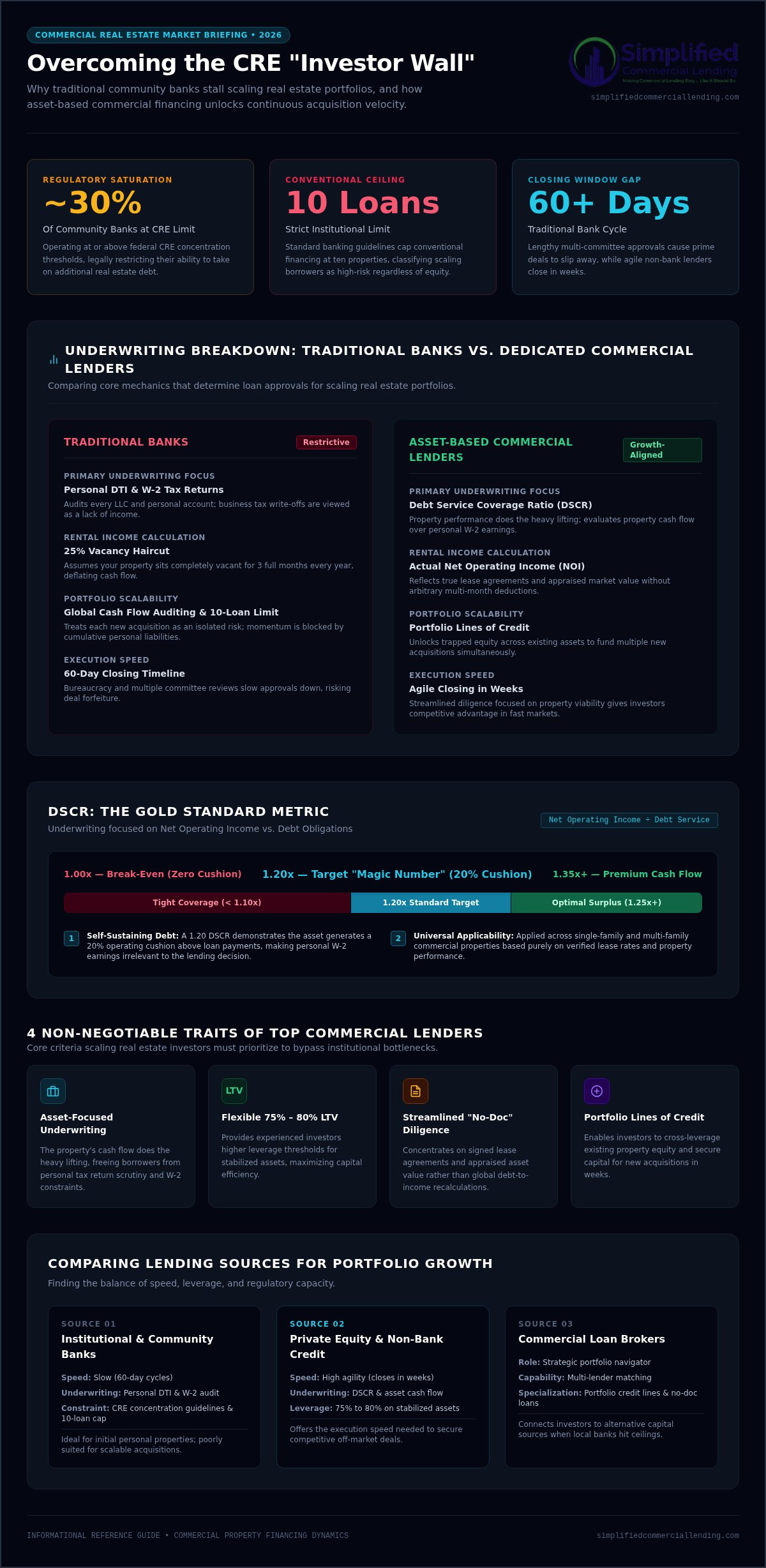
Your local bank isn’t just being difficult; they’re hitting regulatory walls that make scaling your portfolio nearly impossible. With approximately 30% of community banks operating at or above federal CRE concentration thresholds, the best commercial lenders for investors are no longer found on the high street. You’ve likely felt the frustration of a loan denial based on personal debt-to-income ratios, even when the asset itself is a cash-flow machine. It’s exhausting to provide endless documentation only to watch a prime deal slip away due to a 60-day closing window.
Scaling in 2026 requires a partner who prioritizes property performance over your personal tax returns. You can stop acting like a traditional borrower and start acting like a savvy partner with lenders who value Debt Service Coverage Ratio (DSCR) and speed. This guide breaks down how to identify these disruptive financing sources so you can secure portfolio lines of credit and close on new assets in weeks. We’ll explore the shift toward private credit and show you exactly how to bypass the bureaucracy that’s holding your growth back.
Key Takeaways
- Discover why traditional banks stop lending to scaling investors and how to bypass the “investor wall” caused by rigid debt-to-income limits.
- Identify the best commercial lenders for investors by prioritizing asset-based underwriting that values property cash flow over personal tax returns.
- Learn how to use DSCR loans to secure financing for single-family and multi-family properties based on their net operating income rather than your personal income.
- Compare institutional banks, private equity, and brokers to find the right balance of speed, leverage, and cost for your specific investment strategy.
- Unlock the power of a portfolio line of credit to tap into your existing equity and fund new acquisitions in weeks instead of months.
Why Traditional Banks Often Fail Scaling Real Estate Investors
You’ve likely hit the “Investor Wall.” It’s that frustrating moment when a bank officer tells you your debt-to-income (DTI) ratio is too high, despite your properties being profitable. Banks focus on your personal tax returns. They see your aggressive business write-offs as a lack of income. This trap penalizes you for being a smart business owner. Currently, about 30% of community banks are operating at or above federal CRE concentration thresholds. They aren’t just being picky; they’re legally restricted from taking on more real estate debt. If you want to grow, you need the best commercial lenders for investors who look at the deal, not just your W-2.
The reality is that traditional institutions aren’t built for the professional scale. They prioritize global cash flow, meaning they audit every LLC and personal account you own. This creates a documentation nightmare that slows down your momentum. When you optimize your taxes, you inadvertently kill your borrowing power at the local branch. Professional investors are shifting toward asset-based lending to bypass these rigid, outdated institutional norms.
The Limitations of Personal Income Underwriting
Banks view your rental income through a lens of extreme caution. They often apply a 25% vacancy haircut to your gross rents. This move assumes your property stays empty for three months every year, which artificially deflates your actual cash flow. Your W-2 income shouldn’t dictate your ability to buy a multi-family complex, but banks disagree. They also enforce a strict 10-loan limit for conventional financing. Once you hit that ceiling, you’re considered a high-risk liability regardless of your equity. Scaling requires understanding commercial mortgage underwriting metrics that focus on the asset’s performance rather than your personal history.
The Speed Gap in Commercial Real Estate
The market moves fast. A 60-day closing cycle is a deal-killer in a competitive environment. Institutional bureaucracy involves multiple committees and exhaustive documentation that can stretch for months. Private equity and non-bank lenders offer agility that banks can’t match. When you’re bidding on a multi-family asset or a commercial property, your reputation with brokers depends on your ability to close quickly. A “no-doc” approach doesn’t mean skipping diligence; it means the lender focuses on the property’s potential. The best commercial lenders for investors provide the speed needed to secure deals before they hit the open market. This speed is a competitive advantage that traditional banks simply cannot provide.
5 Non-Negotiable Traits of the Best Commercial Lenders
The best commercial lenders for investors don’t just offer capital; they provide a framework for rapid growth. Searching for the lowest interest rate is a common mistake that often leads to a dead end. You need a partner who understands the mechanics of a scaling portfolio. Traditional banks are often handcuffed by commercial real estate concentration guidelines, which force them to limit their exposure to active investors regardless of how strong a deal looks. To bypass these institutional bottlenecks, look for these four core traits:
- Asset-focused underwriting: The property’s cash flow should do the heavy lifting, not your personal tax returns.
- Flexible LTV thresholds: Experienced investors should have access to higher leverage, often reaching 75% to 80% for stabilized assets.
- Streamlined documentation: A true “No Doc” commercial loan focuses on the lease agreements and appraisal rather than your global debt-to-income ratio.
- Portfolio-wide solutions: Look for lenders who offer portfolio lines of credit to help you tap into existing equity for new acquisitions.
If your current lender treats every new application like it’s your first, they are slowing you down. You need a navigator who sees the big picture of your investment strategy. If you’re ready to move past local bank limits, consider exploring flexible commercial property loans that prioritize your growth.
Underwriting Based on DSCR (Debt Service Coverage Ratio)
DSCR is the gold standard for 2026 investor lending. This metric ensures the property generates enough income to cover its own debt obligations comfortably. A 1.20 DSCR is widely considered the “magic number” for most top lenders. It represents a 20% cushion over the mortgage payment, which provides safety for the lender and stability for you. When evaluating short-term rentals, the best commercial lenders for investors use specialized market analytics and actual host history. They don’t just default to standard long-term market rents, which often undervalue the true potential of a high-performing vacation asset.
Flexibility and Closing Speed
Speed is a currency in commercial real estate. You need to know if your lender has true in-house decision-making power. If a loan has to go through a regional credit committee that meets once a month, you’ll lose your earnest money and the deal. Transparent fee structures are equally critical. There should be no surprise junk fees or hidden points appearing at the closing table. Finally, national reach is a major advantage. As you diversify across state lines to find better cap rates, having one lender who can follow you into any market simplifies your entire operation. This consistency allows you to build a reliable reputation with commercial brokers nationwide.
Comparing Lending Sources: Banks vs. Private Equity vs. Brokers
Finding the best commercial lenders for investors requires looking beyond the bank on the corner. You have four primary paths, each with distinct trade-offs. Institutional banks are excellent for low-leverage, long-term holds where you don’t mind providing years of tax returns. They often facilitate the SBA 504 loan program, which is a powerful tool for owner-occupied assets but less flexible for pure investment plays. Conversely, private money and hard money lenders prioritize speed for fix-and-flips. They fund immediate bridge needs when a property isn’t yet stabilized but come with higher interest rates.
Direct private equity and debt funds are the heavy hitters for large-scale multi-family or industrial assets. They offer non-recourse terms and higher leverage but often have high minimum loan amounts. Finally, commercial mortgage brokers act as your navigator. They don’t just sell you a product; they clear the entire market to find the right fit for your specific portfolio stage. This market-wide access is why most professional sponsors avoid the local branch entirely.
Why Brokers Win for Scaling Portfolios
Brokers provide access to “shadow” lending markets that aren’t available to the general public. These are non-bank funds and private credit sources that don’t have retail storefronts or massive marketing budgets. By using a broker, you get one point of contact for multiple loan types, from short-term rental financing to multi-family debt. This advocacy is vital when a deal doesn’t fit a standard box. A broker understands how to highlight the strengths of a property’s cash flow to ensure you get the most competitive terms available. They turn your complex portfolio into a clear, fundable narrative.
The Cost of Capital vs. The Cost of Opportunity
Many investors focus too much on interest rates. While a low rate is attractive, the ability to close more deals is often more valuable. A slightly higher interest rate is usually cheaper than a lender requiring a 20% increase in your down payment. If you tie up all your liquidity in one deal to save 1% on the rate, you lose the chance to acquire a second property. This is the opportunity cost that stops growth. For a deeper dive into these strategies, read our Commercial Property Loan Guide: How to Finance Your Investment in 2026. The best commercial lenders for investors understand that capital is a tool for expansion, not just a monthly expense.
Matching Your Investment Strategy with the Right Loan Product
One size never fits all in real estate. The best commercial lenders for investors recognize that a single-family rental requires a completely different underwriting approach than a 50-unit apartment complex or a suburban warehouse. Your chosen strategy should dictate your loan product, not the bank’s rigid policy. If you’re building a portfolio of single-family homes, DSCR loans are your most powerful asset. They allow you to bypass personal debt-to-income limits by focusing on the property’s ability to pay for itself. This is the fastest way to grow from three properties to thirty without hitting a wall.
Short-term rental (STR) investors face a unique set of hurdles. Traditional lenders often struggle to value the fluctuating income of a vacation property. You need a partner who understands specialized STR financing. These lenders use data from host history and market projections to verify cash flow. They don’t just default to low-ball long-term rent estimates. This ensures you get the leverage you need to secure prime vacation assets in high-demand markets.
Scaling with Portfolio Lines of Credit
Managing ten individual mortgages is a full-time job you didn’t sign up for. A portfolio line of credit allows you to group five or more properties into a single credit facility. This “blanket” structure significantly reduces administrative overhead and simplifies your bookkeeping. You deal with one monthly payment and one annual review. It also provides a strategic advantage for reinvestment by tapping into collective equity. Learn how to use a Portfolio Line of Credit: Scale Rentals Without Tax Returns to fuel your expansion.
Multi-Family and Commercial Asset Financing
Stepping into assets with five or more units requires a shift in your underwriting mindset. These properties are valued based on their income-producing potential. Underwriters for these assets, as well as for warehouses and retail centers, focus almost exclusively on Net Operating Income (NOI). They look at rent rolls and expense ratios rather than your personal salary. For a comprehensive roadmap, see our Multi-Family Residential Investment Loans: The 2026 Guide to Non-Bank Financing. This transition is the key to unlocking institutional-scale wealth.
Stop letting traditional bank limits dictate your future growth. Explore our Portfolio Lines of Credit today and find a product built for your specific investment goals.
Secure Your Growth with Simplified Commercial Lending
Traditional banking is a relic of a slower era. If you’re building a real estate empire, you can’t afford to be tethered to local branch credit committees and the “tax return trap.” Simplified Commercial Lending operates with a “Property-First” philosophy. We underwrite the asset’s performance, not your personal lifestyle choices or business write-offs. This makes us one of the best commercial lenders for investors who value speed and scalability over institutional protocol. Our tech-enabled process and national reach mean you can close deals from anywhere, for properties anywhere, without the friction of a 60-day bank cycle.
We provide customized debt structures that match your specific path. Whether you’re acquiring a single-family rental, a 50-unit multi-family complex, or a suburban warehouse, our team builds the loan around the property’s cash flow. This agility allows you to capture opportunities that others miss because they’re still waiting for a bank to finish an audit. You focus on finding the deals; we focus on funding them.
The No-Doc Advantage for Modern Investors
Personal financial disclosure shouldn’t be a hurdle. By eliminating the need for exhaustive personal tax returns, we remove the primary friction point in commercial financing. Our focus remains strictly on the Debt Service Coverage Ratio (DSCR). This metric tells the true story of a deal’s viability. When the property’s income covers the debt, the deal makes sense. It’s that simple. To understand how to qualify, check out our DSCR Loan Requirements: 2026 Portfolio Scaling Guide. We act as your partner in growth, providing the leverage you need based on the asset’s strength.
Ready to Scale? Your Next Steps
Consolidating your debt into a portfolio line of credit is often the smartest move for a growing sponsor. It frees up equity and simplifies your administrative life. You can start the process today with three simple steps:
- Audit your portfolio: Identify properties with untapped equity or high-interest debt.
- Get a custom quote: Share your property cash flow data for a rapid evaluation.
- Close with confidence: Move your assets into a streamlined credit facility built for expansion.
Don’t let outdated lending models cap your potential. The best commercial lenders for investors are the ones that get out of your way and let the numbers speak for themselves. Apply for your investment property loan today and start scaling your portfolio with a lender that understands the modern market.
Take Charge of Your Portfolio Growth
Scaling your portfolio shouldn’t feel like an uphill battle against your own bank. You’ve seen why traditional DTI limits and tax return requirements act as a ceiling on your growth. By shifting your focus to asset-based underwriting, you unlock the ability to acquire single-family, multi-family, and short-term rentals based on their actual performance. The best commercial lenders for investors in 2026 are those that act as savvy partners; they prioritize your property’s cash flow over your personal financial history.
Whether you’re looking for specialized DSCR underwriting for an Airbnb or need national funding for a large multi-family asset, the tools for rapid expansion are within reach. You don’t have to wait months for a credit committee when you can leverage streamlined, no-doc debt structures. It’s time to stop acting like a retail borrower and start operating like a professional sponsor. Your next deal is waiting. Let’s get it funded.
Scale your portfolio today with Simplified Commercial Lending and experience the freedom of financing with no tax returns required for most investment products.
Frequently Asked Questions
What are the typical requirements for a DSCR loan in 2026?
Most lenders require a minimum DSCR of 1.20x to 1.25x. This means the property’s net operating income must be at least 20% higher than the mortgage payment. Lenders also look for a credit score typically above 660 and liquid reserves covering 6 to 12 months of debt service. The best commercial lenders for investors focus on the property’s cash flow rather than your personal debt-to-income ratio.
Can I get a commercial loan without showing my personal tax returns?
Yes, you can secure investment property financing without providing personal tax returns through no-doc or DSCR-based programs. These loans underwrite the asset itself. This approach is ideal for self-employed investors who use aggressive business write-offs that lower their taxable income. Instead of tax returns, lenders review the property’s lease agreements or host history for vacation rentals to verify that the income supports the debt.
What is the difference between a commercial bank and a non-bank lender?
The primary difference lies in the source of capital and the strictness of underwriting. Commercial banks use customer deposits and are bound by rigid federal regulations and concentration limits. Non-bank lenders use private credit or institutional debt funds. This allows non-bank entities to offer faster closings, higher leverage, and more flexible terms. They act as a disruptive alternative for sponsors who feel underserved by mainstream banking systems.
How much down payment is required for a commercial investment property?
Most commercial investment loans require a down payment between 20% and 30%. For stabilized multi-family or commercial assets, many lenders offer up to 75% or 80% loan-to-value (LTV). If the property is a value-add project requiring significant renovation, the requirement might increase. Stronger DSCR ratios and experienced sponsors often qualify for the lower end of the down payment spectrum, preserving liquidity for future acquisitions.
Can I use a portfolio line of credit for short-term rental properties?
You can definitely use a portfolio line of credit to finance a collection of short-term rental properties. This credit facility allows you to blanket multiple vacation rentals under one loan. It’s an efficient way to tap into the equity of your existing Airbnb or VRBO units to fund new purchases. The best commercial lenders for investors use specialized data to value short-term rental income, ensuring your line of credit reflects the property’s true cash-flow potential.
How fast can I close on a commercial investment loan?
You can typically close on a commercial investment loan in three to four weeks. This timeline is significantly faster than traditional banks, which often take 60 days or more. Because no-doc programs bypass the exhaustive audit of your personal tax returns and global cash flow, the process is streamlined. Speed is a massive advantage when you’re competing for high-demand assets in a fast-moving market.
Do commercial lenders require a minimum number of units?
There is no strict minimum number of units, as programs exist for single-family rentals through large-scale commercial complexes. While residential-style lenders stop at four units, commercial programs cover everything from five-unit apartment buildings to massive warehouses and retail centers. Even single-family homes can be financed under commercial terms if they are part of a business-purpose portfolio. The focus remains on the asset’s income rather than the specific unit count.
What is a ‘no-doc’ commercial loan and how does it work?
A no-doc commercial loan is an asset-based mortgage that doesn’t require personal income verification or tax returns. It works by using the Debt Service Coverage Ratio (DSCR) to determine eligibility. The lender reviews the property’s income potential and the appraisal rather than your W-2 history. This allows independent entrepreneurs to scale their portfolios quickly without the bureaucratic hurdles of traditional personal underwriting. It’s a pragmatic solution for professional investors who value efficiency.