What if the “fast money” you’re using to scale your portfolio is actually the very thing holding your cash flow hostage? When comparing asset based lending vs hard money, many investors realize they’ve been overpaying for speed at the expense of their long-term wealth. You’ve likely felt the squeeze of traditional banks demanding endless tax returns while hard money lenders charge “emergency room” rates that bleed your rental margins dry. It’s exhausting to find great deals only to realize the financing costs make them barely break even. We agree that the old way of borrowing is broken for the modern independent entrepreneur.
This guide breaks down the critical differences between these two paths to help you choose the smartest capital for your 2026 strategy. You’ll discover how to leverage property cash flow to secure lower rates for long-term holds, all while bypassing the intrusive personal income verification that slows you down. We’re diving into the cost differences, the reality of current interest rates, and why a cash-flow-focused approach is the disruptive alternative your portfolio needs to finally break through the growth ceiling.
Key Takeaways
- Stop overpaying for capital by understanding the nuances of asset based lending vs hard money for your 2026 investment strategy.
- Discover how “no-doc” underwriting uses property cash flow (DSCR) to approve loans without requiring your personal tax returns.
- Compare the short-term urgency of bridge loans with the 30-year stability of rental financing to protect your monthly margins.
- Identify exactly when to use high-speed capital for a flip and when to pivot to lower-rate institutional capital for a long-term hold.
- Learn how to scale your portfolio faster by bypassing traditional bank limits and focusing on asset performance instead.
Asset Based Lending vs. Hard Money: Defining the 2026 Landscape
The 2026 investment market doesn’t wait for bank committees. Professional investors are moving toward non-bank solutions at record speeds. In fact, the global asset-based lending market surpassed $1 trillion this year as small and medium-sized enterprises seek alternatives to rigid institutional norms. While the terms are often used interchangeably, the choice between asset based lending vs hard money represents two entirely different philosophies of capital. One is a high-speed emergency tool for distressed assets; the other is a strategic engine for long-term wealth.
A Hard money loan is a specific type of asset-based financing that prioritizes collateral value over everything else. It’s built for the “now.” In contrast, modern asset-based lending (ABL) looks at the property’s income potential and “as-stabilized” value. This shift in perspective is why savvy investors are ditching traditional bank hurdles for more flexible, private capital structures that understand property cash flow.
The Hard Money Reality
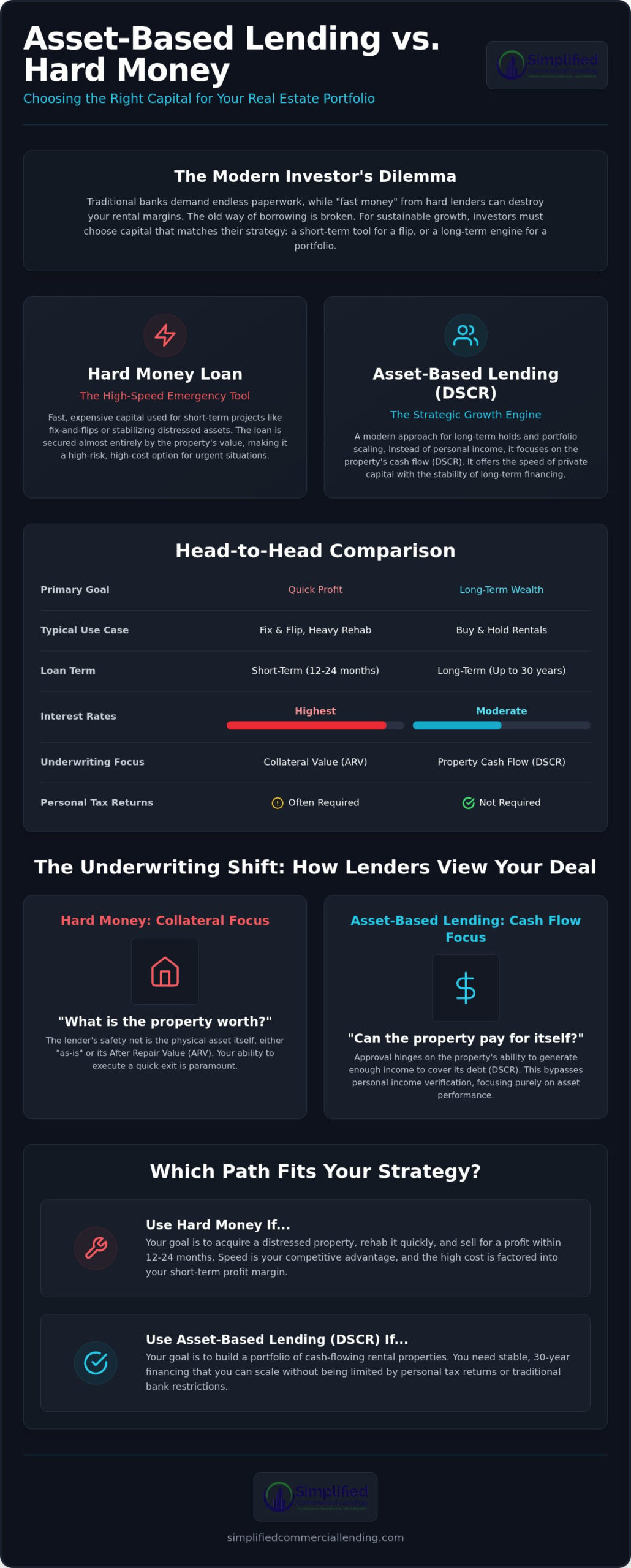
Think of hard money as the emergency room of real estate finance. It’s fast, vital in a crisis, and expensive. Lenders focus almost exclusively on the “as-is” value of the property and the borrower’s ability to execute a quick exit. You use this capital for heavy rehabs, fix-and-flip projects, or when you need to close a deal in 7 to 10 days to beat out a competitor. Because these loans are short-term, usually capped at 12 to 24 months, and carry higher risk, they are often the most expensive capital in your toolkit. They aren’t meant for holding; they’re meant for moving.
The Modern Asset-Based Alternative
If hard money is for the rehab, modern ABL is for the rental. This is where the Debt Service Coverage Ratio (DSCR) changed the game. Instead of obsessing over your personal tax returns, ABL underwriting focuses on whether the property can pay for itself. It represents the perfect middle ground. You get the speed of private equity without the crushing interest rates of hard money for your long-term holds.
Investors choose this path for Single Family Investment Property Loans or Multi-Family Residential Investment Loans because it allows for a more sustainable growth model. Here is why it wins for long-term strategies:
- Scaling without tax returns: Your personal debt-to-income ratio takes a backseat to the property’s performance.
- Long-term stability: Terms often stretch to 30 years, providing a permanent home for your capital.
- Cash-flow focus: Approval hinges on the property’s rental income potential, not your W2.
By focusing on the asset’s performance, you unlock a level of flexibility that traditional banks simply cannot match. It allows you to act like an institutional player while maintaining the agility of an independent entrepreneur.
Underwriting Differences: Collateral vs. Cash Flow
Underwriting is where the rubber meets the road. In the debate of asset based lending vs hard money, the biggest shift happens in how a lender calculates risk. Traditional banks want to see your life story in tax returns. Non-bank lenders care about the asset. Hard money lenders look at the physical collateral as it stands today. Modern asset-based lenders look at the income that collateral generates over time. Understanding this distinction is the key to choosing the right partner for your 2026 investment goals.
The Death of the Tax Return Requirement
Traditional banks often fail independent entrepreneurs and 1099 investors. If your tax returns show heavy deductions, a bank sees a “poor” borrower, even if you have a million-dollar portfolio. Simplified Commercial Lending bypasses this personal income audit entirely. We focus on property performance instead of your W-2 history. Specifically, dscr loan requirements prioritize property income over W-2s, allowing you to scale based on the math of the deal. This “no-doc” approach is a game changer for those who want to finance multi-family assets without the bureaucratic headache of a traditional mortgage.
Collateral Focus in Hard Money
Hard money lenders operate on a different frequency. They are primarily interested in the “as-is” value or the After Repair Value (ARV). Because hard money in real estate investing is meant to be short-term, the lender’s safety net is the property itself. They calculate risk through Loan-to-Value (LTV) or Loan-to-Cost (LTC) ratios. In 2026, most hard money lenders approve a maximum LTV of 65% to 75% of the property value. They care more about the deal than the borrower’s history. However, this creates a risk of over-leveraging. If you miscalculate the rehab costs in a fix-and-flip, that high-interest capital can quickly eat your equity before you ever hit the market.
Does personal credit still matter? Yes, but its role has changed. In asset-based lending, your credit score isn’t the “yes or no” factor it is at a bank. Instead, it’s a dial that adjusts your interest rate. A higher score unlocks better terms, but it won’t kill the deal if the property’s cash flow is strong. Hard money lenders might ignore credit entirely if the equity cushion is deep enough. In the battle of asset based lending vs hard money, your choice depends on whether you’re betting on the property’s future sale price or its monthly paycheck.
Asset Based Lending vs. Hard Money: Side-by-Side Comparison
Choosing between asset based lending vs hard money isn’t just about finding the lowest interest rate. It’s about matching your capital to your clock. If you’re sprinting toward a closing date to beat a competing offer, the speed of hard money is your best friend. If you’re building a rental empire for the next decade, the stability of a long-term asset-based loan is your foundation. Understanding the specific trade-offs in terms, costs, and speed ensures you don’t use a short-term tool for a long-term goal.
Here is how the two stack up in the 2026 market:
- Loan Terms: Hard money typically offers 12 to 24 months. Asset-based rental loans range from 5 to 30 years.
- Costs: Hard money carries significantly higher interest rates and points. ABL rates are lower, designed for long-term hold sustainability.
- Speed to Close: Hard money can fund in 7 to 10 days. Asset-based loans usually require 21 to 30 days for full underwriting.
- Primary Purpose: Use hard money for acquisition and heavy rehab. Use ABL for long-term holds or refinancing into a permanent structure.
Cost of Capital Analysis
Paying more for Hard money loans makes perfect sense for a 6-month project. When speed is the priority, the cost of capital is simply a line item in your rehab budget. However, long-term investors must avoid the “yield spread” trap. If your interest rate is too high, it eats your monthly cash flow, leaving you with a “skinny” deal that can’t weather a vacancy. You should also watch for prepayment penalties. ABL loans often include them to protect the lender’s long-term yield, while hard money usually allows for a quick exit without heavy fees.
Flexibility and Scaling
Hard money is essentially a “one-and-done” tool. You get the loan, finish the flip, and pay it back. It doesn’t offer a path to scale a massive portfolio under one roof. In contrast, a portfolio line of credit for rentals acts as a growth engine. It allows you to consolidate multiple assets into a single facility, making it easier to recycle capital and acquire new properties. While hard money helps you win the deal, asset-based lending helps you build the business. It provides the flexibility to manage your equity across your entire portfolio rather than being locked into isolated, expensive loans.
Strategic Fit: When to Choose Each Loan Type
Matching the right debt to the right deal is the difference between a thriving portfolio and a cash-flow crisis. When weighing asset based lending vs hard money, your decision should hinge on your specific project phase and ultimate goal. One capital source acts as a high-octane fuel for quick sprints, while the other serves as the steady engine for a long-distance journey. Using the wrong tool at the wrong time can leave you over-leveraged or stuck with “dead” equity that isn’t working for you.
Consider these four common scenarios to determine your best path:
- Scenario A: The Fix and Flip. Hard money is the undisputed king here. When you’re buying a distressed property that needs a total overhaul, you need speed and a lender who only cares about the “after repair” value.
- Scenario B: The BRRRR Method. This requires a two-step dance. You use hard money for the initial buy and rehab, then quickly pivot to asset-based lending for the refinance and long-term hold once the property is stabilized.
- Scenario C: Stabilized Rental Acquisition. For properties that are already tenant-ready, single family residential investment loans are superior. They offer lower rates and longer terms that protect your monthly margins.
- Scenario D: Commercial Assets. You can apply the same asset-based logic to a commercial property loan, focusing on the building’s lease income rather than your personal salary.
Exit Strategy: The Determining Factor
Your exit strategy is the most important variable in the asset based lending vs hard money equation. If your exit is a “Sale” within 12 months, the higher cost of hard money is a minor line item in your rehab budget. However, if your exit is “Cash Flow,” hard money is a trap. You need sustainable, long-term financing that allows you to keep more of your rental income. We recommend planning your financing structure 12 months in advance. This foresight ensures you aren’t scrambling to refinance out of an expensive bridge loan when the term expires.
The Short-Term Rental Exception
Airbnb and VRBO properties are unique beasts. They generate high revenue but often carry higher operating costs and seasonal fluctuations. Traditional banks and standard hard money lenders often struggle to underwrite these assets accurately. Specialized short term rental financing uses the actual cash-flow potential of the vacation market to approve your loan. Hard money is rarely a good fit for a stabilized short-term rental because the high interest rates can quickly erase the “premium” income these properties generate.
Ready to move beyond expensive bridge loans and secure a permanent home for your rental capital? Stop letting high rates eat your ROI and apply for a no-doc rental loan today to lock in your long-term cash flow.
Bypassing the Bank: Scaling with Simplified Commercial Lending
Scaling your portfolio shouldn’t feel like an interrogation. Traditional banks focus on your past; we focus on your property’s future. By acting as a strategic bridge to private equity and non-bank institutional capital, Simplified Commercial Lending helps you bypass the rigid committees that kill deals. When evaluating asset based lending vs hard money, the most important factor is the partner you choose. We don’t just offer one rigid loan product. As a broker, we navigate multiple asset-based programs to find the specific fit for your Single Family Investment Property Loans or Multi-Family Residential Investment Loans.
The “No Doc” process is exactly what it sounds like. We don’t ask for tax returns. We don’t audit your personal income. Your application focuses on the deal itself. Whether you’re acquiring a new asset or refinancing an existing one, our national reach allows us to fund investors across the U.S. We handle the complexity of commercial property loans and residential portfolios so you can focus on finding the next opportunity. Working with a broker gives you access to a broader spectrum of programs than any single lender’s rigid box could ever provide.
A Streamlined Path to Closing
We’ve stripped away the fluff to create a 3-step path to funding. First, we provide a rapid quote based on your property details. Second, we move into underwriting where property appraisals and rent schedules take center stage. These are the most critical documents you’ll provide because they prove the asset’s value and income potential. Third, we close. We handle multi-family and commercial assets with a specific eye on DSCR, ensuring the debt structure matches the unique cash flow requirements of larger buildings compared to standard SFRs.
Your Ally in a Rigid Financial World
The financial world is often built to slow you down. We’re built to speed you up. We position ourselves as a disruptive alternative to the status quo, acting as a savvy guide for investors who feel underserved by mainstream systems. Our relationship isn’t a one-time transaction; it’s a partnership designed for your long-term success. We value pragmatism over protocol every time. We understand that in the battle of asset based lending vs hard money, you need a solution that protects your cash flow while allowing for rapid growth.
Ready to scale? Apply for your asset-based loan today.
Master Your Investment Strategy with Smarter Capital
The landscape of real estate finance has shifted. You don’t have to choose between the slow bureaucracy of a bank and the high-interest trap of short-term debt. Understanding the nuances of asset based lending vs hard money allows you to deploy capital with precision. Use hard money to win the property; use asset-based lending to build the empire. By focusing on property cash flow rather than personal tax returns, you unlock the ability to scale without the traditional friction of personal income verification.
We provide national financing for all investment property types, from single-family rentals to multi-family assets. Our underwriting is based on property cash flow, meaning no tax returns are required to get your deal funded. It’s time to stop letting rigid protocols hold back your portfolio growth. Your next big move is just one cash-flow-focused loan away. Bypass the bank and scale your portfolio with Simplified Commercial Lending. Keep building.
Frequently Asked Questions
Is asset-based lending the same as hard money?
No, they aren’t the same, though they share some DNA. Hard money is a specific, short-term subset of asset-based lending designed for speed and distressed properties. When comparing asset based lending vs hard money, remember that modern ABL programs focus on long-term stability and sustainable cash flow. While hard money is a high-cost tool for quick flips, asset-based lending provides a permanent financing home for rental portfolios and commercial assets.
Do I need tax returns for an asset-based commercial loan?
You don’t need to provide tax returns for these loans. We prioritize a “no-doc” approach because it empowers independent entrepreneurs who have significant tax deductions. Instead of auditing your personal income, we look at the property’s Debt Service Coverage Ratio (DSCR). If the asset generates enough rental income to cover the debt and operating expenses, the deal stands on its own merits. This allows you to scale without bureaucratic hurdles.
What is the typical interest rate difference between hard money and ABL?
Hard money rates generally range from 8% to 15% in 2026, depending on the project’s risk and your experience level. Asset-based lending rates for long-term holds are significantly lower, typically sitting just a few points above the U.S. Prime Rate. Choosing ABL over hard money for stabilized assets protects your monthly ROI. It ensures your rental cash flow isn’t eaten up by the high interest costs associated with short-term bridge capital.
Can I use asset-based lending for a fix-and-flip project?
Asset-based lending is a broad category that includes various short-term financing options, but it’s most powerful when used for stabilized assets. For a heavy rehab, you might start with a bridge loan to cover the acquisition and construction phases. Once the property is renovated and a tenant is in place, you should pivot to a long-term asset-based rental loan. This strategy allows you to recycle your capital and lock in lower, permanent rates.
How much of a down payment is required for asset-based rental loans?
Most asset-based lenders require a down payment between 20% and 25%. This ensures there is enough equity in the deal to protect the lender while allowing you to maintain a healthy cash-flow margin. For experienced investors with strong portfolios, some programs may offer higher leverage. The specific amount often depends on the property’s DSCR and its overall performance, focusing on the asset’s strength rather than your personal liquidity or W-2 income.
Can I get an asset-based loan if I have a low credit score?
Yes, you can still qualify for financing. In the world of asset based lending vs hard money, your credit score is a secondary factor. It acts as a dial to adjust your interest rate rather than a “yes or no” gatekeeper. If the property’s cash flow is exceptionally strong, it can often offset a lower personal credit score. We focus on the asset’s performance, making these loans accessible to savvy investors who don’t fit the rigid bank box.
What types of properties qualify for asset-based lending?
A wide variety of investment properties qualify for this financing. This includes single-family rentals, multi-family residential buildings, and diverse commercial assets like retail centers, warehouses, or hotels. We also provide specialized financing for short-term rentals like Airbnb and VRBO properties. As long as the asset is used for business or investment purposes and generates sufficient cash flow to cover the debt, it fits within the asset-based lending framework.
How fast can an asset-based loan close compared to a traditional mortgage?
Asset-based loans typically close in 21 to 30 days, which is significantly faster than the 45 to 60 days required by traditional banks. Because we skip the intrusive personal income audit and endless tax return reviews, the process is highly streamlined. While hard money remains the fastest option for 7-day emergency closings, asset-based lending offers the perfect balance of speed and sustainable long-term rates for professional investors who value efficiency.