Your tax returns shouldn’t be the ceiling for your real estate empire. For many independent investors, the path to growth is blocked by traditional banks that care more about personal debt-to-income ratios than the actual potential of a property. Utilizing asset based lending for real estate allows you to escape this cycle and focus on the strength of the deal itself. You’ve likely felt the frustration of a rejected loan or a missed opportunity because a lender couldn’t look past a complex tax return.
We agree that your ability to scale should depend on your deal-finding skill, not your accountant’s creative filing. This guide is your roadmap to bypassing those bureaucratic hurdles and using property equity to fund your next major move. We’re going to show you how to access capital without personal tax returns, close deals in record time, and build a reliable partnership for a multi-property portfolio. From short-term rentals to multi-family assets, here is how you can finally outpace the competition in 2026.
Key Takeaways
- Learn how asset based lending for real estate shifts the underwriting focus from your personal tax returns to the property’s actual cash flow.
- Discover why the Debt Service Coverage Ratio (DSCR) is the most critical number for securing financing based on property performance.
- Gain a competitive advantage by shortening your closing times to just two to three weeks compared to months with traditional banks.
- Explore the “Equity Recycle” strategy and portfolio lines of credit to leverage existing property value for rapid expansion.
- Understand how a brokerage model provides the flexibility and specialized loan products needed to fund complex commercial and residential assets.
What is Asset Based Lending for Real Estate?
Traditional banking is a grind that often stalls your growth. Asset based lending for real estate is a disruptive financing model that changes the rules. Instead of scrutinizing your personal tax returns or debt-to-income (DTI) ratios, this method prioritizes the property’s value and its ability to generate income. It’s a solution designed for the independent entrepreneur who values results over paperwork.
The core philosophy is simple: the property is the proof. If the asset produces enough revenue to cover its own debt, the loan is viable. This differs significantly from traditional “hard money.” While hard money is often a high-interest, short-term bridge for fix-and-flip projects, asset-based lending focuses on long-term stability. It provides the capital needed for rental holds and commercial assets with terms that actually support a scaling portfolio.
For self-employed investors, the “no-doc” advantage is a game changer. You likely have high write-offs that make your income look lower on paper than it actually is. Asset-based lenders don’t care about your accountant’s creative filing. They care about the deal. This allows you to secure funding based on the strength of your investment rather than the limitations of your personal financial history.
The Core Components of an Asset-Based Deal
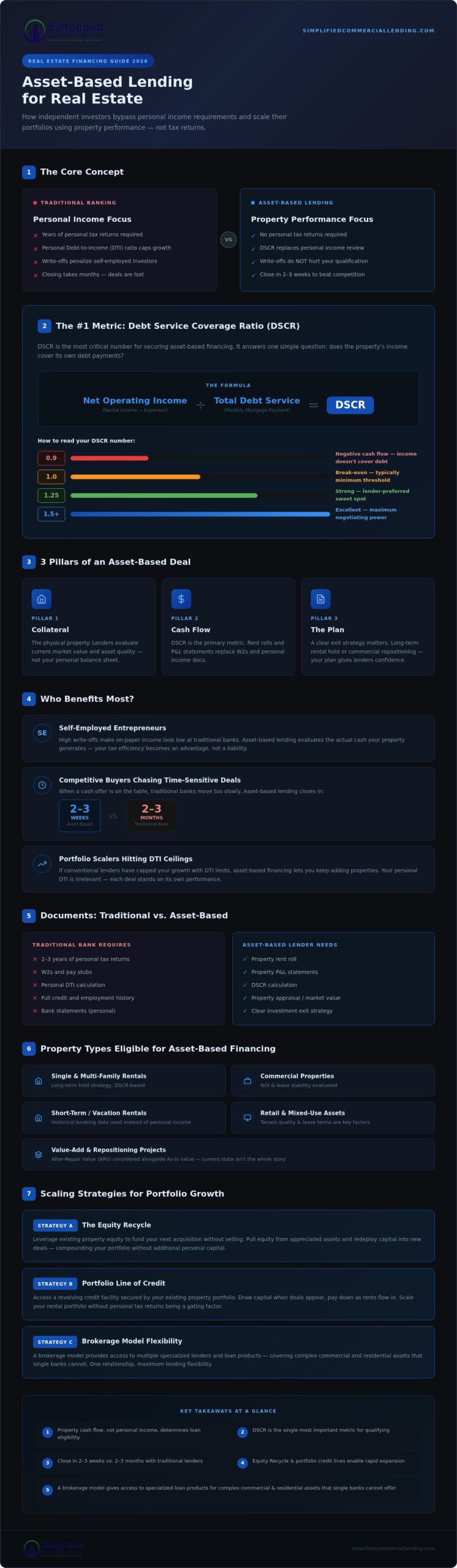
An asset-based deal relies on three primary pillars to determine eligibility. These components ensure the loan is a smart move for both you and the lender:
- Collateral: This is the physical property. Lenders look at the current market value and the quality of the asset itself.
- Cash Flow: The most important metric is often the Debt Service Coverage Ratio (DSCR). This measures if the property’s income can comfortably pay the mortgage.
- The Plan: Lenders want to see a clear strategy. Whether you’re holding a long-term rental or repositioning a commercial warehouse, your exit strategy matters.
Who Benefits Most from Asset-Based Financing?
This isn’t just another loan product; it’s a strategic tool for specific types of investors. You’ll find the most value here if you fall into one of these categories:
- Self-Employed Entrepreneurs: If your tax returns don’t reflect your true purchasing power, this is your bypass.
- Competitive Buyers: When you need to close in two to three weeks to beat a cash offer, traditional banks are too slow.
- Portfolio Scalers: If you’ve hit your DTI limit with conventional lenders, asset-based financing lets you keep growing without hitting a ceiling.
Underwriting the Asset: Property Cash Flow vs. Personal Income
Banks treat your personal finances like a crime scene. They dig through years of history, looking for reasons to say no. When you switch to asset based lending for real estate, the conversation changes. The lender stops looking at your personal debt and starts looking at the property’s performance. It’s a logical shift. If the building makes money, the loan works. This approach allows you to separate your personal life from your business growth and focus on the strength of the deal.
The Debt Service Coverage Ratio (DSCR) is the primary tool used here. It’s a simple calculation: does the income cover the debt? Beyond just the current numbers, lenders look at the “As-Is” value and the “After-Repair Value” (ARV). This is vital for value-add deals where the property’s current state doesn’t tell the whole story. You’ll swap your W2s for property-specific documents like rent rolls and P&L statements. It’s cleaner, faster, and more relevant to your scaling goals. Utilizing asset based lending for real estate means your ability to find profit is more important than your salary.
The Death of the Tax Return Requirement
Traditional banks don’t understand how real estate entrepreneurs operate. You maximize your write-offs and use depreciation to keep more of what you earn. This is smart business, but it kills your chances at a local bank because your “on-paper” income looks low. Asset-based lenders don’t penalize you for being efficient. They focus on the actual cash the asset generates today. This provides the ultimate path for scaling your rental portfolio without tax returns. You can grow as fast as your deals allow without hitting a personal income ceiling.
Evaluating Commercial vs. Residential Assets
Underwriting looks different depending on the asset type. For multi-family or retail centers, the focus is on Net Operating Income (NOI) and lease stability. Lenders want to see reliable tenants and solid lease terms. If you’re in the vacation rental space, modern underwriting has evolved. Instead of personal income, lenders use historical booking data and specialized short-term rental market analytics to verify income. This flexibility lets you fund properties that traditional institutions simply can’t wrap their heads around. If you’re tired of being capped by your tax returns, it’s time to explore flexible financing solutions that value your expertise.
Asset-Based Lending vs. Traditional Mortgages
Choosing between a bank and an asset-based lender isn’t just about interest rates. It’s about the velocity of your capital. Traditional commercial banks operate like massive, slow moving machines. They require a mountain of paperwork that can take months to process. In contrast, asset based lending for real estate focuses on the deal itself. This streamlined approach allows you to close in two to three weeks, while a bank might keep you waiting for 60 to 90 days. When a prime opportunity hits the market, that time difference is often the gap between a closed deal and a missed one.
Flexibility is another major differentiator. Traditional mortgages are often rigid, with fixed terms that don’t account for the unique needs of an investor. Asset-based lenders offer customized structures, including interest only periods or balloon payments. These features help you manage cash flow during the early stages of an investment. You should expect a trade-off, however. Asset-based loans typically carry slightly higher interest rates than bank debt. You aren’t just paying for the money; you’re paying for the leverage, the minimal documentation, and the ability to move at the speed of the market.
When to Choose a Traditional Bank
Banks still have their place in a balanced strategy. If your primary goal is securing the lowest possible interest rate and you aren’t in a rush, a traditional bank might be the right call. This is especially true for owner occupied properties where your personal income is high, stable, and easily documented. If you’re looking for long term debt on a low risk, institutional quality asset with low leverage, the bureaucratic hurdles of a bank might be worth the cost savings.
When Asset-Based Lending is the Clear Winner
Asset-based financing is the tool of choice for the active, scaling investor. It allows you to compete in “all-cash” style markets where speed is the deciding factor for sellers. It’s also the only viable path for properties that need significant repositioning. If a building doesn’t currently meet bank standards, an asset-based lender can fund the acquisition based on its future potential. Investors utilizing multi-family residential investment loans often choose this path to expand their portfolios quickly without being capped by personal debt limits. If your goal is growth, you need a partner that values your vision over your tax returns.
How to Scale Your Portfolio with Asset-Based Financing
Stop thinking of loans as simple transactions. Think of them as fuel. Asset based lending for real estate acts as a scaling engine that allows you to move beyond the “one property at a time” mindset. When you hit the debt-to-income limit at a traditional bank, your growth stops. With asset-based financing, your expansion is only limited by the equity you’ve built and the deals you find. It’s the difference between owning a few rentals and managing a true real estate empire.
The “Equity Recycle” method is how savvy investors turn one successful rental into five. By leveraging a portfolio line of credit for rentals, you can tap into the equity of your seasoned assets without selling them. This liquidity allows you to pounce on new opportunities instantly. You can even use cross-collateralization, where multiple properties secure a single, larger credit facility. This is the bridge that helps you transition from single-family units into high-impact multi-family or commercial assets.
Tapping Into Existing Equity
Cash-out refinances are your best friend for expansion. You take the equity sitting in a renovated property and use it as a down payment for the next one. Managing ten separate loans is a headache; many investors use a “Blanket Loan” strategy to consolidate their portfolio under one roof. In 2026, the “equity harvest” strategy is defined as the systematic extraction of property appreciation to fund the acquisition of higher-yield commercial assets.
Managing Risk While Scaling
Growth is exciting, but it must be sustainable. You need to maintain a healthy dscr loan requirement across your entire portfolio to ensure every asset remains self-sufficient. Liquidity is more important than the absolute lowest interest rate when you’re in a growth phase. If you’re cash-poor, one bad month can stall your momentum. Always have a clear exit strategy for every asset-based loan. Whether you plan to refinance into long-term debt or sell after repositioning, the end goal must be clear from day one. Ready to build your empire? Apply for a portfolio line of credit today and start scaling.
Simplifying Your Commercial Real Estate Financing
A single lender has one set of rules. If you don’t fit their narrow criteria, you’re out. That’s why a brokerage model is the ultimate tool for asset based lending for real estate. We don’t just offer one product; we provide a gateway to a massive network of private equity and non-bank solutions. This variety ensures that your deal finds the right home, regardless of how complex it might seem to a traditional institution. While a single bank is limited by its own balance sheet, our brokerage model taps into diverse capital sources to find the most flexible terms for your specific asset.
Our primary goal is removing the friction from the commercial property loan process. We know you’re busy growing your business. You don’t have time to explain your entrepreneurial tax strategy to a loan officer who doesn’t understand it. We specialize in structuring deals that banks won’t touch. Whether it’s a high-performing short-term rental, an industrial warehouse, or a multi-tenant retail center, we look at the numbers that matter. If the property produces cash flow, we have a path to funding.
The Simplified Commercial Lending Advantage
We provide national reach without the local bank red tape. Our process is built specifically for busy entrepreneurs, meaning we value speed and transparency over rigid corporate protocols. You get access to a wide range of short term rental financing and long-term hold options that adapt to your specific portfolio needs. We act as your advocate throughout the entire process, ensuring you get the leverage required to keep your momentum high in a competitive market.
Ready to Move Forward?
Getting a quote based on your property’s performance today is simple and direct. You don’t need a suitcase full of personal tax returns to prove your worth. To start, have your property addresses, current rent rolls, and your specific scaling goals ready for our team. We move fast because we know that in real estate, time is money. From the initial consultation to a funded deal, our timeline is designed to keep you ahead of the competition. It’s time to stop asking for permission from banks and start using your assets to build your future. Get a custom quote for your next investment property and see exactly how much capital you can unlock right now.
Take Control of Your Real Estate Scaling Strategy
Your growth shouldn’t be limited by a bank’s outdated checklist. You’ve seen how shifting the focus to property cash flow and using the Debt Service Coverage Ratio (DSCR) can unlock doors that were previously closed. By choosing asset based lending for real estate, you’re prioritizing speed and flexibility over bureaucratic hurdles. This strategy isn’t just about closing one deal; it’s about building a scalable engine for your entire portfolio. You now have the tools to bypass the “entrepreneurial tax return” struggle and outpace the competition in a fast-moving market.
Our expert brokerage team is ready to help you navigate this market with direct access to private equity capital. We offer financing for both residential and commercial assets nationwide, and for most investment products, we don’t require tax returns. It’s time to move at the speed of the market and secure the leverage you deserve. Scale your portfolio with a no-doc asset-based loan today. Your next major property move is well within reach, and we’re here to help you fund it with confidence.
Frequently Asked Questions
Is asset-based lending the same as hard money?
No, asset-based lending is not the same as hard money. Hard money is typically a short term bridge for fix and flip projects with higher costs. Asset based lending for real estate focuses on long term rental holds and stabilized commercial properties. It provides more competitive terms for investors who intend to keep the asset for several years. You get the speed of private capital without the extreme costs of a flip loan.
Do I need a high credit score for an asset-based real estate loan?
You don’t always need a perfect credit score to qualify. While your score is a factor, the property’s cash flow and value take the lead. Most lenders look for a score in the mid 600s to ensure baseline financial responsibility. If the asset’s Debt Service Coverage Ratio (DSCR) is strong, the lender is much more likely to overlook minor personal credit hurdles. The property’s performance is the primary security.
Can I get an asset-based loan for a property I plan to live in?
No, you cannot use these loans for a primary residence. Asset-based lending is strictly for investment properties. These products are designed for entrepreneurs who are building a portfolio of income producing assets. If you plan to live in the home, you must seek a traditional residential mortgage. Those loans require personal income verification and fall under different federal consumer protection regulations that don’t apply to commercial deals.
What is the typical down payment for an asset-based commercial loan?
A typical down payment ranges from 20% to 25% of the property’s value. Because the loan is secured by the asset rather than your salary, the lender requires significant equity to manage their risk. This skin in the game ensures the project is viable and that the borrower is committed to the asset’s success. Higher down payments can sometimes help you secure more flexible terms or interest only payment options.
How does a lender calculate the DSCR for a rental property?
Lenders calculate the DSCR by dividing the property’s annual Net Operating Income (NOI) by its total annual debt service. For example, if your rental property generates $15,000 in annual profit after expenses and the mortgage costs $10,000, your DSCR is 1.5. A ratio above 1.2 is generally the benchmark for approval. This simple calculation proves to the lender that the property can pay for itself without your personal help.
What happens if my property is currently vacant?
Vacancy isn’t an automatic deal breaker. In these cases, lenders use market rent data from a professional appraisal to project the property’s potential income. This is especially helpful when you are buying a property that needs a new tenant or is currently undergoing a minor repositioning. As long as the market data supports a healthy DSCR, you can still secure the funding you need to close the deal and start generating revenue.
Can I use asset-based lending to buy a warehouse or retail center?
Yes, you can absolutely fund warehouses and retail centers. Asset based lending for real estate is a preferred method for commercial assets that local banks often find too complex. We look at the strength of your leases and the quality of your tenants rather than your personal tax returns. This allows you to secure large scale industrial or retail spaces based on the actual revenue those commercial buildings generate every month.
Are there prepayment penalties on asset-based loans?
Yes, most asset-based loans include a prepayment penalty. These are often structured on a declining scale, such as a 3-2-1 penalty over the first three years. This means the fee decreases the longer you hold the loan. Lenders include these terms because the loans are designed for stabilized, long term income. Always check your specific term sheet to understand how much it will cost to refinance or sell early in your investment journey.