Why are you still waiting for a bank to dig through years of personal tax returns when your property’s RevPAR already tells the story of your success? If you’ve ever felt like your growth was being held hostage by rigid underwriting and endless requests for paperwork, you aren’t alone. Many independent investors find that traditional hotel financing options are built for corporate giants, leaving savvy entrepreneurs stuck in a cycle of slow closing times and high personal income requirements.
We agree that the process should be about the asset, not just your personal bank account. You deserve a path to capital that recognizes the actual cash flow of your hospitality business. This guide promises to show you how to secure flexible, non-bank solutions that prioritize property performance and debt-service coverage ratios. We’ll preview the 2026 lending environment, where CMBS issuance is hitting record levels and private debt funds are filling the gap for ground-up projects. Discover how to leverage streamlined application processes to get the funding you need without the typical institutional hurdles. It’s time to move past the status quo and scale your portfolio on your own terms.
Key Takeaways
- Understand why the 2026 hospitality market requires a shift away from rigid traditional banking toward asset-based lending strategies.
- Learn how to optimize your capital stack by choosing debt over equity to maintain full ownership and maximize your investment returns.
- Discover modern hotel financing options that prioritize property cash flow and DSCR over personal tax returns for faster scaling.
- Identify the five essential underwriting criteria lenders use to evaluate your hospitality management team and property performance.
- Leverage a streamlined, no-doc application process to bypass industry bottlenecks and reinvest equity from your existing portfolio.
Understanding the Landscape of Hotel Financing in 2026
Hotel financing isn’t just a standard mortgage. It’s a specialized form of commercial debt designed to support the unique needs of hospitality assets. Unlike a traditional warehouse or retail center, a hotel is both a piece of real estate and a high-intensity operating business. This dual nature makes hotels “high-maintenance” assets in the eyes of traditional lenders. In 2026, the market has shifted significantly. As institutional banks contract their lending appetites, non-bank capital has stepped in to provide the flexibility independent owners need to grow.
The difference between branded franchise financing and independent boutique loans is stark. Flagged hotels often enjoy lower down payments, sometimes as low as 10% through specific programs, because they carry the weight of a national brand. Independent boutiques, while potentially more profitable, require a lender who understands the nuances of local market demand. Many developers apply project finance principles to these hospitality ventures, treating the property as a standalone entity to manage risk and secure non-recourse debt.
Why Hotels Require Specialized Lending
Traditional commercial leases last for years. A hotel re-leases its inventory every single day. This daily lease cycle creates a level of operational volatility that standard bank underwriting isn’t equipped to handle. Seasonality also plays a massive role; a resort might generate 80% of its annual revenue in four months. Modern hotel financing options now prioritize RevPAR (Revenue Per Available Room) and property cash flow over personal tax returns. This shift allows investors to qualify based on what the property actually earns rather than what their personal income history shows.
The Role of Commercial Mortgage Brokers
A savvy broker acts as your navigator through a sea of private equity and non-bank debt funds. Instead of knocking on twenty doors, you use a single point of entry to access multiple capital sources. Speed is the ultimate currency in 2026. If you’re competing for a prime acquisition, you can’t wait months for a bank committee to review your 1040s. Brokers streamline the process by focusing on the asset’s performance. They bridge the gap between your vision and the capital required to execute it, ensuring you don’t miss out on high-value opportunities due to institutional red tape. By tapping into a national network, you can find hotel financing options that align with your specific portfolio goals, whether you’re looking for a quick bridge loan or long-term permanent debt.
Debt vs. Equity: Choosing Your Hospitality Capital Structure
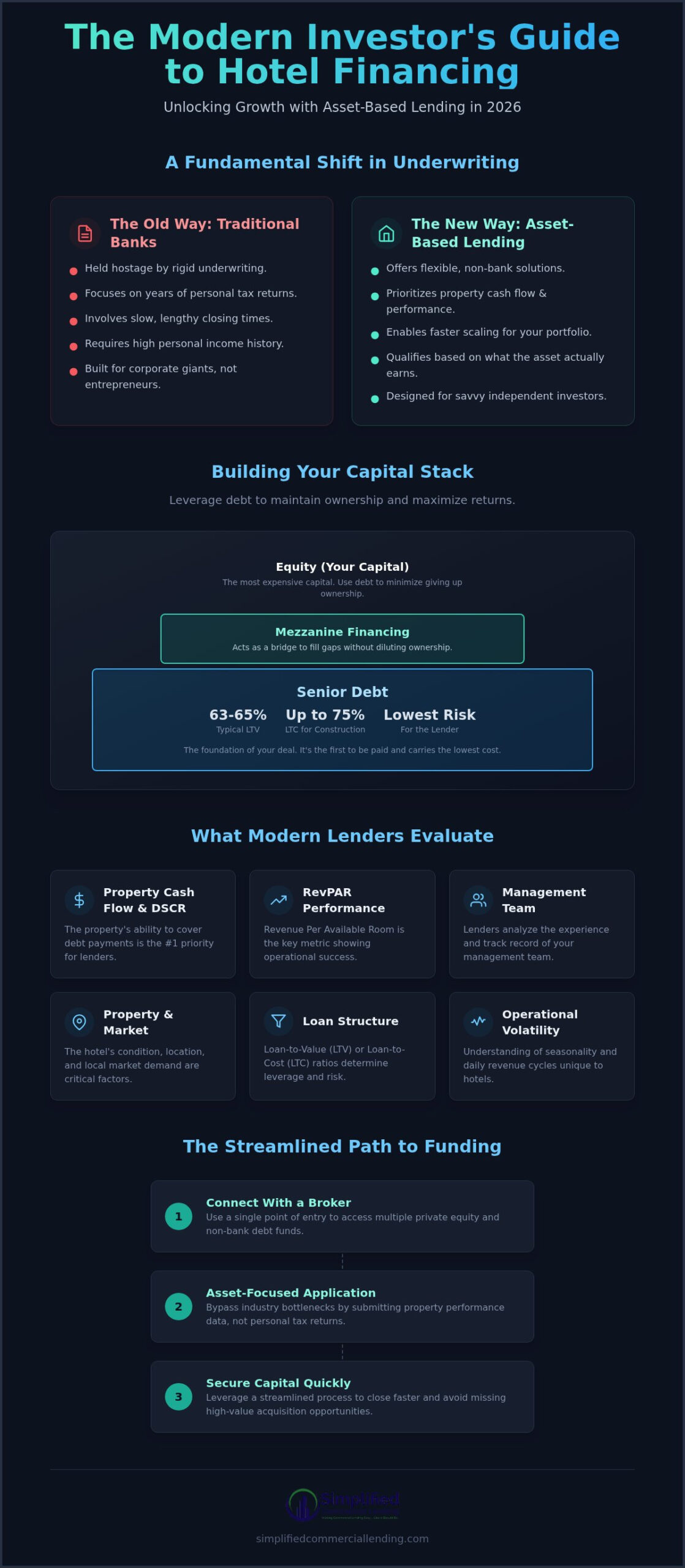
Understanding your capital stack is the first step toward financial freedom. It’s the DNA of your deal. You have three main layers to consider: senior debt, mezzanine financing, and equity. In the 2026 market, equity investors have high expectations. They often demand double-digit returns that can eat into your long-term profits. This makes debt a more attractive choice for owners who want to keep the lion’s share of their property’s appreciation. While debt costs rose roughly 40% between 2022 and 2026, the cost of giving away ownership is almost always higher. Debt allows you to leverage your success without giving up your seat at the head of the table.
Senior Debt: The Foundation of Hotel Funding
Senior debt sits at the bottom of the stack. It’s the first to be paid and carries the lowest risk for the lender. Currently, most conventional hotel financing options target a loan-to-value (LTV) of roughly 63% to 65%. If you’re looking at ground-up construction, private debt funds are pushing leverage higher, often reaching 75% loan-to-cost. You’ll need to choose between fixed and floating rates. Fixed rates offer stability, but floating rates can provide flexibility if you plan a shorter hold or a quick refinance. For a deeper dive into these specific structures, check out this Guide to Hotel and Hospitality Loans.
Equity Financing: When to Bring in Partners
Equity is the most expensive capital you’ll ever use. You’re trading a piece of your vision for a reduced debt burden. This is common for massive resort developments where the total project cost exceeds what a single investor can comfortably leverage. However, for independent entrepreneurs, the goal is often to maintain control. You don’t want a board of directors telling you how to run your lobby. If you find a gap between your senior debt and your available cash, mezzanine financing can act as a bridge without forcing you to sign away your ownership rights.
Market conditions in 2026 have made equity partners more cautious. They’re stress-testing deals at 100 to 150 basis points above the note rate. This means you need a rock-solid plan to secure their interest. If you prefer to skip the partner meetings and focus on your property’s performance, you can explore asset-based commercial property loans that prioritize cash flow over personal signatures. Using debt strategically allows you to scale your portfolio faster while keeping your equity intact for the next big opportunity.
Specialized Loan Products: DSCR and No-Doc Solutions
Stop letting your personal tax history slow down your expansion. Traditional banks often act as if the property doesn’t exist, focusing instead on your personal 1040s. This creates a massive bottleneck for active investors who need to move quickly. Asset-based non-bank loans offer a disruptive alternative. These hotel financing options prioritize the property’s cash flow over your personal debt-to-income ratio. It’s a “No-Doc” advantage that eliminates the need for years of tax returns. You qualify based on the hotel’s ability to pay for itself. This shift in perspective is why non-bank capital is becoming the primary choice for independent entrepreneurs in 2026.
Why wait months for a bank committee when your P&L already proves the deal works? Traditional bank loans are built on rigid, outdated underwriting standards. Non-bank lenders are more pragmatic. They understand that a high-performing hospitality asset is its own best collateral. By focusing on the asset rather than the individual, these lenders provide a streamlined path to capital that banks simply can’t match. This speed allows you to secure properties while your competitors are still digging through their filing cabinets.
How DSCR Loans Work for Hospitality
The Debt Service Coverage Ratio (DSCR) is the heartbeat of modern hospitality lending. Instead of looking at your salary, underwriters analyze the property’s Net Operating Income (NOI). They compare this figure to the annual debt service to ensure the property generates enough profit to cover the loan. Most hotel lenders currently require a minimum DSCR of 1.25x to 1.30x, though CMBS conduits often push for 1.40x or higher for full-service resorts. For a deeper look at the technical specs, review our DSCR loan requirements. This method empowers you to scale based on performance rather than personal income limits.
Bridge Loans and PIP Financing
Acquiring a distressed or aging asset often requires a Property Improvement Plan (PIP). These brand-mandated renovations can be expensive and time-sensitive. Bridge loans serve as the perfect short-term capital solution for these “repositioning” projects. They provide the funds needed for immediate renovations when traditional long-term debt isn’t yet an option. Once you’ve completed the PIP and the property is stabilized, you can refinance into a permanent loan. This two-step process allows you to capture value quickly without getting stuck in a high-interest cycle. It’s a proactive way to manage hotel financing options while forced appreciation is still on the table.
Key Requirements and Underwriting Criteria for Hotel Loans
Securing capital for your hospitality venture shouldn’t feel like a mystery. While banks hide behind vague experience requirements, non-bank hotel financing options operate on transparency. Underwriters in 2026 look for a strong Sponsor profile. They want to see that you or your management team has a proven track record of running profitable hospitality assets. Your resume is often more important than your personal credit score. If the property performs and the team is capable, the deal is halfway to the finish line.
To move from application to closing, you need a specific set of property-level data. Lenders require at least three years of Profit and Loss (P&L) statements and current STR reports. These reports provide the objective data needed to verify your market share against local competitors. You’ll also need a professional appraisal and a feasibility study. These documents prove the property’s value in a market where debt costs have shifted significantly since 2022. Follow this 5-step checklist to prepare:
- Comprehensive Sponsor resume highlighting hospitality experience.
- Three years of historical P&L statements.
- Current STR (Smith Travel Research) reports.
- Detailed Property Improvement Plan (PIP) and cost estimates.
- Third-party appraisal and market feasibility study.
Financial Metrics That Matter Most
Lenders scrutinize your RevPAR and ADR trends to ensure your property is keeping pace with inflation. They look at operating margins to see how well you manage rising labor and utility costs. The debt service coverage ratio (DSCR) is the primary metric asset-based lenders use to determine if a property’s net income can comfortably cover its annual loan payments. In 2026, maintaining an efficient expense ratio is critical for securing the best terms. High occupancy is great, but bottom-line profitability is what closes the loan.
The Property Improvement Plan (PIP) Factor
If you’re acquiring a flagged hotel, the brand will likely require a PIP. This anticipated CAPEX directly impacts your loan-to-cost (LTC) calculations. Savvy investors negotiate these terms upfront to ensure the loan covers both the acquisition and the renovation. For more information on general standards, see our Commercial Property Loan Guide. Don’t let a heavy PIP catch you off guard; make it a central part of your hotel financing options strategy. Ready to see what your property qualifies for? Speak with a commercial loan expert today to skip the bank hurdles and start scaling your portfolio.
Securing Your Hotel Loan with Simplified Commercial Lending
Local banks are often bound by rigid committees and outdated guidelines. They frequently view a hotel as a risky, high-maintenance venture that requires endless documentation. We see it differently. We see a powerful, cash-flowing machine. A solution-oriented broker beats a local bank every time because we have access to a national network of non-bank capital. You aren’t limited to a single institution’s appetite or a local manager’s lack of hospitality expertise. This flexibility is the ultimate advantage when you’re looking for hotel financing options that actually fit your specific growth strategy.
Scaling your portfolio shouldn’t require a mountain of personal paperwork. We focus on the asset. If your property’s cash flow is strong, that’s your primary qualifier. This allows you to tap into the equity of your existing properties to fund new acquisitions. Instead of selling an asset to raise capital and triggering unnecessary tax events, you leverage its success to buy the next one. It’s a streamlined approach that prioritizes your momentum over institutional protocol. We help you move from a single property to a multi-asset portfolio without the friction of personal income requirements.
Scaling Your Hospitality Portfolio
Serial investors use a “rinse and repeat” strategy to build lasting wealth. You can start by using a portfolio line of credit for rentals to bridge the gap into larger commercial hospitality assets. This method allows you to leverage cash flow across multiple properties simultaneously. By treating your portfolio as a unified engine, you can secure larger deals without the hurdles of traditional tax return requirements. It’s about working smarter. You use the performance of your current short-term rentals or boutique stays to qualify for the next major acquisition. This creates a cycle of growth that isn’t capped by your personal salary or tax history.
Get Started with a Direct Partner
Transparency and speed are the core of our approach. We don’t hide behind legalese or slow-moving committees. Our process moves from initial inquiry to pre-approval in days. We understand that in the 2026 hospitality market, the best deals don’t wait for bank bureaucracy. To get started, prepare your property P&Ls and your management resume. We’ll handle the heavy lifting, navigating the industry bottlenecks for you. Our team acts as your advocate, ensuring you get the most efficient hotel financing options available. Ready to move? Apply for hotel financing today and see how fast your portfolio can grow when the red tape is removed.
Take Control of Your Hospitality Growth
Growth in the hospitality sector shouldn’t be stalled by rigid bank committees. You’ve seen how asset-based lending and specialized underwriting can bypass the traditional hurdles of tax returns and personal income requirements. By focusing on property performance and RevPAR, you can scale your portfolio faster and more efficiently. Modern hotel financing options prioritize your property’s cash flow; giving you the freedom to keep your equity while expanding your reach. Whether you’re repositioning an aging asset with a bridge loan or securing long-term permanent debt for a boutique stay, the right capital structure makes all the difference.
We provide national broker access to non-bank capital and fast-paced execution tailored for the independent investor. It’s time to move past the status quo of traditional finance and embrace a partner that values pragmatism over protocol. Secure Your Hotel Financing Without Tax Returns and start building the hospitality empire you’ve envisioned. Your next acquisition is closer than you think. You have the vision and the property has the performance; let’s get the capital you need to succeed.
Frequently Asked Questions
What is the typical down payment for a hotel loan in 2026?
Typical down payments range from 10% for flagged hotels using SBA 7(a) programs to 35% for conventional bank loans. SBA 504 loans usually require 15% to 20% down. If you’re looking at CMBS options, expect to bring 30% to 40% equity to the table. Bridge loans often fall in the 20% to 35% range. These requirements vary based on the asset’s performance and the specific lender’s risk appetite.
Can I get a hotel loan without showing my personal tax returns?
Yes, you can secure hotel financing options without showing personal tax returns by choosing asset-based loans. These “No-Doc” solutions focus on the property’s Net Operating Income rather than your personal income history. This allows independent investors to scale their portfolios based on the cash flow of the hospitality asset itself. It eliminates the traditional bank bottleneck and accelerates the path to closing.
What is a DSCR loan and how does it apply to hotels?
A Debt Service Coverage Ratio (DSCR) loan evaluates a property’s ability to cover its own debt payments. For hotels, lenders calculate this by dividing Net Operating Income by the annual debt service. Most hospitality lenders look for a minimum ratio of 1.25x to 1.30x. CMBS conduits may require 1.40x or higher for full-service resorts. This metric ensures the property generates enough profit to remain sustainable and meet its obligations.
How long does the hotel financing process usually take?
Non-bank financing typically moves much faster than traditional institutional banks. While a local bank might take months to move through a committee, a broker-led process can often reach pre-approval in days. The total time from initial inquiry to funding depends on the complexity of the deal and the speed of third-party reports like appraisals. Streamlined applications prioritize efficiency so you don’t miss out on time-sensitive acquisitions.
Do I need prior hospitality experience to qualify for a hotel loan?
Hospitality experience is a critical factor for most lenders. They look for a “Sponsor” or a management team with a proven track record of operating similar assets. If you’re a first-time hotel owner, you can often qualify by partnering with an experienced management company. Lenders want to ensure the team in place can maintain RevPAR and manage operating margins effectively in any market condition.
What is a PIP in hotel financing and how is it funded?
A Property Improvement Plan (PIP) is a brand-mandated list of renovations required to maintain franchise standards. These are often funded through a combination of equity and bridge loans. Lenders calculate the loan-to-cost (LTC) to include both the acquisition price and the CAPEX needed for the PIP. Negotiating these terms upfront ensures you have adequate capital to complete required upgrades without draining your operating reserves or personal cash.
Can I refinance a hotel to pull out equity for another purchase?
You can absolutely refinance a hotel to pull out equity for your next purchase. This is a primary strategy for serial investors looking to reinvest their gains without selling their current assets. By tapping into the increased value of a stabilized property, you can secure the down payment for a new acquisition. It’s a “rinse and repeat” method that allows for rapid portfolio expansion using hotel financing options.
What is the difference between an SBA hotel loan and a private commercial loan?
SBA loans offer lower down payments but come with more red tape and a $5 million cap for 7(a) programs. Private commercial loans provide more flexibility and faster closing times without the strict government requirements. Private capital often allows for higher loan amounts and doesn’t require the same level of personal tax documentation. Choosing between them depends on your need for speed versus your desire for maximum leverage.