Your 1031 exchange shouldn’t feel like a high-stakes race against a broken clock. Traditional bank delays often turn the 180-day closing window into a wealth-killing gamble that leaves investors scrambling. You already know that the IRS doesn’t care about your bank’s sixty-day tax return audit or your personal debt-to-income ratio. You’re focused on deferring capital gains and acquiring higher-value assets, but rigid institutional norms keep getting in the way of your momentum. It’s frustrating to watch a perfect replacement property slip away because a lender can’t keep pace with federal timelines.
It’s time to stop letting paperwork dictate your portfolio’s growth. This guide explains how leveraging a dscr loan for 1031 exchange provides the speed and flexibility you need to meet federal deadlines with confidence. By qualifying based on property cash flow rather than your W-2, you can bypass the hurdles that stall conventional mortgages. We’ll show you exactly how to navigate the current 2026 investment landscape, satisfy the 45-day identification period, and close on your replacement property fast enough to keep your tax-deferred strategy intact. You’ll learn how to scale your rental business without the hassle of tax return audits or personal DTI constraints.
Key Takeaways
- Discover how a dscr loan for 1031 exchange bypasses the tax return audits that often cause investors to miss critical IRS deadlines.
- Meet the 45-day identification and 180-day closing windows using property-based underwriting that prioritizes speed and deal certainty.
- Master the IRS debt replacement rule by leveraging property cash flow to secure the financing needed for higher-value replacement assets.
- Identify high-growth opportunities to scale your portfolio by transitioning from single-family units into multi-family or short-term rental properties.
- Streamline your execution by coordinating with a Qualified Intermediary and securing pre-approval based on the income potential of your next acquisition.
Understanding the 1031 Exchange and DSCR Loan Synergy
Successful real estate scaling requires two things: keeping your capital out of the tax man’s hands and securing financing that doesn’t slow you down. The synergy between a 1031 exchange and a DSCR loan creates a powerful engine for portfolio growth. One protects your equity from immediate taxation while the other accelerates your next acquisition by focusing on the asset’s performance rather than your personal tax returns. Using a dscr loan for 1031 exchange allows you to trade up into higher-value properties without the bureaucratic friction that usually stalls these time-sensitive deals.
The Basics of Section 1031
Under the Internal Revenue Code section 1031, investors can defer paying capital gains taxes when they sell an investment property and reinvest the proceeds into a like-kind asset. This strategy is essential for stopping depreciation recapture from eroding your profits. To qualify, you must hold the property for productive use in a trade, business, or for investment purposes. Personal residences don’t qualify for this specific tax benefit. In the 2026 market, the definition of like-kind remains broad and flexible. You can swap a single-family rental for an apartment building or even a high-performing short-term rental. The core objective is simple. Keep your money working in the market instead of losing a massive chunk to the IRS the moment you sell.
Why DSCR Financing is the Perfect Match
Traditional bank loans are often the natural enemy of the 1031 exchange. While you’re racing against strict federal deadlines, a retail bank might spend weeks auditing your personal income or questioning your debt-to-income ratio. A dscr loan for 1031 exchange solves this by shifting the focus from you to the property’s cash flow. Lenders look at whether the rental income covers the mortgage payment, which simplifies the entire underwriting process. This is especially useful for investors utilizing single family residential investment loans to scale their holdings. Because there’s no requirement for tax returns or W-2 verification, the loan can close fast enough to meet the 180-day IRS window. You’re qualifying based on the property’s ability to generate revenue, which aligns perfectly with the professional nature of a tax-deferred exchange. It’s a streamlined path to acquiring more doors without the typical paperwork stress.
Beating the Clock: Why DSCR Financing Fits 1031 Deadlines
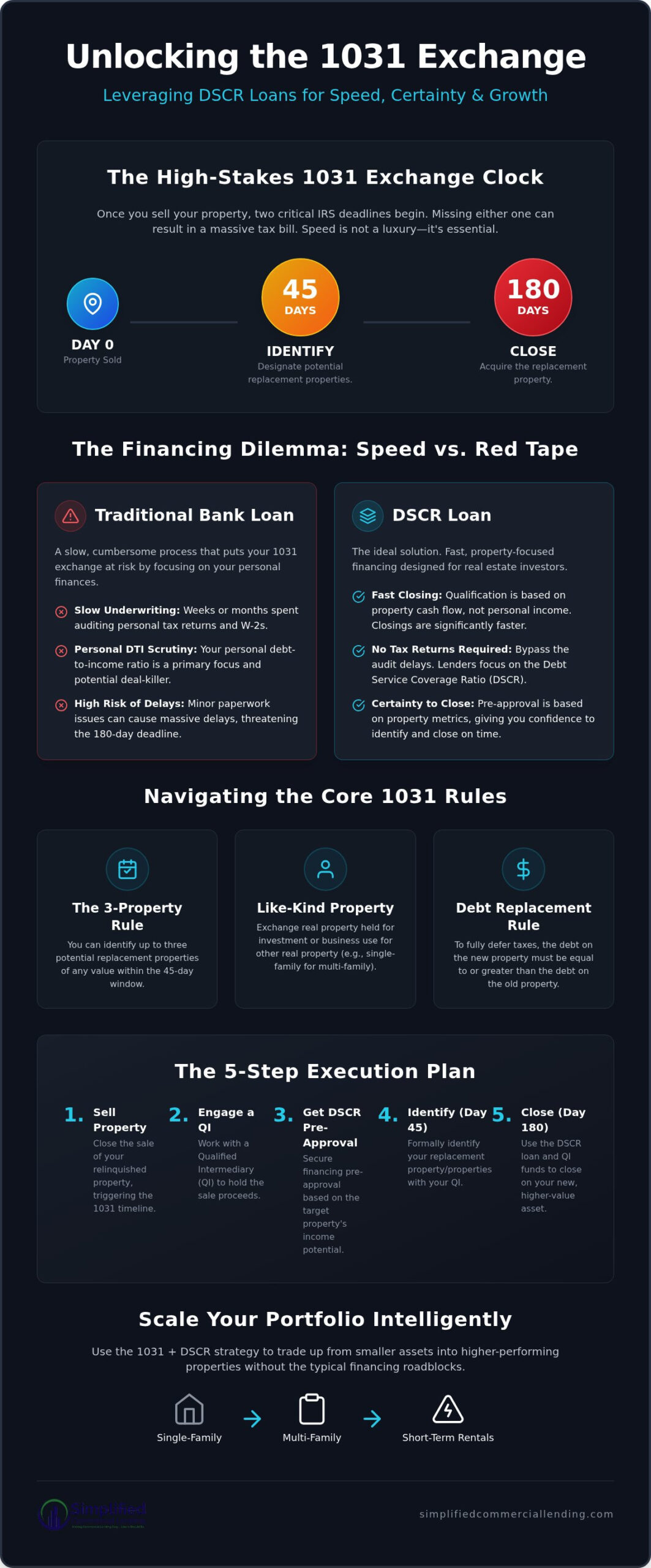
The clock is the biggest threat to your 1031 exchange. Once you close the sale of your relinquished property, the IRS triggers two rigid countdowns. You have 45 days to identify replacement assets and 180 days to close. There are no extensions for lender delays or slow paperwork. This is why a dscr loan for 1031 exchange is the preferred tool for savvy investors. It removes the personal income hurdles that typically bog down the underwriting process. You’ll work closely with your Qualified Intermediary (QI) to move funds, but your lender determines if you actually cross the finish line on time. Speed isn’t just a luxury here; it’s a requirement for tax survival.
The 45-Day Identification Sprint
Identifying your replacement property is a high-speed math problem. Under the 3-property rule, which remains the standard for most 2026 exchanges, you can identify up to three properties regardless of their fair market value. You need to know if those properties can support the debt required to satisfy the exchange before you commit your slots. Waiting for a traditional bank to review your personal debt-to-income ratio (DTI) during this window is a massive risk. A DSCR pre-approval letter gives you immediate clarity. It confirms that the property’s rental income meets the necessary coverage ratio, allowing you to name your targets with confidence. This fast math ensures you don’t waste your identification slots on properties that won’t qualify for financing.
Avoiding the 180-Day “Deal Killer”
The 180-day closing period is where traditional financing often fails. Conventional banks spend months auditing tax returns and searching for reasons to deny a loan based on the borrower’s personal financial history. One unexpected change in your credit profile or a minor error on a tax transcript can trigger a denial on day 150. At that point, you have zero time to find a new lender. DSCR underwriting bypasses these personal audits entirely. By focusing on the property’s cash flow, “no-doc” loans can close in a fraction of the time required by institutional banks. You can review the specifics in our guide on DSCR loan requirements to see how this streamlined approach works. The National Association of REALTORS® on 1031 exchanges highlights how essential these time-sensitive transactions are for maintaining market liquidity. Don’t let a slow bank turn your tax deferral into a tax liability. If you want to move faster on your next deal, you can start the pre-approval process to see how much property your cash flow can support.
The Debt Replacement Rule: Matching Value and Leverage
Most investors understand they must buy a property of equal or greater value to defer taxes. What many overlook is the debt replacement rule. To fully defer your capital gains, you must replace the exact dollar amount of the mortgage you held on the relinquished property. If your old loan was $400,000 and your new one is only $350,000, the IRS considers that $50,000 difference as “mortgage boot.” You’ll pay taxes on that gap just like cash in your pocket. Using a dscr loan for 1031 exchange allows you to precisely calibrate your leverage to satisfy this requirement without the friction of personal income verification.
Structuring your loan for maximum tax efficiency means avoiding boot at all costs. You have two main types to watch out for: cash boot and mortgage boot. Cash boot happens if you don’t reinvest all the net proceeds from your sale. Mortgage boot happens when your new debt is lower than your old debt. A DSCR lender focuses on the property’s ability to service the debt, which makes it easier to secure the exact loan amount needed to wipe out your tax liability. It’s a proactive way to ensure your equity stays fully deployed and protected.
Replacing Your Mortgage with DSCR
The math for a successful exchange is straightforward. Your new loan must be greater than or equal to your old loan, and your new cash investment must be greater than or equal to your old equity. DSCR products are ideal here because they often allow for higher loan-to-value (LTV) ratios than traditional bank products. This flexibility is vital when you’re “trading up” to a larger asset. Whether you’re moving from a single rental to a small apartment complex, a commercial property loan based on cash flow provides the leverage required to meet IRS standards. You aren’t limited by your personal debt-to-income ratio, so you can take on the debt necessary to keep your exchange tax-free.
Closing in an LLC or Entity
The IRS “Same Taxpayer” rule is a non-negotiable part of Section 1031. The entity that sells the relinquished property must be the exact same entity that buys the replacement property. If you sold the asset under “Acme Holdings LLC,” you can’t buy the new one in your personal name. This requirement aligns perfectly with how we operate. DSCR lenders actually prefer, and often require, that you close in the name of an LLC or another business entity. It’s the standard for professional investors. This setup doesn’t just satisfy the IRS; it also reinforces your asset protection strategy. By using a dscr loan for 1031 exchange, you’re maintaining the professional structure the IRS expects while keeping your personal credit and assets shielded from the investment’s liabilities.
Advanced Scaling: STRs, Multi-Family, and Portfolios
Scaling your real estate business isn’t just about adding more properties. It’s about upgrading the quality and cash flow of your assets. A dscr loan for 1031 exchange is the ultimate bridge for investors looking to pivot from a stagnant single-family rental into a high-performance multi-family complex or a lucrative vacation rental. You can consolidate your gains, wipe out tax liabilities, and enter a new asset class all in one move. This approach allows you to move from “collecting doors” to “managing units,” which significantly improves your economies of scale.
Professional investors often use the 1031 window to clean up their balance sheets. If you have equity scattered across five different properties, you can sell them and use the proceeds to acquire a single, larger asset. Once you’ve scaled, you might even consider a portfolio line of credit for rentals to maintain your liquidity. This flexibility is what separates the hobbyist from the professional entrepreneur. It’s about working smarter with your equity, not harder with your paperwork.
The STR/Airbnb 1031 Exchange
The short-term rental (STR) play is one of the most effective ways to supercharge your cash flow. Many investors worry that a vacation rental won’t qualify as “like-kind” for their exchange. As long as the property is held for investment and not primarily for personal use, the IRS generally views it as like-kind to any other rental property. To secure a dscr loan for 1031 exchange on an STR, lenders typically use third-party market data or historical occupancy rates to verify the income potential. This allows you to qualify based on the high daily rates these properties command. If you’re looking for specific criteria, our guide on short term rental financing breaks down exactly how we underwrite these high-cash-flow assets. It’s a powerful way to turn long-term equity into immediate monthly revenue.
Scaling into Multi-Family Assets
Moving from single-family homes to multi-family buildings is the fastest way to grow your unit count. Using your 1031 proceeds as a down payment for a multi family residential investment loan allows you to control more units with a single closing. There is a distinct difference in how these are handled. Properties with 1-4 units are still underwritten as residential, while 5+ units fall into the commercial category. DSCR lenders excel here because they focus on the total rental income of the entire building. This means your personal income doesn’t limit the size of the building you can acquire. You can scale into a 10-unit or 20-unit complex simply because the property’s revenue supports the debt. Ready to see how much you can acquire? You can get a custom quote for your next multi-family acquisition today and start your trade-up with confidence.
How to Execute Your 1031 Exchange with Simplified Commercial Lending
Executing a tax-deferred exchange is a multi-step process that demands perfect timing and a reliable lending partner. You can’t afford a single misstep when the IRS is watching the calendar. To ensure your dscr loan for 1031 exchange stays on track, follow this streamlined execution plan designed for the active investor. We focus on the milestones that matter most so you don’t lose your tax benefits to a paperwork error.
- Step 1: Engage a Qualified Intermediary (QI). You must do this before you close the sale of your current property. If you take possession of the sale proceeds, your exchange is disqualified immediately. The QI holds the funds in a dedicated account until you’re ready to buy your replacement asset.
- Step 2: Secure Your DSCR Pre-Approval. Don’t wait until you find a property to talk to a lender. Get a pre-approval based on your credit score and the income potential of your target asset class. This defines your buying power and proves to sellers that you have the leverage to close fast.
- Step 3: Identify Your Assets. You have exactly 45 days from your sale date to name your replacement properties. Focus on “Like-Kind” assets that meet the debt replacement rules we discussed earlier. Your pre-approval ensures these properties actually qualify for the debt you need.
- Step 4: Close with No-Doc Underwriting. Once you have a contract, our team moves into high gear. We qualify the property’s cash flow and skip the personal income audits that slow down traditional banks. We prioritize speed to hit that 180-day finish line.
Why a Broker is Your Best 1031 Ally
A broker provides a significant advantage when securing a dscr loan for 1031 exchange. We have access to multiple lending outlets, which means we can pivot if one lender encounters an internal delay. This redundancy is vital for meeting the 180-day closing deadline. We specialize in structuring loans that satisfy the IRS’s debt replacement requirements while providing the high leverage you need to scale. Our “Simplified” approach means we manage the technical paperwork and lender communication, leaving you free to focus on finding the next great addition to your portfolio. It’s about removing the anxiety of the process through expertise and speed.
Ready to Trade Up?
The 2026 tax year offers massive opportunities for investors who know how to move quickly. By combining tax deferral with the speed of no-doc financing, you can grow your rental portfolio without the traditional hassle of tax return audits. You’ve worked hard to build your equity. Don’t let it be eroded by capital gains or stalled by rigid banking protocols. Take the next step in your scaling journey today. You can request a custom DSCR quote and see exactly how much property your next exchange can support. Let’s get your equity back to work.
Accelerate Your Portfolio Growth Today
Scaling your real estate business shouldn’t be a battle against rigid institutional delays. You’ve learned how to protect your equity through tax deferral and how to use cash-flow-based underwriting to bypass personal income audits. By prioritizing the asset’s performance, you can meet the strict 180-day IRS window without the stress of traditional bank red tape. A dscr loan for 1031 exchange is the most efficient way to trade up into higher-value properties while keeping your capital fully deployed in the market.
We provide national lending coverage and specialize in closing in LLC names to ensure your professional structure remains intact. With no tax returns required, the path to a larger, more profitable portfolio is clearer than ever. It’s time to stop letting bureaucratic hurdles dictate your investment timeline and start leveraging the power of property-based financing. Take the lead on your next acquisition and keep your momentum moving forward. Secure Your 1031 Exchange Financing with Simplified Commercial Lending and build the high-cash-flow future you’ve planned for.
Frequently Asked Questions
Can you use a DSCR loan for a 1031 exchange?
Yes, you can absolutely use a dscr loan for 1031 exchange to acquire your replacement property. This strategy is ideal for investors who want to avoid the slow, invasive underwriting process of traditional banks. Because the loan is based on the rental income of the new asset, it satisfies the IRS requirement for securing new debt on the replacement property. It provides the speed and flexibility needed to hit your 180-day closing deadline with confidence.
Does the IRS allow no-doc loans for 1031 exchanges?
The IRS does not regulate the specific documentation type your lender requires for a loan. Their primary concern is that you replace the value and debt of the relinquished property to defer taxes. Using a “no-doc” DSCR loan is perfectly acceptable under Section 1031 rules. It allows you to move forward based on the asset’s performance rather than your personal tax history, ensuring you meet federal timelines without bureaucratic delays.
What is the “same taxpayer” rule in a 1031 exchange?
The “same taxpayer” rule requires the entity selling the old property to be the exact same entity buying the replacement property. If you sold the asset under a specific LLC, that same LLC must hold title to the new acquisition. DSCR lenders prefer closing in LLC names, which makes this rule easy to follow. This consistency ensures the IRS recognizes the transaction as a valid continuation of your investment rather than a taxable sale.
How fast can a DSCR loan close to meet the 180-day deadline?
A DSCR loan can typically close in 30 days or less, which is significantly faster than the 45 to 60 days often required by traditional banks. This speed is a massive advantage when racing against the 180-day IRS closing window. Since we provide national coverage for all investment types, you can move quickly regardless of the property’s location. This efficiency ensures your exchange doesn’t fail at the eleventh hour due to lender delays.
Can I use a DSCR loan for a short-term rental 1031 exchange?
Yes, you can use a dscr loan for 1031 exchange to acquire a short-term rental (STR). As long as the property is held for investment purposes and not primarily for personal use, it qualifies as like-kind. We use historical data or projection tools like AirDNA to verify the property’s income potential. This allows you to pivot from a long-term rental into a high-cash-flow Airbnb while successfully deferring your capital gains taxes.
What happens if I don’t replace the full debt amount in my exchange?
If you fail to replace the full debt amount, the IRS considers the difference to be “mortgage boot,” and it becomes taxable. For example, if you sell a property with a $300,000 mortgage and only take on a $250,000 loan for the new one, you’ll owe taxes on that $50,000 gap. Using DSCR leverage allows you to secure the exact loan amount needed to satisfy the debt replacement rule and keep your exchange tax-free.
Do I need personal tax returns to get a loan for my replacement property?
No, you don’t need to provide personal tax returns when using DSCR financing for your replacement property. Unlike traditional mortgages that focus on your W-2 income and personal DTI, DSCR underwriting is centered entirely on the property’s ability to generate rent. This “no-doc” approach is a game-changer for independent entrepreneurs who have complex tax filings or significant deductions that might otherwise make qualifying for a standard bank loan difficult or impossible.
Can I buy multiple properties with one 1031 exchange and DSCR financing?
Yes, you can diversify your portfolio by purchasing multiple replacement properties with a single 1031 exchange. You must follow IRS identification rules, such as the 3-property rule, to name your targets within 45 days. DSCR financing is particularly effective here. You can secure individual loans for each asset based on their specific cash flow. This strategy allows you to turn one large, underperforming asset into a diversified portfolio of high-yield rentals without the hassle of tax returns.