What if your most valuable asset is currently acting as a paperweight? You have built a solid foundation. Yet, traditional banks keep slamming the door because your tax returns don’t fit their rigid, old-school boxes. It’s frustrating to watch your growth stall while your properties sit on thousands in untapped value. You need a way to tap equity from rental portfolio assets without the bureaucratic nightmare of high DTI ratios or months of waiting. Equity isn’t just a number on a spreadsheet; it’s dormant fuel that requires the right engine to ignite your next acquisition.
We agree that your property’s cash flow should speak louder than your personal tax filings. You deserve a partner who values pragmatism over protocol. This guide will show you the exact strategies to unlock $100k or more in capital while maintaining full ownership of your portfolio. We’ll preview the streamlined approval process for portfolio lines of credit and DSCR loans, giving you the tools to scale your empire in 2026. You can finally bypass the bottlenecks of traditional commercial lending and move at the speed of the modern market.
Key Takeaways
- Stop letting your capital sit idle. Your portfolio’s equity is the most powerful tool you have to scale in today’s market.
- Master the specific strategies needed to tap equity from rental portfolio assets without the headache of providing complex personal tax returns.
- Understand why Debt Service Coverage Ratio (DSCR) is the game-changing metric that prioritizes your property’s performance over your W2 income.
- Identify the best financing vehicle for your goals. Compare Cash-Out Refinances, HELOCs, and Portfolio Lines of Credit for investors with five or more units.
- Implement a streamlined five-step audit to calculate your available liquidity. Prepare your portfolio for its next high-impact acquisition.
Why Your Rental Portfolio’s Equity is the Key to Scaling in 2026
At its core, home equity is a simple math problem: the current market value of your properties minus your total debt. It looks great on a balance sheet. However, for many investors, this number is a mirage. You might be sitting on hundreds of thousands of dollars that do absolutely nothing for your growth. This is the “Equity Trap.” As property values climb, your loan-to-value ratio drops, and your return on equity plummets. You’re effectively leaving money on the table while your expansion goals sit on the shelf.
Scaling in 2026 requires a focus on the velocity of capital. This is the speed at which your dollars move through your portfolio to acquire more assets. Traditional banks love stagnation. They impose rigid requirements that make it nearly impossible to tap equity from rental portfolio holdings without a mountain of tax returns. We prefer acceleration. By unlocking that dormant capital, you turn a passive number into an active strike fund. This shift moves you away from the slow, bureaucratic world of institutional banking and into a strategy built for speed.
The Difference Between Personal Equity and Portfolio Equity
Think of personal equity as a safety net. Tapping into your primary residence is usually a defensive move to cover unexpected costs or personal debts. Portfolio equity is a weapon. It’s an offensive strategy that allows you to act when a deal hits the market. When you view your investments as a unified capital source, your perspective changes. You stop thinking like a landlord who manages tenants. You start acting like a real estate asset manager who manages capital. This psychological shift is what separates small-time owners from true empire builders.
Identifying the Right Time to Tap Your Equity
Don’t wait for a “perfect” economic climate that may never arrive. In 2026, several indicators suggest that now is the time to leverage your assets:
- Inventory Scarcity: Total listings remain roughly 16% below pre-2020 levels, keeping property values stable.
- Rental Demand: High occupancy rates and steady rent growth continue to drive property cash flow.
- Opportunity Cost: The profit from a new acquisition often far outweighs the interest expense of a portfolio loan.
Calculate your available leverage today. If your portfolio has significant “dead” equity, you’re paying an invisible tax in the form of missed deals. Waiting for rates to drop by a fraction of a point can cost you six figures in future appreciation and cash flow. Move when the opportunity appears, not when the bank finally decides you’re worthy of their time.
Comparing the Best Ways to Tap Equity from Rental Portfolios
Most traditional banks focus on one property at a time. This piecemeal approach creates a bottleneck for your growth. To effectively tap equity from rental portfolio assets, you must look at your holdings as a unified capital source. Blanket loans are the modern solution for this. They consolidate multiple properties into a single financing vehicle. This allows you to leverage the combined value of your assets rather than relying on a single home equity loan tied to one house. It’s a strategic shift toward asset-based lending that prioritizes your portfolio’s total strength over your personal debt-to-income ratio.
Portfolio Lines of Credit: The Professional Choice
A portfolio line of credit for rentals acts as a revolving fund for your business. Think of it as a massive credit facility backed by your real estate. You only pay interest on the capital you actually deploy. This is the gold standard for investors aiming for 20 units or more. It provides immediate liquidity. When a distressed property or a high-yield opportunity hits the market, you can act instantly. You don’t have to wait for a slow underwriting process on every new deal. It’s about maintaining a constant state of readiness. This is the most efficient way to tap equity from rental portfolio holdings while maintaining ownership of your assets.
Cash-Out Refinance: Locking in Long-Term Capital
A line of credit offers flexibility, but a cash-out refinance offers permanence. This vehicle is ideal when you need a large lump sum to fund a major acquisition or a heavy renovation. You can use single family residential investment loans to reset your cost basis and pull out significant capital. As of August 2026, investment property mortgage rates are estimated between 7.231% and 7.731%. While HELOC rates average around 7.30%, a fixed-rate refinance protects you from future rate hikes. It provides a predictable monthly payment that simplifies your long-term cash flow projections.
Choosing the right path depends on your immediate goals. If you want a “strike fund” for quick deals, a rental property equity line of credit is superior. If you need a stable foundation for a specific project, a refinance is the better play. You can explore our diverse product suite to find the leverage that fits your specific scaling strategy. The goal is to keep your capital moving, not sitting idle in a house you already own.
Navigating the ‘No-Doc’ Advantage: DSCR vs. Traditional Financing
Traditional banks operate on a checklist designed for W2 employees. If you are a professional investor, your tax returns likely show heavy depreciation and legal deductions that make your income look lower than it is. This “Tax Return Trap” is why so many entrepreneurs struggle to tap equity from rental portfolio holdings through conventional channels. Non-bank lenders use a different lens. They focus on the “No-Doc” advantage. This doesn’t mean there are no standards; it means the standards are actually relevant to your business. We look at the property’s ability to pay for itself, not your personal salary.
The Debt Service Coverage Ratio (DSCR) is the primary metric for this evaluation. DSCR is the ratio of Net Operating Income to total debt service. In 2026, most lenders look for a DSCR between 1.10 and 1.25. If your property generates $1,250 in net income and the loan payment is $1,000, your DSCR is 1.25. It is a simple, transparent way to measure risk without digging into your personal life. While these strategies are powerful, it’s vital to understand the underlying mechanics. The Consumer Financial Protection Bureau on home equity loans provides a foundational look at how these instruments work and the risks involved when using your assets as collateral. For the savvy investor, this risk is managed by ensuring the property cash flow remains robust.
Why Banks Say No (And Why Non-Bank Lenders Say Yes)
Banks are often blinded by your personal debt-to-income (DTI) ratio. They see your complex tax returns as a liability rather than a sign of a sophisticated business. Non-bank lenders ignore DTI. They analyze the cash flow of the specific asset you want to leverage. This approach is especially effective for multi family residential investment loans. Since these assets are valued based on the income they produce, a strong rent roll can unlock significant liquidity. You aren’t limited by your personal income. You are only limited by the performance of the asset itself.
Preparing Your Portfolio for a DSCR Evaluation
Optimization is key before you apply. Review your lease agreements and ensure your rent rolls are current. Check the latest dscr loan requirements to see where your portfolio stands. If a property is underperforming, consider a minor rent increase or expense audit to boost your Net Operating Income. A higher ratio doesn’t just get you an approval; it often secures better terms and higher leverage. Beginning in 2026, new tax laws under IRC §163(h) allow you to deduct interest on loans used for rental purposes regardless of which property serves as collateral. This makes it the perfect time to tap equity from rental portfolio assets to fuel your next acquisition. Investors expanding into commercial holdings should also explore commercial real estate cash flow loans, which use the same property-performance-first approach to unlock capital without relying on personal tax returns.
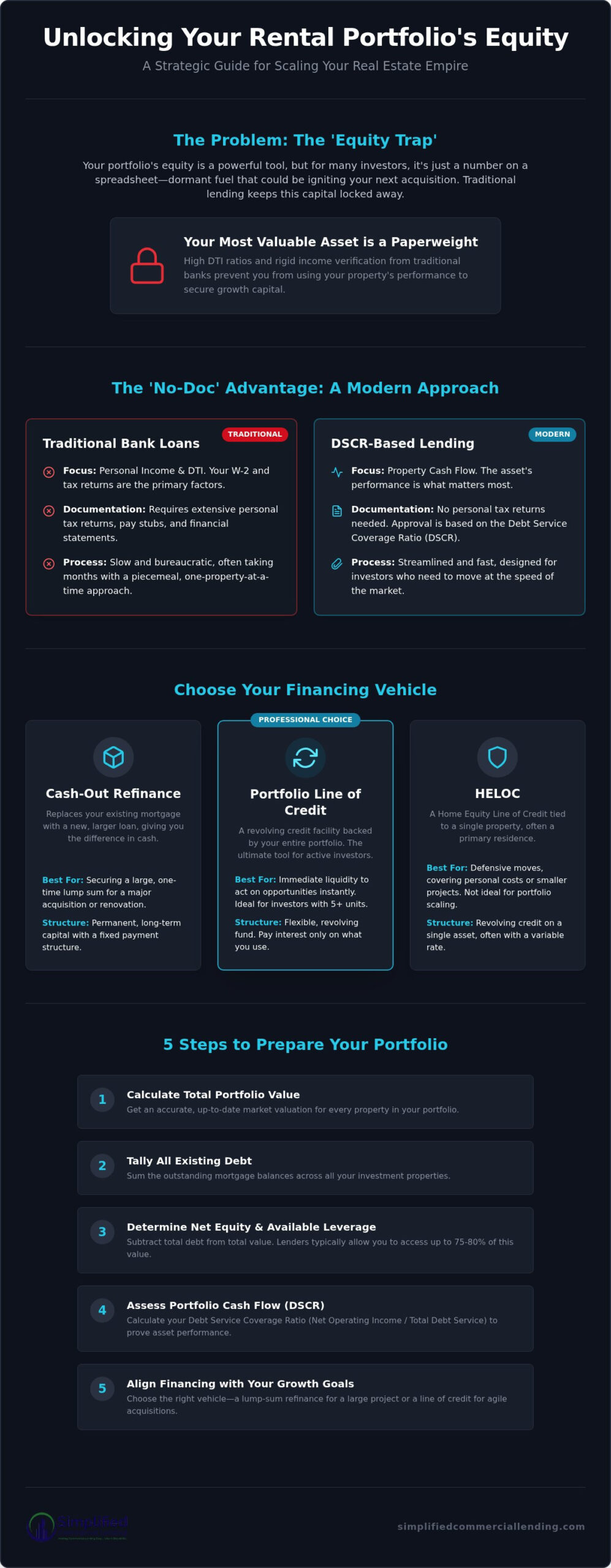
5 Steps to Successfully Tap Your Rental Portfolio Equity
Extraction isn’t an accident. It’s the result of a deliberate, step-by-step process designed to maximize your liquidity while minimizing your risk. To tap equity from rental portfolio assets effectively, you must move beyond the “wait and see” approach of traditional landlords. You are an asset manager now. Follow these five steps to turn your dormant equity into a high-octane growth fund.
- Step 1: Audit your portfolio. Calculate the current market value of every property and subtract the outstanding debt. This is your baseline.
- Step 2: Define your strategy. Are you buying more single-family homes or moving into industrial spaces? Your next move dictates the type of capital you need.
- Step 3: Select your vehicle. Decide between the flexibility of a Portfolio Line of Credit or the stability of a Cash-Out DSCR loan.
- Step 4: Organize your file. Gather your property-level data. This includes current leases, rent rolls, and insurance declarations.
- Step 5: Partner with an expert. Connect with a specialized commercial mortgage broker who understands non-bank lending.
Auditing for Maximum Leverage
Start with a deep dive into your current holdings. Use a commercial property loan framework to assess your assets. Look for “lazy” equity. If you have properties with loan-to-value (LTV) ratios below 50%, you have capital that isn’t working for you. In a 2026 market where national home price growth is projected to be 0%, you cannot rely on appreciation alone to build wealth. You must manufacture your own growth by re-leveraging these stagnant assets. Secure updated appraisals to ensure your data reflects today’s reality, not the market from three years ago.
Organizing Your ‘No-Doc’ File
The beauty of non-bank lending is the lack of personal tax return requirements. However, “no-doc” doesn’t mean “no-data.” You need to prove the performance of the properties themselves. Your Schedule of Real Estate Owned (SREO) is the most critical document in your file. It provides a snapshot of your entire portfolio’s health, including income, expenses, and debt service. Pair this with a professional Investor Profile that highlights your track record and management experience. When you tap equity from rental portfolio holdings, you are selling the lender on your expertise and the asset’s cash flow. Present a clean, organized package to accelerate your approval time. Ready to see what your properties are truly worth? Get a custom quote on your portfolio today and start your next acquisition phase.
Scaling Your Real Estate Empire with Simplified Commercial Lending
You’ve identified your dormant equity. You’ve seen the “no-doc” advantage. Now you need a partner who speaks the language of growth. Simplified Commercial Lending exists because traditional banks are too slow and too rigid for the modern investor. We don’t just provide loans. We provide the fuel for your next acquisition. By focusing on property cash flow rather than your personal tax returns, we empower you to scale without the typical bureaucratic friction. It’s time to tap equity from rental portfolio holdings and turn your current assets into a springboard for future wealth.
Our “entrepreneur-first” mindset is built into our DNA. While a local bank might take 60 days to tell you “no” because of a complex DTI ratio, we look for reasons to say “yes.” We serve investors nationwide with a diverse product suite that handles everything from single-family portfolios to large apartment complexes. Consider a 10-unit investor we partnered with recently. They were sitting on significant equity but couldn’t get a traditional bank to listen. We helped them tap equity from rental portfolio assets to secure a 20-unit complex in less than a month. They didn’t wait for rates to be “perfect.” They moved when the deal was right.
Customized Solutions for Every Asset Class
Investors in 2026 aren’t just buying houses. You might be diversifying into short term rental financing for a high-yield Airbnb portfolio. Or perhaps you’re looking at retail centers, warehouses, and industrial assets. We specialize in structuring blanket loans that wrap these diverse asset classes into a single, manageable facility. This approach maximizes your borrowing power and simplifies your debt management across mixed-use portfolios. We understand that a warehouse has different needs than a duplex. Our team builds the loan around the asset’s specific performance.
Your Next Step Toward 100 Units
Speed is your greatest competitive advantage. In a market where inventory is tight, the ability to close in weeks rather than months is what wins deals. Non-bank capital moves at the speed of business, not at the pace of a bank committee. Our senior brokers are ready to conduct a portfolio strategy session to help you map out your path to 100 units and beyond. We help you look at your entire balance sheet to find hidden opportunities for reinvestment. Don’t let your capital sit dormant for another year while other investors snap up the best properties. Get a custom quote to tap your portfolio equity today and turn your current success into a massive expansion.
Turn Your Portfolio Into a High-Velocity Growth Engine
Your rental properties are more than just monthly rent checks; they are the foundation for your next level of wealth. We have explored how to effectively tap equity from rental portfolio holdings by prioritizing asset performance over personal tax returns. By leveraging DSCR loans and specialized portfolio lines of credit, you can bypass the rigid barriers of traditional banking once and for all. You no longer have to choose between legal tax deductions and your ability to scale your empire. Stop letting your capital sit idle while opportunities pass you by.
Simplified Commercial Lending is here to help you move at the speed of the 2026 market. We serve investors nationwide with a streamlined process that doesn’t require personal income verification. Our team can close your loan in as little as 21 days with no tax returns required. It is time to stop viewing your equity as a passive number and start using it as active fuel for your acquisitions. Scale your portfolio today; get a No-Doc Equity Quote from Simplified Commercial Lending. Your next acquisition is closer than you think, and we are ready to help you reach it.
Frequently Asked Questions
Can I tap equity from a rental portfolio if I have a low personal credit score?
You can often tap equity from rental portfolio holdings even with a lower credit score because the property’s performance takes center stage. While traditional banks usually demand a score of 680 or higher, DSCR lenders prioritize the debt service coverage ratio. If the property generates enough income to cover its debt, your personal credit becomes a secondary factor. We focus on the asset’s cash flow to ensure your growth isn’t blocked by personal financial metrics.
How many properties do I need to qualify for a portfolio line of credit?
Most portfolio lines of credit require a minimum of five properties to qualify. This financing vehicle is specifically designed for investors who have moved beyond the single-property stage and need a unified capital source. By grouping five or more single-family homes or a multi-family building with five or more units, you create a larger borrowing base. This consolidation allows you to manage your debt more efficiently while preparing for your next high-impact acquisition.
Is it better to do a cash-out refinance on one property or a blanket loan on the whole portfolio?
A blanket loan is generally superior for investors with multiple assets because it treats the portfolio as a single entity. While a cash-out refinance on one property provides a lump sum, a blanket loan allows you to leverage the collective value of all your holdings. This is especially useful in 2026 when national home price growth is flat. It simplifies your management and often provides more favorable terms than juggling several individual mortgages.
Do I need to show my personal tax returns to get a DSCR loan in 2026?
You do not need to provide personal tax returns to qualify for a DSCR loan in 2026. This is the core of the no-doc advantage. Lenders look at the rental income and net operating income of the property itself rather than your W2 or personal filings. This approach is perfect for self-employed entrepreneurs who use legal deductions to reduce their taxable income. Your ability to scale is based purely on your property’s performance.
What is the maximum LTV (Loan-to-Value) I can get when tapping equity from rentals?
The maximum loan-to-value (LTV) for tapping equity from an investment portfolio typically ranges between 70% and 80%. While primary residences might allow for higher leverage, investment properties require a slightly larger equity cushion to manage risk. In the current 2026 market, keeping your LTV around 75% often helps you secure the most competitive interest rates. This balance protects your cash flow while still providing a significant strike fund for new deals.
How long does the process take compared to a traditional bank loan?
Non-bank commercial loans typically close in 21 to 30 days, which is significantly faster than the 60 to 90 days required by traditional banks. Because we skip the exhaustive personal income audit, the underwriting process is streamlined and focused on property data. This speed is a massive advantage in a tight market with low inventory. You can move from identifying an opportunity to tap equity from rental portfolio assets to closing a new deal in weeks.
Can I use the equity from my long-term rentals to finance a short-term rental (Airbnb) purchase?
Yes, you can absolutely use the equity from your long-term rentals to finance the purchase of a short-term rental or Airbnb. This is a classic example of the velocity of capital in action. By extracting dormant value from a stable, long-term asset, you can fund a higher-yield investment in the vacation rental sector. We offer specialized short-term rental financing to help you bridge that gap and diversify your income streams across different asset classes.
What happens if one property in my portfolio is underperforming?
If one property in your portfolio is underperforming, a blanket loan can actually help you maintain your leverage. The lender looks at the global DSCR of the entire portfolio rather than just the one struggling unit. The strong cash flow from your other properties offsets the weaker one, allowing you to still access capital. This collective strength provides a safety net that individual property loans simply cannot offer, making it easier to scale.