Why are you letting a tax return from two years ago stop you from buying a high-performing short-term rental today? Most traditional lenders still treat the vacation rental market like a risky hobby. They obsess over your personal debt-to-income ratio while ignoring the actual revenue potential of the asset. It’s a rigid, outdated system that penalizes ambitious investors for having personal expenses or complex tax filings. You know your target property will cash flow, but the bank only sees a paper trail that doesn’t reflect your future success.
You need a financing partner that speaks the language of real estate, not just bureaucracy. This guide reveals how to secure airbnb investment property loans using the property’s own projected income to qualify. You can finally stop worrying about personal tax returns and start focusing on your next acquisition. We’ll explore the 2026 DSCR landscape, explain how to use 75% to 80% of projected rental income for qualification, and outline a clear path to scaling from one unit to a full portfolio. Let’s look at how you can close faster and build the wealth you’ve planned for.
Key Takeaways
- Learn how DSCR loans prioritize a property’s income potential over your personal tax returns, allowing you to bypass traditional debt-to-income hurdles.
- Discover the exact 2026 qualification benchmarks, including why a 1.20 debt service coverage ratio and a 680 credit score are your keys to the best rates.
- Master the strategy for scaling your portfolio by using airbnb investment property loans to acquire multiple units without hitting a personal borrowing ceiling.
- Understand the formula used to calculate a property’s debt-paying ability and why tax write-offs won’t hurt your chances with non-bank lenders.
- Find out how accessing private equity and specialized brokers can help you close on lucrative short-term rentals faster than traditional banking allows.
The Tax Return Trap: Why Traditional Airbnb Loans Fail Investors
Traditional banks live by a rulebook written for a different era. They want steady paychecks and predictable W-2s. If you’re a savvy real estate investor, you likely use every legal tax deduction available to minimize your liability. It’s a smart business move. However, when you apply for airbnb investment property loans at a big-box bank, those write-offs become your worst enemy. The bank looks at your bottom line after deductions and decides you don’t “earn” enough to cover the mortgage. They’re effectively penalizing you for being efficient with your taxes.
The Problem with Debt-to-Income (DTI)
Banks use a rigid Debt-to-Income ratio to decide your worthiness. They take your personal debts, like your primary mortgage or car payments, and weigh them against your taxable income. This creates a ceiling for your growth. Once your DTI hits a certain percentage, the bank shuts the door. It doesn’t matter if the property you’re eyeing is a cash cow. They focus on your personal expenses rather than the asset’s potential. You’ve likely felt the frustration of the endless document request loop. They ask for two years of tax returns, then three months of bank statements, then a letter explaining a minor deposit. It’s a slow, bureaucratic grind that kills deals in a fast-moving market.
Short-Term Rental Stigma in Traditional Banking
Most conventional underwriters are terrified of the vacation rental market. They prefer the safety of a one-year lease agreement. When they see a property relying on nightly stays, they label the income as “unreliable” or “speculative.” This stigma is often fueled by evolving short-term rental regulations across different cities. Banks don’t want to risk a loan on a property that might face new local restrictions next year. They don’t have the expertise to analyze seasonal demand or occupancy rates.
This conservative mindset prevents you from using realistic projections to qualify. Even if you have professional data showing six-figure potential, a traditional bank will likely ignore it. Beyond the income hurdles, you also face the 10-loan limit. Conventional financing typically caps an individual at ten financed properties. If you want to build a real portfolio, you need to break away from these institutional constraints. You need a partner that values the property’s performance over your personal tax history. It’s time to stop letting your W-2 dictate your investment potential.
What are DSCR Loans for Airbnb and How Do They Work?
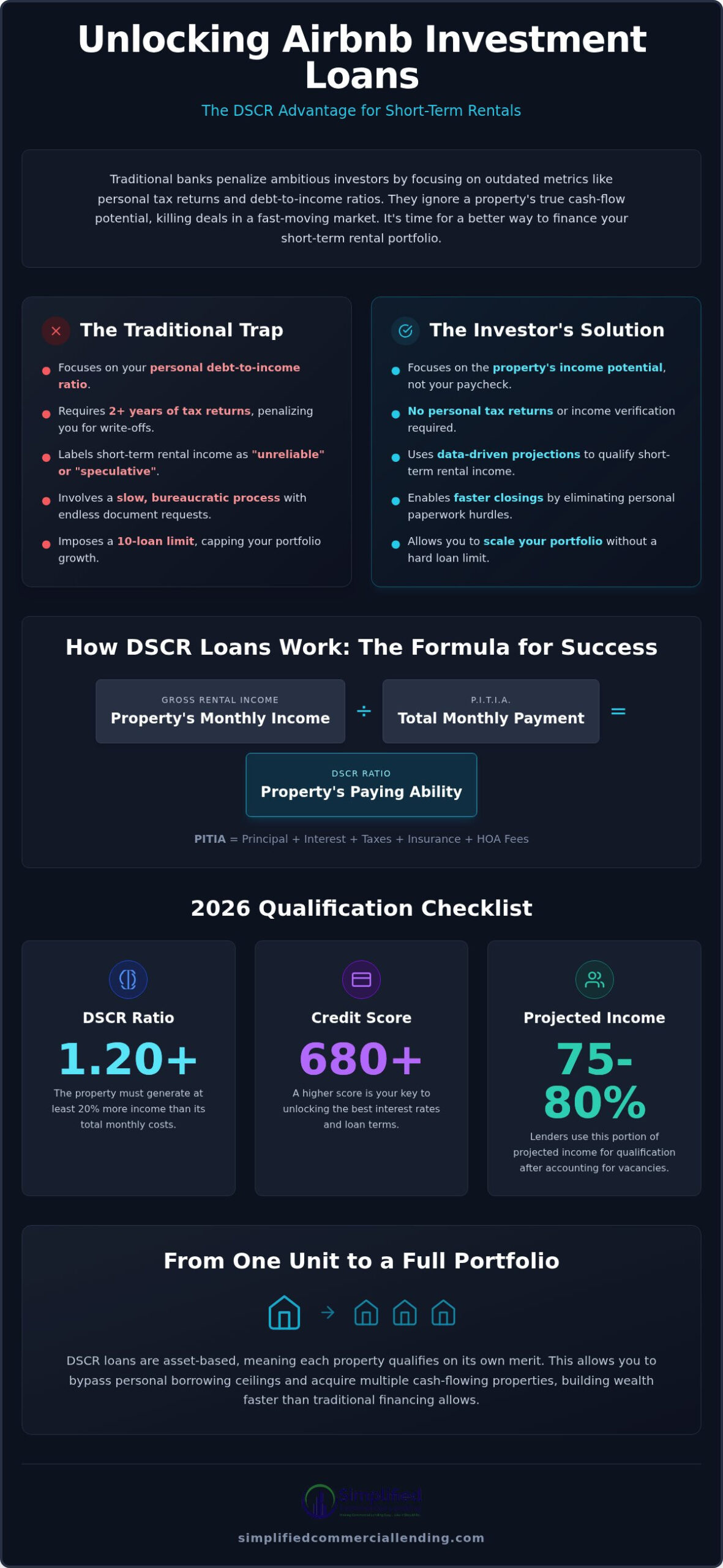
DSCR stands for Debt Service Coverage Ratio. It is a straightforward way to measure if a property can pay for itself. Unlike the tax-return-heavy process at a local bank, this financing focuses entirely on the property’s performance. It is the engine behind most modern airbnb investment property loans. By looking at the asset rather than your personal paycheck, lenders can provide capital to entrepreneurs who have high cash flow but significant tax deductions.
The math is simple. You take the Monthly Gross Rental Income and divide it by the PITIA. PITIA includes your Principal, Interest, Taxes, Insurance, and any HOA fees. Most lenders in 2026 look for a ratio of 1.25 or higher. This means your property generates 25% more income than the cost of the mortgage. While you don’t need tax returns, your credit score still carries weight. A score of 680 or higher is typically the baseline to unlock competitive rates and higher leverage. If you have a lower score, you might face stricter reserve requirements or higher down payments.
Calculating Income for Short-Term Rentals
How does a lender verify income for a property you don’t own yet? They use a mix of historical 12-month statements and market projections. In 2026, underwriters rely heavily on specialized short-term rental data aggregators and market analytics tools to estimate revenue per available rental and occupancy rates. Lenders typically apply a 20% to 25% haircut to these projections to account for vacancies and operating expenses. Having a professional property management agreement in place can often strengthen your case. It shows the lender that the asset is in expert hands, which helps mitigate the risks of seasonal income swings and ensures the property stays competitive in a crowded market.
The No-Doc Advantage
The “no-doc” label is often misunderstood. It doesn’t mean zero paperwork; it means zero personal income verification. You can keep your tax returns private and avoid the headache of explaining every business deduction to a skeptical underwriter. This streamlined approach lets you close deals in weeks, not months. You can focus your energy on finding high-quality locations rather than digging through boxes of old paystubs. If you are ready to see how your target property stacks up, you can explore short-term rental financing options that prioritize your growth. DSCR is the ultimate tool for the tax-savvy investor because it leverages property cash flow to build wealth without the constraints of personal income reporting.
Case Study: Scaling from One Unit to a 5-Property Airbnb Portfolio
Imagine an investor named Sarah. She had $400,000 in equity in her primary residence and a sharp eye for mountain cabins. Sarah was a freelance consultant. Her tax returns showed heavy business deductions, which made her “on-paper” income look insufficient to a traditional bank. Despite having the capital for a down payment and properties with massive revenue potential, she was stuck. Traditional lenders saw her as a risk. They ignored the cash flow of the cabins and obsessed over her personal DTI ratio.
Sarah pivoted to a different strategy. She stopped trying to convince banks of her personal worthiness and started using DSCR loans for Airbnb. This move allowed her to secure her first two units by proving the properties themselves could cover the debt. Within six months, those two units were generating consistent, high-yield revenue. This cash flow became the foundation for her next move. By focusing on airbnb investment property loans that prioritize asset performance, she bypassed the tax return trap entirely.
The Power of the Portfolio Line of Credit
Once Sarah had three units performing, she didn’t stop to wait for more personal savings. She transitioned her individual debts into a portfolio line of credit. This financial tool treats your properties like a revolving door of capital. Instead of managing five different mortgages with five different due dates, she consolidated them into one streamlined facility. This gave her the liquidity to tap into her existing equity and purchase three more units in rapid succession. You can explore similar short term rental financing options to see how a portfolio approach can accelerate your own growth. Sarah’s strategy turned her real estate into a self-funding machine.
Speed as a Competitive Edge
Sarah’s success wasn’t just about the money. It was about the speed of execution. In a competitive 2026 market, she was closing deals in 21 days while other buyers were stuck in a 60-day bank slog. Her financing felt “non-contingent” to sellers because she didn’t have to wait for a personal income audit. This efficiency allowed her to win bidding wars without necessarily being the highest bidder. In just 18 months, she built a portfolio valued at over $2M. She made the psychological shift from a frustrated borrower to a confident portfolio owner, proving that airbnb investment property loans are the ultimate multiplier for your ambition.
How to Qualify for Airbnb Investment Property Loans in 2026
Qualifying for airbnb investment property loans in 2026 is about proving the property’s value, not your personal lifestyle. You don’t need to hand over a decade of tax returns; you do need a clear strategy. Start by identifying a property where the math works. Aim for a projected DSCR of 1.20 or higher to ensure you qualify for the best leverage. Next, check your credit. While we don’t verify income, we do verify creditworthiness. Targeting a 680 score or higher unlocks lower interest rates and reduces your down payment requirements.
Prepare your ‘No-Doc’ package early. This includes your LLC formation documents, two months of bank statements to show liquidity, and any existing short-term rental history if you’re refinancing. The appraisal is the most critical hurdle. You must ensure the appraiser includes a Small Residential Income Property Report. This specific document analyzes market rents and short-term potential. It provides the data our underwriters use to green-light the deal. Finally, close with a lender who understands the Airbnb ecosystem. Traditional banks often fumble STR appraisals; we specialize in them.
Preparing Your Asset-Based Application
Your LLC structure is vital. Commercial lenders prefer lending to entities rather than individuals. It protects your personal assets and simplifies the closing process. You’ll also need to document your ‘reserves.’ Most lenders in 2026 require liquid cash to cover 3 to 6 months of mortgage payments. Even in a no-doc world, a clean 1003 application matters. Accuracy on your basic info prevents delays during the final review. It shows the lender you’re a professional operator who values precision.
Choosing Your Loan Terms
Do you want long-term stability or maximum monthly cash flow? A fixed-rate 30-year mortgage offers peace of mind. However, interest-only options are popular for investors looking to maximize their immediate take-home pay. Be aware of prepayment penalties. Accepting a three-year penalty can often lower your interest rate significantly. In some cases, a specialized vacation rental property loan is better than a standard DSCR product. These loans are designed to account for the unique seasonality of tourist markets. If you’re ready to see what you qualify for, you can get a custom loan quote today and start your next acquisition with confidence.
Simplify Your Growth with Simplified Commercial Lending
Stop acting like a petitioner at a rigid institutional bank. You’re building a business, and you need a partner who values your vision more than your personal tax history. We operate as brokers, not bankers. This is a critical distinction for your bottom line. A banker only has one set of rules. If you don’t fit their narrow box, they simply say no. We shop the entire market for you. We have direct access to private equity and non-bank lenders you won’t find on Google. These are institutions that specifically seek out airbnb investment property loans because they understand the high-yield potential of the short-term rental market.
Our “Success First” approach means we’re in the trenches with you. We don’t get paid a dime unless your loan closes. This aligns our interests perfectly with yours. We aren’t here to collect application fees or drag you through months of bureaucracy. We’re here to help you secure capital and close on properties before your competition even gets a callback from their local credit union. We provide the disruptive alternative to the status quo, giving you the speed and flexibility required to dominate your local market.
Why Investors Choose Us
We’ve built our reputation on removing the obstacles that slow you down. Most of our lending products require zero tax returns. We look at the asset’s ability to generate revenue, not how many deductions your CPA claimed last year. Whether you’re buying a single-family beach house or looking for airbnb investment property loans for a multi-unit complex, we have the specialized knowledge to get it done. We offer nationwide reach, meaning we can finance your entire US portfolio under one roof. Our team speaks “investor,” not “legalese.” We focus on practical outcomes and streamlined procedures so you can spend your time managing guests, not paperwork.
Take the Next Step Toward Your 2026 Goals
Don’t let your tax strategy block your financing. It’s time to leverage the property’s own cash flow to build your wealth. You can get a quote in minutes, not weeks. We provide the direct guidance you need to make your next move with confidence. Whether you’re looking for Short Term Rental Financing or a Portfolio Line of Credit to tap into your existing equity, we have the tools to make it happen. Stop waiting for the banks to catch up to the modern economy. Get your Airbnb loan quote today and start scaling your portfolio on your own terms.
Dominate the 2026 Short-Term Rental Market
The vacation rental market is moving too fast for traditional banking. You don’t have to let outdated debt-to-income ratios or complex tax filings stall your ambitions. By switching to a DSCR model, you shift the focus from your personal paycheck to the revenue potential of your assets. This strategy allows you to build a resilient, high-yield portfolio without the constant document requests that kill momentum.
Securing airbnb investment property loans should be a catalyst for your growth, not a bureaucratic hurdle. We provide the shortcut you’ve been looking for with no tax returns required and access to exclusive non-bank capital that traditional lenders can’t offer. Our team is ready to help you close in as little as 21 days so you can win more bids and scale faster. Stop justifying your business to a bank and start growing it on your own terms.
Scale your portfolio without tax returns—get started with Simplified Commercial Lending. Your next acquisition is closer than you think.
Frequently Asked Questions
Can I get an Airbnb loan with no tax returns?
Absolutely. You can bypass the tax return requirement by using a DSCR loan, which focuses entirely on the property’s revenue potential. This is a game changer for investors who use legal deductions to lower their taxable income but still have high-performing assets. Instead of tax forms, we review bank statements and the property’s income projections to verify that the deal makes sense for your portfolio.
What is the minimum DSCR ratio required for a short-term rental?
Most lenders in 2026 look for a minimum DSCR of 1.25 to offer the most competitive pricing. This means the property’s gross income should be at least 25% higher than the total mortgage payment, including taxes and insurance. While some programs allow for a 1.20 ratio or even a 1.00 ratio with higher credit scores, reaching that 1.25 benchmark usually unlocks the best leverage and interest rates for your acquisition.
Do I need to have a property management company to qualify?
You don’t always need a professional property manager to qualify, but it can help. Lenders often feel more comfortable when an expert is handling the daily operations and guest relations. If you choose to self-manage, you may need to show a history of successful hosting or provide a more robust reserve of liquid cash. Some specific airbnb investment property loans might require professional management if the market is highly competitive.
Can I use projected income from market data reports to get a loan?
Yes, underwriters utilize independent short-term rental analytics to verify potential revenue for properties without a 12-month history. These specialized market reports estimate occupancy and nightly rates based on similar local listings. Lenders typically apply a 20% to 25% haircut to these projections to account for vacancies and expenses. This data-driven approach ensures the loan is supported by realistic market performance rather than just hopeful guesses.
How much down payment is required for an Airbnb investment property?
Expect to put down between 15% and 25% for a short-term rental investment. While some specialized programs in 2026 offer a 10% down payment for high-credit borrowers, the 20% mark is the standard for most DSCR products. A larger down payment not only improves your debt service coverage ratio but also lowers your monthly interest expense, which directly increases your net cash flow and the overall health of your investment.
Are interest rates higher for Airbnb loans than primary residences?
Yes, interest rates for airbnb investment property loans typically run 1% to 2% higher than those for a primary home. Lenders charge this premium to account for the increased risk associated with investment properties. Despite the higher rate, these loans are often more profitable because the property qualifies based on its own income. This allows you to scale your portfolio much faster than you could with a traditional, lower-rate mortgage.
Can I refinance an existing Airbnb to pull out equity?
You can certainly use a cash-out refinance to tap into your property’s equity and fund your next purchase. Most lenders allow you to pull out up to 75% of the appraised value, provided the property still meets the required DSCR thresholds. This is a core strategy for investors looking to scale quickly. It turns your existing units into a source of capital for new acquisitions without requiring you to save for a new down payment.
What property types are eligible for these loans?
Eligible properties include single-family homes, multi-family residential units up to four doors, and townhomes. Some programs also cover condotels or units in resort communities, provided the local zoning and HOA rules allow for short-term stays. The property must be used strictly for investment purposes and cannot be a primary residence. As long as the asset is a dedicated rental, it can likely be financed through our asset-based lending programs.