Why should your personal 1040 determine the fate of a high-performing Airbnb in a prime market? If you’ve been blocked by high DTI ratios or the friction of providing years of tax returns, you aren’t alone. Traditional lenders often fail to grasp the massive income potential of the short-term rental market. Securing loans for vacation rental properties shouldn’t require you to jump through hoops that have nothing to do with the asset’s performance. You’ve found a property that generates cash; your financing should focus on that success.
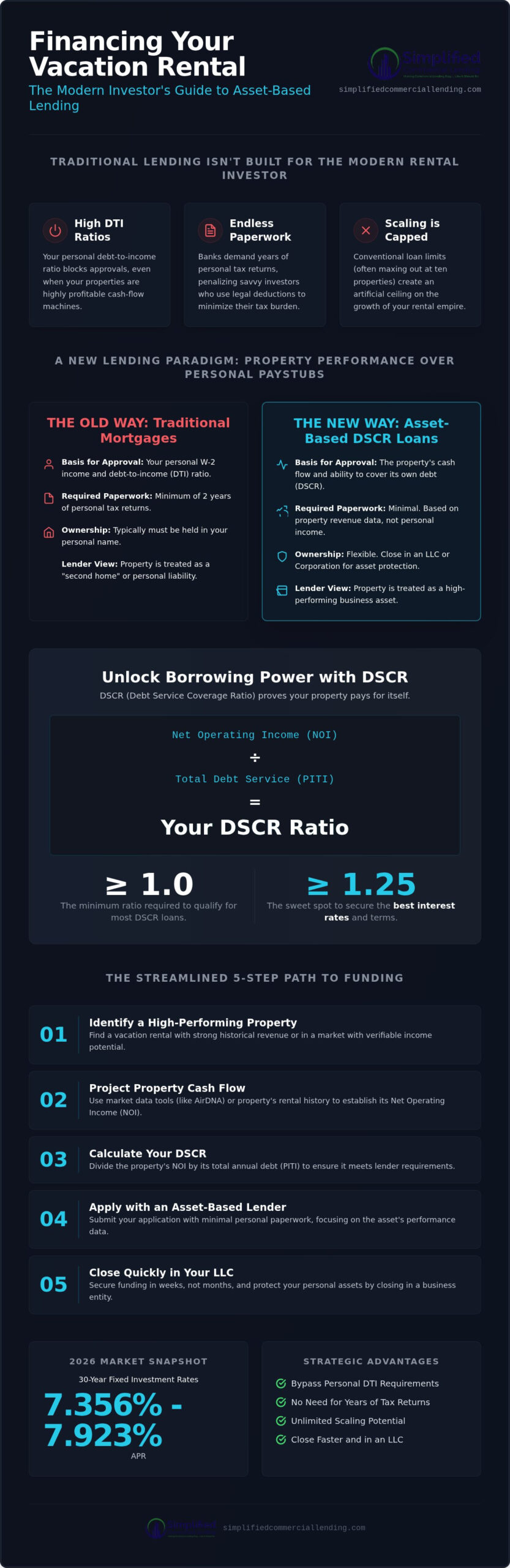
We believe that your investment’s potential matters more than your personal debt profile. This guide will show you how to secure financing using property cash flow to bypass traditional banking bottlenecks. You’ll learn how to leverage DSCR loans to scale your portfolio quickly while keeping your personal paperwork to a minimum. We’ll also break down the 2026 market, where 30-year fixed investment rates currently sit between 7.356% and 7.923% APR. Get ready to stop chasing approvals and start closing deals.
Key Takeaways
- Learn why 2026 investors are moving away from traditional banks toward asset-based financing that treats short-term rentals as high-performing business assets.
- Master the Debt Service Coverage Ratio (DSCR) to calculate your borrowing power based on your property’s Net Operating Income rather than your personal salary.
- Discover the streamlined 5-step process to secure loans for vacation rental properties without the friction of providing years of personal tax returns.
- Evaluate the trade-offs between conventional mortgages and flexible asset-based lending to ensure your financing strategy supports long-term growth.
- Unlock proven strategies for scaling your portfolio by leveraging existing equity to fund new short-term rental acquisitions.
Understanding the Shift: Why Vacation Rental Loans Are Different in 2026
The old way of securing loans for vacation rental properties is dead. Investors used to treat these as “second homes” and qualified based on their personal W-2 income. By 2026, the market has matured into a sophisticated asset class where lenders view these properties as small businesses rather than personal retreats. Understanding the Vacation Rental Market is now essential for any investor who wants to move beyond the hobbyist stage and build a real empire based on asset performance.
Institutional lenders haven’t kept up with this evolution. They still hunt for traditional stability in a modern entrepreneur’s world. They view the seasonal fluctuations of a mountain cabin or a beach house as a liability. Modern non-bank lenders see it differently. They use data and historical revenue to identify high-performing assets. They focus on the numbers that actually matter: the property’s ability to generate cash and cover its own debt.
The Problem with Traditional Mortgages
Traditional banks are built on rigid boxes. If you don’t fit perfectly, you don’t get funded. Their Debt-to-Income (DTI) requirements are a major roadblock for growing investors. As soon as you own a few properties, your personal debt profile looks “risky” to a standard underwriter, even if your rentals are profitable. Then there’s the “two-year tax return” rule. Most savvy investors use legal deductions to minimize their tax burden. Banks see those deductions as a lack of income, creating a catch-22 that kills your momentum. Conventional lenders also cap the number of loans you can hold, usually at ten, which effectively stops you from scaling.
The Asset-Based Alternative
Asset-based lending flips the script by prioritizing property revenue over your personal salary. This approach, often called a DSCR loan, looks at whether the property’s income can cover the mortgage, taxes, and insurance. It offers strategic advantages that traditional banks can’t match:
- Ownership Flexibility: You can close in an LLC or Corporation to protect your personal assets and simplify partnership structures.
- Speed: In competitive markets, you can’t wait 60 days for a bank committee. Asset-based loans for vacation rental properties often close in half that time.
- Unlimited Scaling: Since the loan is tied to the property’s performance, you aren’t limited by personal loan caps.
The 2026 market favors cash-flow-heavy properties. With investment rates currently sitting between 7.356% and 7.923% APR, the spread over primary residences is significant. This makes property performance the only metric that truly matters for your ROI. You don’t need to trade your personal financial privacy for a mortgage; you just need an asset that performs.
How to Calculate Your Property Borrowing Power (DSCR)
Stop looking at your personal paystubs. When you are hunting for loans for vacation rental properties, the only number that truly dictates your success is the Debt Service Coverage Ratio (DSCR). DSCR is the ratio of Net Operating Income to debt obligations. It is the ultimate metric for modern investors because it proves the property can pay for itself without you ever needing to dip into personal savings or provide years of tax returns.
Traditional banks usually choke on the variable nature of short-term rental (STR) income. They want predictable, boring leases. We prefer data. Asset-based lenders use specialized market analysis tools or the property’s actual historical revenue to project future cash flow. This “Simplified” approach allows you to verify income based on market reality rather than your personal tax bracket. While there are many Creative Ways To Finance A Rental Property, using a DSCR model is the fastest way to prove a property’s worth to a lender. Investors who want to go deeper on this topic should explore our complete breakdown of Airbnb investment property loans and no-doc financing strategies for 2026.
The DSCR Formula for Short-Term Rentals
To find your ratio, divide your annual Gross Rental Income by your annual debt service. This debt service includes your principal, interest, taxes, insurance, and any HOA fees (PITI). In 2026, most lenders require a minimum DSCR of 1.0 to qualify. However, aiming for a 1.25 ratio or higher is the sweet spot for securing the best interest rates. You also need to account for seasonal fluctuations. A beach house might earn 70 percent of its revenue in four months. Lenders look at the full annual projection to ensure the highs cover the lows, keeping your momentum steady year-round.
Maximizing Your Ratio
If your ratio is looking thin, focus on reducing property-level expenses to boost your borrowing power. High utility costs or bloated maintenance contracts can drag down your Net Operating Income. Many investors find that professional management companies actually help stabilize income projections. Lenders often give more weight to revenue numbers backed by a firm with a proven track record in the local market. For a deeper look at how to leverage these numbers, read our DSCR Loans for Airbnb: 2026 Short-Term Rental Guide. If you are ready to see how your target property stacks up, you can view your potential loan terms based on its projected cash flow today.
5 Steps to Secure a Vacation Rental Loan Without Tax Returns
Speed is the ultimate currency in real estate. If you are bogged down by a local bank’s paperwork, you will lose the property to a faster investor. Traditional lenders want to see your past; asset-based lenders want to see the property’s future. By focusing on the momentum of the deal rather than the friction of personal tax returns, you can close on loans for vacation rental properties in a fraction of the time it takes for a conventional mortgage. This roadmap is designed for the entrepreneur who values results over bureaucracy.
Step 1: Identify the Right Asset
Qualification starts with the property. Focus on high-yield markets where short-term rental demand is proven and consistent. In 2026, this means doing your homework on local regulations. While states like Idaho and Indiana have passed laws preventing local bans on rentals, cities like New York have issued over $72 million in fines for illegal listings. Hawaii remains the most restrictive state, often limiting rentals to resort-zoned areas. Ensure your target property meets basic safety standards and sits in a zone that welcomes STRs. If the asset doesn’t perform, the loan won’t close, so prioritize revenue potential from day one.
Step 2: Partner with a Specialized Broker
Local retail banks are often the most rigid when it comes to “No-Doc” restrictions. They struggle to categorize loans for vacation rental properties correctly. A specialized commercial broker understands that these are business-purpose assets. They can help you navigate business-purpose credit regulations to ensure your loan is structured for growth rather than personal use. Applying for short term rental financing with non-bank partners allows you to bypass the “tax return trap” and qualify based on the property’s projected income.
Step 3: Document the Property’s Potential
Since you aren’t using your personal 1040s, the property’s data must be bulletproof. Gather historical stay data if the property was previously a rental, or secure professional income estimates from reputable industry market reports. You will need a clear breakdown of projected management fees, maintenance costs, and taxes. This “No-Doc” application package focuses on the property’s ability to cover its own debt service. Once your documentation is ready, the final steps involve a specialized STR appraisal to verify the income projections and a streamlined underwriting process that ignores your personal DTI. This approach keeps your personal financial life private and your portfolio moving forward.
Comparing Your Options: Conventional Mortgages vs. Asset-Based Lending
Choosing the right financing for your short-term rental (STR) is a strategic decision that impacts your entire portfolio. Most investors automatically hunt for the lowest interest rate. However, the “cheapest” loan can often be the most expensive choice for your long-term growth. While conventional mortgages offer lower upfront costs, they come with strings that can tie your hands as you try to scale. Asset-based loans for vacation rental properties offer a different path, prioritizing flexibility and speed over rigid personal qualification.
Conventional Loans: The Personal Path
Conventional loans are designed for individuals, not businesses. They offer attractive rates, but the trade-off is intense personal scrutiny. You’ll need a low debt-to-income (DTI) ratio and a mountain of personal paperwork. There’s also a hard cap on how many properties you can finance, usually ten. If you plan to build a larger empire, you’ll hit this wall quickly. Worse, many conventional “second home” loans prohibit using the property purely for short-term rental business. If a lender discovers your “vacation home” is actually a full-time Airbnb, they could technically call the loan due immediately. This creates a massive risk for professional operators.
Asset-Based Loans: The Professional Path
Asset-based lending treats your property like the business it is. Qualification relies on the property’s cash flow, not your personal salary. This allows for unlimited scaling because each new property is evaluated on its own merits rather than your personal debt load. You can also close in an LLC. This provides essential liability protection and makes it easier to manage partnerships. While rates for these loans for vacation rental properties are typically 0.5% to 2% higher than primary residences, the ability to close quickly and scale without limits often outweighs the interest cost. It’s about buying your time and momentum back from the bank. For investors ready to move beyond conventional restrictions, our guide to no-doc Airbnb investment property loans explains exactly how to qualify using projected rental income instead of personal financials.
In 2026, the barrier to entry remains your credit and capital. You’ll typically need a credit score of at least 620 to 680 to enter the space, though a 740 or higher secures the best pricing. Expect to put down 20% to 25% to secure favorable terms. This skin in the game ensures both you and the lender are aligned on the property’s success. If you are tired of the personal scrutiny and ready to be treated like a professional investor, apply for short-term rental financing today to see how much your property can borrow based on its own merit.
Scaling Your Portfolio: Moving from One Unit to a Vacation Rental Empire
Owning one successful Airbnb is a win. Owning ten is a business empire. To bridge that gap, you must stop viewing each acquisition as an isolated event. Scaling requires a shift from individual loans for vacation rental properties to a cohesive portfolio strategy. This approach allows you to leverage the equity sitting in your current properties to fund your next move without waiting years to save up a down payment. Professional investors don’t wait for the perfect moment; they create liquidity by using their existing assets as a springboard for growth.
As you grow, your management systems must grow with you. Lenders look for stability when you move into multi-unit financing. If your operations are messy, your risk profile increases. Streamlined management isn’t just about guest satisfaction; it’s about protecting your Net Operating Income. High-performing properties with clean books attract institutional-grade financing options that are unavailable to the hobbyist. You are no longer just a “host”; you are a portfolio manager directing a fleet of revenue-generating assets.
The Power of a Portfolio Line of Credit
Managing five separate mortgages with five different lenders is a logistical nightmare that slows you down. A portfolio line of credit for rentals simplifies your financial life by consolidating multiple properties under a single debt structure. This tool provides instant liquidity. You can draw on your credit line to make all-cash offers on new properties, giving you a massive advantage in competitive 2026 markets. Because you’ve already established the value of your portfolio, you can often bypass individual appraisals for new acquisitions. This speed allows for lightning-fast deal execution that traditional bank-bound investors simply cannot match.
Executing Your Growth Strategy
Growth isn’t just about adding more units. It’s about making your existing units more profitable. Reinvest your cash flow into property upgrades that drive higher nightly rates and better occupancy. This increases your overall DSCR, which in turn increases your borrowing power for future loans for vacation rental properties. Diversification is also a critical part of the professional path. Don’t put all your cabins in one mountain range. Spread your risk across different vacation markets to protect your income from local regulatory changes or seasonal shifts. This strategic spread makes your portfolio more resilient and more attractive to lenders. Ready to scale? Get a customized loan quote from Simplified Commercial Lending and see how a portfolio-first approach can accelerate your journey to a rental empire today.
Take Control of Your Investment Future
The landscape of 2026 property investment has shifted. You no longer need to be held back by traditional bank bureaucracy or restrictive DTI ratios. By focusing on property cash flow instead of personal tax returns, you unlock a level of flexibility that traditional mortgages can’t match. Mastering the DSCR and choosing asset-based loans for vacation rental properties allows you to scale your portfolio with speed and precision. Whether you are closing on your second unit or your tenth, the key is using the right financial tools for the job.
Simplified Commercial Lending acts as your expert navigator in this competitive market. We offer national expertise in STR and Airbnb financing, providing asset-based lending that prioritizes your property’s potential. From individual acquisitions to portfolio lines of credit for rapid scaling, we help you bypass common industry bottlenecks. It’s time to stop jumping through hoops and start building real equity. Secure your vacation rental financing without the tax return headache today. Your next high-performing property is waiting, and you now have the roadmap to claim it.
Frequently Asked Questions
Can I get a loan for a vacation rental without showing my personal tax returns?
Yes, you can secure loans for vacation rental properties without providing personal tax returns by choosing asset-based financing. These loans focus on the property’s ability to generate revenue rather than your personal salary or debt-to-income ratio. This “No-Doc” approach is a strategic advantage for entrepreneurs who maximize legal tax deductions, which often make their personal income appear lower to traditional bank underwriters. It keeps your personal financial life private while prioritizing the deal’s momentum.
What is the minimum down payment required for a short-term rental loan in 2026?
You will typically need a down payment of 20% to 25% for a short-term rental loan in 2026. This standard requirement ensures you have significant skin in the game, which aligns your interests with the lender’s goals. While some primary residence loans allow for lower percentages, investment-grade assets require this higher threshold to secure the most competitive interest rates. Having these funds ready allows you to move quickly when a high-performing property hits the market.
How does a DSCR loan differ from a traditional mortgage for an Airbnb?
A DSCR loan qualifies you based on the property’s Net Operating Income, whereas a traditional mortgage relies on your personal W-2 income and DTI ratio. Traditional banks often struggle with the volatility of Airbnb revenue and may limit the number of properties you can own. In contrast, DSCR loans allow you to close in an LLC for liability protection and offer unlimited scaling potential. This makes them the professional choice for serious portfolio builders who value flexibility.
Do I need to have a management company in place to qualify for STR financing?
You don’t always need a professional management company to qualify, but having one can stabilize your income projections in the eyes of a lender. Many asset-based lenders give more weight to revenue data backed by a firm with a proven local track record. If you plan to self-manage, you must provide robust historical data or professional estimates to prove the property can cover its own debt service without a third-party operator. It is about proving performance.
Can I use a portfolio line of credit to buy more vacation rental properties?
Yes, you can use a portfolio line of credit to unlock equity from your current rentals and fund new acquisitions instantly. This strategy provides the liquidity needed to make all-cash offers in competitive markets without waiting for individual property refinances. It consolidates your debt into a single, manageable structure, bypassing the need for multiple appraisals and closing processes. It’s the ultimate tool for moving from a single unit to a vacation rental empire with speed.
Is it possible to finance a vacation rental property through an LLC?
Financing through an LLC is not only possible but often preferred for asset-based loans for vacation rental properties. This structure provides a layer of liability protection that keeps your personal assets separate from your business risks. Unlike conventional loans that usually require you to sign in your own name, asset-based lenders encourage corporate ownership. This makes it easier to manage partnerships and simplifies the process of transferring or scaling your business holdings as you grow.
What happens if my vacation rental has a slow season-will it affect my loan?
Slow seasons won’t affect your loan as long as the annual revenue projections meet the lender’s DSCR requirements. Underwriters look at the full twelve-month performance to ensure high-season peaks cover low-season troughs. For example, a ski resort cabin might earn the bulk of its income in winter, but the loan is structured based on the total yearly cash flow. Lenders typically require 3 to 6 months of cash reserves to handle these seasonal fluctuations safely.