Why are you still handing over three years of personal tax returns to a bank that doesn’t understand your business? The biggest obstacle to your next industrial acquisition isn’t the property price. It’s the outdated paperwork requirements of traditional lenders that move at a snail’s pace. If you’ve found the perfect facility, you need a warehouse purchase loan that prioritizes the asset’s potential over your personal income history. You shouldn’t lose a competitive deal because a loan officer is stuck in a bureaucratic loop.
It’s exhausting to feel like you’re being audited just to grow your portfolio. You deserve a clear path to closing that values property cash flow and speed. This guide will show you exactly how to master industrial financing in 2026. We’ll clarify the difference between property loans and bank-level warehouse lending so you don’t waste time on the wrong products. You’ll learn how to identify financing that skips the tax return headache and provides a streamlined roadmap to securing your next industrial asset.
Key Takeaways
- Understand the critical difference between lender credit lines and a warehouse purchase loan for physical industrial assets.
- Compare SBA 504, CMBS, and private loan options to maximize your leverage and secure competitive 2026 interest rates.
- Learn how to qualify based on property cash flow (DSCR) rather than your personal income or tax history.
- Follow a streamlined 5-step roadmap designed to bypass traditional bank bottlenecks and close deals faster.
- Discover how asset-based lending allows you to scale your industrial portfolio with minimal documentation and maximum speed.
What is a Warehouse Purchase Loan?
Don’t let the terminology trip you up. If you search for “warehouse lending” in a standard banking portal, you’ll likely find jargon about credit lines for mortgage originators. That’s not what you need. A warehouse purchase loan is a commercial mortgage specifically designed for the acquisition of physical industrial buildings. It’s a straightforward path to owning the dirt and the structure, providing you with a tangible asset that generates real value. While traditional institutions might bury you in red tape, modern industrial financing focuses on the property’s ability to pay for itself.
These are specialized commercial property loans that cover a wide range of industrial facilities. You can use this financing for several asset types:
- Distribution Centers: Large scale hubs for logistics and shipping.
- Cold Storage: Specialized refrigerated units for food and pharmaceutical storage.
- Flex Spaces: Buildings that combine office space with light industrial or storage areas.
- Manufacturing Hubs: Facilities equipped for heavy production and assembly.
Why Industrial Real Estate is the 2026 Power Move
The demand for industrial space is exploding. As we move through 2026, the rise of e-commerce continues to reshape the map, creating a desperate need for “last-mile” delivery hubs. These properties offer stable, long-term cash flow that often outperforms retail or office buildings. Investors are also seeing a shift toward automated warehousing. While these high-tech upgrades require more capital, they significantly boost the property’s long-term valuation and tenant retention. You aren’t just buying a building; you’re buying a critical node in the global supply chain.
Industrial vs. Traditional Commercial Loans
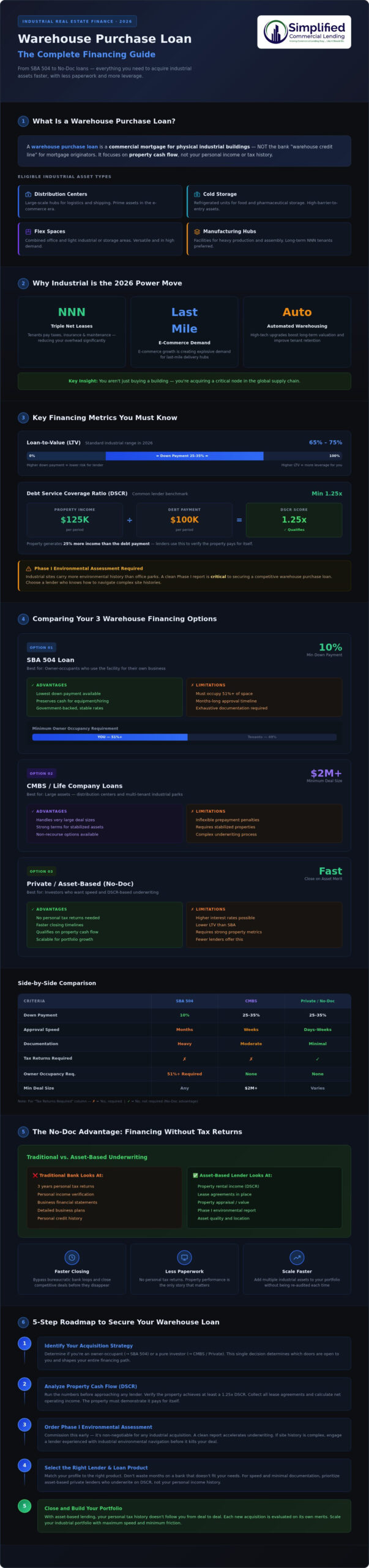
Industrial lending operates on a different set of rules. Most industrial properties utilize Triple Net (NNN) lease structures. This means the tenant, not the owner, handles property taxes, insurance, and maintenance. Lenders love this because it reduces your overhead and creates a more predictable income stream. Because of this stability, many lenders view warehouse assets as lower risk than other commercial types. You’ll typically see LTV standards ranging from 65% to 75% for these assets in 2026. However, you must be prepared for the Phase I Environmental Site Assessment. Industrial sites carry more environmental history than an office park; therefore, a clean report is vital for securing a competitive warehouse purchase loan. If the history is murky, you need a lender who knows how to navigate those complexities without killing the deal.
Comparing Your Warehouse Financing Options
Which financing route fits your growth strategy? Finding the right warehouse purchase loan depends on your specific goals. Are you buying a facility to house your own operations, or are you an investor looking for passive income? The answer changes which doors are open to you. Traditional banks often present a one size fits all approach, but the industrial market in 2026 demands more flexibility. You need to understand the trade offs between leverage, speed, and documentation before you sign a term sheet.
Most borrowers find themselves choosing between three primary paths. Each has a different impact on your liquid capital and your long term liability. Consider these metrics when evaluating your options:
- Loan-to-Value (LTV): This determines your down payment. While some programs offer high leverage, they often come with more strings attached.
- Debt Service Coverage Ratio (DSCR): Lenders use this to ensure the property income can cover the mortgage. A ratio of 1.25 is a common benchmark, meaning the property generates 25% more income than the debt payment.
- Documentation Level: This is the “hassle factor.” It ranges from full tax return disclosure to “No-Doc” programs that only look at the building’s performance.
SBA 504 Loans: The Low-Down-Payment Option
If you plan to run your business out of the facility, the SBA 504 program is a powerful tool. It allows for down payments as low as 10%, which preserves your cash for equipment or hiring. However, the rules are strict. You must occupy at least 51% of the square footage. If you want to rent out the majority of the space to other tenants, this isn’t the loan for you. Be prepared for a marathon, not a sprint. Approval times can stretch for months, and the documentation requirements are exhaustive. You’ll need to provide years of personal and business tax returns, financial statements, and detailed business plans.
CMBS and Life Company Loans for Large Assets
Are you looking at a massive distribution center or a multi tenant industrial park? If the deal exceeds $2 million, CMBS (Conduit) or Life Company loans might be the answer. These loans are often non-recourse, which means the lender cannot come after your personal assets if the deal goes south. The property itself is the collateral. While the rates are competitive, these structures are rigid. They often include “lock-out” periods and significant prepayment penalties. If you think you might sell or refinance in the next few years, the exit costs could be prohibitive. Before committing to such a structured product, consider exploring commercial loan options that offer more exit flexibility.
For investors who prioritize speed over everything else, the “No-Doc” or private lending path is becoming the gold standard. These lenders don’t care about your personal 1040s. They care about the warehouse’s cash flow. If the DSCR is strong and the asset is in a high demand market, you can close in a fraction of the time it takes a big bank to even open your file. This is the ultimate move for the savvy investor who wants to secure a competitive asset before the competition even gets an appraisal scheduled.
How to Secure a Warehouse Purchase Loan in 5 Steps
Securing a warehouse purchase loan shouldn’t feel like a mystery. It is a logistical process, much like the operations that happen inside the building itself. If you follow a structured roadmap, you can bypass the common frustrations that stop most investors in their tracks. By moving through these five steps, you’ll position yourself as a savvy borrower who understands the industrial landscape of 2026.
- Step 1: Determine your occupancy status. Decide early if you are an owner-user or an investor. This choice immediately filters your available loan products.
- Step 2: Calculate the DSCR. Ensure the property’s income can comfortably cover the new debt payments.
- Step 3: Select your lender type. You can choose a traditional bank for lower rates with high documentation, or work with a no doc commercial loan broker to prioritize speed and property cash flow.
- Step 4: Order a Phase I ESA. Initiate the Environmental Site Assessment immediately to avoid late-stage deal killers.
- Step 5: Lock and close. Finalize your rate once the appraisal is in and move to the closing table.
Step 1: Assessing the Property’s Financial Health
Don’t just look at the loading docks and ceiling height. You must dive deep into the rent rolls and existing lease agreements. If the property is currently occupied, analyze the remaining term on those NNN leases. A lender will be hesitant if the primary tenant is set to vacate in six months. You should also look for signs of deferred maintenance. Outdated electrical systems or cracked slabs can impact the appraisal value. If the building needs significant work, you need to know how that affects your overall leverage before you apply for a warehouse purchase loan.
Step 2: Preparing the Right Documentation
The paperwork you need depends entirely on the path you choose. A traditional bank requires a mountain of documents, including three years of personal tax returns and business P&Ls. If you value your privacy and need to move fast, a simplified list is more attractive. This usually only requires an appraisal, the lease agreement, and your credit score. Even for no-doc loans, a clean credit report is vital because it demonstrates your reliability as a borrower. It’s also the stage where you’ll verify the property’s Debt Service Coverage Ratio. For the sake of clarity, DSCR is the property’s net operating income divided by its annual debt service. If that number meets the lender’s threshold, you’re ready to close.
The ‘No-Doc’ Advantage: Financing Without Tax Returns
Why should your personal tax return dictate your ability to buy a multi-million dollar industrial asset? For many independent entrepreneurs, a traditional tax return doesn’t tell the whole story. Between aggressive depreciation schedules and complex business structures, your “taxable income” often looks much lower than your actual liquidity. This is the primary reason traditional banks stall or deny applications. A modern warehouse purchase loan bypasses this hurdle by focusing on the property’s performance rather than your personal 1040s.
Asset-based lending treats the warehouse as the primary source of repayment. If the building’s cash flow is strong and the location is viable, the deal makes sense. This shift in focus offers a massive speed advantage. While a big bank might take three to five months to dissect your personal financial history, a no-doc approach can move you to the closing table in a matter of weeks. When you’re competing for a high-demand flex space or distribution center, that speed is your greatest leverage.
Why Banks Say No and We Say Yes
Traditional institutions are often hamstrung by rigid “Ability to Repay” regulations and internal risk committees that don’t understand the industrial market. They view any deviation from standard documentation as a red flag. In contrast, private debt funds and non-bank lenders view risk through the lens of the asset’s value and its Debt Service Coverage Ratio. It’s important to clarify one thing: “no-doc” does not mean “no-credit.” Lenders still value a clean credit history as a sign of borrower reliability; they simply stop requiring the mountain of income verification that slows everything down. This same cash-flow-first philosophy applies across commercial asset classes — investors diversifying into multi-tenant properties will find a similar approach outlined in this retail center financing checklist that prioritizes property performance over personal paperwork. This flexibility is a game-changer for self-employed investors who prioritize growth over paperwork.
Scaling Your Industrial Portfolio Faster
The biggest “portfolio killer” in commercial real estate is the Debt-to-Income (DTI) limit. Once you own a few properties, a traditional bank will eventually tell you that you’re “tapped out” based on your personal income. By using a warehouse purchase loan that ignores DTI, you can continue to acquire assets as long as the properties themselves are profitable. This allows you to scale at a pace that traditional financing simply can’t match. You can even leverage your existing assets by using Portfolio Lines of Credit to fund the down payments on new acquisitions, keeping your momentum high and your liquid cash available for operations.
Stop letting a loan officer’s checklist stand in the way of your next acquisition. If you are ready to move past the bureaucracy and secure an asset that works as hard as you do, it’s time to explore a more direct path. Contact Simplified Commercial Lending today to see how our cash-flow focused solutions can close your next industrial deal without the tax return headache.
Next Steps: Ready to Close Your Warehouse Deal?
The industrial market in 2026 waits for no one. If you’ve identified a facility that fits your strategy, every day spent waiting for a traditional bank to review your tax returns is a day you risk losing the deal to a more agile competitor. You need a lender who speaks the language of industrial real estate and values property potential over personal paperwork. Securing a warehouse purchase loan should be a strategic move that propels your business forward, not a bureaucratic hurdle that slows you down. Choosing a partner who understands the nuances of DSCR and NNN lease structures is the most important decision you’ll make in the acquisition process.
Simplified Commercial Lending is built for the independent entrepreneur who values results over protocol. We understand that your tax returns don’t define your success. By focusing on asset cash flow and streamlined underwriting, we remove the friction from the acquisition process. We handle the technical complexities and lender requirements so you can stay focused on managing your operations and growing your portfolio. It’s time to stop asking for permission from big banks and start working with a partner who acts as an advocate for your success. We prioritize your speed and privacy so you can close with confidence.
Customized Financing for Every Industrial Asset
Your investment strategy might start with a warehouse, but it doesn’t have to end there. We provide national coverage across the United States for a wide range of investment vehicles. Whether you are looking for Commercial Property Loans for a new manufacturing hub, Multi-Family Residential Investment Loans to diversify your holdings, or Single Family Investment Property Loans to build a rental portfolio, we have the specialized products to help you scale. We even offer Portfolio Lines of Credit for investors ready to leverage their existing equity for new opportunities. You can get started today by requesting a quote; we can often provide preliminary terms without a hard credit pull, protecting your score while you explore your options.
Get Started with Simplified Commercial Lending
Don’t let another competitive asset slip away while you wait on a loan officer’s desk. You deserve a collaborative partnership that prioritizes speed, transparency, and practical solutions. We are ready to act as your resourceful navigator through the 2026 industrial lending landscape. Reach out to our team today to discuss your specific deal and see how our property-first approach can get you to the closing table in weeks, not months. The roadmap to your next acquisition is clear. Take the first step toward securing your industrial future and apply for your warehouse purchase loan today.
Secure Your Industrial Future with Speed and Precision
The industrial landscape of 2026 demands a lender that moves as fast as the market. You’ve learned that the right warehouse purchase loan isn’t about your personal tax history. It’s about the building’s ability to generate revenue. By prioritizing property cash flow and skipping traditional bank documentation, you gain a massive competitive advantage. You don’t have to wait months for an approval when you can close in weeks. Stop letting outdated institutional norms dictate the pace of your growth.
Simplified Commercial Lending acts as your savvy expert guide. We provide national funding for all industrial asset types, from cold storage to distribution hubs, with underwriting based strictly on property cash flow. No personal tax returns are required to scale your business or prove your liquidity. It’s time to move past the institutional bureaucracy and secure the assets that will define your future. You have the vision, and we have the streamlined path to make it a reality.
Scale your industrial portfolio today—get a no-doc warehouse loan quote now!
Your next big deal is within reach. We are ready to help you close it with confidence and speed.
Frequently Asked Questions
Can I get a warehouse purchase loan without showing my personal tax returns?
Yes, you can secure a warehouse purchase loan through asset-based lending programs that prioritize property cash flow over personal income. These “no-doc” options allow self-employed investors to bypass the exhaustive paperwork required by traditional banks. Instead of reviewing your 1040s, lenders look at the building’s income potential and the strength of the existing leases.
What is the typical down payment for a warehouse purchase?
Most industrial lenders in 2026 require a down payment of 25% to 35%, which corresponds to a 65% to 75% loan-to-value (LTV) ratio. If you are an owner-user occupying at least 51% of the space, you might qualify for an SBA 504 loan with as little as 10% down. Private and non-bank lenders typically stick to the 75% LTV ceiling to manage risk on industrial assets.
What is the minimum DSCR required for industrial property loans?
Lenders generally look for a minimum Debt Service Coverage Ratio (DSCR) of 1.25. This means the property’s net operating income must be 25% higher than the annual debt payments. A higher DSCR indicates a safer investment and can often help you secure more favorable interest rates or higher leverage during the underwriting process.
How long does it take to close a warehouse loan in 2026?
The closing timeline depends entirely on your choice of lender. Traditional banks often take 90 to 120 days due to rigid committee reviews and extensive documentation checks. In contrast, streamlined non-bank lenders can often move from application to the closing table in 3 to 5 weeks. Speed is often determined by how quickly the appraisal and environmental reports are completed.
What is a Phase I Environmental Assessment and do I need one?
A Phase I Environmental Site Assessment (ESA) is a report that researches the historical use of a property to identify potential contamination risks. You will almost certainly need one for any industrial acquisition. Because warehouses often house chemicals or manufacturing processes, lenders require this report to protect their collateral. If the Phase I identifies issues, a Phase II study involving soil or water testing might be necessary.
Can I use a warehouse loan to refinance an existing industrial property?
Yes, you can use these loan products for both rate-and-term refinances and cash-out refinances. Many investors use a cash-out refinance to pull equity from a stabilized warehouse to fund the down payment on their next acquisition. This is a common strategy for scaling a portfolio without injecting new personal capital into every deal.
Is a warehouse loan different from a standard commercial mortgage?
A warehouse purchase loan is a specific type of commercial mortgage tailored to the unique risks and lease structures of industrial real estate. While the underlying mechanics are similar to other commercial loans, the underwriting focuses heavily on industrial-specific factors like ceiling heights, loading dock configurations, and Triple Net (NNN) lease terms. It is a specialized tool for a specialized asset class.
What credit score do I need for a no-doc warehouse loan?
Most no-doc lenders require a minimum credit score between 660 and 680. While these programs don’t verify your personal income, they still use your credit score as a primary indicator of your financial reliability. A score above 720 will typically give you access to the most competitive rates and higher leverage options available in the 2026 market.