Why should your personal tax returns dictate the growth of your real estate empire? If you’re a savvy investor, your “on-paper” income often looks smaller than your actual bank account due to strategic tax write-offs. Traditional banks see this as a red flag, but they’re looking at the wrong numbers. You shouldn’t be penalized for being efficient. This is where no doc rental property loans change the game. By focusing on the property’s cash flow rather than your personal debt-to-income ratio, you can unlock capital that institutional lenders keep locked away.
We know the frustration of losing a prime deal because a bank’s underwriting took sixty days or rejected you based on a personal income cap. You’re ready to scale, and you need a partner that moves as fast as the market. You’ll learn exactly how to use property ROI to secure financing and grow your portfolio without the friction of traditional documentation. We will break down the latest 2026 DSCR standards, the impact of new FinCEN reporting rules, and how to access capital for short-term rentals. It’s time to stop acting like a consumer and start borrowing like a professional.
Key Takeaways
- Stop letting personal tax returns limit your growth by shifting the lender’s focus to your property’s actual cash flow.
- Master the DSCR formula to ensure your rental income comfortably covers debt obligations and unlocks better financing terms.
- Discover how no doc rental property loans allow you to bypass traditional banking bottlenecks and close new deals in days or weeks.
- Explore how portfolio lines of credit can consolidate your assets and release trapped equity to fund your next acquisition.
- Streamline your closing process by preparing essential property-level documentation like leases and LLC agreements in advance.
What Are No Doc Rental Property Loans in 2026?
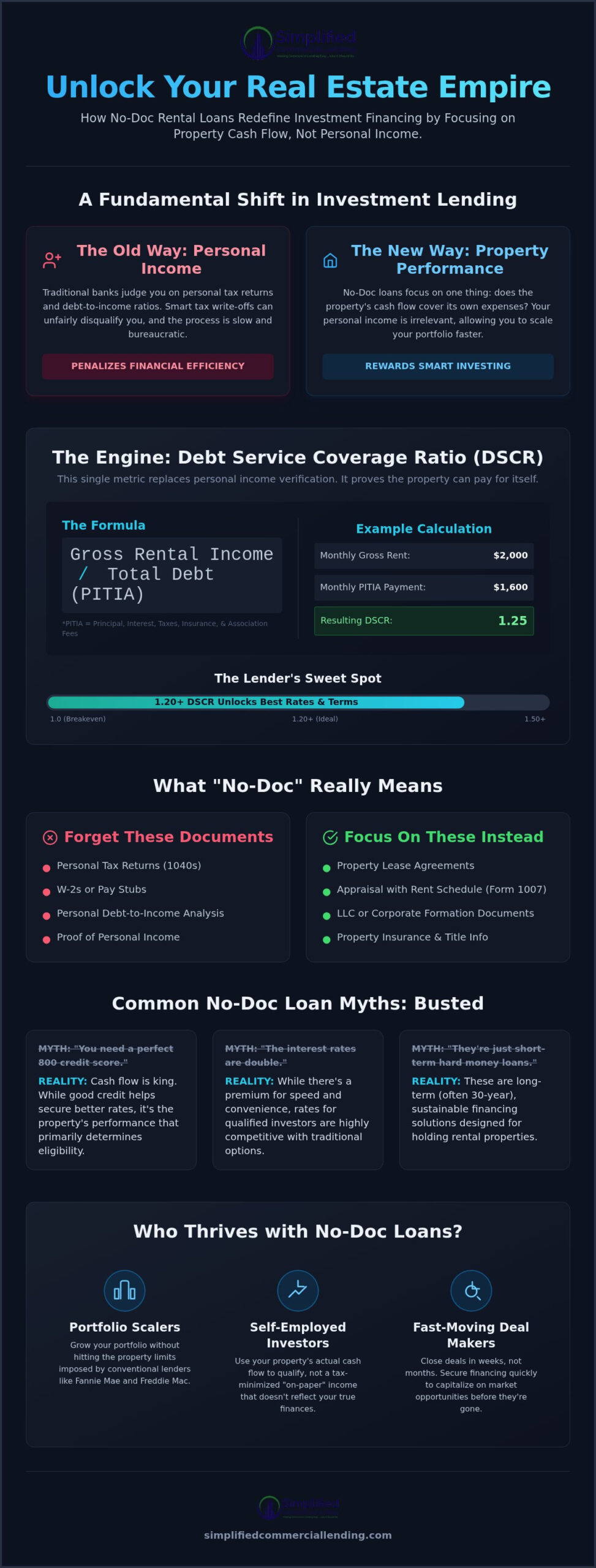
The old way of borrowing is broken. For decades, traditional banks forced real estate investors to jump through hoops, demanding years of tax returns and proof of personal income. If you took too many legal deductions, your “on-paper” income dropped, and your loan was denied. Modern no doc rental property loans solve this paradox. Instead of scrutinizing your W-2 or personal debt-to-income ratio, these loans focus on the asset itself. If the property generates enough cash flow to cover the mortgage, you’re in business. It’s a shift from lending based on who you are to lending based on what you own.
The “no doc” label is actually a bit of a misnomer. You’ll still provide documentation, but the focus shifts away from your personal life. Lenders don’t need your 1040s or pay stubs. They want to see the property’s lease agreements, an appraisal with a rent schedule, and your LLC formation papers. To understand What Are No Doc Rental Property Loans? you have to look at how lending has evolved since the mid-2000s. We’ve moved away from the predatory “liar loans” of the past. Today’s market relies on regulated, asset-based lending where the property’s Net Operating Income (NOI) acts as the primary security for the debt.
Self-employed investors and high-volume portfolio owners benefit most from this model. If you’re scaling quickly, you’ll eventually hit a wall with traditional lenders who cap the number of financed properties you can hold. Asset-based lenders don’t care if you own five properties or fifty. They only care that each deal stands on its own two feet financially. This flexibility allows you to move at the speed of the market rather than the speed of a bank’s bureaucracy.
The Evolution of Income Verification
Traditional W-2 requirements fail modern entrepreneurs because they don’t account for the complexity of real estate wealth. In 2026, lending standards have pivoted to prioritize property-level performance. Non-bank lenders now dominate this space because they provide flexible capital that isn’t tied to rigid federal guidelines. They use the Debt Service Coverage Ratio (DSCR) to verify that the property can repay the loan. This means your personal lifestyle doesn’t limit your ability to acquire new assets.
Common Myths About No-Doc Financing
Many investors mistakenly believe you need a perfect 800 credit score to qualify. While credit matters for pricing, cash flow is the ultimate king in asset-based lending. Another common myth is that interest rates are double those of traditional mortgages. While there is a premium for the convenience and speed, the spreads in 2026 are highly competitive for serious investors. Finally, don’t confuse these with “hard money” situations. These are long-term, sustainable financing solutions designed for holding properties, not just quick flips.
How DSCR Loans Power the No-Doc Model
The engine behind modern no doc rental property loans is the Debt Service Coverage Ratio (DSCR). While traditional banks obsess over your personal income, asset-based lenders focus on this single, powerful metric to determine if a deal makes sense. DSCR is the ratio of gross rental income to debt service obligations. It tells the lender one thing: does the property generate enough cash to pay for itself? This shift in perspective is what allows you to bypass the mountain of paperwork typically required by institutional banks.
Because these products are considered Non-Qualified Mortgages (Non-QM), they operate outside the rigid box of No-Doc Loans vs. Traditional Investment Mortgages and standard federal regulations. This freedom allows lenders to prioritize the property’s performance. To verify this performance, lenders don’t just take your word for it. They use a professional appraisal, specifically Form 1007, to determine the “market rent” for the area. If the property is currently vacant, this market rent estimate becomes the foundation of your loan approval.
Most lenders look for a “sweet spot” ratio of 1.2. This means the property’s gross income is 120% of the total debt obligations. Reaching this threshold often unlocks the most competitive interest rates and higher leverage. If you’re looking to see how your current portfolio measures up, you can explore Short Term Rental Financing options that specialize in these cash-flow calculations.
Calculating Your Property’s Eligibility
To find your ratio, take the gross monthly rental income and divide it by the PITIA. This includes the Principal, Interest, Taxes, Insurance, and any Association fees. For example, if a property rents for $2,000 and the total PITIA is $1,600, your DSCR is 1.25. If your ratio falls below 1.0, don’t panic. Some “no-ratio” programs still exist for high-equity deals, though they typically require a larger down payment to offset the risk.
No-Doc Loans for Short-Term Rentals (Airbnb/VRBO)
Short-term rentals (STRs) require a more nuanced approach. Since STR income can fluctuate, lenders often use historical data from the property or third-party aggregators like AirDNA to project annual revenue. This allows you to secure no doc rental property loans even if you don’t have a long-term lease in place. Underwriters will typically average the seasonal highs and lows to ensure the property remains viable year-round, providing a realistic path for scaling your vacation rental portfolio.
No-Doc Loans vs. Traditional Investment Mortgages
Traditional banks treat real estate investors like standard homeowners. They want to see two years of tax returns, every W-2, and a pristine personal debt-to-income (DTI) ratio. For the independent entrepreneur, this is a roadblock. no doc rental property loans ignore these personal hurdles to focus on the property’s potential. While a conventional bank might take 60 days to close, an asset-based lender can often fund a deal in three weeks or less. In a competitive market, that speed is the difference between winning a deal and watching a competitor take it.
Standard Fannie Mae and Freddie Mac guidelines typically cap you at 10 financed properties. Once you hit that wall, traditional financing disappears. No-doc loans don’t have these arbitrary limits. You can scale to 20, 50, or 100 units without your personal credit profile slowing you down. You’re building a business, not just buying a house, and your financing should reflect that. The “opportunity cost” of waiting on a bank is real. If you save a fraction on an interest rate but lose a high-yield property because of a slow closing, you’ve actually lost money.
The paperwork burden is the most visible difference. Instead of spending weeks digging through old filings and explaining every line item to a confused underwriter, you provide property-specific data. This streamlined approach allows you to focus on finding the next deal rather than managing a mountain of bureaucracy. You aren’t just getting a loan; you’re buying back your time. Investors who focus on single family residential investment loans built around cash flow metrics rather than personal income verification consistently close faster and scale further than those relying on conventional channels.
When Traditional Financing Makes Sense
If you’re just starting and have a stable W-2 job, traditional financing might offer a lower entry cost. Rates for investment properties in early 2026 typically carry a premium of 0.5% to 1.5% over primary residence rates. However, the tipping point comes quickly. Once your legal tax deductions reduce your taxable income to the point where your DTI looks high, no doc rental property loans become your primary path forward. For a detailed side-by-side breakdown of how asset based rental loans compare to traditional mortgages in 2026, you can see exactly where the crossover point makes the most financial sense. It’s often better to pay a slightly higher rate for a loan you can actually get than to be rejected for a “cheaper” one.
Flexibility in Vesting and Ownership
Traditional lenders usually require you to close in your own name. This exposes your personal assets to property-level liabilities. Asset-based lenders are different; they actually prefer you to vest in an LLC. This structure keeps your personal and business lives separate, providing a layer of protection that sophisticated investors require. It also makes it easier to bring on partners or transfer interests later without triggering a “due on sale” clause. You get the benefits of a corporate structure with the speed of a private deal.
Strategic Scaling: Portfolio Lines of Credit
Scaling a real estate business property by property eventually leads to a logistical wall. Managing dozens of individual mortgages with varying rates and terms is inefficient. Sophisticated investors use a “blanket” loan to consolidate multiple rentals into a single financial instrument. This strategy streamlines your operations and often provides better leverage than individual no doc rental property loans. By grouping your assets, you present a more stable profile to lenders, focusing on the collective cash flow of your entire business.
The most significant advantage of this approach is the ability to tap into trapped equity across your portfolio. You might have several properties that have increased in value or seen significant debt paydown. Instead of letting that capital sit idle, a Portfolio Line of Credit allows you to access those funds without the friction of personal tax returns. This is asset-based lending at its most powerful. You aren’t just getting a loan; you’re creating a dedicated capital source for your next acquisition.
Unlocking Equity for New Acquisitions
Recycling capital is the lifeblood of rapid growth. If you follow the BRRRR method (Buy, Rehab, Rent, Refinance, Repeat), a portfolio cash-out refinance is your best friend. You can pull equity from stabilized properties to fund the down payment on your next project. A portfolio line of credit allows an investor to draw funds as needed for new down payments. This revolving access to cash means you don’t have to wait months for a bank to approve a home equity line. You move when the deal is ready.
- Consolidate high-interest debt into one lower-rate blanket loan.
- Release capital from appreciated assets to scale faster.
- Simplify your bookkeeping with a single monthly payment.
Managing Multi-Family and Commercial Assets
As you transition from single-family homes to 5+ unit buildings, the underwriting rules change. While 1-4 unit properties are often viewed through a residential lens, multi-family and commercial assets are pure business plays. Lenders focus exclusively on the building’s Net Operating Income (NOI). Simplified Commercial Lending structures these complex multi-asset deals to maximize your cash flow and minimize paperwork. Whether you’re looking at apartment complexes or warehouses, the same “no-doc” principles apply: the asset must pay for itself.
Ready to take your business to the next level? You can apply for a Portfolio Line of Credit today to see how much equity you can unlock from your current holdings.
Step-by-Step: Securing Your No-Doc Rental Loan
Ready to pull the trigger on your next acquisition? The process for no doc rental property loans is built for speed, but it still requires a disciplined approach. You don’t need to dig through old tax returns, but you do need to prove the asset works. Follow these five steps to move from a potential deal to a funded investment.
- Step 1: Property Analysis. Run the numbers before you apply. Ensure the projected or actual rental income meets your target DSCR. Most competitive programs in 2026 look for at least a 1.2 ratio to unlock the best pricing.
- Step 2: Documentation. Gather your property-specific files. This includes current lease agreements, two months of bank statements to show liquidity, and your LLC formation documents. Remember the new 2026 FinCEN reporting rules; ensure your beneficial ownership information is current to avoid delays.
- Step 3: Appraisal. This is the most critical phase. The lender will order an appraisal that includes a 1007 rent schedule. This form confirms the fair market rent for the area, which the underwriter uses to verify your cash flow claims.
- Step 4: Underwriting. Unlike a traditional bank, our underwriters focus on the asset. They review the appraisal, your credit score, and your liquid reserves. There’s no back-and-forth about your personal business expenses or tax write-offs.
- Step 5: Closing. Once the asset is cleared, you sign and fund. While traditional loans drag on for months, these deals often close in a fraction of that time, letting you move on to your next deal immediately.
Preparing Your “No-Doc” Application
What do lenders actually see in your bank statements? They aren’t looking for income; they’re looking for “skin in the game.” You need to demonstrate enough liquidity to cover the down payment, closing costs, and a few months of PITIA reserves. Disorganized LLC paperwork or unclear title history are the most common pitfalls that stall no doc rental property loans. Keep your corporate records clean and your reserve accounts seasoned to ensure a seamless approval. A proven track record in property management also helps, though many programs are accessible to those just starting their scaling journey.
Partnering with Simplified Commercial Lending
You shouldn’t have to fight your lender to grow your business. We act as a resourceful navigator for independent investors who feel underserved by rigid institutional norms. Our approach is transparent and results-driven, focusing on pragmatism over protocol. We provide access to nationwide programs for Single Family Residential Investment Loans and Multi-Family Residential Investment Loans, as well as specialized Short Term Rental Financing. Whether you’re consolidating a portfolio or buying your fifth Airbnb, we have the specialized expertise to bypass industry bottlenecks.
Ready to scale? Get a quote for your rental property loan today.
Take Control of Your Portfolio’s Growth
Scaling your real estate business shouldn’t feel like a battle against your own tax returns. You’ve seen how shifting the focus from your personal debt-to-income ratio to the property’s actual performance opens doors that traditional banks keep slammed shut. Whether you’re leveraging DSCR metrics for a single-family home or consolidating assets into a blanket loan, the path to expansion is finally clear. You don’t have to choose between legal tax deductions and your next acquisition.
Modern no doc rental property loans provide the speed and flexibility you need to thrive in 2026. By prioritizing asset-based lending, you reclaim your time and your borrowing power. We specialize in DSCR financing and Portfolio Lines of Credit with nationwide coverage for all investment property types. If your property qualifies, we require no tax returns to get you funded. It’s time to stop acting like a consumer and start borrowing like a professional.
Unlock your rental property equity with a no-doc loan from Simplified Commercial Lending. Your goals are within reach. Stop letting bureaucracy hold you back and start building the empire you’ve planned.
Frequently Asked Questions
Do no-doc rental property loans still exist in 2026?
Yes, they exist as modern asset-based or DSCR loans. While the “no-doc” label is a misnomer, these products prioritize property cash flow over personal income verification. They allow you to scale without showing tax returns or W-2s, bypassing the rigid documentation requirements of traditional banks. You get the funding you need based on the property’s performance rather than your personal salary.
What is the minimum credit score for a no-doc rental loan?
The technical minimum credit score is 620, but most lenders prefer a score between 660 and 680. If you want to unlock the lowest interest rates and best pricing, aim for a score of 740 or higher. Data shows that a 20-point improvement in your score can lower your rate by as much as 0.25%, making credit maintenance a high-return activity for serious investors.
How much down payment is required for an asset-based rental loan?
Standard down payments typically range from 20% to 25% of the purchase price. This requirement translates to a maximum Loan-to-Value (LTV) of 80% for new purchases. If you’re looking for a cash-out refinance, expect a slightly lower LTV between 70% and 75%. These equity requirements protect the lender while ensuring the property’s cash flow remains strong enough to cover the debt service.
Can I get a no-doc loan for a short-term rental or Airbnb?
Yes, short-term rentals are fully eligible for no-doc financing. Lenders evaluate these deals using historical income data or projections from platforms like AirDNA. While underwriting for vacation rentals accounts for seasonal fluctuations, the focus remains on the property’s ability to generate sufficient revenue. You can scale your STR portfolio without the friction of traditional personal income limits or DTI caps.
Are interest rates higher for no-doc investment loans?
Yes, interest rates for no doc rental property loans are generally 0.5% to 2% higher than conventional investment mortgages. In 2026, these rates typically range from 6.75% to 9.50% depending on your credit and the property’s DSCR. You’re paying a premium for speed, flexibility, and the ability to borrow without tax returns; this often yields a higher overall ROI by enabling faster scaling.
Can I close a no-doc rental loan in an LLC name?
Yes, closing in an LLC, corporation, or trust is the preferred method for asset-based lenders. This structure protects your personal assets and simplifies the management of a growing portfolio. Keep in mind that as of March 1, 2026, new FinCEN rules require title companies to report these transactions to the federal government. This change increases transparency but doesn’t stop you from using corporate entities for your acquisitions.
What documents are actually required for a no-doc loan?
Lenders require property-specific documents instead of your personal tax returns. You’ll need to provide lease agreements, a professional appraisal with a 1007 rent schedule, and two months of bank statements to verify your liquidity. You’ll also need your LLC formation papers and proof of insurance. The process is streamlined to focus on the asset’s performance rather than your personal financial history or complex tax situation.
How many rental properties can I finance with no-doc loans?
There’s no fixed limit on the number of properties you can finance with no doc rental property loans. Unlike conventional loans that often cap investors at 10 financed properties, asset based rental loans look at each deal independently. As long as each property meets the required DSCR and you have the necessary liquid reserves, you can continue to scale your portfolio indefinitely without hitting an arbitrary wall.