Why are you letting a bank’s rigid debt-to-income requirements dictate the size of your real estate empire? Most investors face the same wall. You find a deal that pencils out, but a traditional lender rejects you because your personal tax returns don’t meet their narrow criteria. It’s a frustrating cycle that keeps your portfolio stagnant while hidden costs like 2026’s 7.3% vacancy rates and rising insurance premiums eat your existing cash flow.
You deserve a strategy that prioritizes property performance over personal paperwork. This guide will show you how to master a rental property calculator to get a clear “buy” or “pass” signal on any asset in seconds. We’ll show you how to account for every hidden expense and discover how specialized financing, like DSCR loans, can help you scale without the burden of traditional income verification. We’re breaking down exactly how different loan types shift your ROI and providing the blueprint to build a massive portfolio on your own terms.
Key Takeaways
- Move beyond manual spreadsheets to eliminate “deal blindness” and accurately capture every hidden operating expense.
- Master the “Big Three” metrics-Cap Rate, Cash-on-Cash Return, and ROI-to distinguish property performance from personal profit.
- Use a rental property calculator to analyze how asset-based commercial lending and DSCR loans can optimize your monthly cash flow.
- Protect your margins by identifying the “CapEx Trap” and accounting for the true costs of property management before you buy.
- Unlock a path to rapid scaling by leveraging your existing equity through specialized Portfolio Lines of Credit.
Understanding the Math: How a Rental Property Calculator Works
Think of a rental property calculator as your investment’s EKG. It doesn’t just crunch numbers. It diagnoses the health of your future wealth. Too many investors rely on messy, manual spreadsheets. This often leads to “deal blindness.” You focus on the high rent but overlook the small, recurring expenses that kill your margins. A professional calculator forces you to face the reality of your purchase price, closing costs, and actual monthly income before you ever sign a contract.
What are the core inputs? You start with the purchase price and closing costs. Then, you layer in your expected monthly income. But the real magic happens when you subtract the “hidden” costs. Cash flow is the lifeblood of investment sustainability. It’s the money left over after every bill, tax, and insurance premium is paid. If your cash flow is negative, you aren’t an investor; you’re just a property owner with a very expensive hobby. A reliable calculator reveals if a property can actually pay for itself.
The 1% and 50% Rules: Quick Gut Checks
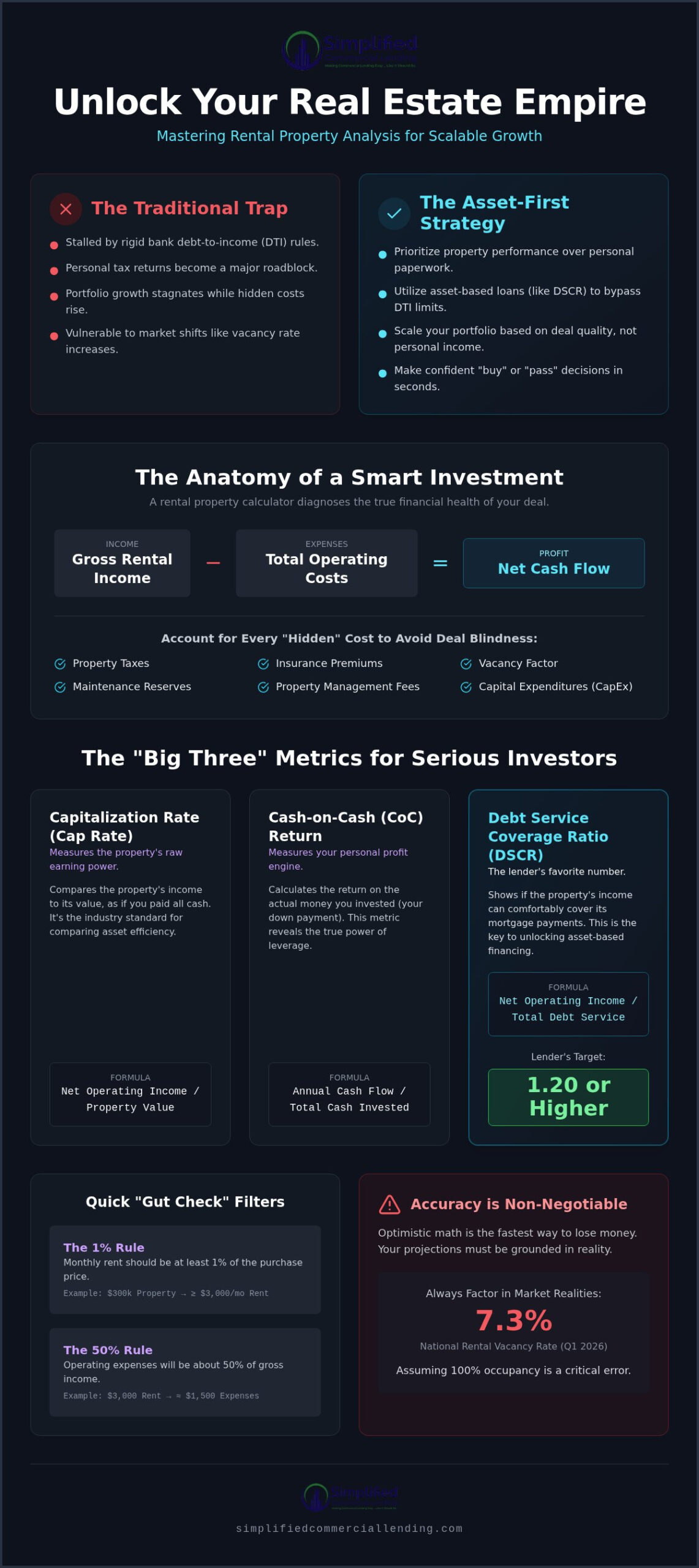
Use these rules to filter deals fast. The 1% rule suggests your monthly rent should equal 1% of the purchase price. If a house costs $300,000, it needs to rent for $3,000. The 50% rule assumes operating expenses will eat half of your gross income. These aren’t final answers. They’re filters. If a deal fails these basic tests, it likely won’t achieve a strong Capitalization Rate once you dig into the specific line items. Use them to say “no” quickly so you can find the “yes” faster.
Why Accuracy in Data Entry is Non-Negotiable
Optimistic math is the fastest way to lose money in real estate. It’s tempting to ignore a $50 utility bill or a $200 landscaping fee to make a deal look “green.” Don’t do it. Missing a single cost can flip a profitable property into a monthly liability. You must also account for the reality of the market. For instance, the national rental vacancy rate reached 7.3% in the first quarter of 2026. If your rental property calculator assumes 100% occupancy, your ROI projections are already wrong. Always include a vacancy factor and realistic maintenance reserves to ensure your portfolio can survive a quiet month or an unexpected repair.
Beyond the Basics: Advanced Metrics for Serious Investors
Once you’ve mastered basic cash flow, it’s time to think like a pro. A standard rental property calculator helps you see if a deal is “good,” but advanced metrics tell you if it’s “scalable.” Serious investors don’t just look at the monthly check. They analyze the “Big Three”: Cap Rate, Cash-on-Cash Return, and ROI. Each one tells a different story about your performance. Understanding these advanced ROI calculation methods is what separates the hobbyists from the portfolio builders.
Capitalization Rate (Cap Rate) vs. Cash-on-Cash Return
Cap Rate measures the property’s performance as if you paid all cash. It’s the raw power of the asset. Formally, Cap Rate is the ratio of Net Operating Income to property value. It ignores your mortgage and focuses purely on the property’s efficiency. If two buildings are side-by-side, the one with the higher Cap Rate is the more efficient engine. It’s the industry standard for comparing properties across different markets.
Cash-on-Cash (CoC) Return is different. It measures the return on the actual dollars you moved from your bank account. If you put 20% down, your CoC might be much higher than the Cap Rate because of leverage. This is why your personal ROI often looks better than the property’s base performance. It’s also where real wealth is built. By using a rental property calculator to model different down payments, you can find the “sweet spot” where leverage maximizes your cash without overextending your risk.
The DSCR Calculation: The Lender’s Favorite Number
Forget your personal debt-to-income (DTI) ratio for a moment. In the world of commercial and asset-based lending, the Debt Service Coverage Ratio (DSCR) is king. The formula is simple: Net Operating Income divided by Total Debt Service. Lenders use this to see if the property’s income can comfortably cover the mortgage. A ratio of 1.2 or higher is the magic number for most. It means the property generates 20% more income than the debt costs. Because this metric focuses on the asset, it often allows you to skip the grueling tax return verification process that stalls so many investors. If you want to see if your next deal qualifies, you can explore Single Family Investment Property Loans that prioritize cash flow over your personal tax history.
These metrics shift significantly depending on your strategy. Short-term rentals often boast massive gross income, but their expenses are equally high. You have to account for utilities, cleaning, and higher management fees that can range from 20% to 30%. Long-term leases are more predictable. A high-quality calculator allows you to toggle between these scenarios. It shows you exactly how a 7.3% national vacancy rate affects a short-term rental versus a stable multi-family unit. Don’t guess which strategy wins. Let the data decide.
The Financing Factor: How Loan Terms Change Your ROI
Most investors view a mortgage as a fixed monthly hurdle. Savvy professionals see it as a flexible lever. When you plug numbers into a rental property calculator, the loan terms you choose will dictate your speed of growth. A 1% difference in your interest rate or a 5% shift in your down payment doesn’t just change your payment. It fundamentally alters your ability to acquire the next property. In 2026, with 30 year fixed rates for investment properties hovering between 7.297% and 7.797%, the way you structure debt is just as important as the price you pay for the asset.
Traditional bank loans are often the first stop, but they usually come with a ceiling. Banks are obsessed with your personal debt to income (DTI) ratio, which is typically capped at 45%. For the independent entrepreneur or the self-employed investor, this is a scaling killer. You might have the cash and a profitable property, but your personal tax returns say “no.” This is where asset based rental loans become your secret weapon. These loans prioritize the property’s performance over your W2 income, allowing you to bypass the bureaucratic gridlock of traditional banking.
Traditional Mortgages vs. DSCR Loans
Traditional mortgages focus on you. They want years of tax returns, pay stubs, and a deep dive into your personal spending. DSCR loans focus on the asset. If the property’s income covers the debt service, the deal moves forward. This shift in focus offers a massive speed advantage. While a traditional bank might take 60 days to close, a commercial brokerage can often move much faster. This speed allows you to secure deals in competitive markets where sellers won’t wait for a slow institutional lender. If you are looking to move quickly, Multi-Family Residential Investment Loans can provide the flexibility you need to close without the tax return headache.
The ROI Impact of Points and Fees
Don’t just chase the lowest interest rate. You must calculate the “break-even” point when paying points for a lower rate. If you spend $5,000 upfront to save $100 a month, it will take you over four years to see a return on that cost. If your strategy involves selling or refinancing in three years, you’ve lost money. Always factor loan origination fees into your initial investment in your rental property calculator. High upfront fees might feel steep, but they are often the price of admission for non-recourse loans or higher leverage. Putting 15% down instead of 25% might increase your rate, but it preserves your capital. That saved cash can be the down payment on your next unit, doubling your portfolio’s growth rate even if the individual property ROI is slightly lower.
Common Pitfalls: Why Your Calculator Results Might Be Lying
A rental property calculator is a powerful tool, but it isn’t a crystal ball. It’s a mirror. It only reflects the data you choose to provide. Many investors fall into the trap of “paper profits” by feeding their models dangerously optimistic numbers. They see a green signal on the screen and assume they’ve found a winner. In reality, they’ve just ignored the silent killers of cash flow that emerge months after the closing papers are signed. To scale a portfolio in 2026, you have to be more disciplined than the average buyer.
Factoring in Capital Expenditures (CapEx)
Most investors mistake maintenance for CapEx. They aren’t the same. Maintenance is the $100 bill for a leaky faucet or a broken door handle. CapEx, or Capital Expenditures, refers to long-term investments in the property’s physical structure. This includes the $10,000 HVAC replacement or the $15,000 roof job. If you don’t set aside a monthly reserve for these big-ticket items, your ROI is a lie. You are simply borrowing from the future to make your current cash flow look better. Keep your results honest by diverting a percentage of every rent check into a dedicated CapEx fund.
Management Fees and the Value of Your Time
Self-managing a property isn’t free. It’s a job. If you spend five hours a week chasing late rent or coordinating with contractors, you are paying yourself with your own time. What is your hourly rate? Professional property management fees typically range from 8% to 12% of the monthly collected rent. Even if you plan to handle the tenants yourself, plug that 10% fee into your rental property calculator. This ensures the deal still works if you eventually decide to step back. Paradoxically, professional management can often increase your ROI. They have the systems to keep your property at or below the 7.3% national vacancy rate through better screening and faster turnovers.
Short-term rentals bring another layer of complexity known as the “Airbnb Premium.” While the gross income looks massive, the operating costs are equally high. You are responsible for utilities, Wi-Fi, and frequent professional cleanings. Management fees for these assets often jump to 20% or 30%. If you are analyzing a vacation property, you can explore specialized Short Term Rental Financing that accounts for these unique cash flow dynamics.
Finally, don’t let property tax reassessments kill your margins. Many investors use the current owner’s tax bill in their projections. This is a fatal error. Once you buy the property, the local municipality will likely reassess its value based on your new purchase price. If that price is significantly higher than the previous assessment, your taxes will spike. When you add in the national average landlord insurance premium of approximately $1,500 annually, your expected profit can vanish overnight. Always calculate your “post-purchase” tax reality to ensure your deal remains in the black. For self-employed investors whose write-offs reduce their on-paper income, no doc rental property loans offer a way to qualify based on the property’s cash flow rather than personal tax returns, keeping your growth on track even when traditional lenders say no.
Scaling Your Portfolio with Simplified Commercial Lending
Analyzing a single deal is the first step toward financial freedom. Building a commercial enterprise is the final destination. Once you’ve mastered the rental property calculator for individual assets, your focus must shift from “buying a house” to managing a high-performance portfolio. The data you’ve gathered on Cap Rates and cash flow isn’t just for your records. It’s the leverage you need to convince lenders that your business is a safe bet for rapid expansion. In a 2026 market where rental vacancies sit at 7.3%, having a data-driven scaling strategy is what keeps you ahead of the competition.
Traditional banks often stop being helpful once you own more than four properties. They view your growing debt as a liability rather than an asset. We see things differently. We prioritize the “No-Doc” advantage, focusing on the strength of your properties rather than the complexity of your personal tax returns. This approach allows high-growth investors to move with the speed of a commercial enterprise rather than the sluggishness of a retail borrower.
Unlock Equity with a Portfolio Line of Credit
If you own five or more properties, you likely have “lazy equity” sitting in your portfolio. You can use your rental property calculator to identify which assets have appreciated significantly since purchase. Instead of selling and triggering a massive tax bill, you can tap into that value with a Portfolio Line of Credit. This allows you to access cash across your entire holdings to fund new down payments or renovations.
Using a blanket loan simplifies your debt management by consolidating multiple mortgages into a single, streamlined facility. This flexibility is vital for quick-close opportunities. When a distressed seller needs to move fast, having a pre-approved line of credit means you can bypass the 60-day bank queue and close in a fraction of the time. It turns your existing success into a perpetual engine for new acquisitions.
The Simplified Path to Your Next Closing
Working with a commercial broker beats shopping at local banks every time. Local lenders are often constrained by geographic limits or rigid internal caps. A specialized broker has a national reach, connecting you to capital for single-family and multi-family assets regardless of where they are located. As we navigate the 2026 lending environment, where 30-year fixed investment rates are averaging between 7.297% and 7.797%, having access to diverse funding sources is your best defense against margin compression.
The outlook for rental property financing remains strong for those who know how to present their numbers. If your DSCR is 1.2 or higher, you are in a prime position to scale. Don’t let traditional lending hurdles slow your momentum. Use the equity you’ve built and the data you’ve crunched to take the next step in your investment journey.
Ready to see if your numbers qualify? Get a loan quote from Simplified Commercial Lending
Take Control of Your Real Estate Empire
Success in 2026 requires more than just finding a good house. It demands a rigorous commitment to the math. You’ve learned how to identify the “Big Three” metrics and how to avoid the CapEx traps that sink most novice investors. Using a rental property calculator gives you the data. Now, you need the right partner to turn that data into a closed deal. Traditional banks might be stuck in the past; your growth shouldn’t be.
Stop letting personal tax returns and rigid DTI ratios hold you back from your next acquisition. We provide financing based on property cash flow (DSCR) with national coverage for all your rental and commercial assets. Our process requires no personal tax returns for underwriting. We put the focus exactly where it belongs: on the strength of your investment. It’s time to shift from analyzing deals to building a legacy.
Bypass the bank and scale your portfolio today. Your next profitable property is waiting. We’re ready to help you secure it with speed and confidence.
Frequently Asked Questions
What is a good ROI for a rental property in 2026?
A strong ROI in 2026 typically ranges from 8% to 12% for long-term rentals. Since investment mortgage rates currently hover between 7.3% and 7.8%, your return must comfortably exceed your cost of debt to be worth the risk. Short-term rentals usually require a higher target of 15% or more. This compensates for the increased vacancy risks and higher management intensity associated with vacation assets.
Can I get a rental property loan without showing my tax returns?
Yes, you can bypass the tax return requirement by opting for a DSCR or “no-doc” loan. These programs focus exclusively on the property’s ability to generate cash flow rather than your personal income history. This is the ideal solution for self-employed investors whose tax write-offs might make them look less qualified to a traditional bank. We prioritize the asset’s performance to get you to the closing table faster.
How is a DSCR loan different from a traditional mortgage?
The main difference is that traditional mortgages are tied to your personal debt-to-income (DTI) ratio, while DSCR loans are tied to the property. Most banks cap your DTI at 45%, which limits how many houses you can buy. A DSCR loan ignores your personal debts entirely. If the property’s income covers the mortgage by a ratio of 1.20 or higher, the loan is typically approved regardless of your personal income. For a detailed side-by-side breakdown of how these two approaches compare, see our guide on asset based rental loans vs. traditional mortgages in 2026.
What expenses should I always include in a rental property calculator?
You must include property taxes, landlord insurance, and a management fee of 8% to 12%. It’s also vital to plug a 7.3% vacancy factor into your rental property calculator to stay aligned with 2026 national averages. Always set aside an additional 10% for maintenance and Capital Expenditures. If you leave these out, you aren’t looking at a real profit; you’re looking at a mathematical fantasy.
Does the calculator account for property tax increases?
Most calculators use current tax data, so you must manually adjust for post-purchase reassessments. Many investors get blindsided when the local municipality spikes the tax bill based on the new, higher purchase price. Don’t rely on the seller’s old tax rate. Research local assessment trends and manually input the expected “new” tax amount into your rental property calculator to ensure your margins stay protected after the sale.
How do I calculate the cash-on-cash return for an Airbnb?
Divide your annual pre-tax cash flow by the total cash you invested, including furniture and startup costs. Short-term rentals require a more detailed analysis because management fees often reach 20% to 30%. You also have to account for cleaning fees and higher utility usage. If you invested $100,000 and your net cash flow after all these expenses is $18,000, your cash-on-cash return is a solid 18%.
What is the “1% rule” and is it still relevant?
The 1% rule states that a property’s monthly rent should be at least 1% of its purchase price. In 2026’s high-price and high-interest environment, this rule is much harder to satisfy in most markets. Use it as a quick initial filter to see if a deal is worth a deeper dive. However, don’t discard a property just because it hits 0.8% if it offers high appreciation or significant tax advantages.
How can I use a portfolio line of credit to buy more rentals?
A Portfolio Line of Credit lets you tap into the equity of five or more properties without selling them or triggering tax events. You can use this revolving credit line to fund down payments for new acquisitions instantly. It effectively turns your existing portfolio into a private bank. This strategy allows you to move with the speed of a cash buyer, giving you a massive advantage when competing for high-yield deals.