The financing option that unlocks the most cash may also put the most pressure on your existing portfolio. A cash out refinance to buy another rental property replaces your current mortgage with a larger one. A HELOC can provide access to equity without replacing that first loan. The right fit depends on more than how much equity you have.
It’s reasonable to ask whether a lender will focus on your personal income, the rental property’s cash flow, or both, and whether a new payment could strain your plans. You’ll also need to estimate how much equity is usable after lender limits and transaction costs, then account for all the funds needed to close on the next property.
This article compares cash-out refinancing and HELOCs, including their effects on your current loan, access to funds, and portfolio cash flow. You’ll also see what lenders may assess, how a portfolio line of credit could fit into the comparison, and how to choose a financing path without overlooking the risks.
Key Takeaways
- You may be able to use borrowed equity for another rental’s down payment, but lender terms determine whether the funds are available and how they can be used.
- Compare how a cash-out refinance and HELOC affect your existing mortgage, payment structure, and access to funds before choosing a path.
- When considering a cash out refinance to buy another rental property, estimate usable equity carefully, then confirm the lender’s valuation, proceeds, and qualification requirements.
- Model the added debt against rental income, expenses, and vacancy risk to see whether the next purchase can support your wider portfolio.
- Include a portfolio line of credit in your comparison, and verify its eligibility, intended use, and documentation requirements with the lender.
Can you use home equity to buy another rental property?
Yes. Investors may borrow against an existing property’s equity and use the proceeds toward another rental’s down payment, subject to lender approval and the terms of both loans. This can help fund an acquisition without selling the property. But the money isn’t newly created equity or guaranteed investment capital. It’s borrowed, and the debt must be repaid even if the new rental takes time to generate income.
What does it mean to tap equity for another rental?
Equity is the estimated value of a property minus the debt secured against it. Available equity is the portion a lender may allow you to borrow after considering its valuation, existing debt, and maximum leverage. A loan’s proceeds are the funds you receive from borrowing. The down payment is the portion of the purchase price you pay upfront rather than finance with a loan on the new property.
A lender’s valuation may differ from your estimate, and its maximum leverage can limit proceeds even when the property has substantial equity. With a cash-out refinance, the existing mortgage is replaced by a larger loan, and eligible cash is released after the existing debt and transaction costs are accounted for. Other equity financing may add a separate borrowing obligation instead. Selling the property is different: ownership transfers rather than borrowing against the property while keeping it.
Either way, plan for separate debt obligations. The property used to access equity may have a new or additional payment, while the rental you buy will have its own financing and expenses. A vacancy or unexpected repair at either property can affect your ability to manage both.
What is the difference between a down payment and total cash to close?
The down payment is only one part of the funds needed to complete a purchase. Total cash to close may also include closing costs, required reserves, and other lender-required funds. Amounts and conditions vary by lender and transaction, so don’t assume that the proceeds you expect to borrow will cover every purchase expense.
- Estimate the down payment: Confirm the purchase lender’s requirements for the specific property and financing structure.
- Budget beyond the down payment: Ask which closing funds and reserves may be required, and keep a buffer for costs you haven’t confirmed.
- Verify fund sourcing: Tell the purchase lender if you plan to use borrowed equity. Ask which source documentation it accepts and how the new debt affects qualification.
If you’re considering a cash out refinance to buy another rental property, confirm the potential proceeds with the refinance lender and the acceptable source of funds with the purchase lender before relying on that capital. A rough equity estimate is a starting point, not a lender-approved amount.
How a cash-out refinance and HELOC release rental-property equity
Both options can turn property equity into funds for another purchase, but they change your debt in different ways. A cash-out refinance replaces an existing mortgage. A home equity line of credit, or HELOC, generally adds a separate credit obligation secured by the property. Neither guarantees a particular amount of cash, payment, interest rate, or total borrowing cost. Those depend on lender approval and the specific terms offered.
How does a cash-out refinance work for an investor?
A cash-out refinance pays off an existing mortgage with a new, larger loan. If approved, the difference may be available as cash after the old loan payoff and transaction costs are accounted for. Actual proceeds depend on the lender’s valuation, permitted leverage, existing debt, and final loan terms. Before applying, check what changes: the interest rate, payment, repayment period, and other terms of your current mortgage. Replacing a favorable existing loan may affect your portfolio even if the refinance provides funds for the next purchase.
For an investor planning a cash out refinance to buy another rental property, estimate net proceeds rather than focusing only on the new loan amount. Ask the refinance lender for a transaction-specific estimate, then confirm with the purchase lender how it will document and assess those borrowed funds.
How does a HELOC work when funding a rental down payment?
A HELOC is a credit line secured by a property. The lender sets a credit limit, and the borrower draws funds as needed, subject to the line’s terms. Draw availability, repayment structure, interest rate, and any transition from drawing to repayment are lender-specific. A HELOC can provide access to funds without replacing the existing first mortgage, but it creates another payment obligation. If you miss payments, the property securing the line may be at risk.
Before counting on a HELOC for a down payment, ask the purchase lender whether it accepts borrowed funds and what documentation it requires. The new credit line may also affect your qualification for the purchase loan. Confirm the timing, too: funds need to be available when required, and the purchase lender must be able to verify their source.
Choose a structure that works for the whole portfolio. A refinance may be worth investigating if replacing the existing mortgage fits your plans. A HELOC may be worth comparing if keeping that mortgage in place matters and the lender’s terms fit your cash flow. Neither is automatically cheaper or safer. Compare the new payment and debt obligations with expected rental income, reserves, and the possibility of vacancies or repairs.
If you’re comparing structures for investment properties, review investment-property financing options, including portfolio lines of credit, and verify eligibility and intended use with the lender.
Cash-out refinance vs. HELOC: which better fits your next rental purchase?
Start with the existing loan, not just the cash you hope to access. A refinance replaces that mortgage, so it may be a poor fit if you’d give up favorable terms. A HELOC generally leaves the first mortgage in place but adds another debt obligation secured by property. Either choice increases leverage. If rent falls short or a major repair comes up, you still owe the payments, and missed payments can put the property securing the debt at risk.
| Factor | Cash-out refinance | HELOC |
|---|---|---|
| Existing loan | Replaces the current mortgage with a new loan. | Typically adds a separate credit obligation, leaving the existing mortgage in place. |
| Payment structure | One new mortgage payment; rate and repayment terms depend on the offer. | A separate payment based on line terms and amounts drawn; rates and repayment structure vary. |
| Access to funds | Usually provides approved proceeds at closing. | May allow funds to be drawn over time, subject to the credit limit and lender terms. |
| Underwriting and use | Approval, valuation, proceeds, and permitted use depend on the lender and property. | Eligibility, lien position, available credit, and acceptable use depend on the lender. |
Neither structure automatically has a lower payment, rate, or total borrowing cost. Verify current rates, fees, draw periods, repayment terms, and intended-use rules with each lender. Then compare the complete proposals, not just the initial cash available.
When might a cash-out refinance make more sense?
Consider it when replacing the current mortgage fits your broader financing plan, such as when you want one new loan rather than keeping the existing mortgage and adding a separate line. Compare the proposed loan terms with your current mortgage, including how the payment and repayment period would change. Qualification, valuation, costs, and net proceeds all depend on lender approval and the property.
When might a HELOC or portfolio line be worth comparing?
A HELOC may be worth exploring if you expect to need capital in stages and its draw and repayment terms fit your plan. It’s secured by a property. A portfolio line of credit is a different financing structure that may provide access to equity from existing rentals; underwriting may consider property cash flow, depending on the option and lender. Review portfolio line of credit for rentals as another option to investigate, not an automatic substitute for a HELOC.
Before choosing either route, model the added debt against portfolio cash flow, including vacancy and repair scenarios. The right fit is the structure whose terms and timing support the next acquisition without relying on overly optimistic assumptions about repayment.
How to check whether equity financing can support the next rental
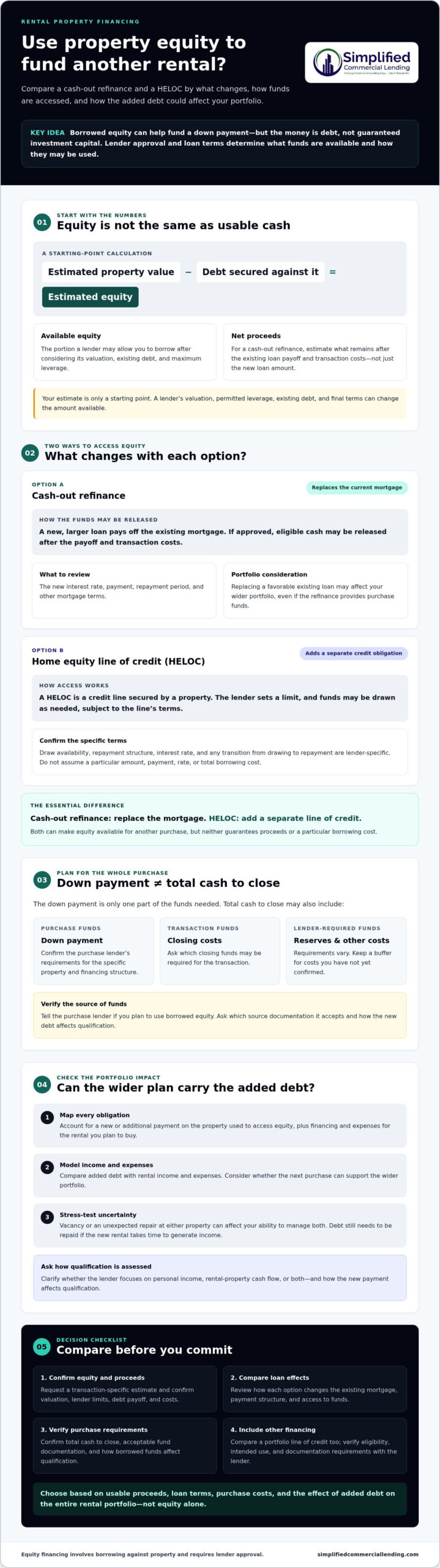
Before applying, work through four steps: estimate the equity, confirm lender rules, model the next property’s cash flow, then compare financing structures. This sequence can help you spot gaps early without mistaking a personal estimate for an approval. Only the lender can confirm the property value, available proceeds, and whether you qualify.
What should you calculate before applying?
Start with your best estimate of the existing property’s value and the debt secured against it. Treat both figures as unverified. A lender may use a different valuation or apply leverage limits that change the amount you can access. Next, model the new payment using the terms you’re investigating, but treat the result as a planning scenario, not a loan offer.
Then test whether the rental can handle more than an ideal month. Include projected rent, operating expenses, debt service, and reserves. Account for vacancy, repairs, property taxes, and insurance. If the financing could have a variable rate or otherwise changing borrowing costs, test how a higher payment would affect the property and your portfolio. A deal that only works with full occupancy and no unexpected costs deserves a closer look.
Also separate the equity-access financing from the acquisition loan. The source property may carry a new or added payment, while the purchased rental has its own debt and expenses. Review the rental property loan guide to understand acquisition financing factors to discuss with the purchase lender.
What documents and lender questions should you prepare?
Gather current loan and property details, rent and expense records, and information about the planned acquisition. Ask each lender what it needs to assess your application, and verify the rules for your specific property and intended use of funds. Requirements can vary by lender and financing structure.
- How will the property be valued, and are there seasoning or lien-position requirements?
- What credit, reserve, occupancy, and property-type criteria apply?
- Can proceeds be used for the planned purchase, and what source-of-funds documentation will be required?
- Will qualification be based on personal income, property cash flow, or both?
Property cash flow may be important in some investment-property underwriting. For related context, see DSCR loan requirements. The method and documentation depend on the lender and financing option.
Once you have those answers, compare the confirmed terms with your cash-flow scenarios. Explore investment-property financing options to compare structures, including portfolio lines of credit, with your acquisition plan.
Choose a funding path that supports the whole rental portfolio
The best funding choice isn’t simply the one that releases the most cash. Weigh how it affects your existing loan, when you need the capital, how repayment works, and whether the portfolio can carry the added debt through vacancies or unexpected expenses. A cash-out refinance to buy another rental property may suit an investor whose broader plan supports replacing the current mortgage. A HELOC or portfolio line may be worth comparing if keeping that mortgage matters or capital needs may arise in stages. No structure removes the risks of borrowing.
When should investors explore portfolio financing?
Consider a portfolio line of credit when you want to evaluate equity across multiple rentals or are planning repeat acquisitions. Unlike a HELOC secured by a particular property, a portfolio line is designed around investment-property financing and may involve multiple properties, depending on lender terms. Underwriting, collateral, intended use, and documentation vary by lender and portfolio. Property cash flow may be considered, but don’t assume a particular qualification method, tax-return waiver, approval, amount, or closing timeline.
Simplified Commercial Lending arranges investment-property financing, including portfolio lines of credit. Whether a particular option fits your properties and planned purchase depends on lender requirements. Treat it as another structure to investigate, not an automatic replacement for a HELOC or refinance.
What should you ask before moving forward?
Get the details that determine how the financing would work across your holdings. Ask the lender:
- Can proceeds be used for the planned acquisition and property type?
- Which properties secure the debt, and how could that affect existing loans?
- What repayment terms apply, and how might payments change over time?
- Does underwriting consider personal income, property cash flow, or both?
- What documentation, reserves, and other qualification factors should you prepare for?
Then compare the full obligations, not just the available proceeds. Model how payments fit with expected rental income, operating expenses, existing debt, and a downside scenario that includes vacancy or repairs. If the plan only works when every property performs perfectly, pause and revisit the amount or structure before taking on more leverage.
There’s no need to choose based on a headline feature alone. Compare your acquisition timeline, current loan terms, collateral exposure, and portfolio cash flow, then verify the lender’s specific terms. Compare investment-property financing options to explore which structures may fit your next acquisition.
Make your next acquisition fit the portfolio
The right funding path depends on more than the cash you can unlock. Compare refinance terms with your existing mortgage, check when you’ll need funds, and model the added payments against rental income, expenses, and realistic vacancy and repair scenarios. A cash out refinance to buy another rental property can be worth exploring, but weigh its impact on your current loan alongside a HELOC or portfolio line of credit.
Portfolio-line underwriting may consider rental-property cash flow rather than personal income, but eligibility, documentation, and permitted use depend on the financing option and lender. Confirm current requirements before building your purchase plan around expected proceeds.
Simplified Commercial Lending is a nationwide commercial mortgage brokerage serving investment-property borrowers. Explore available structures and ask what may fit your properties and acquisition goals. Explore investment-property financing options.
With a clear view of the debt, timing, and portfolio cash flow, you can move toward your next acquisition with more confidence.
Frequently Asked Questions
Can I use a HELOC for a down payment on a rental property?
Possibly, if the HELOC lender permits the intended use and the purchase lender accepts borrowed funds for the down payment. A HELOC provides access to credit secured by a property, so using it adds debt and a payment obligation. Before relying on the funds, confirm the line’s terms, how the purchase lender will document the source, and how the additional payment affects your qualification and cash flow.
Is a cash-out refinance better than a HELOC for buying another rental?
Neither option is automatically better. A cash-out refinance replaces the existing mortgage with a new loan, while a HELOC generally adds a separate credit obligation and leaves the first mortgage in place. Compare the full terms, including payment structure, rates, fees, repayment rules, and timing of access to funds. Also consider whether changing your current mortgage would disrupt a favorable loan and how either option affects portfolio risk.
How much equity can I access for another rental property?
The amount depends on the lender’s valuation, its maximum leverage rules, the debt already secured by the property, and the financing structure. A rough estimate of property value minus secured debt isn’t a promise of available proceeds. For a cash-out refinance, account for the existing loan payoff and transaction costs. Ask the lender for an estimate based on your property and confirm final proceeds after underwriting.
Will a lender allow borrowed funds for a rental-property down payment?
Some purchase lenders may accept borrowed funds, but the rules depend on the loan program and lender. Disclose the source before you apply, and ask which records are needed to document the funds and related debt. The new payment may affect qualification, and the lender may assess overall debt and property cash flow. Don’t assume the funds will be accepted until the purchase lender confirms.
What happens if the rental income does not cover both loan payments?
You’ll need other available cash to cover the shortfall, along with the property’s operating expenses. Vacancy, repairs, taxes, and insurance can add pressure even when rent usually covers debt service. Build reserves and test your plan against lower income and higher costs before borrowing. If payments are missed, the property securing the refinance or credit line may be at risk under the loan terms.
Can I qualify for rental-property financing based on cash flow instead of tax returns?
Possibly. Qualification depends on the financing option and lender. Some investment-property financing may assess rental-property cash flow rather than relying only on personal income, and documentation requirements vary. Simplified Commercial Lending’s portfolio-line underwriting may focus on property cash flow, but that doesn’t guarantee approval or mean tax returns won’t be requested. Ask the lender which income measures and documents apply to your properties and application.
Should I use a portfolio line of credit instead of refinancing one rental?
A portfolio line may be worth comparing if you want to evaluate equity across multiple rentals or expect to fund acquisitions over time. It isn’t automatically a substitute for a refinance or HELOC. Ask which properties may secure the debt, how proceeds can be used, what repayment terms apply, and how underwriting works. Compare total payments and downside scenarios against portfolio cash flow before choosing.