The state with the highest Airbnb return on paper may not be the best place for your investment. BNBCalc’s March 2026 analysis ranked Alaska and Maine first for median cash-on-cash return, but those figures rely on financing assumptions and don’t explain how seasonality, local rules, or property costs could affect a specific deal. The best states for airbnb investment 2026 are the ones where guest demand, regulations, and property economics work together.
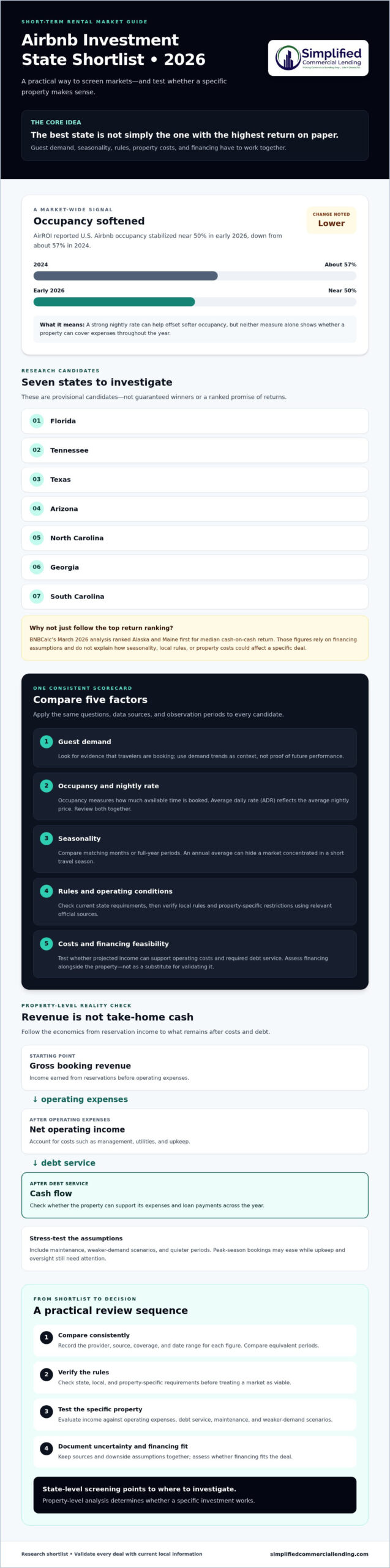
It’s easy to focus on headline revenue or occupancy. But AirROI reported that U.S. Airbnb occupancy stabilized near 50% in early 2026, down from about 57% in 2024. A strong nightly rate can help offset softer occupancy, yet neither metric alone shows whether a property can cover its expenses throughout the year.
This guide compares states using the same practical questions: Is there evidence of guest demand? How does it change by season? What rules and operating requirements apply? Can the property’s economics support its costs and financing? Treat the shortlist as a starting point, not a promise of returns. Before moving forward, verify current local rules, test realistic income and expense assumptions, and assess the property and loan together.
Key Takeaways
- Compare guest demand, occupancy, nightly rates, and seasonal changes using the same data sources and periods.
- Research Florida, Tennessee, Texas, Arizona, North Carolina, Georgia, and South Carolina as provisional candidates for the best states for airbnb investment 2026.
- Check current state, local, and property-specific short-term rental rules before treating a market as viable.
- Test a specific property’s income against operating expenses, debt service, maintenance, and weaker-demand scenarios.
- Record your sources, uncertainties, and downside assumptions, then assess whether financing fits the deal.
Best States for Airbnb Investment in 2026: What Makes a State Promising?
A promising state combines bookable demand with workable rules and property economics. Look beyond traveler interest and ask whether a property can attract guests across the year, operate under applicable requirements, and support its expenses and financing. For a neutral overview of the short-term rental market, start with the basic category, then evaluate the investment on its own facts.
Compare five factors: demand, seasonality, regulation, operating costs, and financing feasibility. Demand indicators can help show whether travelers are booking. Occupancy and average daily rate offer different views of performance: occupancy measures how much available time is booked, while average daily rate reflects the average nightly price. Seasonality shows when bookings may rise or slow. Rules and operating costs affect what it takes to run the property. Financing feasibility tests whether projected income and required debt service make sense together.
State-level screening identifies where to investigate; property-level analysis determines whether a specific investment works. State averages are useful signals, not predictions. A state’s overall performance can conceal major differences between individual markets, property types, and operating models.
Why a high-revenue ranking is not enough
Gross booking revenue is not profit. It’s the amount earned from reservations before operating expenses. Net operating income accounts for operating expenses, while cash flow also reflects debt service. A listing with impressive revenue may still leave little cash after management, utilities, upkeep, and loan payments.
Seasonality matters, too. A property that books heavily during a short peak period may face quieter months while still requiring upkeep and oversight. Staffing needs can change with guest volume, and maintenance may not wait for bookings to return. Compare income across equivalent periods, then check statewide averages against current property-level data before relying on them.
How to use a state shortlist
Treat the best states for airbnb investment 2026 as candidates for research, not guaranteed winners. Verify demand and operating assumptions for the specific property, and confirm the rules that apply to its intended use. State-level rules don’t necessarily settle local requirements or property-specific restrictions, so check relevant official sources before committing.
Once demand, rules, and property economics look workable, assess financing fit. Review short-term rental financing options alongside projected income, expenses, and debt service. Financing is one part of the decision, not a substitute for validating the deal. Keep your data sources and assumptions together so you can compare candidates consistently and revisit the numbers when conditions change.
How to Compare States for Airbnb Investment Without Chasing Hype
Build one scorecard and apply it to every candidate state. Define each metric, record its source and date range, and keep the comparison consistent. A useful scorecard separates guest demand, occupancy, average daily rate (ADR), seasonality, regulation, operating conditions, and financing feasibility. The U.S. Travel Association’s state-by-state data can add context about travel’s broader economic impact, but it doesn’t measure short-term rental performance directly.
Choose a current short-term rental dataset and note its coverage, observation period, and limitations. Compare the same months or full-year period across states instead of combining figures from different windows. Demand trends provide context for occupancy and ADR. Review both measures together, not as standalone proof that a market or property will perform well. Keep the provider and date range beside each figure so you can trace the comparison later.
Which demand and seasonality measures belong in the comparison?
Track demand trends, occupancy, and ADR across matching periods, then examine how results shift through the year. An annual average can hide a market that relies on a concentrated travel season. Note when booking activity strengthens or softens, and consider what that pattern could mean for income consistency and operating needs. Keep each metric’s source beside the figure so you can distinguish reported data from your interpretation.
How should regulation and operating conditions affect a ranking?
Review relevant official state sources for current requirements, then identify what still needs local or property-level verification. Check operating factors that could affect the deal, including insurance availability, taxes, permitting, and the practical demands of running the rental. Verify details with authoritative sources and qualified professionals where appropriate. Don’t assume requirements or costs are uniform across an entire state.
Make your scoring method visible. Explain how you weigh demand, seasonality, regulatory checks, operating conditions, and property economics. Don’t raise a state’s score based on assumptions about future policy stability. Record confirmed facts separately from your assessments, and flag missing data that could change the comparison.
Gross booking revenue alone cannot establish investment viability; expenses, seasonality, regulations, and debt service all shape what a property may support. Use the scorecard to narrow your research, then test individual properties with realistic income and expense assumptions. Once the fundamentals are clearer, review short-term rental financing options as one part of assessing the deal.
Seven States to Research for Airbnb Investment in 2026
Florida, Tennessee, Texas, Arizona, North Carolina, Georgia, and South Carolina are candidates for further research, not a final performance ranking. The available evidence doesn’t provide a complete, comparable 2026 set of short-term rental demand, occupancy, rate, and seasonality figures for all seven. Use the shortlist to guide your research, then keep, remove, or reorder states only after checking the same metrics over the same time window.
Start with current short-term rental data from a named provider, and record its coverage and observation period. State-level tourism context can add another layer: the U.S. Travel Association publishes state-level tourism economic data. Tourism activity, however, isn’t proof of rental demand or investment returns. The table flags where evidence still needs verification rather than filling gaps with assumptions.
What should the state-by-state profiles include?
Use the same fields for every candidate: demand evidence, seasonal pattern, official rules to check, and the biggest unknown. The comparison below separates a reported regulatory signal from data gaps. It doesn’t promise appreciation, occupancy, or returns.
| State | Demand evidence and seasonality | Regulatory checks | Key uncertainty |
|---|---|---|---|
| Florida | 2026 state-level STR dataset and seasonal pattern: verify. | Houfy and AirROI reported an active preemption law in June 2026; confirm current official rules and local requirements. | Comparable property-level demand and operating conditions. |
| Tennessee | 2026 demand and seasonality data: verify using the same provider and period. | Check current official state and local requirements. | Seasonal swings and property economics. |
| Texas | 2026 state-level STR dataset and seasonal pattern: verify. | Houfy and AirROI reported an active preemption law in June 2026; confirm current official rules and local requirements. | Comparable occupancy, rates, and operating conditions. |
| Arizona | 2026 demand and seasonality data: verify using comparable periods. | Houfy and AirROI reported an active preemption law in June 2026; confirm current official rules and local requirements. | Seasonality and property-level expenses. |
| North Carolina | 2026 state-level STR demand and seasonal pattern: verify. | Check current official state and local requirements. | Comparable market data and operating conditions. |
| Georgia | 2026 state-level STR demand and seasonal pattern: verify. | Check current official state and local requirements. | Comparable market data and operating conditions. |
| South Carolina | 2026 state-level STR demand and seasonal pattern: verify. | Check current official state and local requirements. | Comparable market data and operating conditions. |
How can readers compare candidate states fairly?
For the best states for airbnb investment 2026, separate sourced facts from editorial judgment. Compare identical date ranges for demand, occupancy, average daily rate, and seasonality. Don’t combine historical results in one state with forecasts in another. If you create a score, disclose the categories and weights before ranking, and don’t present those weights as an industry standard.
Mark missing data plainly. A property-level review can change a state’s position once you account for its location, rules, operating needs, expenses, and financing feasibility. Treat each state as a research lead until those details are checked.
How to Test Airbnb Investment Risks and Property Economics
A state shortlist is only the starting point. Before making an offer, test one property with assumptions you can explain and verify. This process helps show whether projected income can support operating costs and debt service under both expected and weaker conditions.
- 1. Check comparable rental performance. Use short-term rental data that matches the property type and covers a clearly stated period. Compare occupancy and average daily rate across similar seasons. Treat estimates as inputs to verify, not guaranteed results.
- 2. Confirm rules and obligations. Check applicable permits, restrictions, and tax obligations through relevant official sources. State-level information may not answer local or property-specific questions, so confirm details with qualified professionals where needed.
- 3. Build a complete expense picture. Estimate management, cleaning, utilities, insurance, maintenance, taxes, and platform-related expenses. Separate recurring costs from irregular repairs, and document the source of each estimate.
- 4. Model income and debt service. Project revenue using realistic occupancy and nightly-rate assumptions. Subtract operating expenses to estimate net operating income, then account for anticipated loan payments to understand potential cash flow.
- 5. Stress-test the deal. Model weaker demand, seasonal income changes, vacancies, and unexpected expenses. Don’t rely on a universal threshold. Ask how the property performs under several plausible scenarios and whether you have a plan for a shortfall.
Which assumptions should investors verify before making an offer?
Check that comparable data reflects the same kind of property and a useful observation period. Then verify expenses instead of relying on broad averages. A property’s maintenance needs, insurance availability, management approach, and applicable taxes can change the calculation. A rental property calculator can help organize assumptions, but its result is only as reliable as the data entered.
How does financing affect short-term rental feasibility?
Compare projected property cash flow with anticipated debt service and the lender’s underwriting requirements. Debt service coverage ratio, or DSCR, compares a property’s income available for debt payments with those payments. In plain English, it helps show whether projected property income can cover the loan obligation. Review the relevant DSCR loan requirements and confirm details directly, since qualification depends on the lender, borrower, and property.
Financing fit is one part of the investment analysis, not a shortcut around it. Short-term rental financing may be worth exploring after you’ve checked demand, rules, expenses, and downside scenarios. Simplified Commercial Lending offers financing for short-term rentals and other investment properties; eligibility and terms depend on the program and borrower. Review short-term rental financing as you evaluate whether a property’s cash flow and financing requirements align.
Turn a 2026 State Shortlist Into an Airbnb Investment Plan
A shortlist is useful only when it leads to a property-level decision. Move through four checks: shortlist states, verify current rules, assess the property’s income and expenses, then review financing fit. The best states for airbnb investment 2026 won’t be the same for every investor or property. Keep a working record of data sources, assumptions, uncertainties, and downside scenarios so you can see what supports your decision and what still needs checking.
What information should investors prepare for a financing discussion?
Bring a clear picture of the property and your plan. Useful items include property details, intended rental use, purchase assumptions, and any available operating history. Add income and expense projections, with the sources behind your assumptions. If you’re estimating future performance, separate estimates from documented property results.
Use the discussion to ask practical questions: What underwriting criteria apply? What documentation is required? How is property eligibility assessed? Which loan structures could fit the investment? Requirements vary by program, borrower, and property, so confirm details directly rather than relying on general descriptions of financing.
How can financing support the next investment decision?
Match the financing approach to the plan. A single-property purchase may call for a different review than an investor considering multiple properties. Compare single-property financing with portfolio options only if they fit your goals, and assess how projected property cash flow relates to anticipated debt service. Simplified Commercial Lending serves investors nationally and offers short-term rental financing alongside other investment-property loan options.
Some lending programs may consider rental property cash flow in underwriting, and some may not require tax returns. Those features depend on the program and borrower; they aren’t available or applicable in every case. Ask lenders to explain the criteria and documentation for the specific option under consideration. For more background, review Airbnb investment property financing as you move from market research to evaluating a particular deal.
Before committing, revisit your downside case. Would the plan still make sense if bookings softened, seasonal income fell short, or an unexpected expense arose? If key assumptions remain unverified, pause and investigate them. A financing review can help you understand how a potential loan fits the property analysis, but it can’t replace due diligence or guarantee an outcome.
If you’ve assessed the market, rules, and property economics and want to discuss financing for an investment, you can review short-term rental financing options with Simplified Commercial Lending. Use the discussion to clarify program fit, documentation, and next steps for your plan.
Make Your Next Move With Clearer Numbers
The best states for airbnb investment 2026 are starting points for research, not guarantees of performance. Use your shortlist to identify markets worth checking, then ground your decision in current rules, realistic property economics, and a financing structure that fits your plan. Keep assumptions and downside scenarios visible. That makes it easier to compare opportunities without letting a high-level ranking make the decision for you.
Once you’ve assessed the property, financing can help shape the next step. Simplified Commercial Lending serves real estate investors across the United States with short-term rental loans and other investment-property financing solutions. Eligibility and terms depend on the borrower, property, and program.
Ready to discuss financing for your investment? Explore short-term rental financing options with Simplified Commercial Lending. Bring your questions and property assumptions so you can clarify program fit and next steps.
Frequently Asked Questions
What are the best states for Airbnb investment in 2026?
Florida, Tennessee, Texas, Arizona, North Carolina, Georgia, and South Carolina are candidates to research, not guaranteed winners. The best states for airbnb investment 2026 depend on whether current demand, seasonality, applicable rules, operating expenses, and financing fit the specific property. Compare states using the same data provider and observation period, then verify local and property-level requirements before deciding whether a market belongs on your shortlist.
How do I compare states for a short-term rental investment?
Use one scorecard for every state. Compare short-term rental demand, occupancy, average daily rate, and seasonal variation over identical time windows. Add current regulatory checks and operating considerations, such as insurance availability, taxes, and permitting. Record each data source and its limitations. If you assign scores or weights, disclose your method. A state ranking can guide research, but property-level income and expenses determine whether a particular deal merits closer review.
Is Airbnb profitable in every state?
No. Profitability depends on booking income relative to operating expenses, vacancies, maintenance, and debt service. A state may show strong tourism activity without every rental earning enough to cover its costs. Local rules and seasonality can also affect whether the intended rental model is workable. Build realistic income and expense scenarios for the property, including weaker-demand periods, before treating projected revenue as evidence of profit.
Can I invest in an Airbnb property if short-term rental rules change?
Possibly, but a change in rules could affect whether and how you can operate the property. Before investing, review current official state requirements and confirm local rules, permits, and property-specific restrictions with appropriate authorities or qualified professionals. Consider how your plan would change if short-term rental use were limited. Don’t treat current rules as permanent or assume a state-level law resolves every local requirement.
What data should I check before choosing a state for Airbnb investment?
Check current short-term rental demand, occupancy, average daily rate, and seasonal patterns from a named data provider. Record its coverage, date range, and limitations, and compare states over the same period. Add state and local regulatory information from official sources, plus property-level estimates for expenses and operating needs. Broader travel data can provide context, but it can’t replace booking evidence or a realistic analysis of a specific property.
How does seasonality affect Airbnb investment returns?
Seasonality can concentrate bookings and income in certain parts of the year, leaving slower periods with fewer reservations. Expenses, maintenance, and debt service may continue even when occupancy falls. Review performance across a full annual cycle when data is available, and compare individual seasons rather than relying only on an annual average. Test how a slower period could affect cash flow and whether projected income remains workable.
Can I get financing for an Airbnb investment property based on rental income?
Some financing programs may consider rental property cash flow during underwriting, but availability and qualification depend on the lender, program, borrower, and property. Simplified Commercial Lending offers short-term rental financing and investment-property loan options to investors across the United States. Some products may not require tax returns, but that isn’t universal. Ask lenders about income calculations, documentation, property eligibility, underwriting criteria, and potential loan structures before relying on projected rental income.