The best loan for a BRRRR deal may be the one you never plan to keep. Finding the best loans for BRRRR method means matching financing to each stage, then checking that the refinance can repay the short-term debt before you buy. If the property’s appraised value or rental income falls short, your next move could stall.
It’s reasonable to focus first on getting the purchase and renovation funded. But the exit matters just as much. A loan that fits the acquisition may have repayment terms that leave little room for delays, while refinance options can depend on the property’s cash flow, your experience, documentation, and how long you’ve owned it.
This guide compares financing categories for buying, rehabbing, renting, and refinancing, so you can build a loan plan around the whole deal. You’ll learn what to compare beyond the rate, how to test refinance feasibility with conservative assumptions, and what to ask lenders about repayment, appraisal, rental income, and timing. Plan the exit before you commit, and you can make a clearer call on whether the numbers support the repeat step.
Key Takeaways
- The best loans for BRRRR method depend on the stage of the deal, the repayment plan, and whether the refinance can realistically pay off earlier debt.
- Compare acquisition and renovation financing by term, payment structure, collateral, and the conditions that apply if the project takes longer than planned.
- Estimate refinance proceeds using a conservative property value, potential loan limits, existing debt, and transaction expenses before committing to a purchase.
- Check how appraisal results, property condition, rental income, and ownership timing could affect your refinance options.
- Use lender documents to verify fees, extension terms, prepayment provisions, and eligibility, then compare pathways that fit your property and portfolio.
Best Loans for the BRRRR Method: Understand the Strategy Before Choosing Financing
The best loans for BRRRR method deals aren’t necessarily one loan used from purchase through payoff. The strategy moves through different needs: buying a property, funding improvements, earning rent, refinancing into longer-term debt, and using any available capital for another investment. Each step has its own risks, costs, and lender criteria.
Short-term project financing is intended to fund an acquisition, renovation, or other defined project phase, with repayment tied to a planned payoff or refinance. Long-term rental financing is designed to support ownership after the property is ready to rent, with repayment structured over a longer period. Terms, eligibility, and availability vary by lender and property.
How the BRRRR method works from purchase to repeat
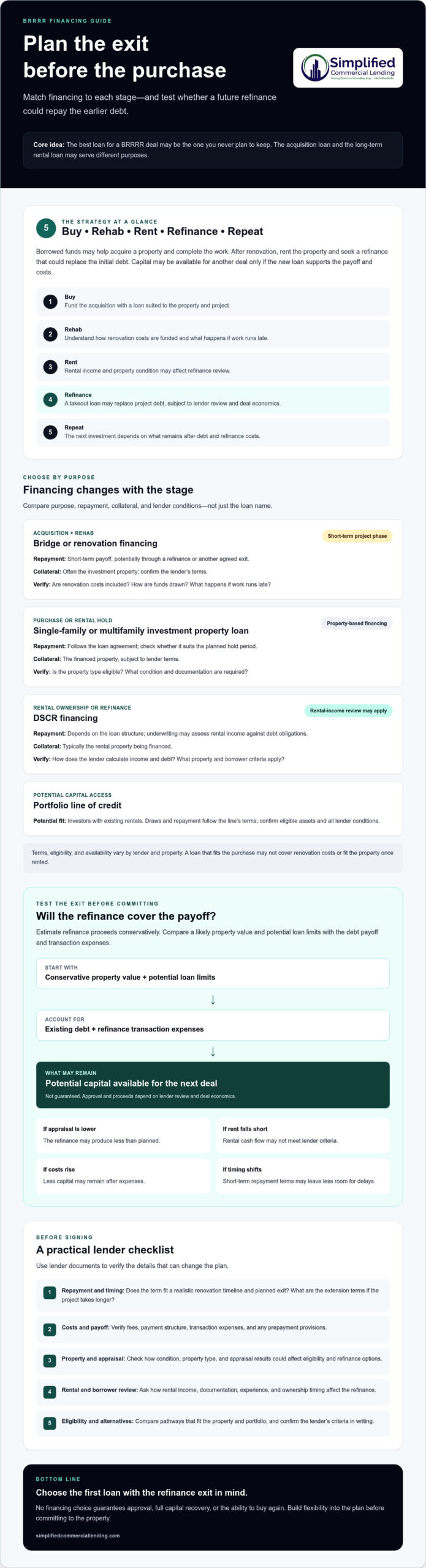
BRRRR stands for buy, rehab, rent, refinance, and repeat. Borrowed funds may help acquire the property and complete the work. After renovation, the investor rents the property and seeks a refinance that could replace the initial debt. If the new loan supports the payoff and costs, some invested capital may become available for another deal.
That sequence connects financing decisions across the whole project. A property’s condition can limit which loan options fit at purchase, while its completed condition, rental income, borrower profile, and lender criteria may affect the refinance review. For a broader foundation, Real estate investing includes an overview of the BRRR strategy.
Why the refinance exit should shape the first loan
The planned replacement for short-term acquisition debt is often called the takeout loan. Work backward from that exit: estimate the property’s likely appraised value and rent, then consider how the refinance amount may compare with the debt payoff and transaction expenses. If the appraisal is lower than expected, costs rise, or rental cash flow doesn’t meet lender criteria, less capital may come back than planned.
A BRRRR takeout refinance is a new loan intended to replace earlier project debt after renovation and rental preparation, with proceeds subject to lender review and deal economics. It doesn’t guarantee full capital recovery or approval. The repeat step depends on what remains after the old balance and refinance costs are addressed.
So, don’t choose the first loan in isolation. Compare its term and repayment structure with a realistic renovation timeline and a refinance scenario that still works if the valuation or rental income disappoints. No financing choice can guarantee a successful refinance, recovered capital, or the ability to buy again. Build flexibility into the plan before committing to the property.
Compare BRRRR Loans by Stage: Acquisition, Rehab, Rental, and Refinance
The BRRRR method links several financing decisions into one investment plan. A loan that funds a purchase may not cover renovation costs or fit the property once it’s rented. Compare options by purpose, repayment, collateral, and the exit you expect, not by loan name alone.
| Loan category | Likely stage | Repayment plan | Collateral | Questions to verify |
|---|---|---|---|---|
| Bridge or renovation financing | Acquisition and rehab | Short-term payoff, potentially through refinance or another agreed exit | Often the investment property; confirm the lender’s terms | Are renovation costs included? How are funds drawn? What happens if work runs late? |
| Single-family or multifamily investment property loan | Purchase or longer-term rental ownership | Repayment follows the loan agreement; check whether it suits the hold period | The financed property, subject to lender terms | Is the property type eligible? What condition and documentation are required? |
| DSCR financing | Rental ownership or refinance | Repayment depends on the loan structure; underwriting may assess rental income against debt obligations | Typically the rental property being financed | How does the lender calculate income and debt? What property and borrower criteria apply? |
| Portfolio line of credit | Potential access to capital for investors with existing rentals | Draws and repayment follow the line’s terms | Eligible rental assets, as specified by the lender | Which properties qualify? How is available credit determined? What are the repayment conditions? |
Short-term financing for buying and rehabilitating a property
Bridge or renovation financing may address a defined project phase, but terms and availability vary. Ask whether funds are released all at once or in draws, what work is permitted, what documentation is needed, and when repayment comes due. Build a realistic exit plan before accepting a short term. Hard money is a separate financing category; Simplified Commercial Lending does not offer hard money loans.
For property-level options, review this single-family investment property loan guide. Confirm directly with the lender whether the loan can support the property’s purchase, condition, and planned work.
Long-term rental loans and refinance options
A DSCR loan may assess whether rental income supports the property’s debt obligations, but calculation methods and qualification criteria differ by lender. A property-level rental loan is tied to one investment, while a portfolio line may use eligible existing rentals as collateral. It isn’t automatically a fit for financing a single new acquisition. For more on eligibility, read the DSCR loan requirements guide.
The best loans for BRRRR method depend on the full timeline and exit, not just the first funding need. Simplified Commercial Lending is a nationwide commercial mortgage brokerage that may help investors compare pathways across eligible property types. To explore its investment property financing options, verify current availability, property eligibility, and lender requirements for your specific stage.
Will a BRRRR Refinance Return Your Capital? Test the Deal Before You Commit
A refinance can replace the initial project debt, but it may not return all the cash you put into a BRRRR deal. The amount a lender might approve depends on more than your renovation budget or target after-repair value. Test the exit before you buy, using conservative assumptions and current lender criteria.
Estimate refinance proceeds without treating them as guaranteed
Start with a realistic estimate of the property’s completed value, then ask what loan amount a lender might allow based on its valuation, leverage limits, property condition, and rental income. That approved amount is not the same as the property’s estimated value. From potential new financing, subtract the existing loan payoff and applicable refinance expenses to estimate possible net proceeds.
Estimated equity is not cash-out proceeds; only an approved refinance, minus debt and transaction expenses, shows what capital may actually be available.
Illustrative refinance worksheet
- Estimated completed property value: use comparable properties and a conservative appraisal assumption.
- Potential refinance amount: verify eligible leverage and rental-income requirements with the lender.
- Less existing debt payoff: request a current payoff estimate, including any applicable charges.
- Less transaction expenses: ask which lender, appraisal, title, and closing costs apply.
- Estimated net proceeds: compare the remainder with your cash invested. This is a planning exercise, not a promised loan result.
Stress-test the rent, valuation, and timing assumptions
Use property-specific rental evidence, then test whether the deal still works with lower rent, vacancy, or operating costs than your base case. A DSCR lender may assess rental income against debt obligations, so weaker income can affect eligibility or the amount available. An unfinished renovation can also delay leasing or lead to a different valuation than expected.
Timing matters, too. If construction, stabilization, or the refinance takes longer than planned, you may carry the initial debt for longer or need another repayment plan. Some lenders require a seasoning period before a cash-out refinance; ask how ownership timing applies to your proposed exit. Confirm the lender’s current requirements before relying on a refinance date.
Run at least one downside scenario: What if the appraisal comes in lower, rent is softer, or the property isn’t ready on schedule? If the numbers no longer support the payoff, reconsider the purchase price, scope, or financing plan. Investors with existing rentals may also explore whether a portfolio line fits their broader capital needs. Review the rental portfolio line of credit guide, and verify eligible assets and terms with the lender.
The best loans for BRRRR method are only a good fit if the refinance exit remains plausible under cautious assumptions. Treat projected proceeds as an estimate, not a promise.
A BRRRR Loan Checklist: Compare Lenders and Protect the Exit Plan
The best loans for BRRRR method are the ones whose written terms fit your project and planned exit. Compare offers in sequence, not just by headline rate. Use this checklist before you commit:
- Define the exit: Identify how you expect to repay acquisition or renovation financing, and what you’ll do if the refinance is delayed or unavailable.
- Gather property facts: Document the property type, current condition, planned work, estimated timeline, and evidence supporting expected rent and value.
- Compare offers: Review term length, payment structure, fees, prepayment provisions, and any conditions for extending the loan.
- Verify requirements: Get lender criteria for the property, renovation scope, documentation, appraisal, and refinance in writing.
- Review the risks: Test whether the deal still works if costs rise, work takes longer, or the refinance proceeds fall short.
Questions to ask before accepting acquisition or rehab financing
Confirm that your property type and planned work are eligible. Ask how renovation funds are released, what inspections or records are required for each draw, and when payments and principal are due. What are the written extension conditions if the project runs late? If a refinance isn’t immediately available, what repayment options remain? Request a written breakdown of requirements and transaction costs. Don’t rely on verbal estimates or assume two lenders use the same terms.
Questions to ask before relying on a rental refinance
Ask how the lender determines value and evaluates rent, what property condition standards apply, and what borrower information is required. Verify whether ownership timing, existing debt, other properties, or portfolio exposure could affect eligibility. Documentation and underwriting vary by lender and product, so confirm requirements for your specific property rather than assuming a general guideline applies.
Then compare the proposed refinance with conservative rent and value estimates before making an offer. A deal that only works with the highest projected appraisal, full occupancy, and a perfectly timed renovation has little room for setbacks. Check the loan documents for the exact payment obligations, maturity date, extension terms, prepayment provisions, and fees. Have qualified lending, legal, tax, and real estate professionals review relevant parts of the deal as appropriate.
Want help comparing pathways for an eligible investment property? Compare investment property financing options with a financing professional, and verify current product availability and lender criteria for your deal.
Choose a BRRRR Financing Partner That Fits Your Rental Portfolio
The right financing partner should help you compare possible paths across the deal, not just discuss the first loan you need. A commercial mortgage broker may help investors review options for eligible single-family rentals, multifamily properties, commercial assets, short-term rentals, and rental portfolios. That can be useful if you’re planning more than one BRRRR project or need to think through acquisition, renovation, and long-term rental financing together.
Simplified Commercial Lending is a nationwide commercial mortgage brokerage for investment-property financing. It can be a potential resource for exploring loan categories, but a conversation doesn’t guarantee approval, specific terms, or that a particular product will fit your BRRRR stage. Product availability and lender criteria must be confirmed for the property and borrower.
When broker support may help a BRRRR investor
Comparing lenders can get more complex if you own several rentals, are weighing different property types, or need financing at multiple stages. A broker discussion may help clarify which categories to investigate before you commit to a purchase. Ask how each option’s repayment plan and requirements align with your renovation timeline and intended refinance. Don’t assume access to a broker ensures better terms, faster closing, or approval.
For investors with existing rentals, a portfolio line of credit may be worth asking about if eligible property equity and cash flow fit the lender’s criteria. Simplified Commercial Lending describes its portfolio lines as underwritten around property cash flow rather than personal income. That doesn’t mean every investor or property qualifies, or that the line will fund a single new acquisition. Confirm what assets may secure the line, how the lender evaluates them, and how repayment works.
What to prepare for a financing conversation
Bring the deal facts that help a financing professional assess fit. Be ready to discuss:
- Purchase: Target price, property type, and current condition.
- Renovation: Planned scope, estimated timeline, and how you expect to fund the work.
- Rental plan: Expected rent and the evidence behind your estimate.
- Refinance: Your intended timing and assumptions about the completed property’s value.
- Portfolio: Existing rentals, current debt, property performance, and relevant income information.
Ask which documents apply to the specific loan and lender. Simplified Commercial Lending says its loan options don’t require tax returns, but documentation and eligibility vary by product and lender. Confirm requirements directly rather than assuming tax returns, or any other document, are never needed.
The best loans for BRRRR method depend on the property, your portfolio, and a realistic repayment plan. Prepare your deal details, then discuss your BRRRR financing plan and compare potential investment-property financing pathways.
Build Your BRRRR Plan Around the Exit
A strong BRRRR plan connects the purchase, renovation, rental period, and refinance before you commit. Compare financing by repayment structure and stage, then test whether conservative assumptions about value, rent, timing, and costs leave a workable exit. The best loans for BRRRR method are those that fit the full deal, not just the immediate funding need.
Simplified Commercial Lending is a nationwide brokerage serving investment property borrowers across the United States. Its financing categories include single-family rentals, multifamily, commercial property, short-term rentals, and portfolio lines of credit. For eligible investors with existing rentals, portfolio line underwriting is described as focusing on property cash flow rather than personal income. Product availability, documentation, and qualification depend on the lender and loan, so confirm what applies to your situation.
Ready to discuss how financing options may fit your property and portfolio? Discuss your BRRRR financing plan and prepare your purchase details, renovation scope, rental expectations, and refinance timeline. A clear plan gives you a stronger foundation for your next investment step.
Frequently Asked Questions
What is the best loan for the BRRRR method?
There’s no single best loan for every BRRRR deal. The best loans for BRRRR method depend on the property, project stage, borrower qualifications, and planned repayment or refinance exit. Short-term financing may fit an acquisition or renovation phase, while a rental property loan may suit longer-term ownership. Compare the full terms and verify lender requirements for your specific deal before choosing.
Can you use a DSCR loan for the BRRRR method?
Yes, a DSCR loan may be an option for the rental or refinance stage, subject to lender and property criteria. DSCR underwriting generally considers a property’s rental income relative to its debt obligations. Ask how the lender calculates income, what property condition is acceptable, and whether ownership timing affects eligibility. Don’t assume a projected rent estimate alone will qualify the property.
Can I use one loan for every BRRRR stage?
Sometimes a financing arrangement may cover more than one phase, but don’t assume one loan will suit the entire sequence. Acquisition and renovation funding needs differ from long-term rental ownership, and loan terms may set specific repayment dates or project conditions. Ask the lender whether the financing covers your planned work and hold period, and how repayment works if refinancing is delayed or unavailable.
How does refinancing work in the BRRRR method?
After improving and renting the property, an investor applies for a new loan intended to replace the initial project debt. The lender reviews factors such as appraised value, property condition, rental income, borrower qualifications, and its own lending criteria. Potential proceeds must cover the existing payoff and transaction expenses before any remaining cash is available. Approval and capital recovery aren’t guaranteed.
Can I do BRRRR without showing tax returns?
Possibly, depending on the loan and lender. Simplified Commercial Lending says its loan options don’t require tax returns, but that doesn’t mean every lender or product uses identical documentation or qualification rules. Ask what records are required for the specific property and financing stage. Confirm how the lender evaluates income, assets, rental performance, and borrower eligibility before relying on a particular documentation approach.
What happens if the BRRRR refinance does not return enough cash?
You may have to leave more of your original capital in the property, bring other eligible funds to address the payoff, or consider another repayment strategy permitted by your loan terms. Revisit the numbers with the lender before assuming a second refinance will solve the gap. A lower appraisal, weaker rent, higher expenses, or delayed work can limit proceeds and disrupt the next purchase.
Are hard money loans the same as BRRRR loans?
No. BRRRR describes an investment strategy, not a specific loan product. Hard money is a financing category some investors may consider for a project, but it isn’t synonymous with BRRRR financing. Compare any proposed loan’s permitted use, repayment structure, costs, and exit requirements. Simplified Commercial Lending does not offer hard money loans, so don’t treat them as one of the brokerage’s products.